The 141st Royal Armoured Corps (RAC) regiment was formed in 1941 by the conversion of the 7th battalion, Royal East Kent regiment which raised itself in 1940 and the “3rd Regiment of Foot” (created in 1572 in London). In November 1941, the regiment was assigned to the 31st Tank Brigade and in early 1944 was equipped with Churchill crocodiles. The independent regiment was nicknamed “The Buffs” and while attached to the 79th Armoured Division, its individual squadrons or troops were by request loan out to other units as short term support for an operation or battle and then afterwards were returned back to the 79th. Following are some of the operations and battles.
A Squadron: HQ Troop
1 Troop, 2 Troop, 3 Troop, 4 Troop, 5 Troop
B Squadron: HQ Troop
6 Troop, 7 Troop, 8 Troop, 9 Troop, 10 Troop
C Squadron: HQ Troop
11 Troop, 12 Troop, 13 Troop, 14 Troop, 15 Troop
The regiment had 45 crocodiles total and each numbered troop had three crocodiles. In October 1944, the squadron organization was changed to 3 troops each containing 4 crocodiles and the 4th troop containing 3 crocodiles.
All the regiment’s Churchill tanks had names that began with the letter “S”.
Here are some names and info:
“Sabre” AVRE Fascine, B Squadron, 7 Troop, T68434C
“Samovar”
“Sandgate” C Squadron, 13 Troop
“Sandling” C Squadron, T173174
“Sandwich”
“Scimitar” B Squadron, 7 Troop
“Sheridan” B Squadron
“Sidcup”
“Skipper”
“Squirt” B Squadron
“Stalin”
“Stalingrad”
“Steed” A Squadron
“Sublime” C Squadron, 14 Troop
“Sudan” B Squadron
“Sultan”
“Superb” C Squadron, 14 Troop
“Supreme” C Squadron, 14 Troop
“Sword” B Squadron, 7 Troop
D-Day, 6 June 1944
At H+35 on D-Day, two troops of crocodiles landed on Gold Beach in Normandy, 15 Troop (Lt Davis) and 13 Troop (Lt Sherman). Three crocodiles of 15 Troop landed at Le Hammel where one sank in the rough sea; one became stuck in a deep crater on the beach and the third broke its tracks in attempting to scale a beach obstacle. Three crocodiles from 13 Troop landed at La Riviere where one floundered in a deep underwater crater and the other two crocodiles were able to get ashore.

The two crocodiles supported the 7th Green Howards (69th Brigade, 50th Infantry Division) assault on the La Marefontaine gun battery (WN32) which contained four Czech 100mm guns located in fields outside the hamlet of La Marefontaine south of Ver-Sur-Mer. The battery was not completed where the protective blast shields were missing from the casemates. As the infantry companies approached the battery, the crocodiles did not use their flame throwers but instead fired two 75mm rounds and supported the infantry with MG fire. The infantry overran the battery taking 40 to 50 POWs.

Crocodiles vs Panthers, 14 June 1944
By June 13, Panthers of Panzer Lehr was dug in from Lingerves to Tilly-Sur-Suelles (D13 today). Heavy fighting occurred all along that line and at Lingerves. On June 14 at La Senaudiere, the 1st battalion, Hampshire Regiment, 50th Division was to attack the village with three crocodiles of 15 Troop in support. La Senaudiere is 1.5 miles (2.4 Km) to the west of Lingevres and 5 miles (8 Km) due south of Bayeux.
While being watched by the Hampshires, the three crocodiles advanced towards the town laying a smoke screen as they went. As the crocodiles passed a building, less than a gun width away awaiting was a Pz III [1]. Simultaneously, the two crocodiles and the Pz III fired. The Pz III missed and the two crocodiles rounds hit but bounced off the Pz III due to poor aiming and firing while moving. Startled by the near hits, the Pz III withdrew.
Around the corner of another building was a Panther as the three crocodiles entered the village. The Panther was only able to see the trailer of one of the crocodiles and quickly put two point-blank shells into it but fortunately flame thrower fuel tanks do not burn or explode when hit. Suddenly the Panther found itself face to face with the other two crocodiles as they darted out of the smoke cover. One crocodile fired its 75mm at point-blank range which its shot bounced off the Panther’s front armour. The second crocodile fired its flame thrower engulfing the Panther in flames which immediately immobilized it.
All of a sudden a round blew off a track of one of the crocodiles. The Pz III had returned and did not get another shot as it was quickly destroyed. As the crocodiles continued to push into the town another Panther appeared and it destroyed a crocodile. The village was mostly destroyed and the remaining crocodile withdrew. A few hours later, the Hampshires captured the village.
Operation Greenline, 15–17 July 1944
The crossroads at le Bon Repos and the higher ground overlooking Esquay-Notre-Dame were attacked by the 2nd Battalion, Glasgow Highlanders (227th Infantry Brigade, 43rd Division) supported by Churchill tanks (107 RAC, 34th Tank Brigade) and 2 troops of 141 RAC Crocodiles. The Highlanders advanced from the north-east of Hill 112, south-westwards over the northern slope, towards the defences of the III Battalion, 21st SS Panzergrenadier Regiment. The Highlanders managed to cross the start line at 2130 hrs and captured the SS survivors of a flame attack by the crocodiles on the Caen–Évrecy road, between Croix des Filandriers and le Bon Repos.
Operation Totalize, 7-8 August 1944
The Les Fusiliers Mont-Royal, 6th Canadian Infantry Brigade, 2nd Canadian Infantry Division attacks on the village of May-Sur-Orne which was defended by the German I/Grenadier-Regiment, 89th Infantrie Division stalled due to heavy resistance. At 1545 hrs on August 8, the Les Fusiliers supported by 2 troops of 141 RAC crocodiles made their third and final assault on May-Sur-Orne. The crocodiles advanced with the infantry into the village. They fired their 75mm guns to make holes in the houses’ walls in which they sent a stream of flame through. The infantry then kicked in the doors of the burning house and cleared out the defenders. After some initial heavy resistance, the defenders simply fled as the crocodiles approached. By 1800 hrs, the infantry had secured May-Sur-Orne.
Operation Astonia, 10-12 September 1944
The German-held channel port of Le Havre was assaulted by the British 49th Infantry Division “Polar Bears” and the 51st (Highland) Infantry Division supported by detachments of special armour from the 79th Armoured Division including a 141 RAC squadron (A or C but not B). There is no information on how much the crocodiles were used in this operation.
Brest, 14-16 September 1944
After the Normandy breakout (Operation Cobra), the US 3rd Army passed through Avranches and the US VII Corps veered west along the Brittany peninsula to capture the ports of St. Malo, St. Nazaire, Lorient and Brest. US forces reached the fortified port of Brest on August 7 and a siege which lasted five weeks where heavy artillery shelling, air strikes and infantry assaults failed to take the port. General Omar Bradley requested special support from the 79th Division and 141 RAC B Squadron commanded by Major Nigel Ryle and consisting of 2 Command Churchill tanks, 2 95mm support Churchills and 5 Troops (15 crocodiles total) was transported by US Army transports through the US sector to the west end of the Brittany peninsula.
Some crocodiles had teeth!
US engineers fitted Hedgerow cutters to some of the Crocodiles. There is no information if there were orders to install them or the crocodile crews pleated/bartered to have them installed. It appears that the cutters were not installed to the gun tanks but only to the crocodiles due to the trailers.


Crocodiles moving up to the outskirts of Brest.

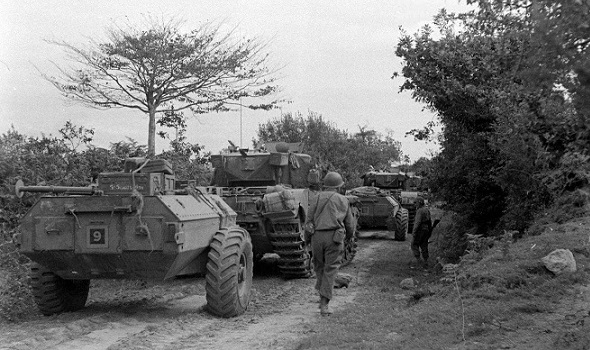
This is my close-up. Note that this crocodile’s trailer has two different tire thread patterns.

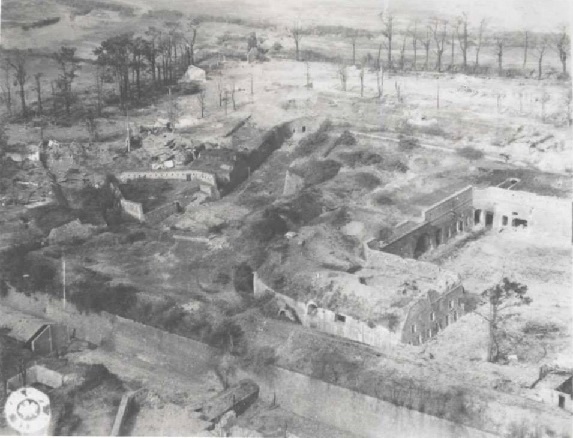
Fort Montbarey located west of the Brest was built between 1777 and 1784 had earth filled masonry walls 40 feet (12.1 m) thick and surrounded by a 15 foot (4.6 m) moat. Part of the German defenses in 1944, the fort had an outer barrier with a ring of mine fields and anti-tank ditches. The inner barrier was interlaced with barbed wire fences, hedgerows, trenches and pill boxes. Many of the mines were buried artillery shells fitted with pressure igniters including some 300 lb. (136 kg) naval shells. There were also large craters made by heavy US artillery fire.
Left: US 29th Infantry Division “The Blue-and-Gray” Right: British 79th Armoured Division

Capturing the fort was one of the objectives of the US 29th Infantry Division. 141 RAC B squadron along with 4 M10 tank destroyers from the A company, US 644th TD Battalion [2] was assigned to support B company, 116th Infantry regiment (B/116) for the assault on the fort. For a few days before the assault, the 116th infantry trained with the British tanks. Due to different radio frequencies, the infantry had to communicate with the crocodiles through the command tanks.

The assault on the fort began on September 14 at 1615 hrs. when the engineers moved up and cleared a path through the mine field. Once a lane was cleared of mines, three crocodiles under command of Lt Hubert Anthony Ward moved up with B/116 infantry following close behind. The M10s provided fire support on suspected gun positions in the fort. Lt Ward’s crocodile exhausted its flame fuel supply (enough for about 120 one-second bursts) against gun emplacements along a sunken road then continued to support the infantry with its remaining guns. Lt Ward’s tank then turned back and fell into a large crater. Sgt Leslie Morley’s crocodile ran over one of the naval shells causing a huge explosion which wrapped a whole track over the turret. The third crocodile moved past the first two and got close to the wall of the fort. Unable to find an opening in the wall to flame, it finally withdrew. A mine disabled one of the command tanks. Two more crocodiles moved up where one got stuck in a crater and the other fell into an antitank ditch. The flame attack allowed the infantry to get close to the fort and cleared the external defenses. The fort’s wooden main door on the east side was burned by flame which allowed a partial view of the interior but the Germans had built a thick stone barricade inside against door which prevented entry.

During that night. the engineers cleared another path for the tanks and constructed a causeway across the antitank ditch with picks and shovels. The 1/116 infantry continued attacks which nearly encircled the fort except for a small corridor in the southeast that was still held by the Germans. At 1030 hrs. on the 15th, the crocodiles returned and flamed the moat and over the walls until their fuel was exhausted. An armored bulldozer was brought up and cleared a path around the disabled tanks but a German (most likely a sniper) managed to shoot through the vision slot which took out the driver.
On the morning of the 16th, the 1/116 infantry made ready for its final assault on the fort. At 1300 hrs., three crocodiles attacked the fort with one of the M10s firing HE rounds at the main gate. After the M10 had expended all its shells, the next M10 was brought up to replace it. The third M10 was instructed to fire at the concrete top of a tunnel under the moat on the north side of the fort. It managed to create a small hole in the tunnel which allowed entry to the passageways underneath the fort. The M10 3″ guns had little effect on the rubble blocking the main doorway so a short barrel M3 105mm howitzer from the cannon company was brought up. Positioned directly in front of the main door and after firing 15-20 HE rounds it effectively destroyed the blocking rubble then three more crocodiles moved up and flamed the fort. After the 105mm ran out of shells, one of the Churchill tanks continued the firing at the main doorway. For the final assault, three crocodiles moved up and flamed everything except the north wall while the B/116 infantry covered engineers who placed 1500-2000 lbs. (680-907 kg) of TNT in the tunnel underneath the fort’s north wall. The detonation of the TNT charge in the tunnel caved in part of the north side of the fort. The Germans in the fort finally surrendered and 60+ POWs were taken. The Germans were only able to hold out against all the flaming because they had a supply of discarded gas masks.
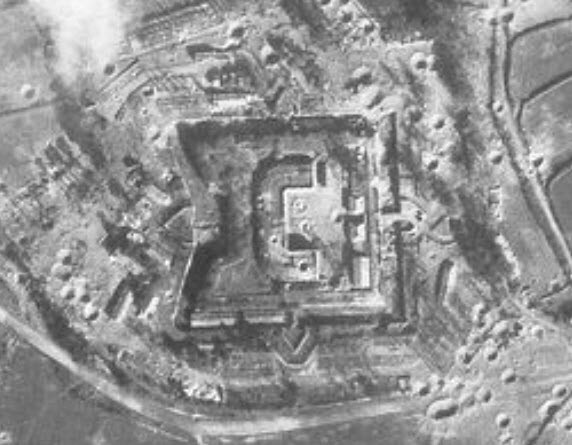
Views of Fort Montbarey after its capture.

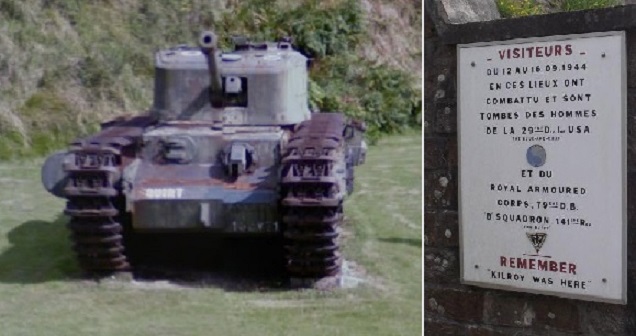
Fort Montbarey today is a museum and within the fort is a crocodile from the battle. Note that the hull side escape hatch is open but they plated over the opening.

Operation Alan, S’Hertogenbosch, Holland 24–27 October 1944
The 53rd (Welsh) Infantry Division was one of the divisions that liberated the city which was occupied by the German 712 Infanterie-Division and was supported by crocodiles of 141 RAC C Squadron.
24 October 1944: [3]
Lieutenant Ian Sheriff’s crocodile “Sandgate” flames very close to an Esso petrol station.

Two of the three crocodiles supporting the East Lancs waiting on the Vughterstraat for the signal to advance.

26 October 1944:
At the Wilhelminaplein roundabout in S’Hertogenbosch are two bridges, one went south to Vught and the other west to Vlijmen. The buildings on the German side of the Dommel canal were strongholds manned by troops of Feldersatz-Bataillon 347 (FEB 347) [4] which were supported by two Sturmgeschutz IIIs from schwere Heere Panzerjager-Abteilung 559 with one concealed inside or near one of the buildings. The 141 RAC crocodiles supporting the 1st Battalion, East Lancashire Regiment (158th Infantry Brigade) entered the roundabout and immediately flamed the wrong bridge, the southern one to Vught. Lt Sheriff realized his mistake after being alerted by the infantry (who were probably cursing at him). He then directed his driver to the other bridge. Once he began flaming the correct bridge, there was a sudden flash and his tank was hit on the turret side. The shell did not explode and did not completely penetrate the armour but was stuck half way through and was still glowing. That crew was very lucky to survive.

The Wilhelminaplein roundabout with crocodiles flaming in the background.

The beginning segment of this film shows 141 RAC crocodiles in action between Nuland and Geffen supporting an attack of the 160th Brigade, 53rd Division.
Film: Hammering At Hertogenbosch (1944)
This is my close-up of “Sandling” from the film.

Geilenkirchen, 19 November 1944
During Operation Clipper, A Squadron supported the US 84th infantry Division “Rail splitters” while attached to the British XXX Corps. During most engagements, after a few flame squirts the defenders would pour out and surrender but that was not always the outcome. While supporting the US 333rd Infantry Regiment during an advance to towards the village of Beeck (northeast of Geilenkirchen) during a heavy rain, two crocodiles and three gun tanks moved forward to flame two pillboxes blocking the infantry’s advance. Unknown was one of the pillboxes had an 88mm AT gun. After three successive shots, three of the advancing tanks were knocked out and the infantry were forced to dig into the muddy ground while under fire in the rain and had to wait for re-enforcements.
Whitewashed 141 RAC crocodiles (probably A Squadron) passing through Höngen, Germany heading toward Heinsberg in November. Höngen is northwest of Geilenkirchen and Heinsburg is directly north of Geilenkirchen.

Film: West Front War Report (1945)
This is my screen capture from segment 2:04-2:05 in the film.
Note this crocodile is still equipped with a Hedgerow cutter.

British Pathe Film 1970.01 [5]: Invasion Scenes 1944
Liberation Film Deventer, Holland 1945: Bevrijdingsfilm Deventer
British Pathe Film 1891.10 [6]: Flame Throwing Tank 1944
FOOTNOTES
[1] Panzer Lehr records indicate only 6 Panthers were lost that day. However several reports state that the crocodiles knocked out an armed Pz III and one account stated it was a Pz IV. Panzer Lehr Division (Lehr = “teach”) was formed in 1943 from training and demonstration troops stationed in Germany. I believe it was actually an early short barrel Pz IV.
[2] Companies B and C of the 644th TD Battalion was attached to the US 8th Infantry Division which was east of the 29th and north of the city of Brest.
[3] In 1972, Esso (Standard Oil Company) changed its branding in the USA to Exxon. Esso is still used in Europe today.
[4] Feldersatz-Bataillon is a division’s replacement battalion where new drafts were sent for unit assimilation after initial training.
[5] The last scene of the film is the crew mounting captured panther “Cuckoo” of the Cold Stream Guards HQ battalion, 6th Guards Tank Brigade.
[6] Any of these How To modeling videos could help make any Churchill crocodile model be more interesting by adding flaming action.
Video: HOW TO sculpt FLAMES for Flamer and REPOSE Dreadnought Legs
Video: Figure Flame Effect Prop/Accessory
Video: Bob’s Lab – Making fire effects from Hot Glue

 Mike's Research
Hi Richard
As you will see I am mainly focussed on B squadron. Have you got a copy of the Word/PDF versions of the War Diary? You can download a copy from WW2Talk here https://ww2talk.com/index.php?threads/141-rac-war-diary-wanted.87260/
Cheers
John
LikeLike
Hi John,
Many thanks I’ve just downloaded the war diary. In fact my dad & his Crocodile was seconded to B Squadron (The Playboys – I have the book!) twice. First on 17th January 1945 at Sittard, Netherlands and also later on March 6th at Xanten where my father commanded 7 Troop with C & A companies (described on page 120 in the book) right up to the Rhine at Luttingen.
Still looking for the name of my Dad’s tank!!
Regards Richard
LikeLike
Hi John
Thanks for the link I’ve down loaded the war diary, actually my late father was seconded to B Squadron a couple of times, I found this information in the book “The Playboys” all about the exploits of B Squadron.
Regards Richard
LikeLike
Hi Richard,
Trying to find that book! Do you have the ISBN? Without author or editor it’s tough to track on the net. I’m back in UK in late November with appointments at National Army Museum, who have all the former Buffs Museum archives, and IWM. I’ll keep an eye out for you.
Regards John
LikeLike
Hi John,
The Playboys has no ISBN. My copy has a compliments slip tucked in the back saying ” With the compliments and best wishes of Capt. Harry Bailey. It is undated but has the address ” Royal Agricultural College Cirencester on it.
Regs Richard
LikeLike
Dear Richard,
You lucky man!
Grahame Eckworth has sent me a PDF version which has allowed me to track down the original texts from Bovington. Some slight but amusing variations. Lt Ward was the resident expert in milking the 141st cow!! It really brings them alive as real people. So, Im good for now. Feel free to follow the progress on Facebook “Remebrance in North Finistere” or Twitter “Brittany Remembers”.
Bets wishes
John D
LikeLike
Hello Richard,
I’m afraid I can’t help with the name of any Churchill your father commanded in A Sqn, A Sqn tank names are sadly few and far between. He was though loaned to B Sqn in early 1945, c. February when he took charge of the Echelon and had its half-track as his vehicle. Soon though he took over 7 Tp, B Sqn from Ron Corney c. Mar 1945 and possibly ended the war in command of 7 Tp, B Sqn. In 7 Tp he would have been commanding Crocodile SWORD. There is also a possibility he took command of 9 Tp at a similar time/end of the war but I’m not sure on that one, if so he would have commanded SUDAN.
Your father is mentioned in Playboys on pp 112, 120/21 and 130.
Regards
John A Smith
LikeLike
Hi John,
Many thanks for your reply.
Kind Regards Richard
LikeLike
hi,
harry bailey was my great uncle and i’m trying to track down a copy of “the playboys” (either the book itself or a scanned copy).
any help in this regard would be massively appreciated.
with thanks,
david bailey
LikeLike
hi David,
My late father, Lt. Rex Lowe, was a commander of a Crocodile in 141st A Squadron. Amazon has the book you want, available now.
cheers Richard
LikeLike
Hello David,
There is a PDF version of the book available through the Apple Store, if you’d like to send me an email via the contact details on the following web site I can send you a copy and possibly a bit more info – https://www.tankfactory.co.uk/pages/contact.htm.
Regards
John
LikeLike
hi john and richard,
many thanks to both of you for getting back to me. after leaving the message on this forum i, with zero expectation of finding anything, typed “harry bailey playboys” into the ebay search. lo and behold a copy, reprinted in 2023, came up. so that’s now winging it’s way to me. can’t wait to read it. once again, many thanks for your offers of help.
LikeLike
Hi, excellent blog. I have just found out from my father than my uncle served in number 2 troop A squadron 141 RAC. We have a citation for him winning the Military Medal on March 1st 1945 for rescuing another crew but no other information at all of his service. Can anyone help? He was sergeant Alfred Leslie Scott. I would love to show my dad as he is 92 and time is running out for him to know the full story. If anyone could share any relevant pages from the A squadron book that would be amazing as I can’t track it down at all. I am here simoncoble@gmail.com Best Simon
LikeLike
Simon,
Below are quotes from the History of “A” Squadron about the day your uncle won his Military Medal. They were under the command of the 53rd Welsh Division.
“This Division had been given the task of capturing the town of Weeze and in the planning for this battle, the Brigadier was determined to use flame somewhere in the attack. It was decided that flame support over an anti-tank ditch to the north of the town was required, and Captain Strachan’s half squadron with numbers 1 and 2 Troops was allotted the task. The approach was over bad ground and was made with considerable difficulty, Lieut. Dutton’s tank sliding off the road into a ditch and Sergeant Ross’s shedding a track on account of the mud. In addition to this, the enemy refused to be intimidated by the barrage under which the crocs crept forward and continued to put down very heavy mortar and machine gun fire with disastrous results to the infantry. The attack which was done at night was pressed home with great determination by both troops, and the ditch and houses nearby were drenched in flame; it was then found that the illumination from the flame and burning houses made it even more difficult to withdraw and also brought down very cruel enemy shelling. On the way back Lieut. Jim Stacey’s tank was hit twice by anti-tank shots, on the back of the tank, killing both him and Trooper Alfred Risk and wounding L/Corporal Leach. Lieut. Stacey had disappeared from hospital to get back to the squadron for the operation and the loss of him and Trooper Risk, an original member of No. 2 Troop, cast a gloom over the proceedings. Trooper Syd Morphew made a very gallant attempt to drive the tank back but eventually it had a track blown off on a mine and he had to leave it. Throughout this action, Captain Strachan had kept excellent control of all the tanks, showing great coolness and personal bravery, and as a result was awarded the Military Cross. For similar actions and for the very gallant part he played in saving the lives of some wounded infantry, Sergeant Scott was awarded the Military Medal. Trooper Syd Morphew was ‘Mentioned in Dispatches, for his valiant efforts to save his tank after his commander was killed.”
I hope this is of some interest to you and your father. You can be proud of your Uncle.
Regards
Andrew Morrison
LikeLike
Hello everyone. Just to confirm that the Commemoration of the capture of Fort Montbarey by 141 RAC and the 116 Regt US Army is going ahead on Sunday 22 September 2024. Families of those who served and those with an interest are very welcome. On last count we have four families attending including those of – Albert Frudd (KIA and buried in Bayeux) Alan Lynn (in several of the LIFE photos) Harry Bailey (author of the Playboys).
LikeLike
Hi all. I have been trying to piece together my late father’s war journey but have reached a bit of a dead end. It’s a bit of a long shot but perhaps someone is able to add something. The Tank Museum at Bovington was very good, providing a copy of his ‘Tracer’ card and copies of various war diaries. I have also requested copies of his MOD war/personnel records but 8 months on I am still waiting – “in the queue” apparently!
The bits I do know are as follows. My father’s name was Peter James Goodwin (Army no. 14324975), he was called up in November 1942 and transferred from the General Service Corps to the 141st (Buffs) on 29th. May 1943. He stayed with the Crocodiles through the war before getting transferred to the Royal Scots Greys 16th. November 1945. It seems that he was trained as a driver and wireless operator.
I understand that there were 3 Crocodile Flamethrower squadrons, each consisting of 5 troops of 3 tanks each. What I haven’t been able to find is any reference to which tank, troop or even squadron, my father served in. I know one of the other crew in his tank was Harry Cherrington and I also know that Andrew Wilson (author of Flamethrower) knew him as “Blondie” – my father was blond haired. What I don’t know is whether Andrew Wilson and my father were in combat together or whether they met in training, so it doesn’t really help in working out his squadron or troop.
If anyone can add any further information or provide any other research ideas I would be very grateful. I’m hoping to put the story together and create a history pack for my grandchildren to keep.
LikeLiked by 1 person
Hi,
My father in law Arthur Maurice Robert Dixon his last 4 numbers were 6294 served in 141 RAC, I think it was B Squadron.
He was known as a PLAYBOY, as far as I remember they got that nickname due to some unofficial weekend leave/going back to England after Brest.
I did attend a few reunions at the Union Jack club, listened to the stories and chat which were very humbling.
I’m visiting Normandy soon it would be great if I could visit where he landed, is there any way of finding this out?
Regards
Clive Allen
LikeLiked by 1 person
Hi Clive,
My late father was in A Squadron commanding a Crocodile, he was at one point loaned to B Squadron, he landed on Juno Beach on June 23rd. You can get a copy of the book The Playboys, it’s a great read. https://www.amazon.co.uk/PLAYBOYS-Squadron-141-Buffs-1944-45/dp/1474538134/ref=sr_1_1?crid=243SUO91TJESV&dib=eyJ2IjoiMSJ9.vQ0fF0mMdsb1aFd85hx9rJf21iBj6sZ5u569ZWubWJu5cNb_p7yn8-YHcYtfZtohbIjNJqHoT2eYLBkq7e9vZV1z6I8lNfhoP3vyG3sCwgfhojfrXifndJDqO32KOxzdkuCtn_3caK54QgSc3gPhlDTGKvRS8arrdRG0mo2oOPT7Z1VAokp4_5uZbmJ3xWhfSESJSQ8ULjcuL3OTiFuSfSC5ViCixoYxDDuVh661aFcIDSmJ58dujhv7MIz_XQj2sB5C9ATT27focWS2jDRzTJNAnz1ofAdsUh30ZCgHffM.a4J95XwOQdv938ILxQ8YgUmUTPMNkr7ovwE6IdzahKE&dib_tag=se&keywords=The+playboys+tank+war&qid=1722260010&s=books&sprefix=the+playboys+tank+war%2Cstripbooks%2C55&sr=1-1-catcorr
Ferocious fighting meant they spent 8 weeks all within 35km of Caen, so even well after d-day it was very hard fought. You could contact the Tank Museum in Bovingdon (well worth a visit) and ask them to check their records for any mention of your father. I did that for my dad via email and got some good short mentions of him in action.
Also I have a map of the 79th Armoured Division progress across France, Belgium, Holland and finally Germany.
There is also a book called Flamethrower about the Crocodiles in action.
regs Richard
LikeLiked by 1 person
Clive,
Your father in law served with the Echelon of B Sqn as one of the Fitters. The Echelon was the support element of the regiment that kept the tanks running and the men fed and watered amongst other things. He was also an original Buff with the 7th Bn when it converted to tanks in November 1941.
Two troops of C Sqn landed on D-Day but the bulk of the regiment, including B Sqn, landed in France between the 22nd and 24th June. B Sqn went straight to the village of St Gabriel, due east of Bayeux, near Creully, for a couple of days. They very soon moved to fields south-west and north-east of Cresserons where they were based for several weeks, so there’s a good chance that’s where your father in law spent some of his early weeks in Normandy. Because they were based there for a while, the men could walk from there into Lion-sur-Mer which would be well worth a visit on your trip. I’ve not been able to find specifially where they landed but they would have travelled over in one of the big Landing Ship Tanks, possibly unloading at Arromanches but possibly further along the beaches between there and Asnelles.
If you’d like to send me an email to the address on this page – https://www.tankfactory.co.uk/pages/contact.htm – there’s extra info I can provide that will hopefully help with your trip.
Regards
John
LikeLiked by 2 people
Hi John
In one of my letters communicating with Dennis Hischier he stated they were landed at Juno beach. Whether this was just 8 Troop with my Grandfather, I don’t know? But would presume B Squadron were landed there as a whole? He did say that they spent an uncomfortable 3/4 nights on the Solent in the tank transporter, before landing.
With Arthur Dixon being in the echelon it is pretty likely he was caught up in the unfortunate incident when the Americans bombed it in error on 8th August 1944! You will recall the only other surviving member of my grandfather’s tank, John Humphrey, was killed during the bombing.
I don’t know if there is anything written about it that gives details?
LikeLiked by 2 people
Hi Clive John and I have corresponded before. My father was Trooper John Howes, one of the crew of Crocodile “Sabre”, B Squadron , 7 troop. Dad’s “wartime notes” reveal that his final embarkation point was Lee-on-Solent… “renamed “Lee on Bostiks” by tank crews who still had last-minute adjustments to the waterproofing to make”. “At last we were taken one dull evening – still raining – to our tanks which we drove to small tank landing craft waiting in the harbour”. “We were then told that terrible storms were causing serious delays on the Normandy beaches and our departure would not be for a few days…”
LikeLiked by 2 people
Many thanks for the responses I’m amazed at the detail in them.
Yes he was a Buff before it mechanised, firstly a tank driver but on passing a fitters course painstakingly making a spanner from a lump of steel, he became a fitter.
He drove a truck with his Sargeant and had to dig both foxholes when they stopped, compo box lids on top, then soil. He was very annoyed when they had to shift quickly and had to leave his compo boxes behind.
He told me about the incident with the Americans bombing them, apparently a tiny spotter plane stopped further casualties.
Another incident at a crossroads, German artillery fatally injured a colleague whilst they stood and chatted.
At the reunions I met a great character called Ardy Norrington, the others told me he was a very brave man… They all were.
Many thanks again
LikeLiked by 1 person
Dear Clive and Steve
I can se that your questions are being well catered for by those who know much more about this than I do. Just a reminder that we are hosting a Commemoration of B Squadron’s action at Fort Montbarey on 22 September this year. Last count 4 families of those who served attending.
LikeLike
Just a quick update. The Crocodile donated by the Playboys Association to Fort Montbarey in 1987 was moved on Friday to begin its restoration in time for the September Commemoration
https://www.letelegramme.fr/finistere/brest-29200/a-brest-le-char-churchill-du-fort-montbarey-va-etre-restaure-a-la-fin-de-lete-6633750.php?fbclid=IwY2xjawEUzqRleHRuA2FlbQIxMQABHX-A2myqfIpg5vCJelYL-edX9zvq9Rgo5NBnIBgtGm6eI6hkyGiNi6um5g_aem_5K6yUWmpeMJ2PII0WEONKA
LikeLiked by 1 person
Thanks Grahame, after I’d written the bit about where they landed something was nagging in the back of my mind it might be elsewhere. I’d agree, almost certainly the whole of B Sqn landed in the same place. Together with the delay due to the big storm that wrecked the US Mulberry Harbour, landing on Juno beach would make sense. And at Juno, that would mean Courselles-sur-Mer, which does have a small dock/harbour facility.
There is a piece in Playboys about the bombing on 8th August, p32/33, as per with Harry Bailey’s excellent book, very evocative.
Clive,
Courselles-sur-Mer would be the place to visit, I’ve not been for years but with all the extra signs and memorials that have gone up, there might be something there acknowledging where the follow up troops landed.
Regards
John
LikeLiked by 1 person