From June 1940 to November 1942, the fight for the control of the strategically important island of Malta pitted the air and naval forces of Italy and Germany against the Royal Air Force (RAF) and the Royal Navy. Malta was one of the most intensively bombed areas during WWII.
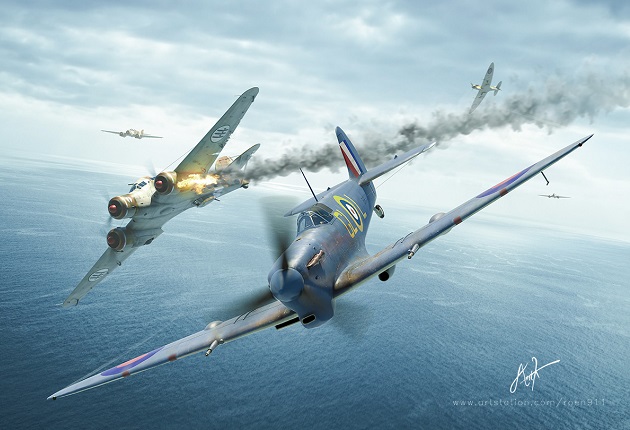
Artist: Antonis Karidis
Malta was a military and naval fortress, being the only Allied base between Gibraltar and Alexandria, Egypt. In peacetime, it was a way station along the British trade route to Egypt and the Suez Canal to India and the Far East.
While the battles were being fought in North Africa, the Axis had a thorn in their side. Malta was strategically located in the the near center of the Axis supply routes from Italy and Sicily to North Africa. Allied air and naval forces based on the island were in range to attack Axis supply ships.
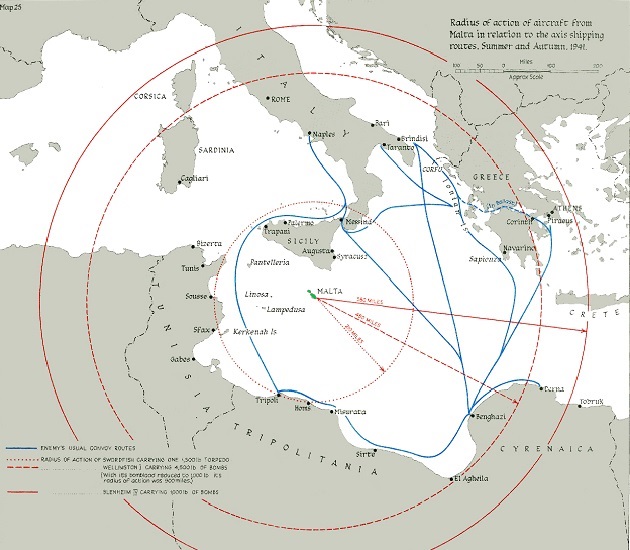
The Axis resolved to bomb or starve Malta into submission, to soften it up for invasion, by attacking its ports, towns, cities, and Allied shipping supplying the island. The Italians deployed 54000 mines around Malta to prevent it being supplied. For over two years, the Luftwaffe and the Italian Regia Aeronautica flew a total of 3000 bombing raids over Malta.
Film: WAR PICTORIAL NEWS NO 59 IWM WPN 59
Video: BATTLEZONE | Malta WW2 | Battle Line | S3E8
Malta Air Defenses
Malta, the “unsinkable aircraft carrier” had three main airfields known as RAF Hal Far, RAF Luqa, and RAF Ta’ Kali with an intermediate landing area known as the Safi Dispersal Strip.
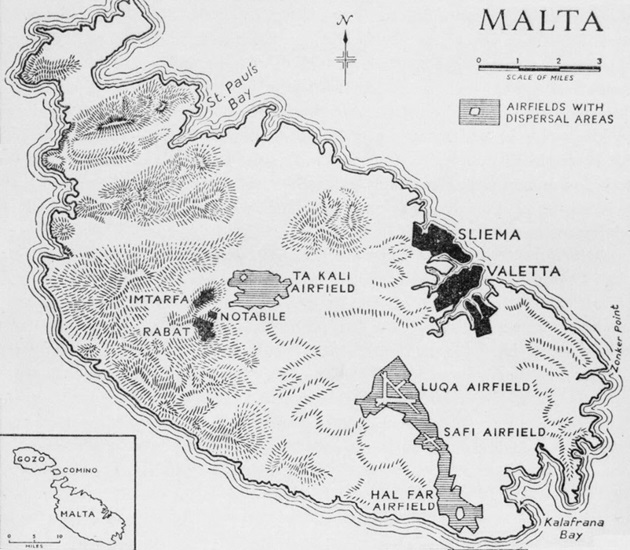
RAF Krendi, also known as RAF Qrendi, was a RAF base located near the town of Qrendi. The station was officially inaugurated in 1941 as a diversion airstrip for the main operating bases such as nearby RAF Luqa. Other diversion airstrips similar in function to Krendi were located at Safi and on Malta’s second island of Gozo. In November 1942, the British began sending fighter squadrons to Krendi. They remained there until late 1943.
Video: Forgotten Airfield of WW2, MALTA
Only six obsolete Gloster Sea Gladiator biplanes were stationed on the island, with another six in crates when, on 10 June 1940, Mussolini declared war on Britain and France. The Gladiators in crates for transit were assembled and as no more than three aircraft flew at once. The pilots were flying boat aircrews and other fliers with no experience in aerial combat. One Gladiator was shot down but the rest managed to shoot down several Italian aircraft.
Twelve Fairey Swordfish torpedo bombers escaped from southern France following the French capitulation and flew to the French colony in Tunisia. They then flew on arriving at Malta on 19 June 1940. They formed the nucleus of what was to become 830 Naval Air Squadron, providing Malta with its first offensive strike aircraft. By the end of June, they raided Sicily and sank one Italian destroyer, damaged a cruiser and destroyed oil storage tanks in the port of Augusta.
On 10 January 1941, No. 431 (General Reconnaissance) Flight RAF, was briefly re-designated as No. 1431 Flight RAF, on Malta and then became RAF No. 69 Squadron. It carried out strategic reconnaissance missions mainly using Martin Marylands until May 1942 when it converted to Supermarine Spitfire PRs.
In early 1941, new squadrons: RAF No. 185 and No. 126 were formed and they received the first cannon armed Hawker Hurricane Mk IICs. Naval carriers flew in a total of 81 more fighters in April–May. By May 12th, there were 50 Hurricanes on the island. On May 21st, RAF No. 249 Squadron arrived. RAF No. 46 Squadron arrived in June, to be renumbered to No. 126 Squadron. In May 1941, 47 Hurricanes were flown to the island. From May–December, the first Bristol Blenheim units (RAF No. 113 Squadron and No. 115 Squadron) began to arrive and Bristol Beaufighter units, No. 252 and No. 272 Squadrons arrived. Malta was used as a base for supplying Egypt. Between July and December 1941, 717 RAF fighters arrived on Malta and 514 flew to North Africa bases. By early August, Malta had 75 fighters and 230 anti-aircraft guns. Bristol Blenheim bombers also joined the defenders and began offensive operations. In February 1942, RAF No. 249 Squadron converted to Spitfire Vs.
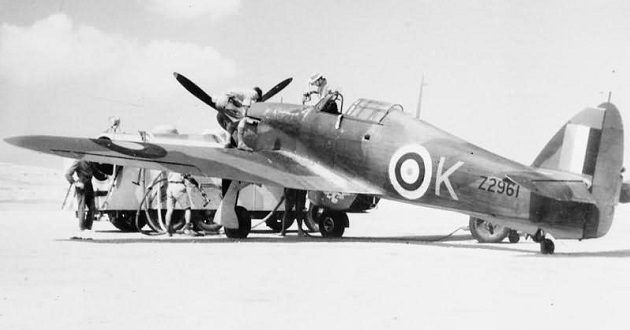
The Malta Night Fighter Unit (MNFU) was formed in late July 1941 at RAF Ta’ Kali, equipped with 12 Hawker Hurricane Mk.II fighters. The unit’s Hurricanes usually operated in pairs in conjunction with ground searchlights. It claimed its first successes on the night of 5-6 August 1941, when two Italian Fiat BR.20M bombers were shot down.
Hurricane Mk IIA Z2961 plane K of the MNFU being refueled and rearmed at Ta’ Kali airfield.
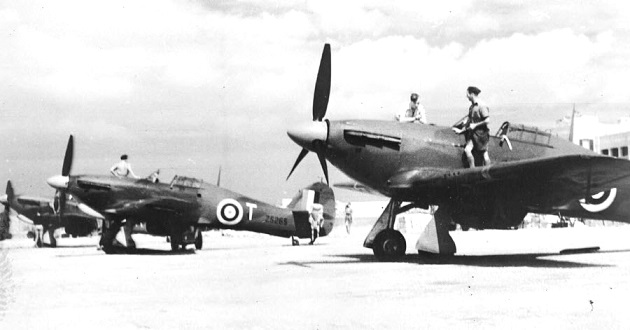
Hawker Hurricane Mark IIs of RAF No. 185 Squadron, lined up at Hal Far airfield. Hurricane Mark IIB Z5265 plane T (center) was flown by Squadron Leader Peter William Olber Mould (CO) when he was shot down and killed after the squadron had scrambled to intercept Italian fighters northeast of the island on 1 October 1941.
Adrian Warburton
Flying Officer Adrian “Warby” Warburton of the RAF No. 69 Squadron was a photo-reconnaissance Maryland Mk.I pilot who claimed 9 kills. He became legendary in the RAF for his role in the defense of Malta and was described as “the most important pilot in the RAF”.
The Maryland Mk.I was the RAF designation for the US built Martin 167-F light bomber which entered RAF service after the Fall of France. Many of these aircraft were refitted with Pratt & Whitney Twin Wasp engines in place of the original Wright Cyclones and the French 7.5mm machine guns were replaced with .303 Browning Mk.IIs in the outer wings and .303 Vickers K-Guns in the gunner positions. Warburton’s Maryland, Martin 167-F #114, had already had an interesting service life before its arrival on Malta. It flew against the Germans during the Battle of France, then with a Vichy French reconnaissance squadron in the South of France, before its crew flew the plane to Gibraltar to defect. Although the RAF operated the Maryland as both a bomber and a recon plane, often in the same squadron, No. 69 Squadron primarily flew recon, and Warburton himself was not known to have operated his Maryland in bombing missions, preferring instead to use it as an impromptu fighter against targets in the air and on the ground. In the reconnaissance role, the plane kept its guns but not its bombs, which were replaced with cameras. Warburton scored his 5 confirmed kills with his Maryland’s four forward firing machine guns.
Warburton’s patched up Maryland Mk.I bomber at Luqa airfield.
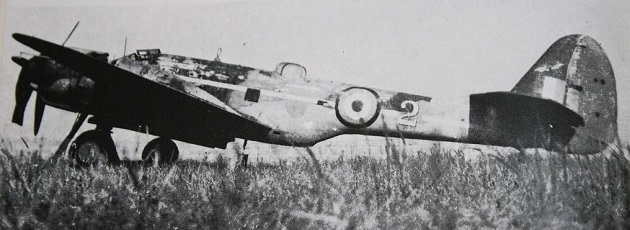
Warburton entering the cockpit of his Maryland bomber at Luqa.

On 14 April 1941, Warburton’s Maryland was mistaken for a Ju 88 and was attacked by a Hurricane flown by Flying Officer Innes Westmacott (RAF No. 56 Squadron). Warby had to make a wheels up force landing. Later, he photographed the entire 250 mile (402.34 km) length of the coast road from Benghazi to Tripoli. It was thought the task would take six sorties to complete. Warburton did it in one sortie, with every yard photographed and no breaks in coverage. During the flight, he was chased out to sea four times by enemy fighters, but returned to his task after shaking off his pursuers.
Warburton met Christina Ratcliffe in Floriana, Malta, on the evening of 24 January 1941. They soon became recognized by many as Malta’s “golden couple”. Ratcliffe was a dancer stranded on Malta and a founder member of the cabaret troupe the Whizz Bangs which entertained the troops. She became a civilian plotter working for the RAF at the Lascaris War Rooms. Later she became captain of her watch and an assistant controller. She was decorated in 1943. After Warburton left Malta in October 1943, she never saw him again. She stayed in Malta, never married, and died there in 1988.
On the morning of 12 April 1944, Warburton was flying a US Lockheed F-5B photo-reconnaissance aircraft (an unarmed fast version of the P-38 Lightning fighter) on a mission to photograph targets in Germany. Warburton was not to be seen again and was reported as missing. In 2002, 58 years later, his remains were found with his aircraft, buried about 2 yards (1.8 m) deep in a field near the Bavarian village of Egling an der Paar, 34 miles (55 km) west of Munich. According to local witnesses, the aircraft crashed there on 12 April 1944, around 11:45. One of the propellers had bullet holes in it, which suggests that Warburton had been shot down.
The 1953 British war film, Malta Story, starring Alec Guinness is loosely based on Warburton and Ratcliffe.
His life and work has been depicted in the book “Warburton’s War” by Tony Spooner and in the BBC Timewatch documentary “The Mystery Of The Missing Ace”. A full depiction of his life, “The Maltese Spitfire”, was written by Squadron Leader Harry Coldbeck, with an introduction by Wing Commander P.B. Lucas, both of whom knew Warburton well.
Video: Mystery Of The Missing Ace 1/4
Malta Convoys
On Saturday 9 May 1942, USS WASP (CV-7) and HMS EAGLE were ferrying Spitfire Mk Vb fighters to Malta during Operation Bowery. At 0630 hours, WASP launched 11 Grumman F4F-4 Wildcats of VF-71 as a Combat Air Patrol (CAP) over the task force. First, EAGLE launched 17 Spitfires in two waves, then WASP launched 47 more. The first Spitfire that took off at 0643 hours, piloted by Sergeant Pilot Herrington, lost power soon after takeoff and plunged into the sea, with the loss of the pilot and aircraft. The other Spitfires took off safely and formed up to fly to Malta.
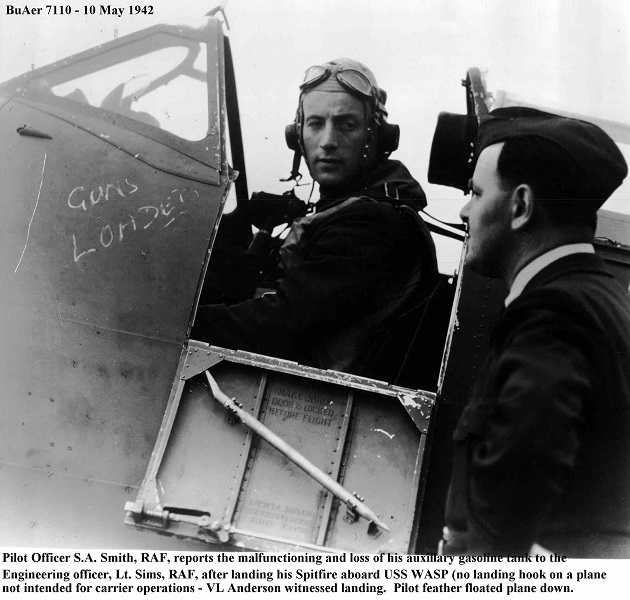
Upon take off, Pilot Officer Jerrold Alpine “Jerry” Smith (RCAF) discovered the intake from the slipper auxiliary belly tank was not drawing fuel. This made it impossible for him to make the 500 mile (804.67 km) flight to Malta. His only alternatives were to either land back on board the WASP with NO tailhook or to ditch and take his chances in the sea. He chose to attempt a landing on the WASP. After an aborted first attempt, he was guided in by Landing Signal Officer (LSO) Lieutenant David McCampbell (later became the highest scoring US Navy ace of WWII) and came to a halt 15 feet (4.6 m) from the forward edge of the flight deck. The WASP’s Dental Officer (Dentist), Lieutenant (jg) Vernon Leroy Anderson, observed the landing. Smith’s Spitfire was undamaged and for this unprecedented and remarkable feat, he was unofficially awarded a gold pair of US naval aviators wings from the WASP’s Air Officer, Commander Michael Holt Kernodle.

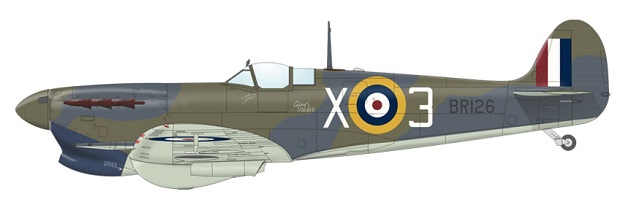
Smith was flying Spitfire Mk Vb (Trop) BR126 coded “X 3”.
The next day, Smith took off from the WASP and flew back to Gibraltar. Flying overhead is a Wildcat fighter patrol from the WASP.
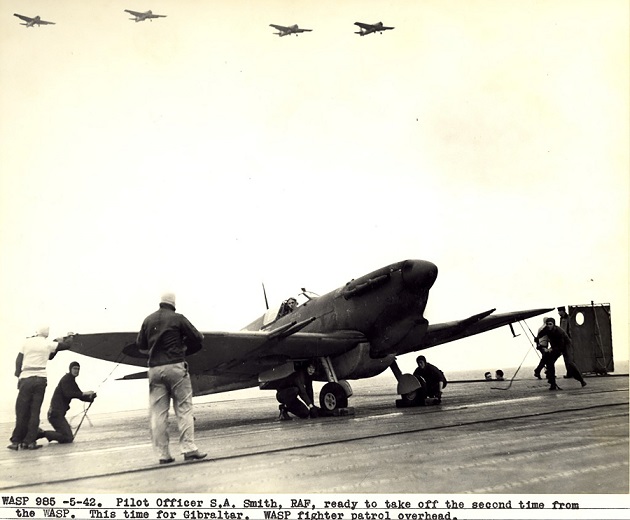
On 18 May 1942, he made another trip to Malta aboard the HMS EAGLE. He took off and landed successfully on Malta where he joined the RAF No. 126 squadron. The next month he was joined by his brother, Rod Smith who flew as his wing man. Jerry was last seen on 10 August 1942 flying Spitfire BR366 chasing a German Ju 88 bomber over the Med. He was first listed as MIA and later it was changed to KIA. His brother, Rod finished the war as a Spitfire ace with 15 and 1/5 kills.
Video: Operation Pedestal: The Convoy That Saved Malta
George Beurling
Flight Sergeant George Frederick Beurling (6 December 1921 to 20 May 1948) was the highest scoring Canadian pilot over Malta with over 26 kills. He was known as “The Falcon of Malta” and the “Knight of Malta”. Some other nicknames he had were “Buzz”, “Screwball”, and “Joe”.
Beurling dedicated himself totally to the art of aerial combat. Being a loner on the ground and in the air, Beurling angered his commanders with his disregard for teamwork. His relentless concentration on aerial fighting led Beurling to develop a marked skill at deflection shooting and together with his situational awareness, he was recognized as a deadly fighter pilot.
Like many successful Spitfire pilots, Beurling developed the habit of only engaging enemy aircraft at 250 yards (230 meters) or less, a range at which most other pilots would break away. Beurling owed his success to remarkably good eyesight and the ability to “toss his Spitfire” into violent combat maneuvers. If jumped from behind, he would pull back on the stick of his Spitfire so hard that the aircraft would enter a violent stall, flick over and spin. This was a hard, sudden and very dangerous maneuver for the enemy fighter on his tail to follow. Beurling would also ram both ailerons and rudder into a sudden and violent turn, causing his Spitfire to flip over and drop like a stone. Only a very experienced (or crazy) pilot would constantly pull such stunts. Beurling made them his reflex reactions. He was always able to nurse his Spitfire out of such self-induced situations and get home safely.
On 9 June 1942, Beurling landed his Spitfire Mk Vc (Trop) on Malta, after having flown off the deck of HMS Eagle during Operation Salient.
In order for the Spitfire to take-off from HMS Eagle’s short 660 feet (201.168 meters) flight deck, the Spitfire needed take-off flaps. However, the Spitfire’s pneumatically operated flaps had only one setting of 85 degrees (drag flap for landing). The solution was to wedge the flaps at the 25 degrees setting with a wooden wedge. Once safely airborne, the flaps were simply lowered to drop the wedges and then raised again for normal flight.
Beurling’s Aerial victories over Malta
| Date (1942) | Destroyed | Damaged | Notes |
|---|---|---|---|
| June 12 | 1x Messerschmitt Bf 109 | ||
| July 6 | 2x Macchi MC.202, 1x Bf 109 | 1x CANT Z.1007 Alcione | |
| July 8 | 1x Bf 109 | 2x Bf 109 | South of Gozo |
| July 10 | 1x Bf 109, 1x MC.202 | ||
| July 12 | 3x MC.202 | North of Gozo | |
| July 23 | 1x Reggiane Re.2001 | 1x Junkers Ju 88 | |
| July 27 | 2x MC.202, 2x BF 109 | 2x “damaged” | Near Valletta [1] |
| July 29 | 1x Bf 109 | ||
| August 8 | 1x Bf 109 | Shot down by JG 53 [2] | |
| August 13 | 0.33x Ju 88 | 1/3 shared victory | |
| August 25 | 2x Bf 109 | 1x Bf 109 | |
| August 10 | 2x Bf 109 | Over Filfla | |
| August 13 | 1x Ju 88, 2x Bf 109 | 1x “damaged” | North of St. Paul Bay |
| August 14 | 2x Bf 109, 1x Ju 88 | Shot down again [3] | |
| Total | 26.33 | 9 |
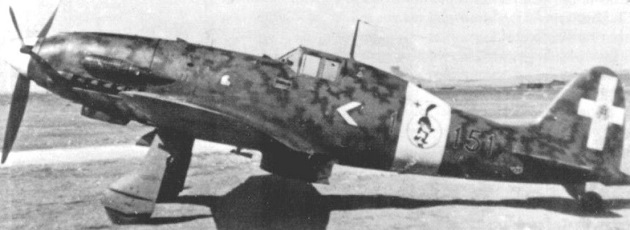
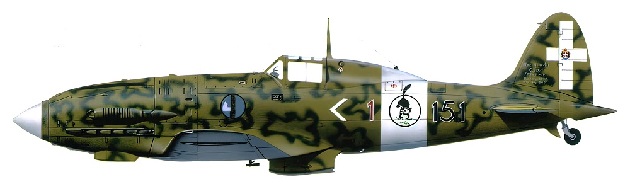
[1] Beurling shot down Italian ace Furio Niclot Doglio who was Capitano (commanding officer) of 151° Squadriglia, 20° Gruppo, 51° Stormo based at Gela, Sicily, flying a Macchi MC.202 Folgore. Doglio claimed six Allied aircraft shot down plus four probables and shared two with his wingman, Ennio Tarantola. Also in the 1930’s, Doglio set nine official aviation world records for altitude and speed events.
[2] Beurling may have been shot down by Oberleutnant Herbert Rollwage, II. Gruppe, JG 53, based on Pantelleria island (northwest of Malta).
[3] Beurling bailed out into the sea and was rescued, required hospitalization.
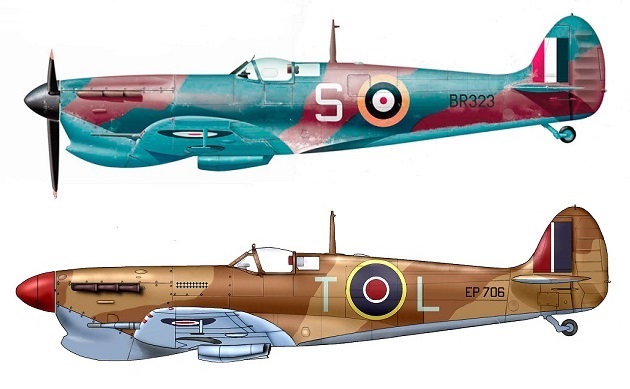
Beurling flew many Spitfires during his tour on Malta. Beurling flew Spitfire Mk Vc (Trop) BR323 for his kills on July 6 and 10. While flown by another pilot, Spitfire BR323 was shot down in the sea off Malta on 18 July 1942. Beurling flew Spitfire Mk Vb (Trop) EP706 on October 10th.
Doglio’s Macchi MC.202 Folgore (MM 9042), aircraft number 1-151.
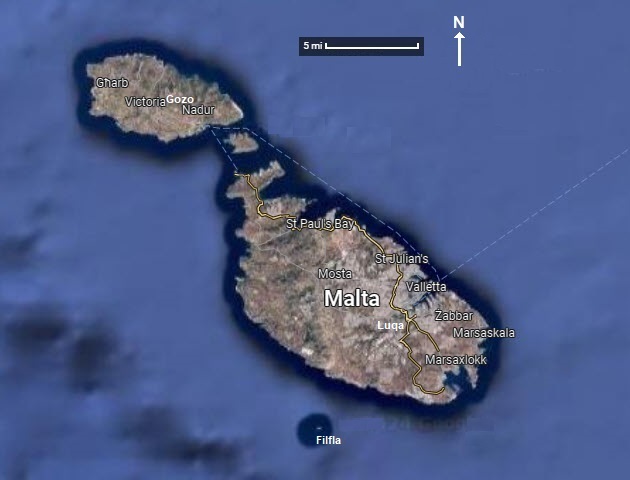
Filfla is a mostly barren, uninhabited island 4.5 km (2.8 miles) south of Malta. It has an area of 3.7282 hectares (9.213 acres) with a 988 meters (1080.48 yards) long coastline. It is mainly a crumbling flat topped limestone plateau surrounded by 60 meter (196.85 feet) high cliffs.
Beurling standing by a sandbag revetment at Ta’ Kali with the rudder and unit emblem cut from a Macchi MC.202 of 378° Squadriglia, 51° Stormo CT, one of four enemy aircraft which he shot down on July 27th. The Macchi MC.202 was piloted by Faliero Gellis and Beurling hit his plane in the engine and radiator, but Gellis managed to crash land it on Gozo and became a POW.
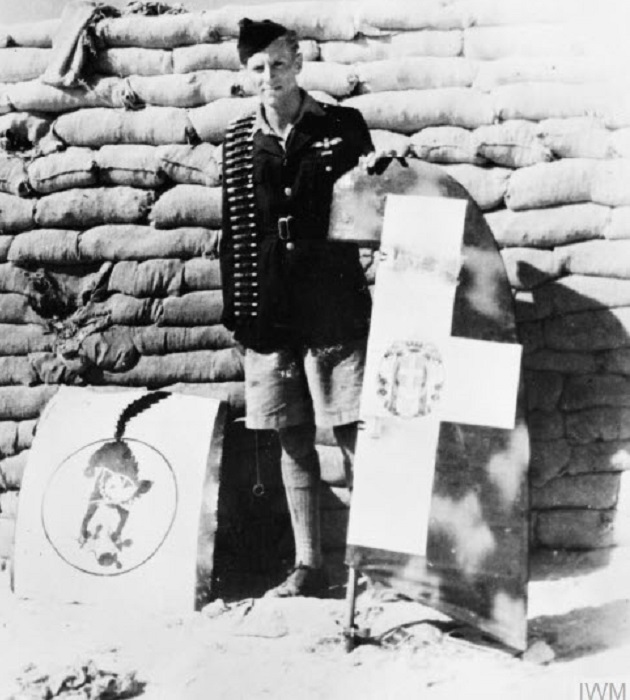
Beurling was not invincible, he was shot down four times over Malta.
On 31 October 1942, the injured Beurling was being transported back to the UK. On the way, the RAF B-24 transport aircraft he was aboard crashed into the sea off Gibraltar. Beurling was one of only three survivors. He jumped out just as the plane hit the water and then swam 160 yards (146.3 meters) to shore with a heavy cast on his foot. Beurling was hospitalized again, he was in shock and had an infection on his wounded heel.
In 1948, Beurling was recruited to fly for the Israeli Air Force. After a test flight, Beurling fatally crashed his Noorduyn Norseman transport aircraft while landing at Aeroporto dell’Urbe in Rome on 20 May 1948, just six days after the Israeli Declaration of Independence.
John Lynch Jr.
Squadron Leader John Joseph “Johnny” Lynch Jr. (3 February 1918 to 9 March 1956) was the commanding officer of RAF No. 249 Squadron. Lynch, an American who joined the RAF in 1941, served with RAF No. 71 (Eagle) Squadron in the UK before being posted to 249 Squadron on Malta in November 1942. He became a flight commander in early 1943 and was given the command of the squadron in March. He enjoyed much success during operations over the sea routes between Sicily and Tunisia. In July 1943, Lynch transferred to the USAAF after having scored 10 and 7 shared victories with the RAF.
Lynch’s Aerial Victories
| Date | Enemy Aircraft |
|---|---|
| 17 April 1942 | 0.5x Junkers Ju 88 destroyed |
| 19 July 1942 | 0.5x Focke-Wulf Fw 190 destroyed |
| 11 December 1942 | 1x Messerschmitt Me 110 destroyed 1x Junkers Ju 52/3m probable |
| 13 December 1942 | 0.5x Ju 88 damaged |
| 14 December 1942 | 0.33x Ju 88 destroyed |
| 17 December 1942 | 0.33x Ju 88 destroyed 0.33x Ju 88 destroyed |
| 7 February 1943 | 0.5x Ju 52/3m destroyed [1] |
| 7 April 1943 | 1x Ju 88 destroyed |
| 22 April 1943 | 2x Ju 52/3m destroyed |
| 25 April 1943 | 1x Caproni Ca.313 destroyed |
| 28 April 1943 | 1x Ju 52/3m destroyed [2] |
| 10 May 1943 | 1x CANT Z.506B Airone destroyed 1x Ju 52/3m destroyed 1x Fiat RS.14 destroyed [3] 1x Messerschmitt Me 210 destroyed |
| 13 July 1943 | 1x Fw 190 destroyed |
[1] Shared victory with squadron mate Irving Farmer “Hap” Kennedy (4 February 1922 to 6 January 2011).
[2] Lynch shot down a Junkers Ju 52/3m over the sea five miles (8 km) north of Capo Cefalù (Sicily) which was assessed as being the 1000th Axis aircraft shot down by Malta-based units since the start of the war.
[3] The Fiat RS.14 initially claimed as a CANT Z.506B Airone.
Lynch sitting in the cockpit of his Spitfire Mk Vc at Krendi airfield as an airman chalks “Malta’s 1,000th” below his then victory tally (not including shared victories).
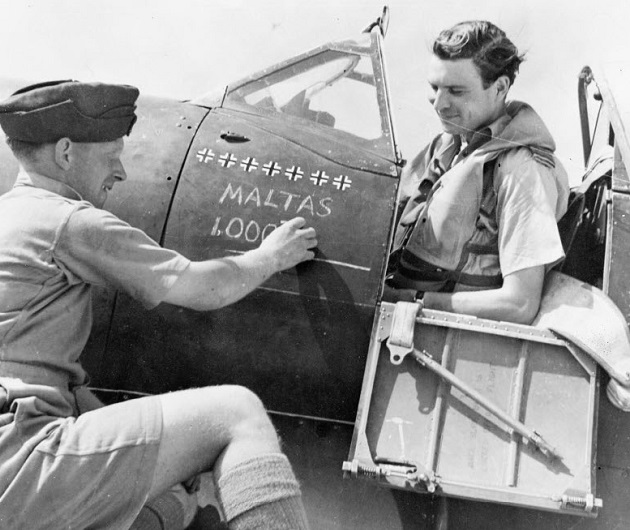
Lynch seen no further combat and after the war he stayed in the USAF. He was killed on 9 March 1956 when his Republic F-84 Thunderjet crashed near Naha Air Field on Okinawa.
10th Submarine Flotilla
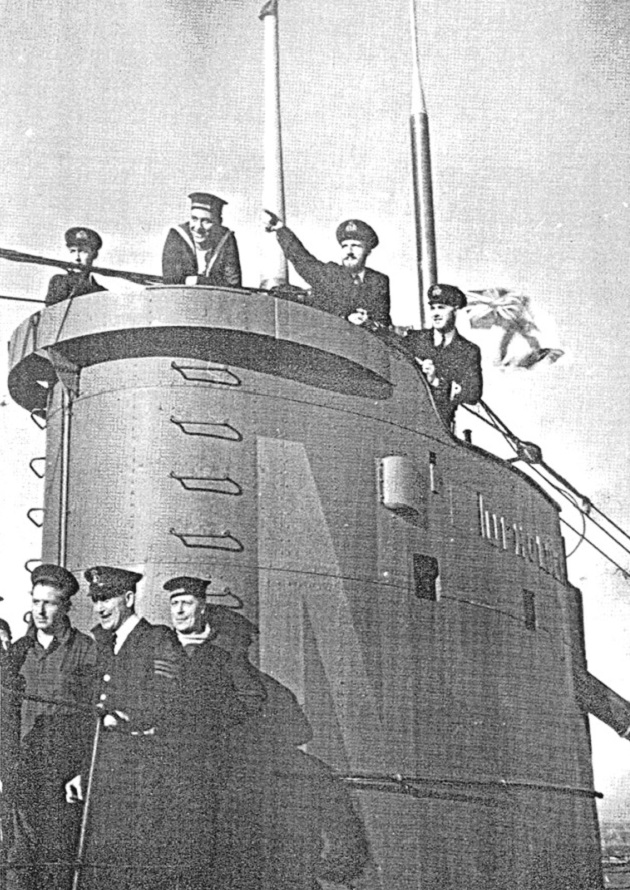
The flotilla was formed at Malta in January 1941 and comprised of Royal Navy and Polish Naval Force submarines assigned to the British Mediterranean Fleet. It composed of U-class submarines including HMS UNBEATEN, HMS UPHOLDER (N99), HMS UNITED, HMS UPRIGHT, HMS UNA, HMS UNSEEN, HMS UNBENDING, HMS UNBROKEN, HMS URGE, HMS UTMOST, HMS P38 and HMS URSULA (N59) together with ORP Sokół (N97) and ORP DZIK of the Polish Navy. The U-class submarine was designed for training crews rather than combat but its diving performance made it the best choice for operating in the clear waters of the Mediterranean where submarines could be easily seen by aircraft. The flotilla never numbered more than 12 submarines, but this small force between January 1941 and December 1942, sank 412,575 tons of Axis shipping. Due to a shortage of torpedoes, enemy ships could not be attacked unless the target in question was a warship, tanker or other “significant vessel”.
The flotilla’s base was the ancient fort on Manoel Island, in the Marsamxett Harbour opposite Sliema. This shore base was named HMS TALBOT. The Lazzaretto of Manoel Island formed part of the quarters for the sub crews. The submarine base at Manoel Island was a priority target for Axis aerial attacks and was heavily bombed in 1942 which forced a temporary withdrawal of the flotilla from Malta to Alexandria where the ships of the Mediterranean Fleet had already relocated to. During this relocation to Alexandria, HMS URGE was sunk after striking a mine and there were no survivors. The mines were the bane of the Royal Navy’s submarines.
During the 16 month operational career of HMS UPHOLDER (Lieutenant-Commander Malcolm David Wanklyn), UPHOLDER completed 24 patrols and sank around 121,000 tons of Axis ships, consisting of three U-boats, a destroyer, 15 merchant ships with possibly a cruiser and another destroyer also sunk. On 13 January 1942, Wanklyn was awarded the Victoria Cross for attacking a well-defended convoy from Naples to Tripoli and sinking the Italian SS Conte Rosso troop ship on 25 May 1941. On UPHOLDER’s 25th patrol, which was to have been her last before she returned to the UK, UPHOLDER was sunk with no survivors on 13 April 1942 north of Tripoli. Wanklyn was the Allies’ most successful submariner in terms of tonnage sunk.
HMS UPHOLDER
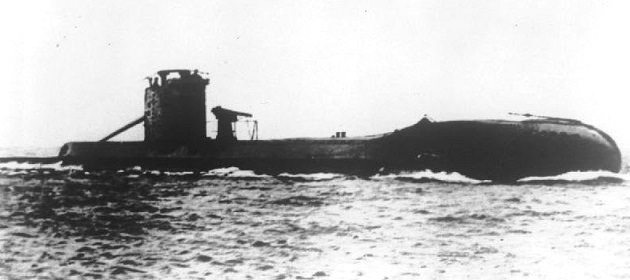
Complement: 27 – 31
Armament:
- 4 × internal bow 21 inch (533mm) torpedo tubes (10 torpedoes)
- 2 x external bow tubes
- 1 × QF 3-inch (76mm) 20 cwt gun (gun crew exited from conning tower)
HMS UPHOLDER had a large N99 painted on the conning tower.
Malta Command
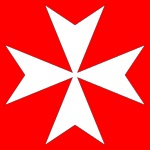
The Malta Command was an independent command of the British Army. It commanded all army units involved in the defense of Malta. Once mobilized, the Command deployed its headquarters to underground hardened shelters and its combat units were deployed to fixed points in the Maltese countryside, from where they operated. While the Malta Command was already a functioning command before 1939, the Command operated as a genuine war fighting headquarters but in a static defensive role. The mobilized, largely static, army garrison on Malta was tested by aerial bombardment and a naval blockade.
Malta Command’s insignia & shoulder flash, the Croix de Malte (“Maltese Cross” ).
Malta Camouflage
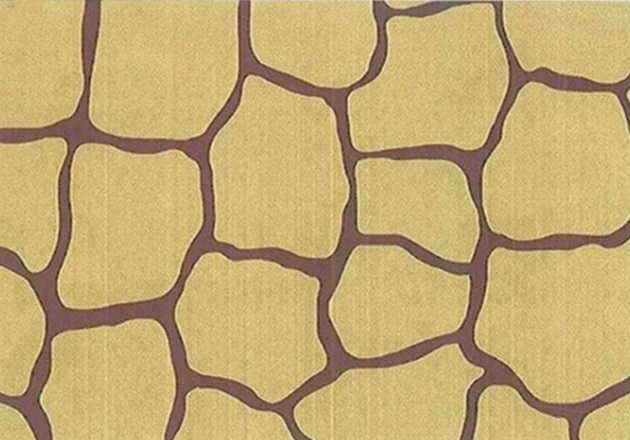
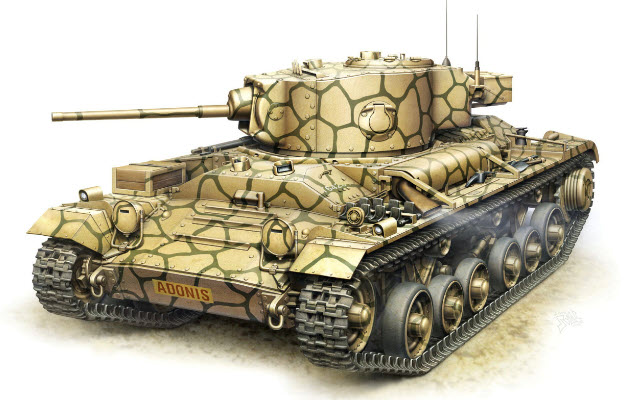
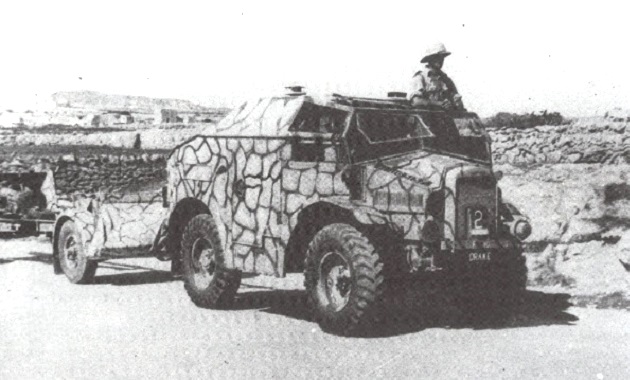
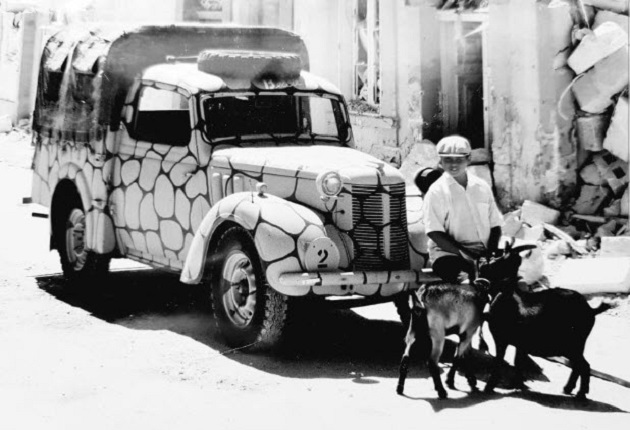
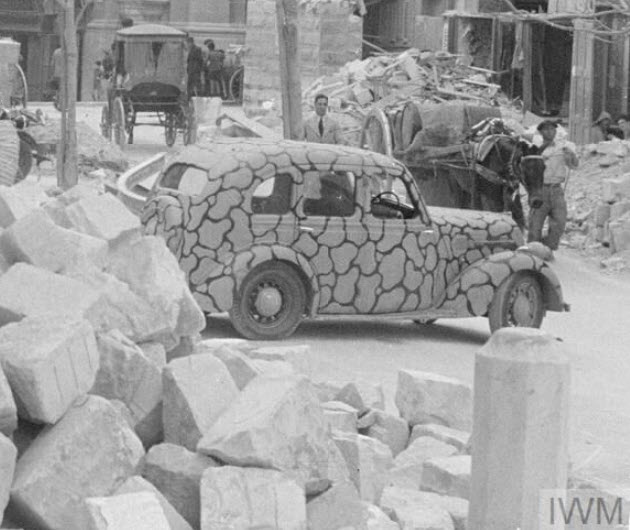
One distinctive feature of the British Army on Malta was the rubble-wall camouflage. Although particular to Malta, similar patterns were used elsewhere such as during Operation Husky (1943 Invasion of Sicily) and the Germans in the Aegean. It is highly effective wherever the countryside is dominated by limestone walls. It was applied to everything: helmets, Anti-Aircraft guns, field artillery guns, tanks, Bren gun carriers, trucks, cars, motorcycles and even entire defense posts/pillboxes were transformed into rubble walls.
There appear to been no standard for the camouflage pattern and there were many variations. Vehicles or items originally painted green had sand color blocks painted on and left the original green for the mortar lines. The original markings were left on the green background. For vehicles or items originally painted sand color only the mortar lines for bricks were painted in black or brown.
Malta Camouflage Pattern
Infantry on Malta
1st Infantry Brigade:
Assigned to the Southern Sector. HQ Southern Infantry Brigade was at Luqa.
- 2nd Battalion, The Devonshire Regiment
- 1st Battalion, The Hampshire Regiment
- 1st Battalion, The Dorsetshire Regiment
- 2nd Battalion, The King’s Own Malta Regiment
- 3rd Battalion, The King’s Own Malta Regiment
2nd Infantry Brigade:
Assigned to the Northern Sector. HQ Northern Infantry Brigade was at the Melita Hotel Attard next to San Anton Gardens.
- 2nd Battalion, Royal Irish Fusiliers
- 8th Battalion, King’s Own Royal Regiment (Lancaster)
- 8th Battalion, Manchester Regiment
3rd Infantry Brigade:
Formed on 30 July 1941 and assigned to the Central Sector.
- 11th Battalion, The Lancashire Fusiliers
- 2nd Battalion, The Queen’s Own Royal West Kent Regiment
- 10th Battalion, The King’s Own Malta Regiment
4th Infantry Brigade:
Assigned to the Western sector.
- 4th Battalion, The Royal East Kent Regiment (The Buffs)
- 1st Battalion, The Durham Light Infantry
- 1st Battalion, The Cheshire Regiment
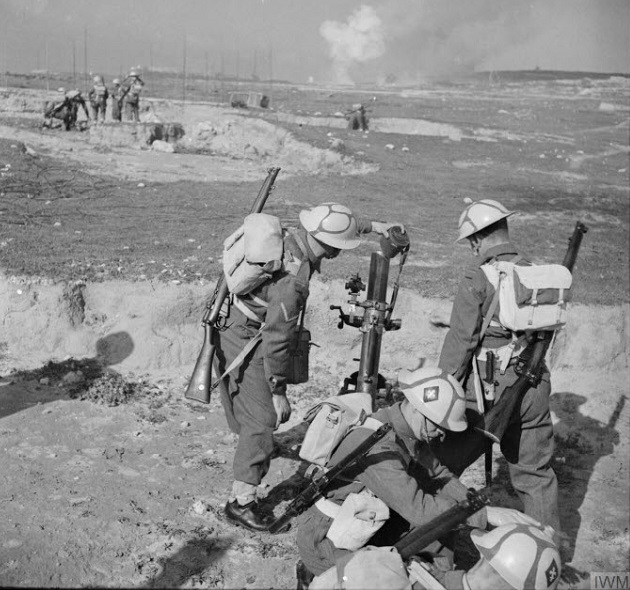
Ten Universal Carriers (“Bren Gun Carrier”) were deployed with each infantry battalion making a total of 140 (on paper) on the island.
A 3-inch mortar team from the Manchester Regiment laying a smoke screen during a demonstration exercise on 13 April 1942. Note the helmets are painted in Maltese camouflage and the soldiers are carrying short magazine Lee–Enfield .303 rifles.
The anti-aircraft defenses were dense and the British and Maltese anti-aircraft (AA) units were interwoven into the following order of battle.
7th Anti-Aircraft Brigade:
- 32nd Light Anti-Aircraft Regiment RA
- 65th Light Anti-Aircraft Regiment RA
- 74th Light Anti-Aircraft Regiment RA
- 3rd Light Anti-Aircraft Regiment RMA
- 4th Searchlight Regiment RA/RMA
The 40mm Bofors anti-aircraft gun was widely used. A Bofors gun crew keep watch as a destroyer enters Grand Harbour (also known as the Port of Valletta) on 8 January 1942. Note the degree bearing numbers chalked on the inside wall of the gun pit. The gun barrel is pointing approximately southeast.

My close up of IWM GM 350.
10th Anti-Aircraft Brigade:
- 4th Heavy Anti-Aircraft Regiment RA
- 7th Heavy Anti-Aircraft Regiment RA
- 10th Heavy Anti-Aircraft Regiment RA
- 2nd Heavy Anti-Aircraft Regiment RMA
- 11th Heavy Anti-Aircraft Battery RMA
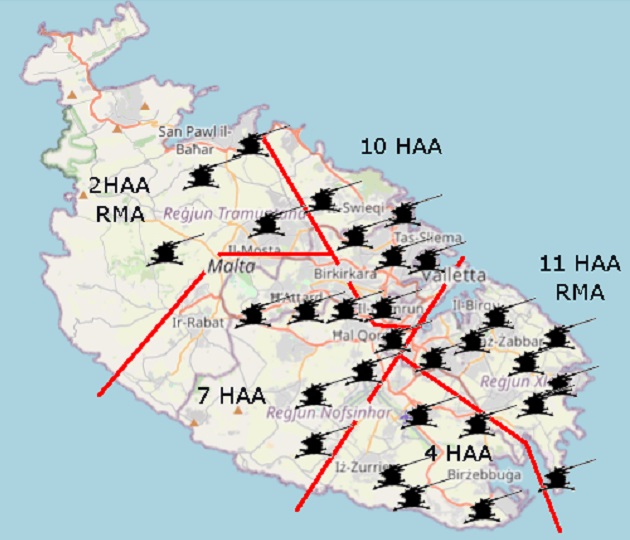
Map of the Heavy AA Regiments sectors on Malta.
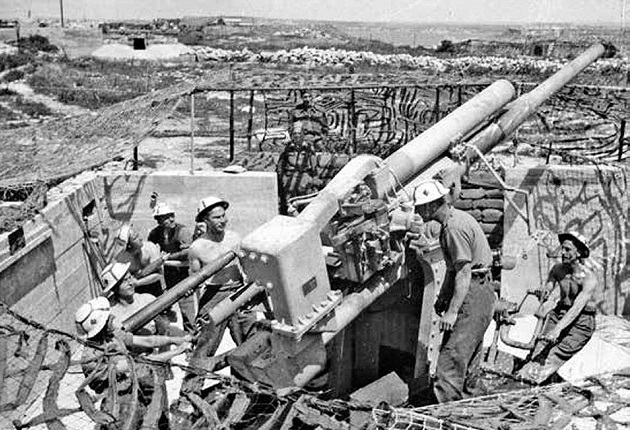
One of four 3.7-inch (94mm) Heavy AA guns of the 4th Heavy AA Regiment at XHB 8, near Benghisa, was credited with shooting two of three Ju 88s during the night of 20-21 July 1942.
Armour on Malta
The first armoured unit destined for Malta was organized in 1940. The unit was formed with strength of five officers and 62 other ranks; and was attached to 44th Royal Tank Regiment prior to its embarkation for Malta where the unit became part of Malta Command. The tanks belonged to an independent Royal Tank Regiment (RTR) unit made of a mixture of British tank types.
On 28 November 1940, No. 1 Independent Troop RTR, drawn from the 1st Army Tank Brigade under the command of Acting Major Robert Esmond Hill Drury, arrived on Malta from the UK via Gibraltar.
The equipment included:
- Four A12 Matilda Mk. II infantry tanks
- Two Light Tank Mk. VIB/Cs
- Four Bedford OXD 30-cwt lorries
- Two 15-cwt trucks
- One 15-cwt water bowser
- One Car Utility
- Four motorcycles
The four Matildas were named after the destroyer escorts (“FAULKNOR”, “GALLANT”, “GREYHOUND” and “GRIFFIN”) of the convoy that brought them to Malta, so the names would have been applied locally, probably in white but possibly in yellow. The census numbers would have remained in white on the base color and been painted around it.
The vehicles would have been finished in Khaki Green 3 base color. It is unknown whether they carried the Dark Green G4 disruptive scheme. After being readied for use at Mamo’s Garage in Gzira, they were repainted by unit personnel in the Malta camouflage. The exact shade of the light color is not known, or even whether it was service paint or something obtained locally.
On 19 January 1942, tanks of A Squadron, 6th RTR (which had sailed from Alexandria, Egypt) arrived at Malta with Convoy MF3.
The tanks that arrived were:
- Four A9 Mk. I Cruiser Tanks (no photographic evidence)
- Three A13 Mk. II Cruiser Tanks
- One Valentine Mk.V Infantry Tank
The Valentine V tank was the same as the Valentine III but with a GMC 6004 diesel engine and US-made transmission.
Ten tanks were lost when freighter MS THERMOPYLAE (Norwegian) was attacked by 2 Ju 88s of Lehrgeschwader 1 on 19 January 1942 and sunk near Benghazi, Libya. The tanks that did arrived were finished in Light Stone and they would then be painted with lines for the Malta camouflage.
The unit never became larger than 14 vehicles and did not have any direct contact with the enemy. It spent the war patrolling, boosting morale across central Malta and were used as tugs for removing damaged aircraft from runways and tow bomb loads to the bombers. They also practiced on the firing range (when ammo was available) in preparation for the day the enemy invades the island.
Instructors address troops from top of Matilda tank GALLANT in the distinctive Malta camouflage on 13 April 1942.
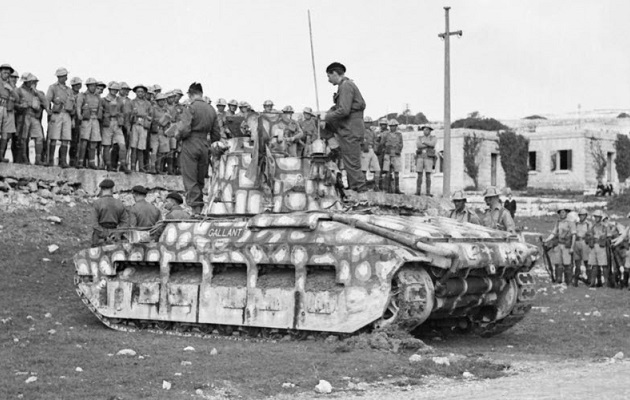
My close up of IWM GM 494.
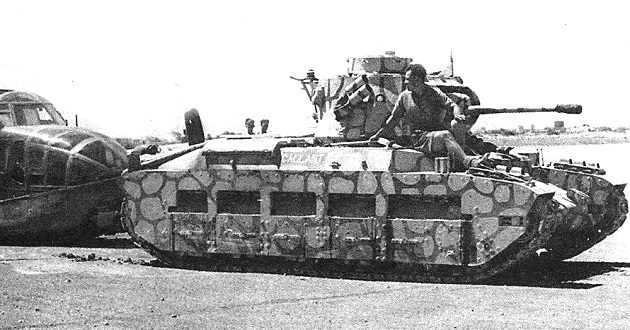
Matilda tank GALLANT towing a Beaufort torpedo bomber which made a belly landing at Luqa airfield after being damaged during an attack on the Italian Fleet on 16 July 1942.

This is a close up of Matilda GALLANT towing the Beaufort bomber in the above photo.
Matilda tanks, painted in distinctive Malta camouflage, give a gunnery demonstration during a training exercise on 13 April 1942. The nearest Matilda is GRIFFIN and the Matilda in the background is too far away to read the name.
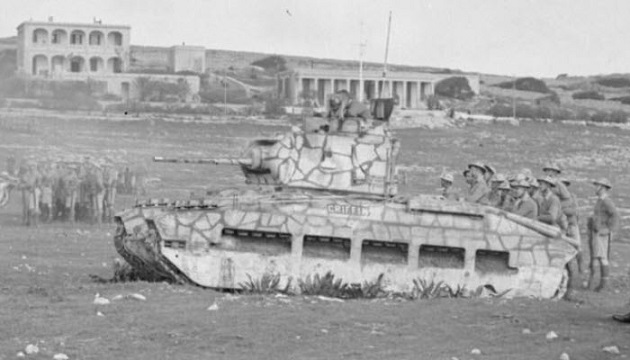
This my close up of IWM GM 498.
Matilda tank GRIFFIN during an exercise in the Maltese countryside on 24 May 1942. Note how its distinctive camouflage blends with the stone wall in the background.

My close up of IWM GM 836.
A Vickers Light Tank Mk. VIC, wearing the distinctive Malta camouflage, on a firing range on 24 March 1942. Number T5978 can be seen on the hull side.
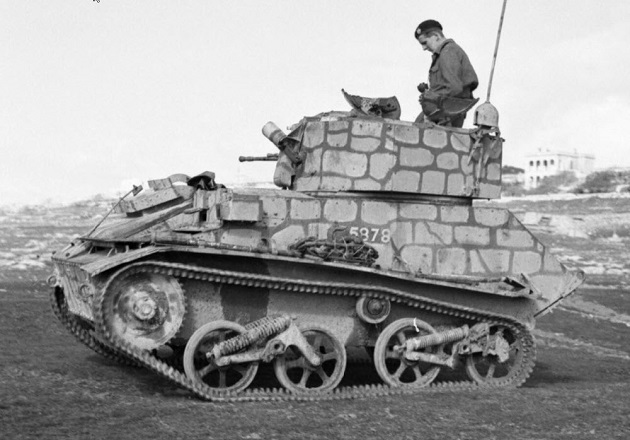
This is my close up of IWM GM 474.
A Vickers Light Tank Mk. VIC on an exercise in the Maltese countryside on 24 March 1942. Number T5878 can be seen on the hull side.
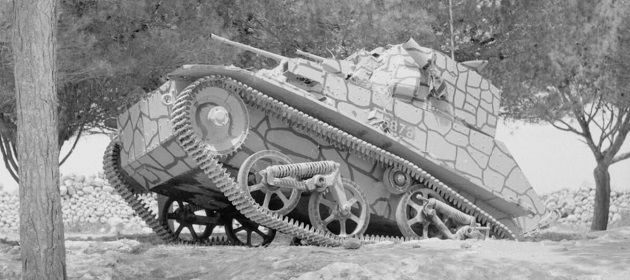
This is my close up of IWM GM 847.
This is a rear view of the above Light Tank Mk. VIC. The camouflage pattern on the rear side hull match in both photos.
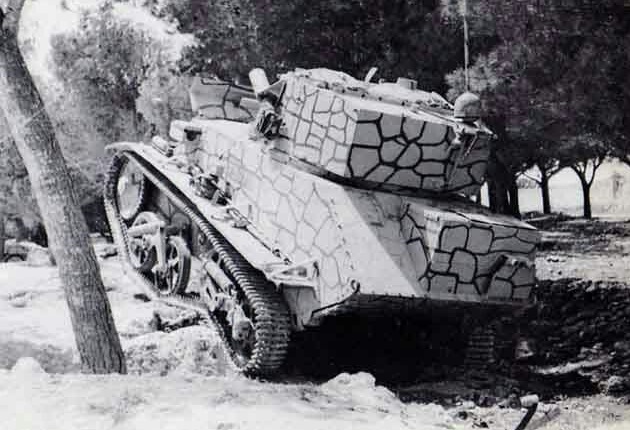
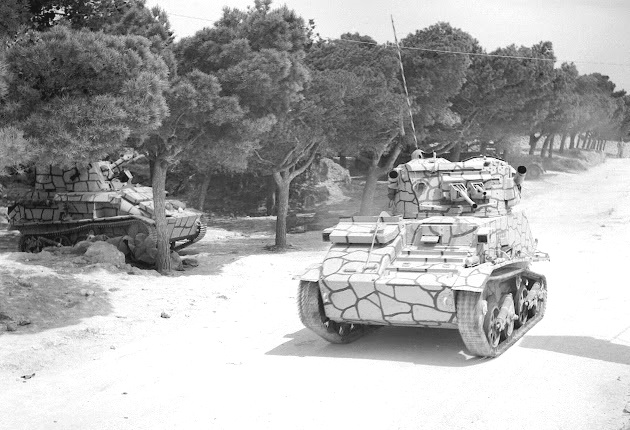
Vickers Light Tanks on an exercise on a Maltese road on 24 May 1942. On the road is a Mk. VIC with 15mm Besa MG and a Mk. VIB with a commander’s cupola is parked in the trees on the side of the road.
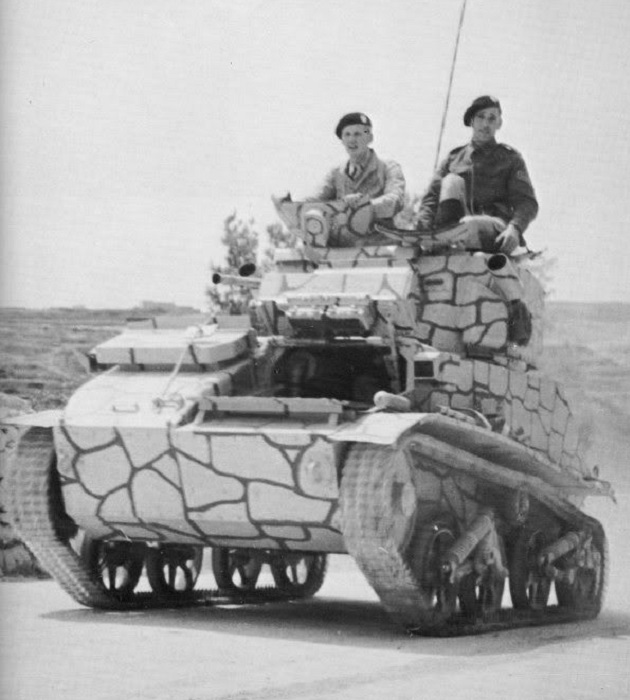
A Vickers Light Tank Mk VIC driving on a Maltese road with the turret crew riding on top and the driver’s hatch open.
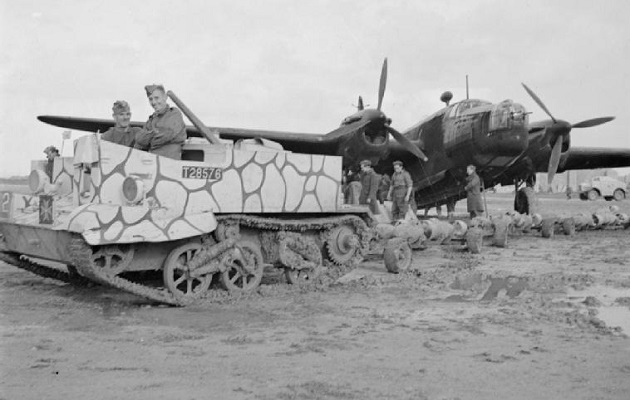
A Bren carrier of the Malta Garrison tows a trolley-load of 250-lb GP bombs to a Vickers Wellington in its dispersal area at Luqa airfield.
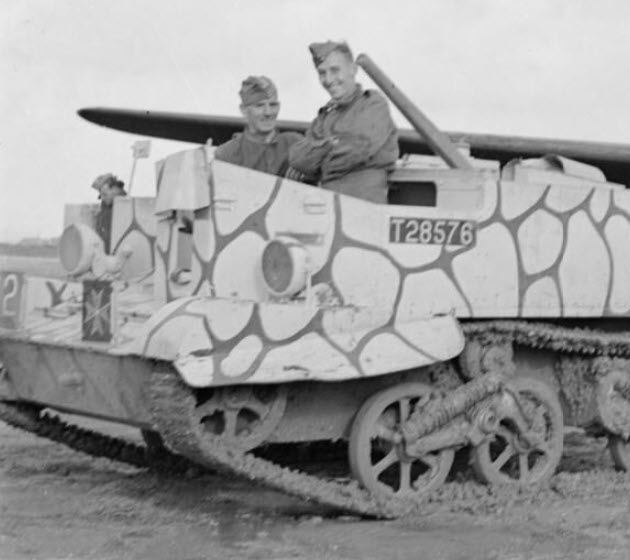
This is my close up of the above Bren carrier. On the front hull is the Maltese Cross and the Arm of Service (AoS) number 2 which was for HQ Services.
The following three photos are A13 Cruiser tanks on a firing range on 24 March 1942. For some unknown reason, they did not have the Malta camouflage applied.
On the side of the turret of this A13 Cruiser tank is number T.18113.

My close up of IWM GM 467.
This A13 Cruiser tank and the one above are not the same tank. The faded paint on the front right fender are not the same or similar in both photos.
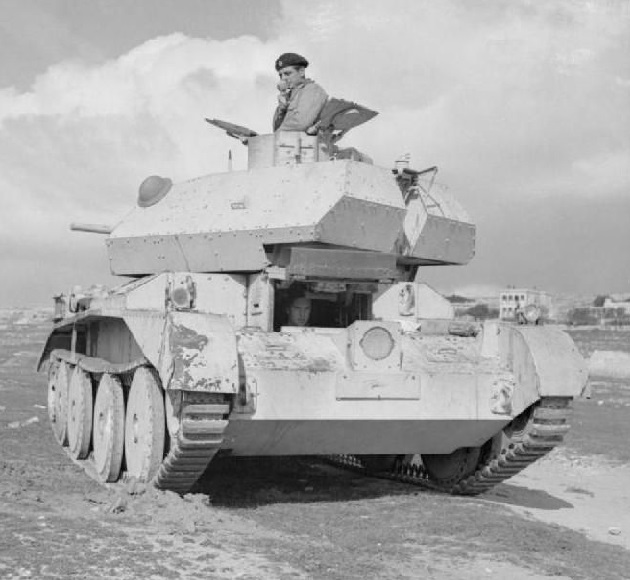
My close up of IWM GM 470.
Probably side view of the above A13 Cruiser tank.
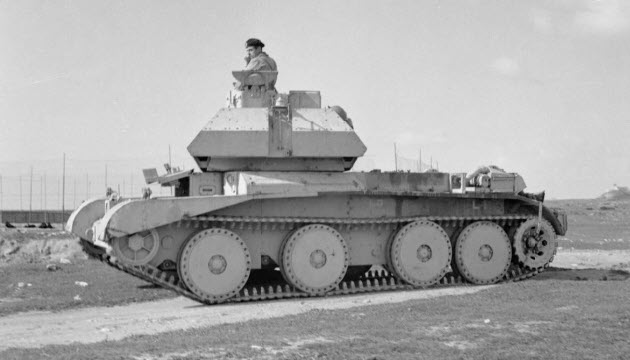
A 40mm Bofors anti-aircraft gun being unloaded from a ship in Grand Harbour also on 24 March 1942. The tanks in the hold are A13 Cruiser Tanks and the one on the right has number T.15231 on the turret. In front of the tank on the left is the front left fender and front hull machine gun turret of an A9 Cruiser Tank. These tanks are not the tanks seen on the firing range in the above photos.

On 24 March 1942, MV PAMPAS (Royal Mail Line cargo ship) and MS TALABOT (Norwegian) were the only two of four ships in Convoy MW 10 to arrive at Grand Harbour at 0915 hours. After their arrival, unloading was slow due to constant Axis air attacks. Both ships were heavily bombed on March 26 and were sunk (in the case of the TALABOT it was scuttled due to the risk of explosion). Very little of their cargoes were unloaded. These tanks were most likely not unloaded before the ship was sunk since food, medical supplies, guns and ammunition were a higher priority. Have not found any information on how many tanks were on these two ships.
Maltese children playing on a Valentine Mk.V tank with the distinctive Malta camouflage in a town, fall 1942. The small boy standing in front of the tank is obscuring the front hull marking. We can only see the first two letters “AD” or “AO”.
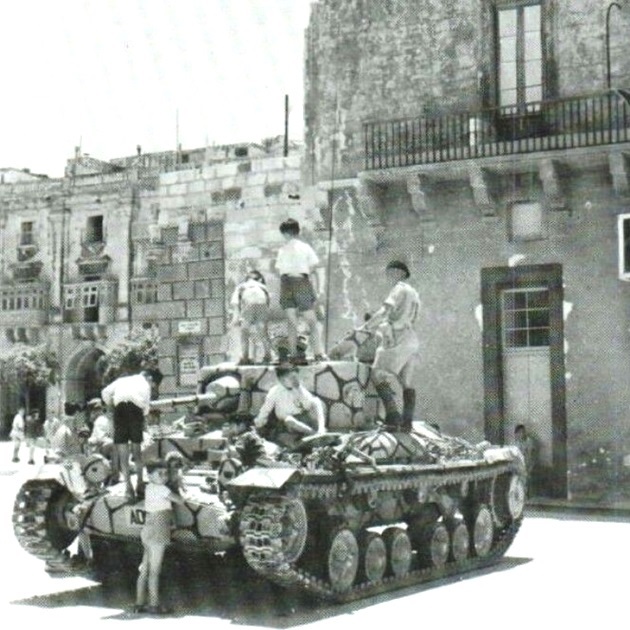
The hull marking could been “ADONIS”, a good guess, but there was no ship named ADONIS in any of the convoys to Malta. Your guess is as good as mine.
A camouflaged Bren gun carrier during an exercise in the Maltese countryside on 24 May 1942. The soldier is aiming a Bren machine gun at the photographer. Below the soldier and to the left is the circular muzzle brake of a Boys 0.55 in (14 mm) anti-tank rifle nicknamed by its users the “elephant gun”.
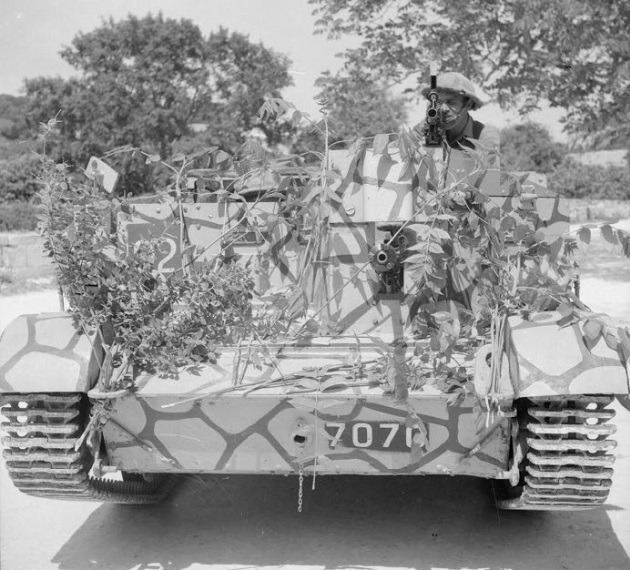
The crew of a Light Tank Mk. VIB tank work on the Vickers machine gun during an exercise in the Maltese countryside on 24 May 1942.

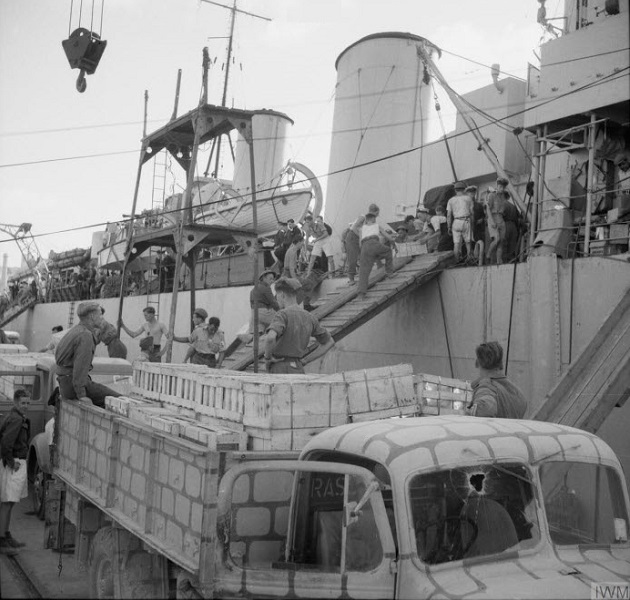
In May 1942, HMS WELSHMAN (M84), an Abdiel-class minelayer, sailed to the Mediterranean to join Force H in the Malta Convoys. On 8 May 1942, HMS WELSHMAN sailed from Gibraltar disguised as a French destroyer, with 240 tons of stores and RAF personnel aboard, during Operation Bowery. She was sighted by enemy aircraft the next day, but her deception succeeded. On entering the Grand Harbour at Malta on the morning of May 10th, she detonated two mines with her paravanes (water kite), sustaining minor damage. Laden with ammunition for the island’s AA guns, naval ratings and troops immediately got to work and despite three major air attacks on the ship, she was unloaded and had left the harbour by nightfall without receiving any further damage.
On 10 May 1942, ammunition boxes are off loaded from HMS WELSHMAN into waiting trucks which were then driven off to gun sites and stores. The nearest truck is an Austin K30 (YC) Open Cab 30-cwt (1.5 ton) 4×2 Truck.
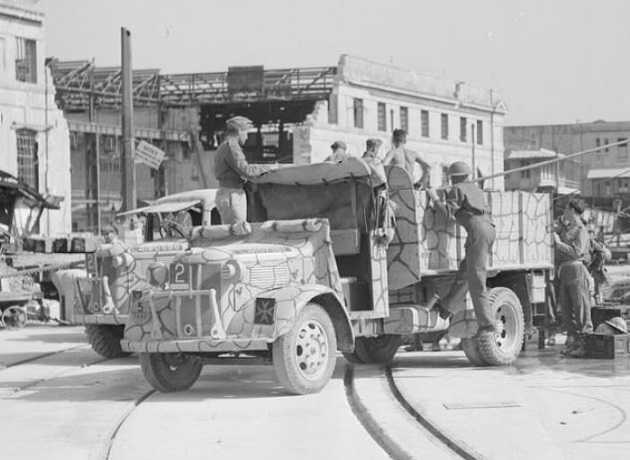
My close up of IWM A 9506.
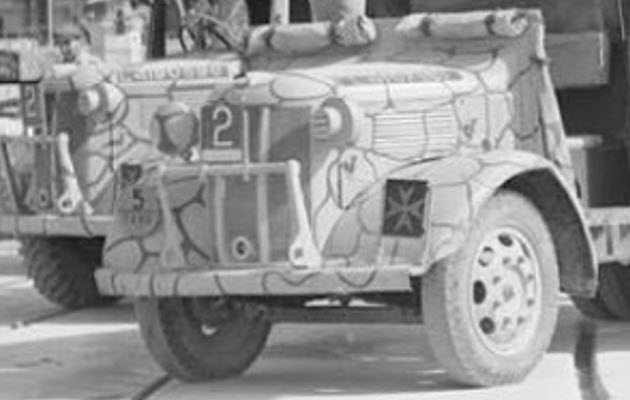
My close up of the the above trucks. On the front of the trucks is the Maltese Cross and AoS number 2 which was for HQ Services. The number 5 on the disc is the bridge classification number.
Supplies being unloaded from HMS WELSHMAN directly into waiting lorries on 16 June 1942. The truck on the far right is a Bedford. Not able to identify the make and model of the other two trucks.
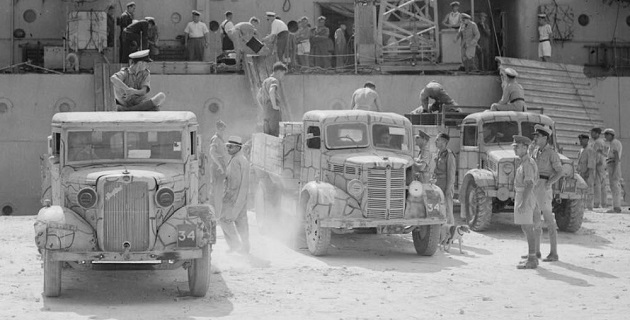
My close up of IWM A 10833.
Crates of powdered milk and foodstuffs being unloaded onto lorries from HMS WELSHMAN, 16-18 July 1942. The truck in the foreground is a Bedford OYD cargo truck. HMS WELSHMAN arrived at Malta again on July 16 during Operation Pinpoint and departed on July 18 returning to Gibraltar on July 21.
A Morris C8 Quad Field Artillery Tractor (FAT) towing a limber and an artillery gun somewhere on Malta.
A civilian with two goats standing in front of an Austin Tilly 10HP utility vehicle. The number 2 on the disc is the bridge classification number.
An open air market in Valletta carries on among the bomb wreckage. The car is painted with the distinctive Malta camouflage. It was most likely used by a British or Maltese officer.
My close up of IWM A 8553.
Unternehmen Herkules
Operation Herkules was the German code name given to the plan for the invasion of Malta.
The airborne component was Fliegerkorps XI commanded by Generaloberst Kurt Arthur Benno Student. Mastermind of the Battle of Crete. He had months to prepare, gaining knowledge of Malta’s terrain and defenses in great detail. Thanks to a meticulous aerial mapping by the Italians, he was able to devise a carefully planned systematic attack of all defenses. Ten Junkers Ju 52 assault groups were setup for the operation, about 500 of them committed to air landings along with 300 DFS 230 gliders plus 200 large Go 242 gliders and 24 Messerschmitt Me 321 Gigant gliders towed by the He 111Z Zwilling. In total, this combined force was able to carry 21200 Fallschirmjäger (paratroopers).
On the Italian side, 180 to 220 three-engined SM.75s, SM.81s and SM.82s were mobilized, able in total to carry in one assault some 6000 men on average, but the short distance from Sicily meant four round-trips per day were possible. The main assault would take place on the southern side of the island, securing the high ground behind the invasion beaches, capturing an airfield for further reinforcements. Participating were the German Fliegerdivision 7 and Italian 185th Airborne Division Folgore, plus 80th Infantry Division La Spezia airlanding division, in total roughly 29000. Three glider strips of about 25 miles (40 km) were created south of Mount Etna on Sicily in preparation.
Armored support for the invasion would been 64 Italian Semovente 47/32 and 8 heavier Semovente 75/18 self-propelled guns plus 30 L3 tankettes (comparable in size and armament to the British Bren Gun Carrier). Additional armour intended for the invasion included 2. Kompanie, Panzerabteilung z.b.V.66, a German unit commanded by Oberleutnant Hans-Günther Bethke and partly equipped with 10 captured KV-1/KV-2 heavy Russian tanks and T-34s. The captured Russian tanks received a German commander’s copula and German radio equipment. Plans to use the captured Russian tanks were at some point abandoned and all armour transported to Malta were to be Italian only.
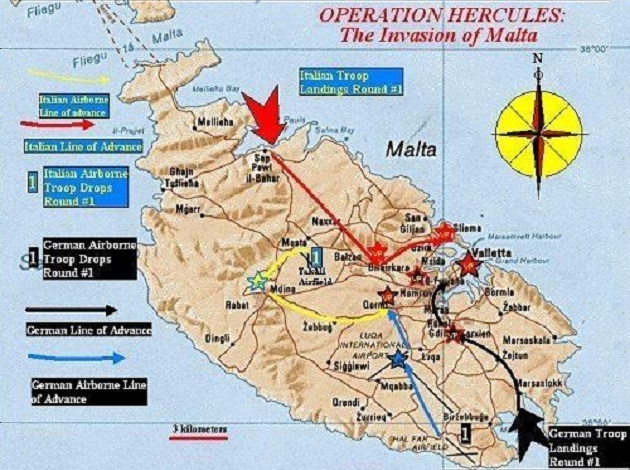
One problem with the German plan to land tanks was that their chosen beach near Marsaxlokk was at the base of a cliff with no real route to get them off the beach.
The Italians were confident they could defeat any daylight incursions by the Allied Fleet, especially given the Luftwaffe’s ability to dominate the skies during the day, but there were concerns the Italian fleet would face serious difficulties if the British attacked at night. Lacking ship-borne radar and having neglected night fighting training and equipment, the Italian fleet had been defeated at the Battle of Cape Matapan in March 1941. A similar encounter off Malta might wreak havoc on the slow moving Axis invasion convoys, leaving the Axis airborne forces cut off and not be able to take the island.
Another problem was the Axis landing forces would had to deal with all the mines they deployed around Malta.
A date in mid-July 1942 was set for the invasion, partly to allow time to transport troops and equipment from other front lines for the invasion. Field Marshal Erwin Rommel supported the Malta invasion plan and asked Hitler for command of the invasion forces. His reasons for invading Malta was to hinder the Allied forces fighting in North Africa, as well as to remove the threat to their convoys heading to Italian-German forces with supplies, oil and men, all of which they lacked. He was even willing to transfer units from the African front for the invasion. The head of the Luftwaffe, Reichsmarschall Hermann Göring, opposed the invasion, fearing it would turn into another near disaster for his Fallschirmjäger, which had happened during Unternehmen Merkur (the airborne assault on Crete) in May 1941. Generalfeldmarschall Albert Kesselring who supported the plan was eventually dissuaded when it became apparent that too many air and ground units had been diverted to support the current Axis drive into Egypt. With Hitler lacking faith in the Fallschirmjäger divisions after Crete and in the ability of the Italian Royal Navy to protect the invasion fleet, the invasion was finally cancelled in November 1942.
Video: The Most Bombed Place on Earth – Operation Herkules vs. the Undefeated WW2 Island
After the Axis forces surrendered in Tunisia on 13 May 1943, Malta’s defensive role switched to an offensive role. The RAF facilities on Malta had undergone significant expansion in anticipation of the island serving as a major base in support of the Allied offensive against Italy. This began with Operation Husky, the invasion of Sicily.
Then and Now
Luqa airfield has transformed into today’s Malta International Airport. The Air Wing of the Armed Forces of Malta is based at the Malta International Airport and its terminal has six hangars. The Air Wing operates four fixed-wing aircraft for maritime patrols, six helicopters for SAR/utility/patrol duties and one UAV for surveillance. Since its creation, the Air Wing has never operated jet-powered or combat aircraft.
On the evening of Tuesday, 7 April 1942, the Royal Opera House in Valletta was devastated by Luftwaffe bombers. The next morning, people hardened by aerial bombing, are inspecting the damage done. The portico and the auditorium were a heap of stones, the roof had a gaping hole with twisted girders. The rear end starting half way from the colonnade was intact.
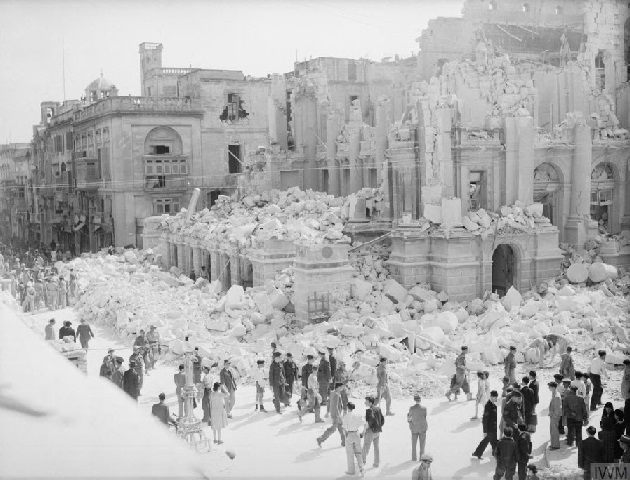
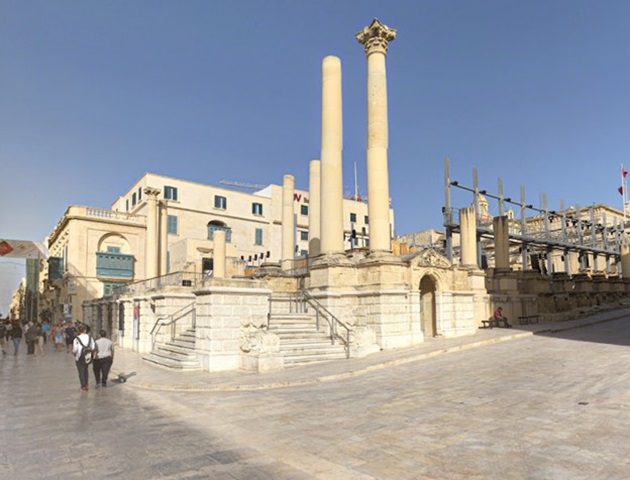
In the late 1950s, the remaining structures were razed as a safety precaution. All that remains of the Royal Opera House are the terrace and parts of the columns. On 8 August 2013, an open-air theater was inaugurated on the site named “Pjazza Teatru Rjal” which translates to “Royal Theater Square.”
Compare this today’s view to the above photo. Note the arched doorway below the two columns and the second floor arched balcony on the building in the background on the left.
Model Kits and Decals
1/35
Echelon Fine Details ALT352011 Matildas in North Africa, Malta & Crete Decalset
1/48
Special Hobby SH48077 Martin Mk.I / Mk.II Maryland ‘Warburtons War’ – 2023
AeroMaster 48-597 Defenders of Malta Part I Decalset – 2002
AeroMaster 48-598 Defenders of Malta Part II Decalset – 2002
Stormo! 48-007 Battle of Malta Macchi C.202 Italian Aces Decalset
1/72
Italeri 7035 Matilda Mk.II – 2006
ACE 72500 British Light Utility Car Tilly 10HP – 2013
Plastic Planet Club PPC-001 Martin 167F / Maryland Mk.I – 2014
Xtradecal X72161 Battle for Malta Blenheim; Beaufighter; Sea Gladiator; Hurricane; Spitfire; Beaufort Decalset

 Mike's Research