The Martin B-57 Canberra was a US-built, twin-engine tactical jet bomber and reconnaissance aircraft that entered service with the USAF in 1953. It was a license-built US version of the British English Electric Canberra manufactured by the Glenn L. Martin Company. The USAF deployed the B-57 Canberra to Vietnam and it holds the distinction of being the first US jet bomber to drop bombs in combat. The Australian Canberra B.20 bomber was a Australian license built version of English Electric Canberra manufactured in Australia and it was deployed to Vietnam.
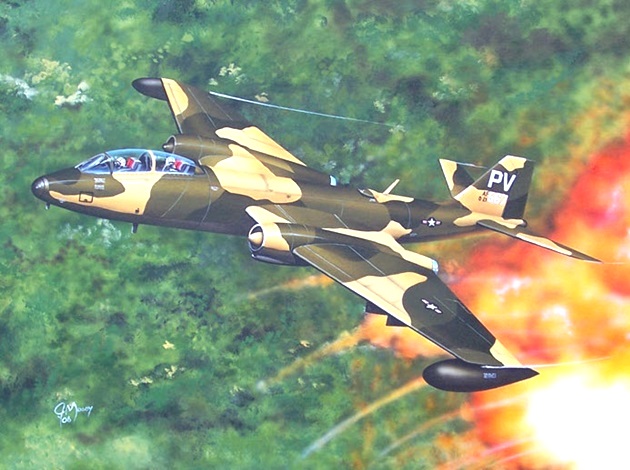
During the Korean War (1950-53), the US Air Force’s primary interdiction aircraft was the WWII Douglas A-26 Invader, but these twin piston engine aircraft took heavy losses operating as they did at low level. US Air Force planners subsequently issued an urgent request for an advanced all-weather jet-powered medium bomber. As time was of the essence, only existing designs already flying were considered.
The US contenders were the Martin XB-51, the North American B-45 Tornado and AJ Savage. To expedite the process, foreign aircraft were also considered. The foreign contenders were the Canadian Avro CF-100 and the British English Electric Canberra B.2.
On 21 February 1951, A RAF English Electric Canberra B.2 bomber, WD932, under the command of Squadron Leader Arthur Edward Callard, took off from RAF Aldergrove, Belfast, Northern Ireland, and flew across the North Atlantic to Gander, Newfoundland, Canada. Also aboard were Flight Lieutenant Edward Arthur Joseph Haskett, navigator, and Flight Lieutenant A.G.R. Robson, radio operator. WD932 was the fourth production Canberra B.2, with manufacturer’s serial number 71012. The 2050 miles (3299 km) flight was the first non-stop non-refueled transatlantic flight by a jet aircraft which took 4 hours and 37 minutes. The RAF had not requested observers from Royal Aero Club of the UK, so no official world record was set by this flight. This Canberra participated in the US competition.
As part of the USAF’s evaluation process, all five aircraft were submitted to a series of fly-offs to determine their performance. On 26 February 1951, the fly-offs took place at Andrews Field, Prince George’s County, Maryland. Each aircraft was tasked with performing a set sequence of maneuvers within a ten-minute window which demonstrated its agility and performance against its competitors. The Canberra proved to be superior to all the competing aircraft.
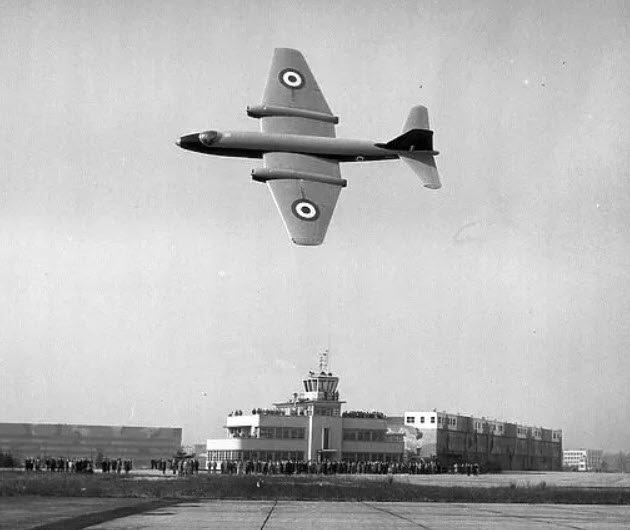
Canberra B.2 WD932, flown by RAF Wing Commander Roland Prosper “Bee” Beamont, during a demonstration flight at Martin Airport, Middle River, Maryland (northeast of Baltimore), home of the Glenn L. Martin Company, on 11 March 1951.
On 2 December 1951, WD932 disintegrated in flight during 4.8g maneuver at 10,000 feet (3048 meters), near Middle River, Maryland. Major Harry M. Lester and Captain Reid Johns Shaw ejected, although Shaw was killed when his parachute failed to open. The accident was believed to have resulted from a problem with fuel management which caused the airplane’s center of gravity to shift aft. The accident did not dissuaded selecting the Canberra but only added more changes to the long list of USAF modifications.
There were doubts about production availability with English Electric being able to mesh with USAF requirements, as well as questions over spare parts. With production lines at full capacity meeting RAF and other export customers orders, English Electric entered into discussions with the Glenn L. Martin Company and proposed that Martin would receive a license to build the Canberra in the US.
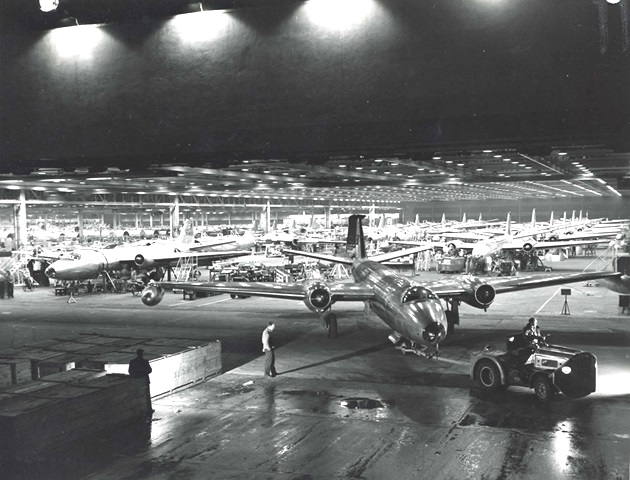
B-57As rolling off the Martin production line at Middle River in 1952. A row of B-57As is on the left and a row of RB-57As is on the right. The RB-57A was a Photo Reconnaissance production version with cameras installed in the bomb bay and only 67 were built.
Several minor differences were present between the early US-built and UK-built Canberras. The differences included the canopy and fuselage windows being slightly revised, the crew being reduced from three to two, engine nacelles were modified with additional cooling scoops, and the conventional “clam shell” bomb bay doors were replaced with a low-drag rotating door originally designed for the XB-51. When closed, it was an upside-down bomb rack. They proved to be faster to open/close and reduced buffeting, which in turn improved accuracy and allowed for faster attack speeds. The redesigned bomb bay also enabled faster turnaround times on the ground.
Another difference was the adoption of more powerful Armstrong Siddeley Sapphire engines capable of producing 7,200 lbf (32 kN) of thrust, which were license-built in the US as the Wright J-65. The Sapphire-based J-65 power plant had been selected in place of the British-built Canberra’s Rolls-Royce Avons as the USAF had placed an emphasis on operations within hot climates and intended to fly at a slightly higher maximum gross weight than the RAF’s operating practices. The B-57 did not have self-sealing fuel tanks. Instead, it carried nitrogen that would be gently blown into the empty tanks, greatly reducing the risk of fire should it have taken hits from ground fire.
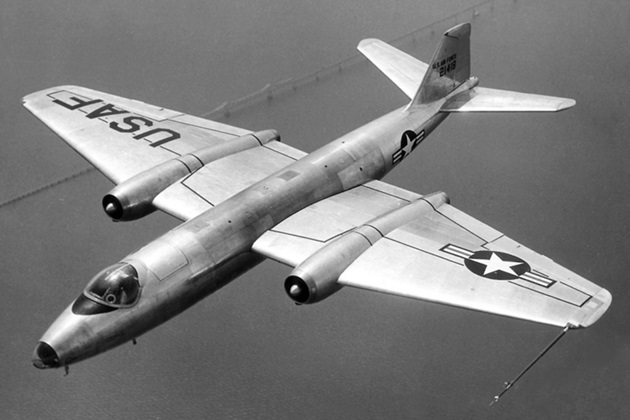
The first B-57A Canberra built in the US was serial number 52-1418. Here, it is flying near the Chesapeake Bay Bridge (opened in 1952) in Maryland. The USAF did not considered the B-57A ready for combat so only 8 were built (52-1418 to 52-1425).
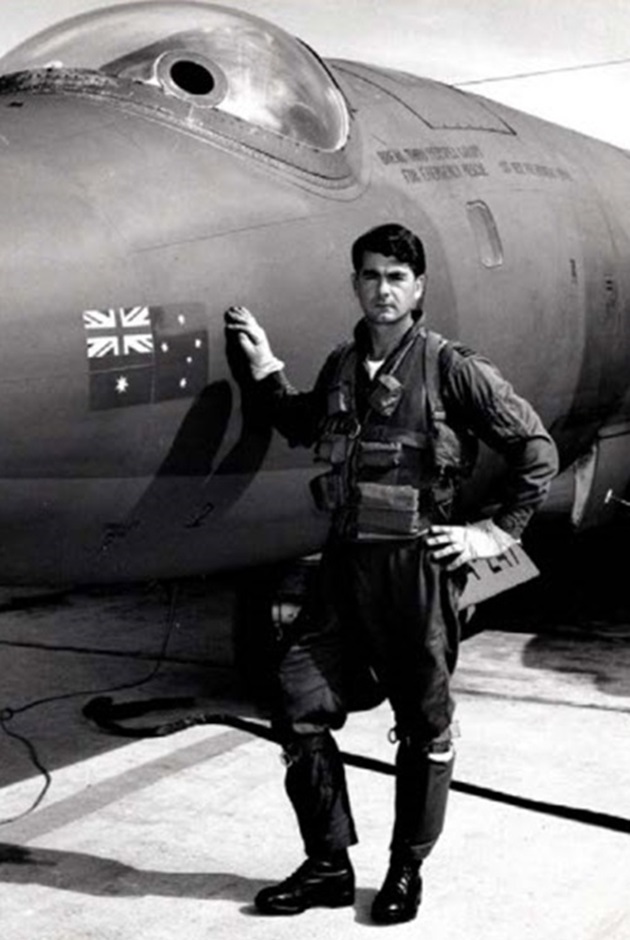
A USAF pilot standing next to a B-57A Canberra. The entrance hatch under the cockpit was omitted on later US variants.
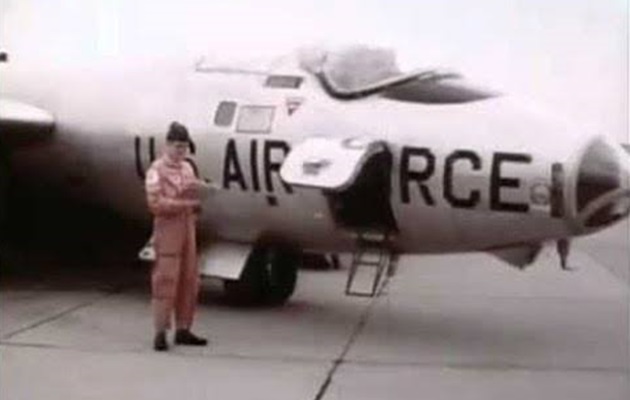
Film: Captain Larry B. Mason – Air Force Cross winner in B-57 Canberra
This film honors Captain Mason while flying a B-57B in Vietnam but the footage is a B-57A in the 1950s. More about Captain Mason below.
B-57B/C Variants
The B-57B was the more refined bomber variant which incorporated the structural and system changes that had been recommended by the Wright Air Development Center (WADC). The most significant change was the adoption of a fighter-style canopy which provided greater transparency and an improved view for both the pilot and navigator, as well as allowing it to be equipped with a gun sight. The glass nose bombardier position was omitted.
The B-57C was a dual-control, combat-capable production version of the B-57B. The first flight was on 30 December 1954 and only 36 were built.
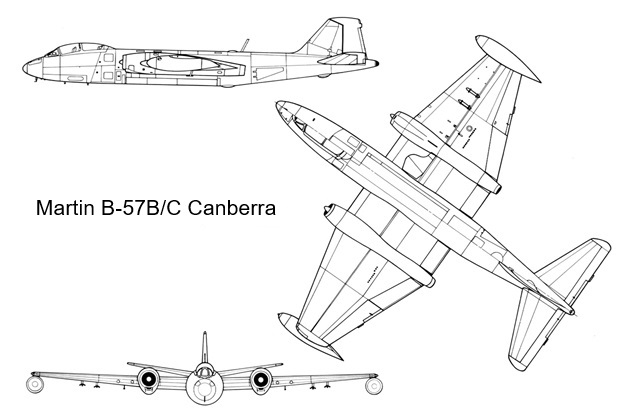
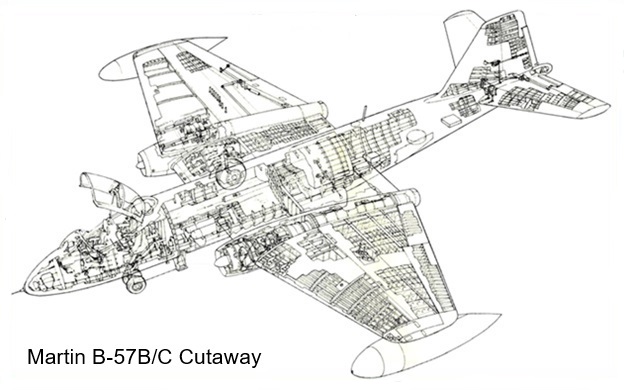
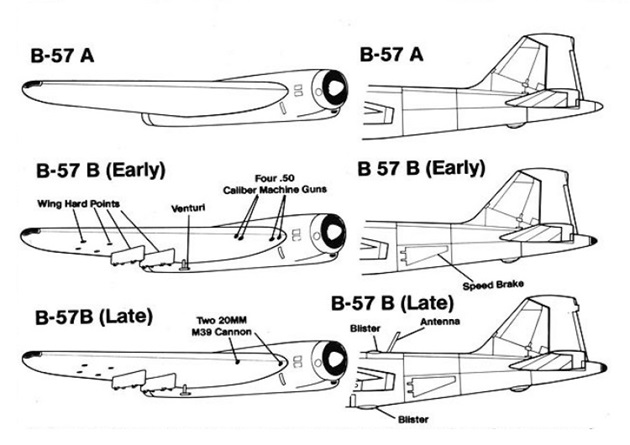
In terms of armaments, four hard points on the outer wing panels were capable of mounting external bombs or rockets. There is no photo evidence of B-57Bs armed with rockets in Vietnam. The B-57B was also furnished with a gun armament for strafing attacks. The first 90 aircraft of this variant built were equipped with eight 0.50 Caliber (12.7 mm) Browning machine guns installed within the wings. On later aircraft, these were replaced by four 20mm M39 cannons.
In addition, hydraulically-operated triangular air brakes were installed on the rear fuselage, which worked in addition to the existing ‘finger’ type air brakes installed in the wings. The new air brakes gave the pilots a greater level of control-ability, improving the accuracy of low-level bombing runs.
The bomb bay could hold combinations of 250 lbs. (113.2 kg) and 500 lbs. (226.8 kg) bombs. The four external pylons under the wings could be fitted with anything up to the large cluster bombs. The Canberra carried four hours of internal fuel and an impressive bomb load which made it very effective at attacking targets on the Ho Chi Minh trail.
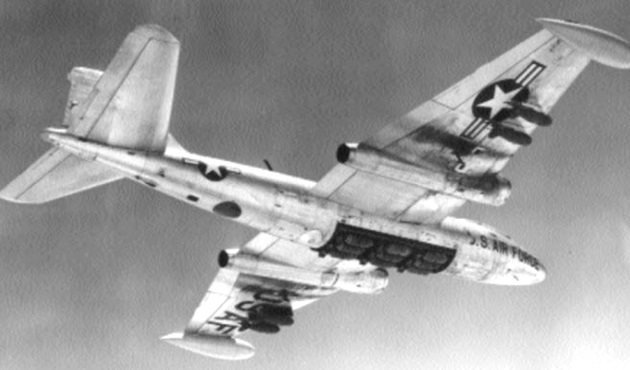
Film: Martin B-57 Canberra Documentary (Part 4)
During the production run from 1953 to 1957, a total of 403 B-57s of all variants were built. During the 1950’s, most of B-57s were issued to Air National Guard units in the US and to US tactical air units stationed in Europe.
A Kansas Air Guard B-57B Canberra starting an engine in the 1950s. The dark smoke is normal. The English Electric Canberras and the US B-57 Canberras used Coffman cartridges to start the engines. Since the ground crewman is dragging the fire extinguisher away from the plane, the port (left) side engine is probably running and the starboard (right) side engine had just started.
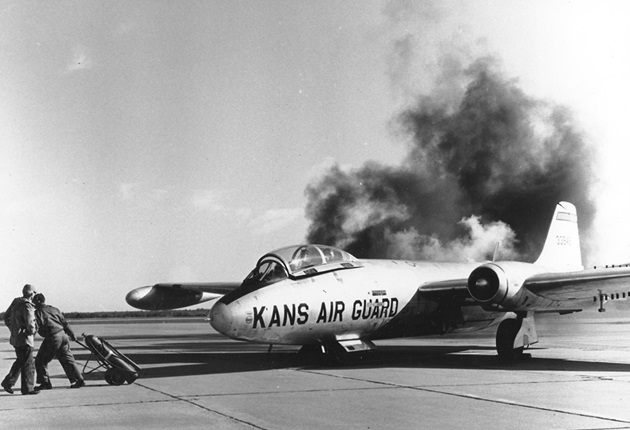
The Coffman engine starter (also known as a “shotgun starter”) was a starting system used on many radial piston engines in aircraft and armored vehicles of the 1930s and 1940s. It used a cordite cartridge to move a piston, which cranked the engine. For early jet engines, a high gas volume cartridge was used which turned the jet turbine. An auxiliary power unit was not required but still be used to start the engines.
Video: B-57 Canberra
Vietnam
By the end of 1957, the USAF tactical squadrons were being re-equipped with the supersonic North American F-100 Super Sabre. The complete retirement of the B-57 was delayed due to the start of the Vietnam War. Only two B-57B Canberra bomb squadrons, the 8th “Liberty” and the 13th “Grim Reaper”, of the USAF 3rd Bomb Wing were still active when war in Vietnam revived the need for light bombers. In April 1964, 47 B-57Bs were flown from England Air Force Base, Louisiana, to Clark Air Base in the Philippines.
The first US B-57 Canberras deployed to Vietnam were actually two RB-57Es of the “Patricia Lynn” reconnaissance missions which began in May 1963.
Patricia Lynn Project
PATRICIA LYNN was a highly-classified reconnaissance program using specially-modified RB-57Es. The sophisticated equipment in these aircraft revealed enemy positions and transportation even on the darkest nights. They also carried optical cameras for day missions. The project was given the code name “Patricia Lynn”, after the wife of the chief engineer who led the conversion.
The forward nose section of the B-57Es (Dual-control trainer and target tug version) were modified to house a KA-1 36-inch forward oblique camera and a low panoramic KA-56 camera used on the Lockheed U-2. Mounted inside the specially configured bomb bay door was a KA-1 vertical camera, a K-477 split vertical day-night camera, an infrared scanner, and a KA-1 left oblique camera. The unarmed modified aircraft were re-designated the RB-57E.
The first mission was flown on 7 May 1963 by the highly classified Patricia Lynn squadron (Detachment 1, 33rd Tactical Group, later 6250th Combat Support Group, later 460th Tactical Reconnaissance Wing) operating from Tan Son Nhut Air Base. The Detachment flew unarmed night reconnaissance missions to identify Viet Cong (VC) base camps, small arms factories and storage and training areas.
The sorties yielded results that were only had been wished for. The night time imagery showed VC training and base camps; small, hidden factories and storage dumps that RF-101 Voodoo crews had flown over during the day and had been unable to locate from the air. The existing RF-101s in 1963 could only photograph a few kilometers (they had to fly very low) per flight with their cameras. The RB-57Es could scan the whole border with Cambodia in 2-1/2 flights at 16000 to 17000 feet (4900 to 5200 meters) with far superior results.
Although there were only six PATRICIA LYNN RB-57Es and two of them were shot down, their effectiveness far outweighed their numbers. Flying under the radio call sign Moonglow, RB-57Es remained in heavy use until the PATRICIA LYNN program ended in 1971. The six RB-57Es were 55–4237, 55-4243, 55–4245, 55–4249, 55–4257, and 55–4264.
RB-57E 55-4243 landed at Tan Son Nhut Air Base (near Saigon) on 6 May 1963.
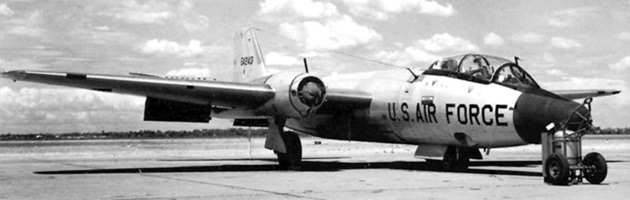
RB-57E 55–4257 of Detachment 1, 460th Tactical Reconnaissance Wing (TRW) at Tan Son Nhut Air Base in May 1971.
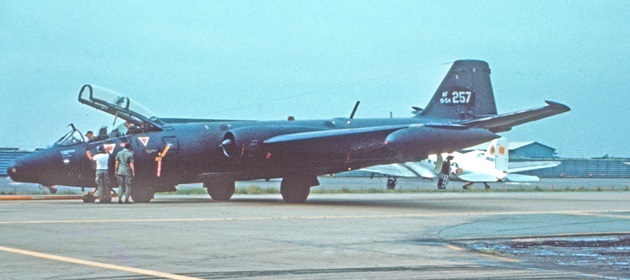
RB-57E 55-4243 was lost in combat with Detachment 1, 6250th Combat Support Group, when it was hit by ground fire on 5 August 1965 and it caught fire while returning to base.
RB-57E 55–4264 was lost in combat with Detachment 1, 460th Tactical Reconnaissance Wing, on 25 October 1968 after being hit by ground fire 3 miles (4.8 km) southwest of Truc Giang, South Vietnam. Both crewmen ejected safely and were rescued.
On 2 August 1964, US destroyer USS Maddox reported an attack by North Vietnamese patrol boats in the Gulf of Tonkin. Two days later, US destroyer USS Turner Joy also reported an attack.
At the request of the South Vietnamese government on 5 August 1964, 20 B-57Bs were flown from Clark Air Base to Bien Hoa Air base near Saigon. This was the first deployment of US jet combat aircraft to Vietnam. At this time, no US ground combat forces were deployed to South Vietnam.
Unarmed 8th Bomb Squadron B-57Bs leaving Clark Air base on the way to South Vietnam in August 1964.
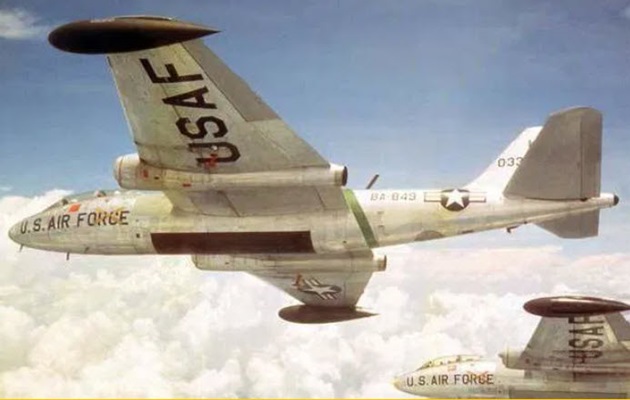
However, this was technically a violation of the Geneva Protocols which forbade the introduction of jet combat aircraft to Vietnam. To abide by the Geneva protocols, the 8th and 13th bomb squadrons rotated frequently over the next four years from Clark AB to Bien Hoa AB (later to Tan Son Nhut AB). In November 1964, both squadrons were transferred from 13th Air Force control to the 405th Fighter Wing (FW) at Clark AB.
B-57Bs stand ready on the east ramp of Bien Hoa Air base in August 1964. In the background near the runway on the left is the control tower.
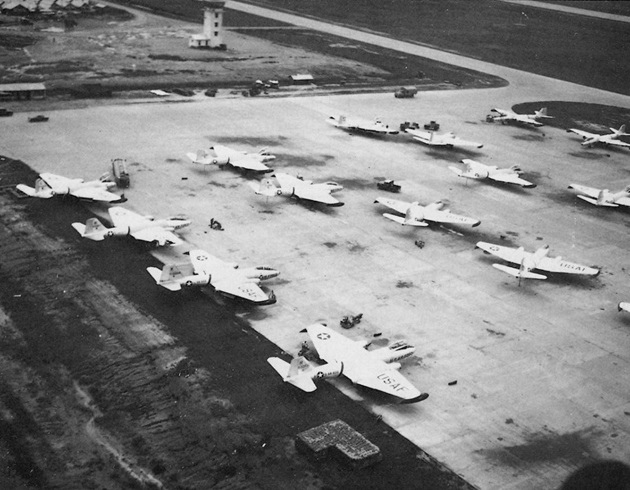
The B-57B aircraft flew daily practice missions and remained on alert. A few road reconnaissance flights were also made.
Film: B-57’S IN SOUTH EAST ASIA – NO SOUND
Mortar Attack
On 1 November 1964 at 0200 hours, a VC mortar team penetrated the Bien Hoa Air base perimeter. A 30 minute mortar barrage destroyed 5 B-57B bombers, 3 Douglas A-1H Skyraider attack aircraft, a Kaman HH-43 Huskie helicopter and two Douglas C-47 transport aircraft. The VC fired their mortars from the bomb dump within the air base compound and killed four US and two South Vietnamese personnel. The attack also damaged 10 of the 20 bombers present, and caused 76 US and South Vietnamese wounded.
A view of surviving B-57Bs on the east ramp of the Bien Hoa Air base on 1 November 1964.
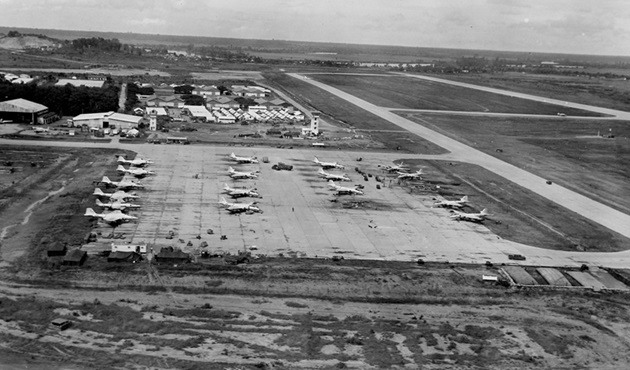
An aerial view of the east ramp from the door of a UH-1 Huey helicopter.
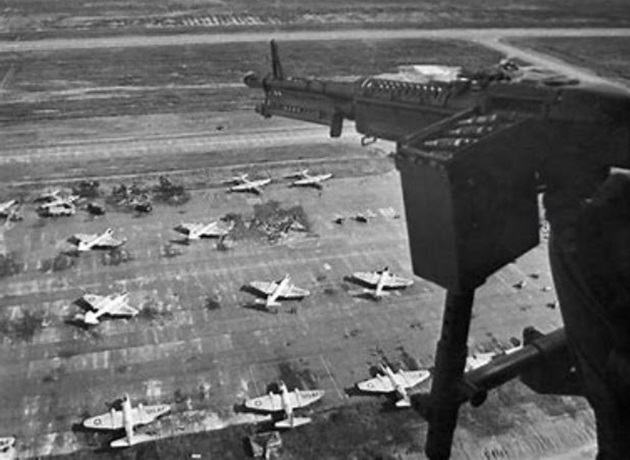
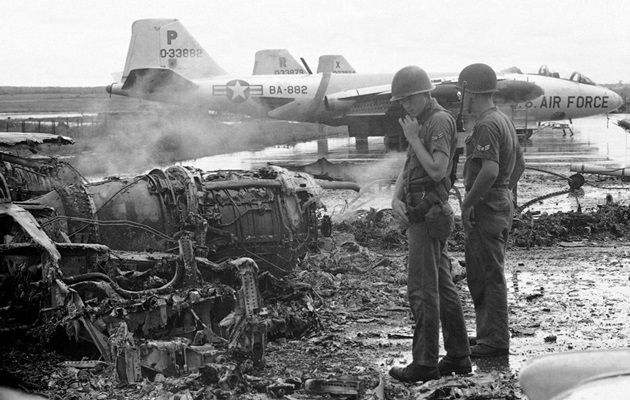
Two USAF airmen look at the remains of a B-57B engine. In the background is B-57B 53-3882 (13th BS, letter P) which was lucky that day but eight months later on 8 June 1965, B-57B 53-3882 was shot down by ground fire west of Can Tho City, South Vietnam. Both crewmen ejected and were rescued.
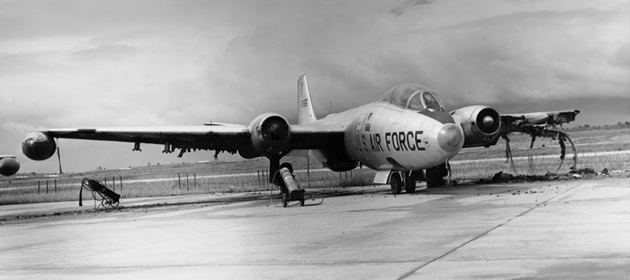
A B-57B on the east ramp with its port wing damaged during the mortar attack.
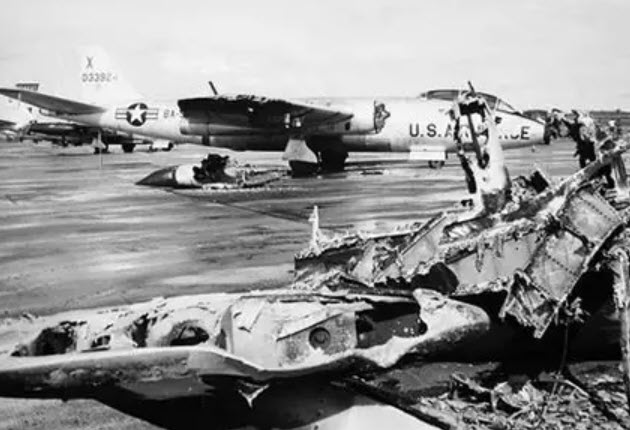
The wing wreckage of a destroyed B-57B on the east ramp. In the background is B-57B 53-3924 (13th BS, letter X). Its wing tip tank was hit, dropped off and exploded. B-57B 53-3924 was written off.
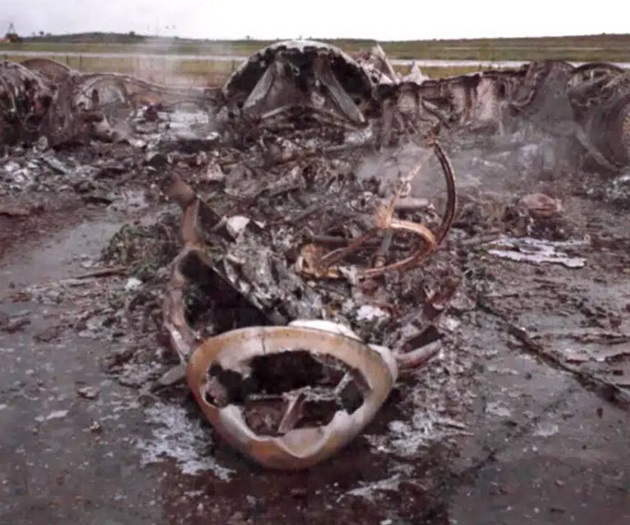
Front view of a completely destroyed B-57B on the east ramp. Since the mortar attack was early in the morning, the crew would not been in the cockpit.
On 6 November 1964, the Army of the Republic of Vietnam (ARVN) launched a 32 aircraft (A-1H Skyraiders) retaliatory attack against targets around Bien Hoa. Led by Air Vice Marshal Nguyễn Cao Kỳ, the ARVN claimed to have killed 500 VC troops.
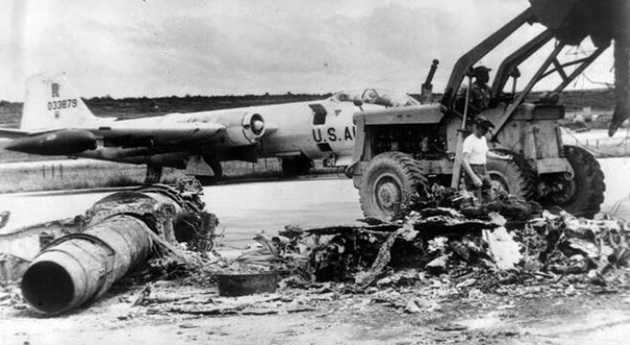
On 7 November 1964, USAF ground crews using a tractor remove the wreckage from the east ramp. The tractor is probably dumping the wreckage into a truck to be hauled away. Parked in the background is B-57B 53-3879 (letter R).
Film: Devastating Viet Cong Attack on Bien Hoa Air Base (1964)
Film: 01/11/1964 South Vietnam: Bien Hoa Air base – Vietcong damage at Bien Hoa Air base.
Film: USAF B-57C’s in flight at Bien Hoa Air Base.
First Combat Mission
After long consideration, US President Lyndon Baines Johnson decided to commit the USAF for direct intervention. Further VC mortar attacks led General William Childs Westmoreland (commander of US forces in Vietnam) to release the 24 B-57Bs for combat operations on 19 February 1965.
The first mission took place on that same day, an air strike against suspected VC guerrillas near Bien Gia, about 30 miles (48.3 km) east of Saigon. This air strike was the first time that live ordnance had been dropped on an enemy from a USAF jet bomber.
Film: USAF Martin B-57B bomber aircraft parked on ramp at Bien Hoa AB
Film: Crewman directs a taxiing B-57B bomber carrying bombs at Bien Hoa
Film: USAF B-57B bombers taxiing at Bien Hoa
Film: USAF B-57B bombers in flight carrying 750-lb bombs on pylons
On 2 March 1965, the Rolling Thunder bombing campaign against North Vietnam began with an attack which included 20 B-57Bs.
In April 1965, the Canberras began flying night intruder missions supported by USAF’s Fairchild C-123 Provider or Lockheed C-130 Hercules flare ships and USN’s EF-10B Skyknight electronic warfare aircraft.
The B-57Bs were primarily used for dive bombing and strafing. With their bomb loads and four hours of flight time made them excellent ground support aircraft, as well as exceptional truck killers along the Ho Chi Minh trail.
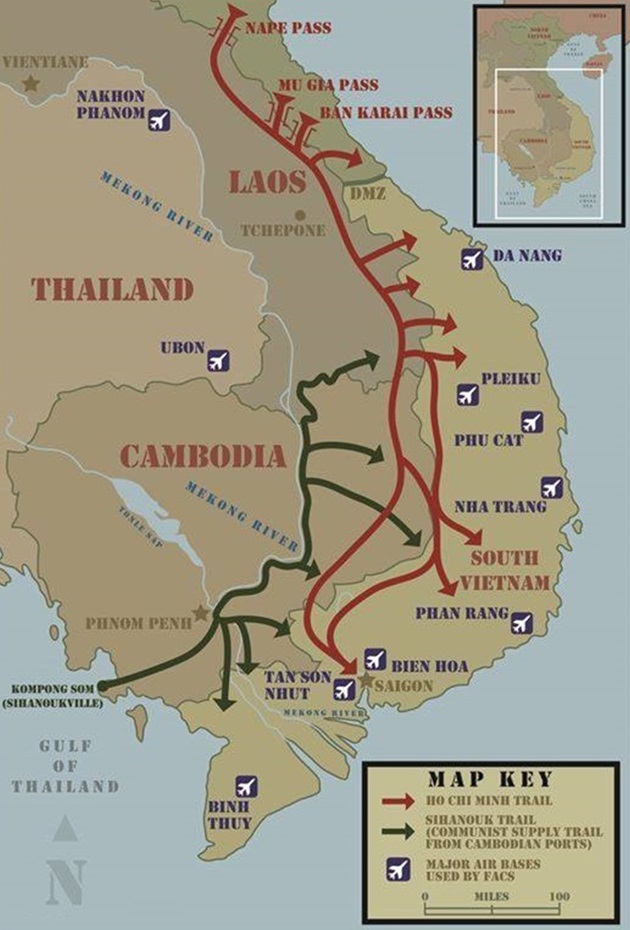
Deployed along the “trail” for much of their eight years in Vietnam, the Canberras participated in truck hunting campaigns during operations Barrel Roll, Steel Tiger, and Tiger Hound. Canberra crews gain reputations with their “Centurion Club” which consisted of crews who scored 100 truck kills.
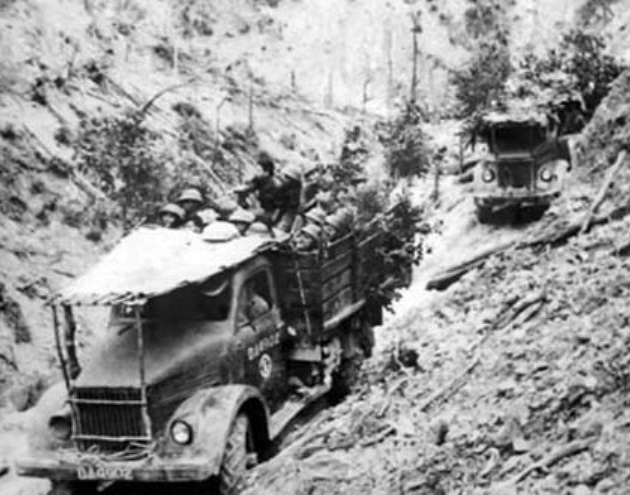
Camouflaged NVA GAZ-51 trucks on the Ho Chi Minh trail. The white panel erected over the cab and engine of the closest truck make the cab appear part of the road from above and it also prevented sunlight reflecting off the cab’s windscreen.
Bein Hoa Explosion
Heavy AAA fire was dangerous enough, but the worse experience occurred on 16 May 1965 at Bien Hoa Air Base. Operating at the base was the 8th TBS and 13th TBS of the 405th FW attached to the 34th Tactical Group (TG). At that time, all the aircraft at the base were completely engaged in flying daily combat missions.
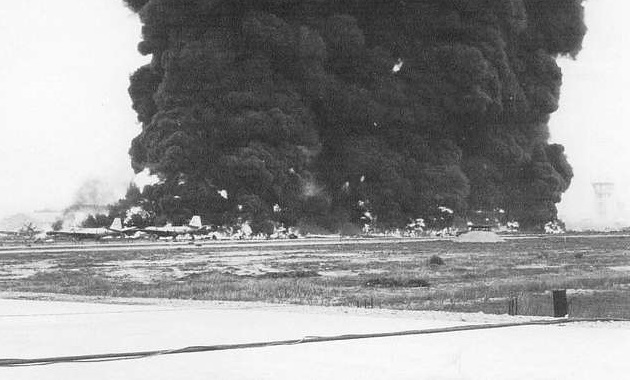
At 0815 hours on Sunday morning, 16 May 1965, Captain Charles Nathan Fox and his navigator, Captain Vernon Lee Haynes, were sitting in their B-57B at Bien Hoa about to start engines to lead a flight of four aircraft on an air strike. Fox’s Canberra was loaded with four 750 lbs. (340.2 kg) bombs under the wings and nine 500 lbs. bombs in the bomb bay. Without warning Fox’s aircraft exploded and debris hit other aircraft on the flight line causing further explosions in what seemed to be a chain reaction. When the smoke cleared the scene was one of utter devastation with dead, dying and wounded airmen and wrecked aircraft everywhere.
A complete J-65 engine was hurled half a mile (0.80 km) and smaller fragments were found at twice that distance from the flight line. Besides 10 B-57Bs that were destroyed, a US Navy F-8E, a USAF A-1E (52-133901) and two VNAF A-1Hs were also completely wrecked. A total of 30 VNAF A-1Hs received some degree of damage as did a USAF HH-43 rescue helicopter.
The destroyed USN Vought F-8E Crusader was BuNo 150931 with tail code AH. The Modex number on the nose was either 22? or 23? (third digit unknown). The pilot, USAF Major Robert Graham Bell, was on temporary duty (TDY) with USN VF-162 squadron “The Hunters”. In the early morning hours on that day, Major Bell took off from the USS Oriskany (CVA-34) on an air support mission in the vicinity of Saigon. His Crusader was a hit by enemy ground fire which damaged a bomb release mechanism and caused a fuel leak. He aborted his mission, but he was not allowed to land on his carrier with a hung bomb. Low on fuel, he opted instead to divert to Bien Hoa, where maintenance technicians could fix or remove the hung bomb. After landing, he climbed out of his cockpit and was making his way to the base operations center when it seems he returned back to his plane to get something he left in it. While walking back to his Crusader, he was killed by a sudden blast from exploding aircraft and bombs. If he did not go back to his plane, he might had survived. He was in the wrong place at the wrong time.
This was the worst single incident suffered by the USAF on the ground during the entire war and it was only eclipsed by the fires onboard the aircraft carriers USS Oriskany and Forrestal. Twice as many aircraft were lost in this accidental explosion at Bien Hoa than had been destroyed by VC attacks on aircraft on the ground in the war up to that date. The cause of the explosion was thought to have been a malfunction on a time-delay fuse on one of the bombs carried by Captain Fox’s aircraft. Some sources state that while starting a B-57B engine a Coffman starter blew up and its flying debris hit a nearby bomb. Some expected it was VC sabotage.
Lessons were learned from this accident and actions were taken to prevent it from happening again. On all Air Bases, separate spaced apart revetments were constructed for each combat aircraft, not just to protect the aircraft from an enemy attack but also to contain ordnance explosions from damaging/destroying nearby aircraft.
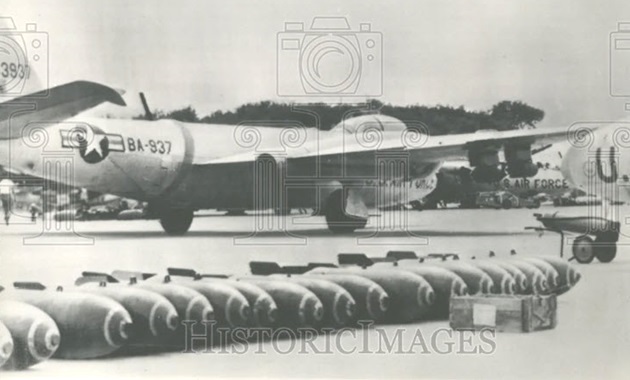
B-57B 53-3937 on the east ramp at Bien Hoa Air Base sometime before the accidental explosion. Note the line of bombs on the tarmac close to the armed bomber. B-57B 53-3937 was later destroyed in the explosion.
The immense explosions engulfing the B-57Bs on the east ramp at Bien hoa.
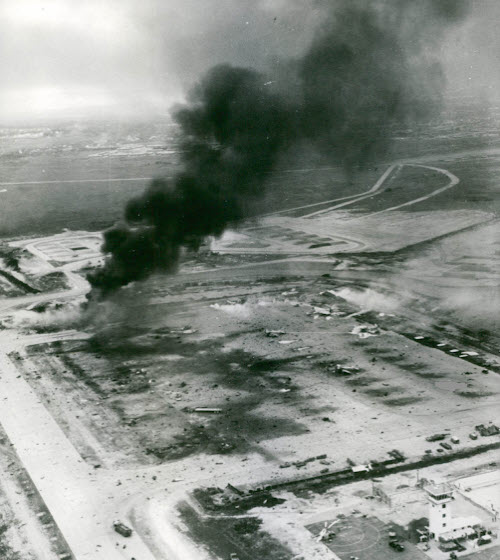
An aerial view of the exploding and burning B-57Bs.
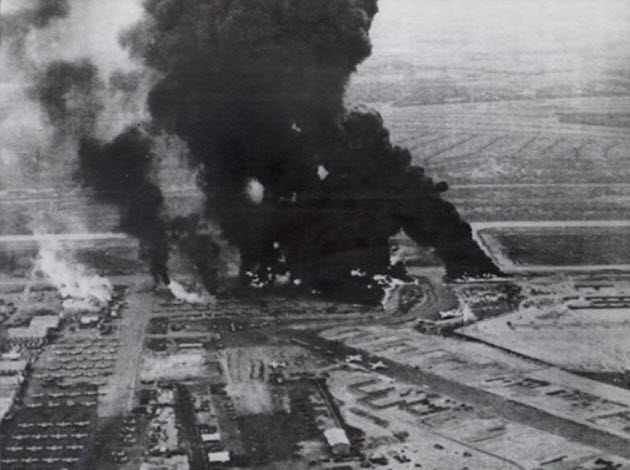
An aerial view after the exploding and burning B-57Bs. In the background, a JP-4 (a 50-50 kerosene-gasoline blend) jet fuel storage area is still burning. In the lower right corner of the photo is the control tower which was also damaged by flying debris.
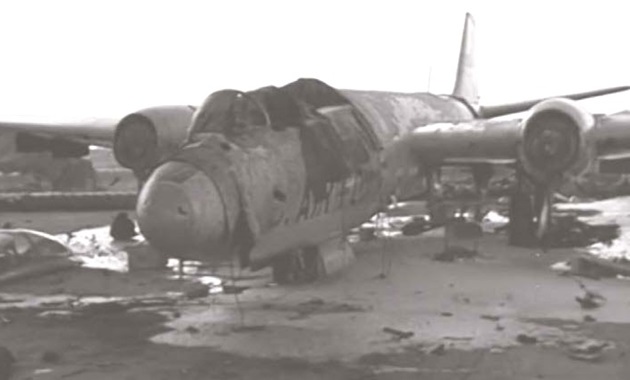
The remains of one of the destroyed B-57Bs.
Film: Bien Hoa Air Base Vietnam May 16 1965 Conflagration / Fire
Film: Explosions At Bien Hoa Us Air Base (1965)
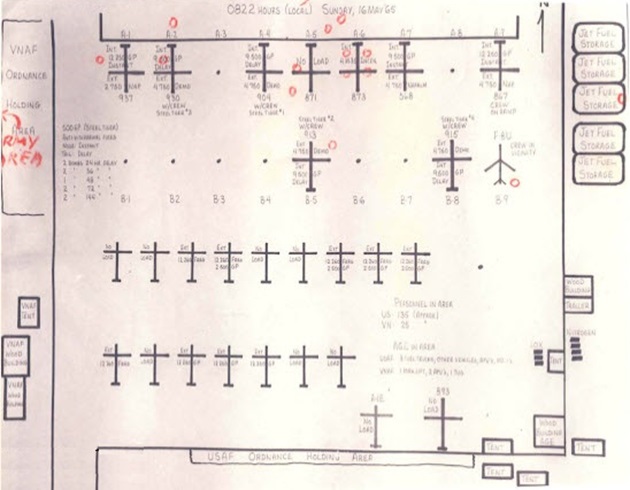
This diagram of the east ramp at Bien Hoa was created by the USAF Accident Review Board showing where all the aircraft were with their flight numbers and their weapons load listed. The red circles are the locations where bodies of those killed were found. The one plane symbol with swept wings is Major Bell’s F-8E Crusader and along the upper right edge of the diagram are the Jet fuel storage areas.
The surviving remnants of the 8th and 13th TBSs were moved to Tan Son Nhut Air Base and continued operations as best they could but it was some time before the squadrons could function normally again. To replace the losses, B-57Bs were transferred from Air National Guard units in the US and a number of B-57Es (trainers and target tugs) and RB-57Bs were re-converted to B-57B bomber configuration.
Da Nang
By June of 1965, the USAF 3rd Bomb Wing had moved to Đa Nang Air Base to carry out night interdiction operations over North Vietnam and Laos. Principal targets were trucks, storage and bivouac areas, bridges, buildings and AAA sites. When deployed at Đa Nang, the 8th and 13th Bomb Squadrons came under operational control of the 6252nd Tactical Fighter Wing (TFW) which became the 35th TFW about a year later.
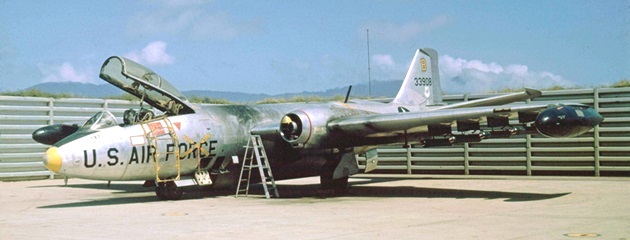
B-57B 53-3908 of the 8th BS, 405th FW, in its revetment at Da Nang Air Base, 1965/66.
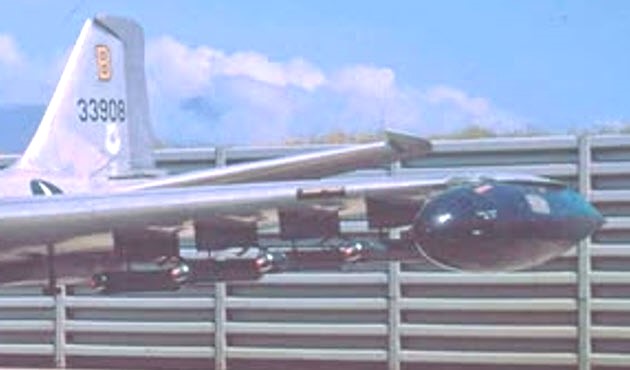
This is my close up of the port wing of B-57B 53-3908. Mounted on the four pylons appear to be SUU-30 cluster-bomb dispensers. The SUU-30 dispenser unit contained 665 tennis ball-sized fragmentation sub-munitions, also known as bomblets. Once dropped, the SUU-30 breaks open in-flight and releases the individual bomblets, scattering them over a large area.
The 1/48 Zotz Decals sheet (see below) has an option for B-57B 53-3908 of the 8th BS/6252nd TFW at Da Nang in January 1966 with name “Miss Mi-Nuki”, nose art, and mission markings. The nose art appear to be a woman’s head with red hair in a heart.
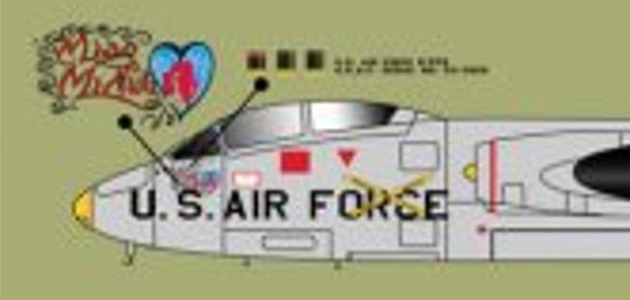
Prior to being sent to South Vietnam, B-57B 53-3908 was with the 8th BS on nuclear alert at Kunsan Air Base in South Korea starting in August 1958 and one source state it was named “Miss Mi-Nuki” and the nose art was added while in Korea. The photo of B-57B 53-3908 above does not have these markings, so either they had been removed sometime before the above photo was taken or added after the above photo was taken. Not able to find any other period photo of B-57B 53-3908 with those markings on the nose.
On 9 June 1967, B-57B 53-3908 was shot down by ground fire near Hao Chu Hi Mountain, South Vietnam. Pilot Captain Elwin Harry Busch and navigator First Lieutenant Peter Whitcomb Morrison were KIA.
B-57B 53-3906 of the 8th BS at Da Nang Air Base. The pilot was Captain Larry B. Mason and Captain Jere Paul Joyner, the navigator.
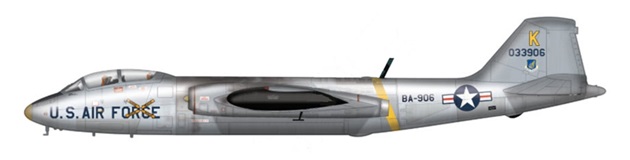
On 15 March 1966, while on a strafing run over Laos, Mason’s B-57B 53-3906 was hit repeatedly by enemy 37mm and 57mm shells which set fire to the starboard engine and created an extreme vibration in the port engine. One shell exploded in the rear cockpit, wounding navigator Joyner and severing a section of wiring which deprived the crew of most electrical power.
Wind, blasting through a large hole in the fuselage, scattered dirt and debris around the cockpit temporarily blinding Mason. As he regained his sight, he realized that a safe ejection could not be done because of Joyner’s wounded condition. With one engine shut down and the other on fire, and with approximately 30 squared feet (2.78 squared meters) of surface missing from the starboard wing, Mason attempted to return to base. Flight conditions were hampered by inoperative radios, no hydraulic pressure or oxygen, severe air frame vibration, and no indication of gear position or fuel level.
Mason piloted his crippled aircraft and made a safe landing at the air base. After the aircraft rolled to a stop, emergency ground crews foamed it down. Mason signaled the emergency crew to blow the 800 lbs. (362.9 kg) canopy. He feared Joyner would have bleed to death before the canopy be opened manually.
Captain Mason made the first and only single engine go-around and landing in a B-57.
The nose of B-57B 53-3906 had been secured by a jack to ensure that the nose gear could not collapse due to the flak damage. The large hole on the side of the fuselage below the cockpit was made by a 57mm shell.
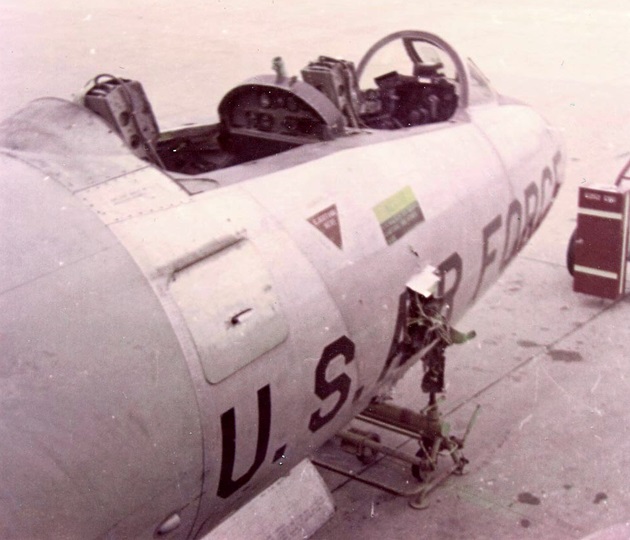
USAF Captain William “Pappy” Boyington (the 8th BS CO’s navigator) examines the holes below the rear cockpit of B-57B 53-3906.
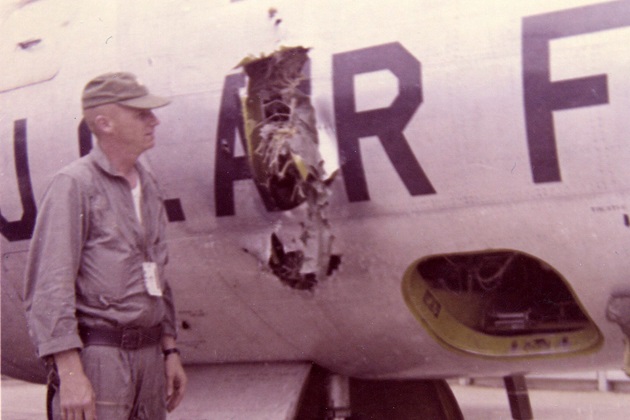
This is the large hole in the starboard wing of B-57B 53-3906.
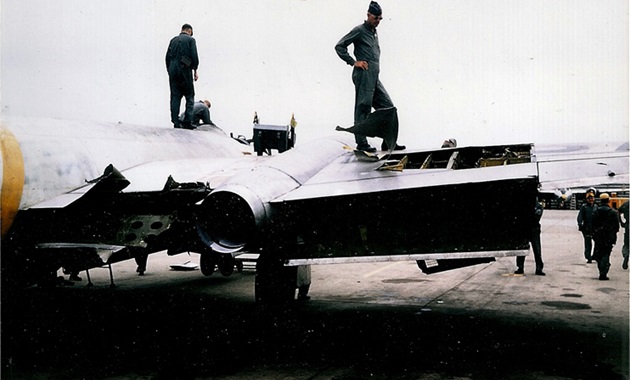
The large hole was made by a radar-guided 57mm shell. After penetrating the wing, the shell exploded, blowing the gun bays to pieces and shredding the wing skin outward on the top and bottom of the wing exposing the wing’s internal structure.
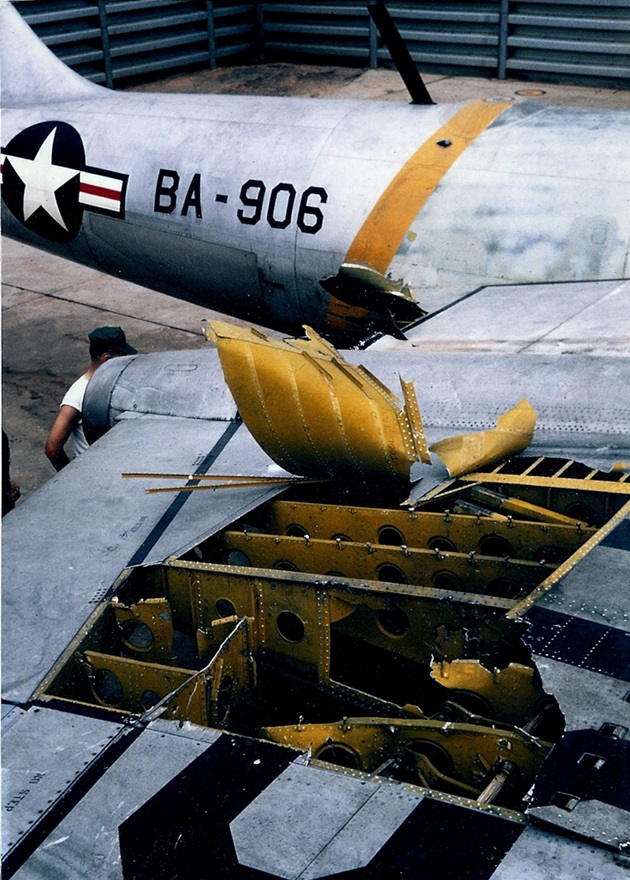
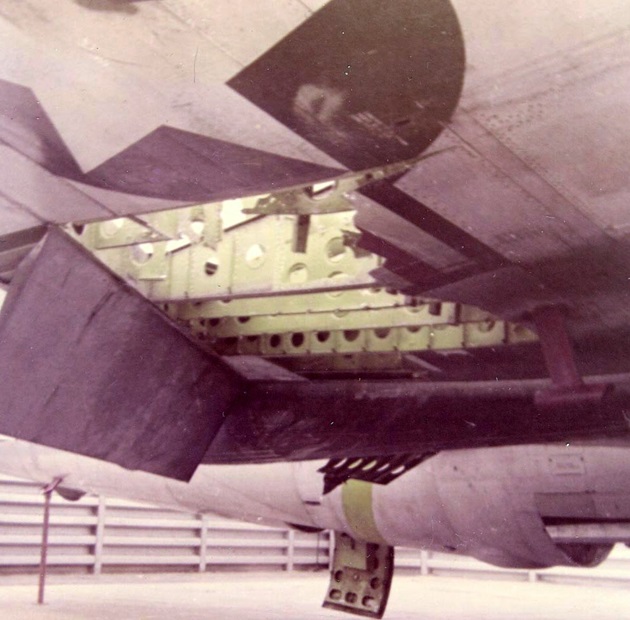
Joyner had more than 40 shrapnel wounds which he almost bleed to death. After months of recovery, he returned to duty. Joyner was awarded the Silver Star. Mason was later awarded the Air Force Cross and the Distinguished Flying Cross. B-57B 53-3906, tail number 906, was repaired and flew three more years of combat.
Film: Pilot starts engines of Martin B-57 Canberra bomber at Da Nang
Film: 8th Bomb Squadron captain checking napalm tanks on Martin B-57B bomber
Film: Aerial views of Martin B-57 Canberra bomber aircraft in flight
Film: Armament crew load bomb on Martin B-57B Canberra bomber at Da Nang
VNAF B-57Bs
In 1964, the US secretly agreed to supply a few B-57Bs to the South Vietnamese Air Force (VNAF). Initially, the US was reluctant to equip the VNAF with jet aircraft, since it would be a violation of the Geneva Accords and might further escalate the war. However, the US had already equipped other friendly nations in the region with jet aircraft, and pressure from the government leadership in Saigon coupled with a need to boost the sagging morale of the South Vietnamese people, led to the change of heart.
The first VNAF B-57B crews began training in secret with 405th FW aircraft at Clark Air Base in late 1964. One of the students was Nguyen Cao Ky, the commander of the VNAF and later president of the Republic of Vietnam. As the crews completed their training at Clark, they went to Da Nang Air Base and flew combat missions with the USAF 8th or 13th Bomb Squadrons, whichever happened to be on station at the time. To gain combat experience, each new VNAF crew member flew with a US pilot or navigator, whichever the case may be. Eventually, the VNAF crew members would fly in VNAF marked B-57Bs, but their combat missions would always be under strict USAF operational control.
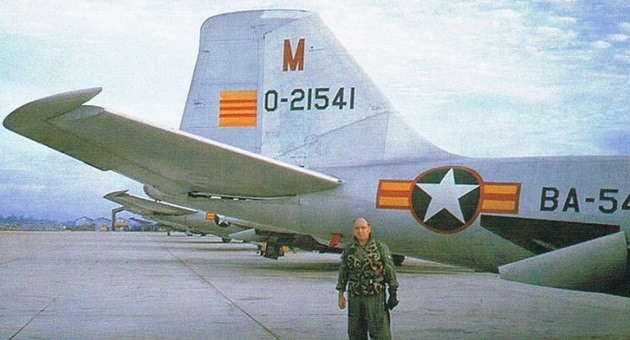
The tail of B-57B 52-1541 in VNAF markings at Clark Air Base. Below the “BA-54” on the fuselage is an extended air break. The identity of the crewman is unknown.
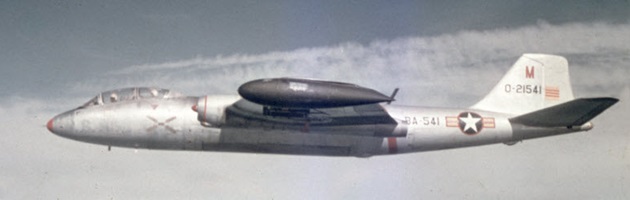
VNAF B-57B 52-1541 in flight.
The South Vietnamese government felt that the VNAF B-57B program should be given some more visibility, and to celebrate Vietnamese Armed Forces Day, on 29 October 1965, 5 B-57Bs of the USAF 8th Bomb Squadron, then based at Da Nang Air Base, were repainted with VNAF insignia and carried out an air strike against a suspected VC stronghold and afterwards landed at Tan Son Nhut Air Base. After landing, the planes immediately took off again and joined other VNAF non-jet aircraft in a formation flyover of Saigon. Although manned solely by US crews, this attack was heralded as the introduction of VNAF B-57Bs into combat.
However, the VNAF pilots had severe difficulties operating the B-57B. The Vietnamese crews suddenly began to complain of various illnesses, which grounded many of the trainees and brought their training to a standstill. In addition, on 8 January 1966 a B-57B was destroyed in a training accident, further lowering their morale. It was immediately replaced by another repainted USAF B-57B to keep the illusion that all 5 VNAF B-57Bs were operational.
Some Vietnamese crews flatly stated that they could not physically perform the maneuvers required with the B-57B. Then Major Nguyen Ngoc Bien, the leader of the VNAF B-57B program, was killed in a freak ground accident on 23 February 1966 at Da Nang. Major Bien’s death, who was well-liked and well-respected by both Vietnamese and the Americans, resulted in a complete loss of any incentive for the Vietnamese crewmen to stay in the program, and from that point on there was very little Vietnamese activity in the program.
On 20 April 1967, the VNAF B-57B program was officially terminated and the B-57Bs were transferred back to the USAF bomb squadrons and repainted in USAF markings. They were needed to replace combat losses.
Phan Rang
Combat attrition of the B-57 force, plus the increasing availability of higher performance jets (F-4, F-100, F-105, etc.) to carry out the air war against North Vietnam, caused the USAF 3rd Bomb Wing to be withdrawn from operations against the North in October 1966 and relocated to Phan Rang Air Base, known as “Happy Valley”. The 8th and the 13th Tactical Bombardment Squadrons operated together as part of the 35th Tactical Fighter Wing (35th TFW) at Phan Rang.
Film: USAF 13th BS B-57B “Canberra” Air Strikes – Vietnam 1967
Film: B-57B Canberra and F-100D Super Sabre aircraft at Phan Rang Air Base
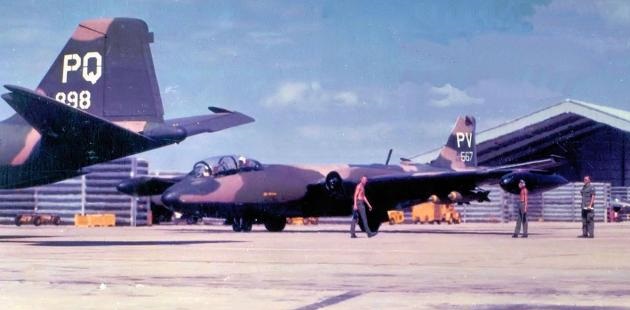
B-57B bombers at Phan Rang Air Base in 1968. On the left is 8th TBS B-57B 53-3898 (PQ) and on the right is 13th TBS B-57B 52-1567 (PV). On 15 March 1969, B-57B 52-1567 was written off when hit by ground fire but was able to fly back to Phan Rang. It suffered a dual engine flame out near Pleiku. Both crew ejected and were rescued by USAF HH-43 helicopter.
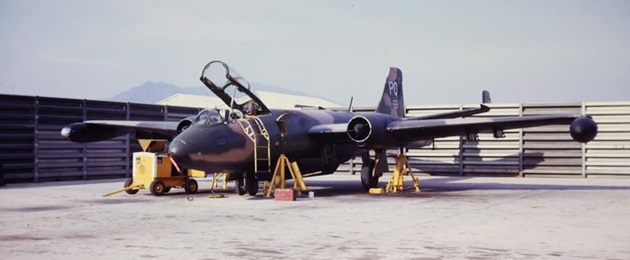
A B-57B of the 8th TBS parked in its revetment at Phan Rang with a couple of hydraulic jacks around it. The port engine appears to be jacked up so that the landing gear or wheel/tire can be repaired.
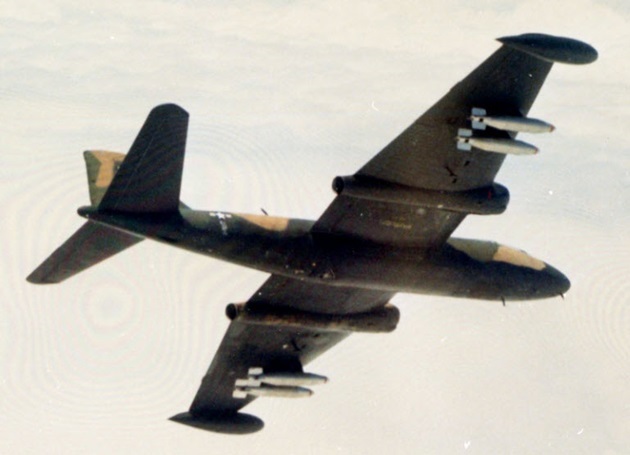
A B-57B of the 8th TBS carries two napalm bombs under each wing flying from Phan Rang in 1969. Note the undersides are painted black for night missions.
B-57B Nose Art
Nose art was not as common in the USAF B-57 squadrons as the F-4 and F-105 units, some USAF Canberras had a name and/or nose art which depicted the crew’s feelings towards the enemy. Here are a few examples.
This upper port side aerial view of B-57B 53-3877 shows the typical Southeast Asia (SEA) camouflage scheme.
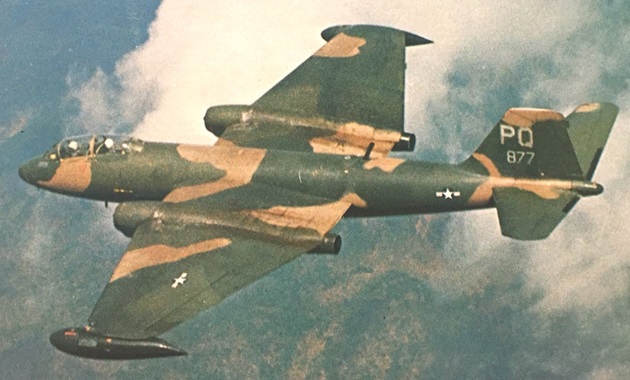
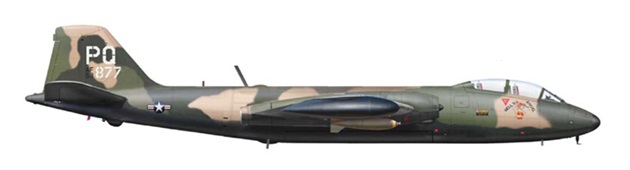
This is a close up of the nose art on B-57B 53-3877 named “HELL’S ANGEL”.
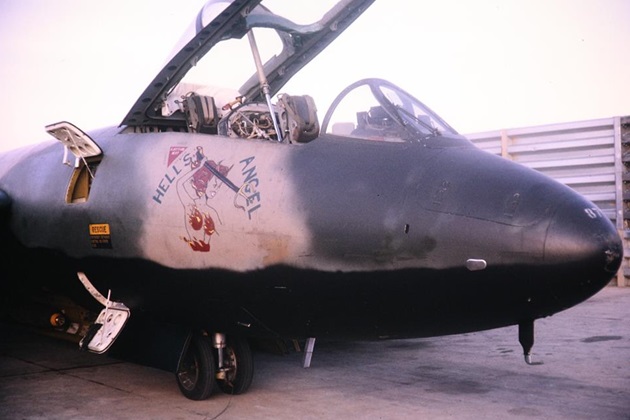
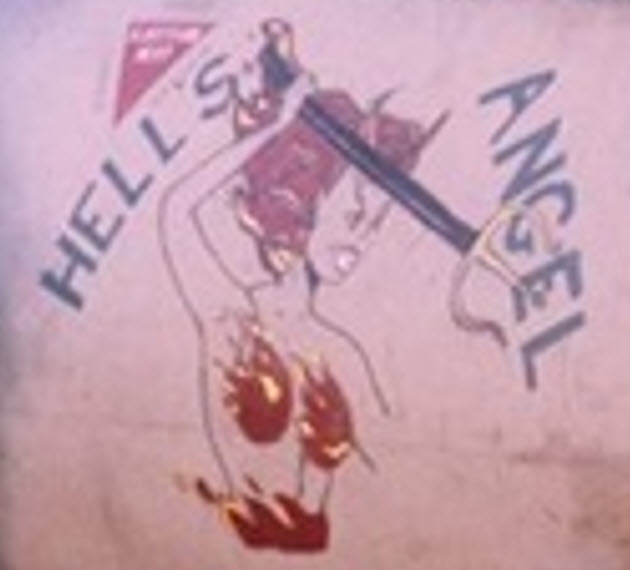
This is my close up of the nose art in the above photo. Depicted is an angered woman devil with flaming red hair and horns holding a trident fork. Her private parts are covered with flames.
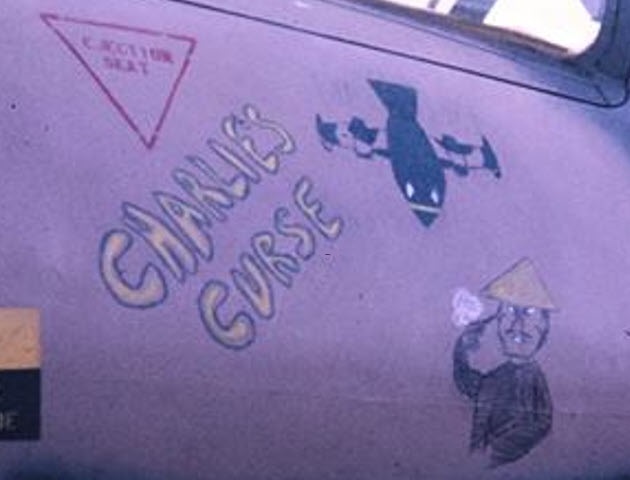
This is a close up of the nose art on an unknown B-57B named “CHARLIE’S CURSE”.
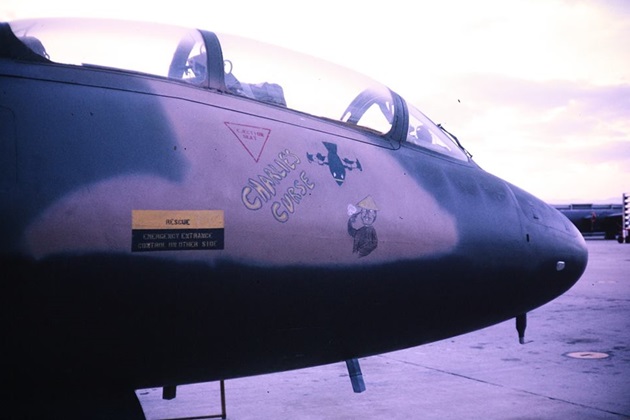
This is my close up of the nose art in the above photo. Depicted is a camouflaged Canberra bomber diving on a VC soldier who is “scared to death”.
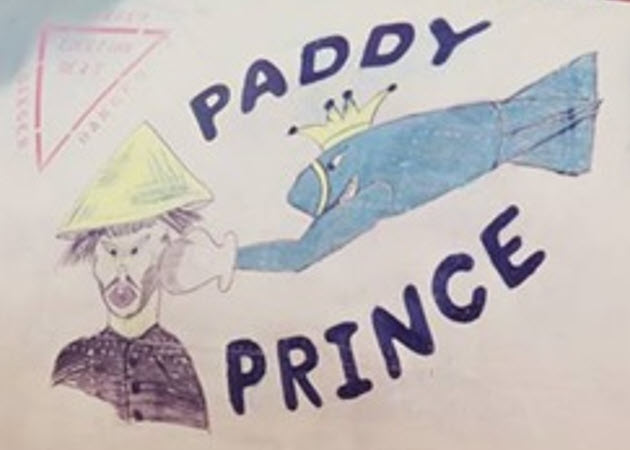
This is a close up of the nose art on an unknown B-57B named “PADDY PRINCE”.
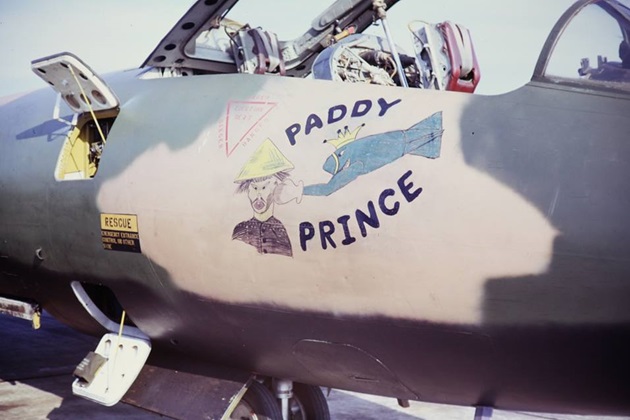
This is my close up of the nose art in the above photo. Depicted is a bomb wearing a crown for a king and boxing gloves “hitting” a VC soldier.
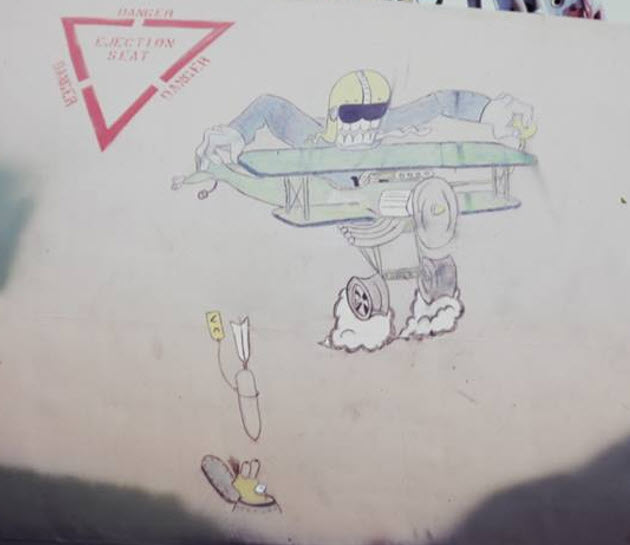
This is a close up of the nose art on an unknown B-57B with no name but the nose art does depicts the crew’s feelings.
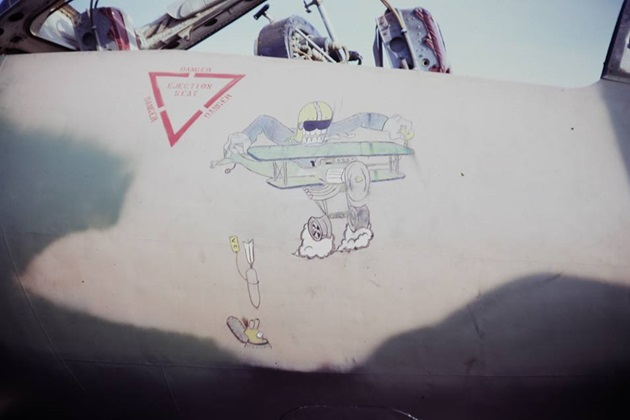
This is my close up of the nose art in the above photo. Depicted is a frustrated pilot flying a “suped up outdated biplane” had just dropped a bomb on a surprised VC soldier who had stuck his head out of his hole. At that time, the B-57B bomber was around 15 years old and was based on a first generation jet design.
B-57G Variant
When the B-57Bs were operating from Bien Hoa in 1965, they were attacking the North Vietnamese supply lines supplying the VC insurgents. These airstrikes, carried out at night, highlighted the USAF’s complete lack of night attack capability. The poor effectiveness of the night strikes were a serious liability to the war effort. In December of 1965, US President Johnson personally ordered the USAF to come up with a solution – resulting in Operation Shed Light.
Operation Shed Light was to tackle the problem of strike aircraft being blinded during night missions. To solve this problem, a new pair of sensor pods was developed by Dalmo-Victor (Tropic Moon I) and Westinghouse (Tropic Moon II) for use by the twin-seat Douglas A-1E Skyraider and the Martin B-57B Canberra. Both pods were fitted with an LLLTV (low-light level television), however, only the Westinghouse unit also contained a laser rangefinder. The first system, Tropic Moon I, was only fitted to the Skyraider and immediately proved inadequate. The second system, Tropic Moon II, was actually used in combat, but after 182 sorties and 456 targets detected, only 89 were destroyed, leading to Tropic Moon II’s withdrawal in 1968.
The Tropic Moon III combined the sensor pack from Tropic Moon II, as well as a FLIR (forward looking infrared) system previously tested on a Douglas A-26 Invader (Operation Lonesome Tiger) into one package. Additionally, Tropic Moon III included a new GMTI (ground moving target indicator) radar system, the AN/APQ-139, based on the LTV A-7D Corsair II’s AN/APQ-126. The entire sensor suite was built into the aircraft – the radar installed in the nose, and the LLLTV/FLIR/laser pack installed in a gimballed chin mount. All four sensors were routed through a sophisticated 32 kb digital computer and display system, the AN/AXQ-5 and AN/AXQ-7, allowing the operator to simultaneously control and swap between all four systems. An advanced LORAN navigation system was included, to help precisely guide the plane towards the target. The AN/ALT-28 jammer was included for defense against radar-guided SAM’s, and although rarely used, was retained. The M39 20mm cannons were also retained. Outside of sensors and avionics, upgrades included a pair of 30 KVA generators, each mounted below the jet engines, to provide constant power for the numerous electronic systems.
The fuel tanks were all modified to be self-sealing using polyurethane foam, and armor against small-arms fire was applied to protect fuel lines, control hydraulics/cabling, and crew positions.
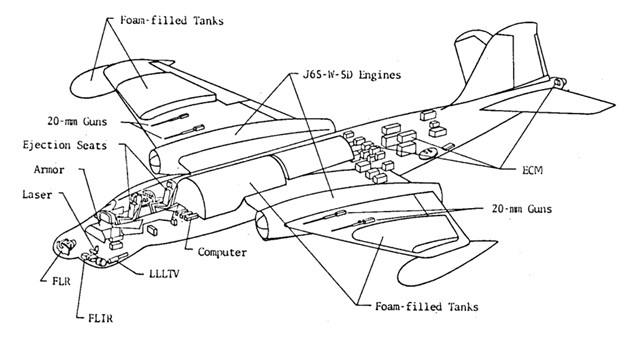
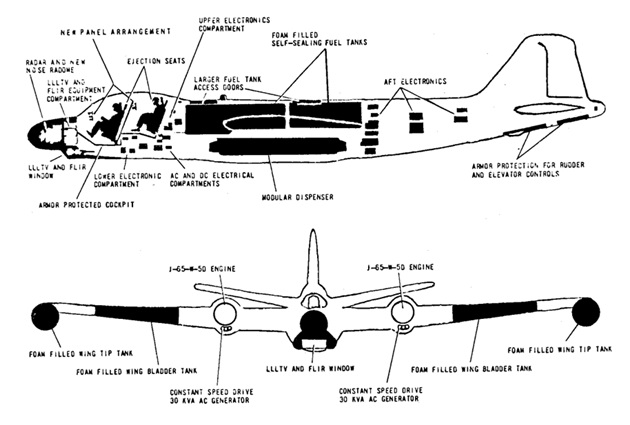
In total, 16 existing B-57Bs were modified by Martin-Marietta, Westinghouse, and Texas Instruments, and re-designated to B-57Gs.
B-57B 52-1578, B-57B 52-1580, B-57B 52-1582, B-57B 52-1588
B-57B 53-3860, B-57B 53-3865, B-57B 53-3877, B-57B 53-3878
B-57B 53-3886, B-57B 53-3889, B-57B 53-3898, B-57B 53-3905
B-57B 53-3906, B-57B 53-3928, B-57B 53-3929, B-57B 53-3931
Out of the 16, 11 B-57Gs were deployed in Ubon, Thailand, in September 1970, and 5 remained in the US, four for training in Tampa, Florida, and one for experimental development. The 11 B-57Gs deployed to combat were tasked with striking at the Ho Chi Minh trail at night. The strike aircraft were equipped with various types of bombs, conventional, incendiary, cluster, retarded, or laser-guided.
The typical attack run was conducted using navigation to get close to the target area. Once in the area, targets would be spotted from range using the radar. The pilot would fly according to the sensor data, and once closer to the target, the sensor operator switched to LLLTV or FLIR for visual confirmation of the target. Once confirmed, weapons were deployed through the weapons delivery system, and the LLLTV shut-off to prevent the brightness of the bomb blast from damaging the TV. Due to various maintenance issues, the B-57Gs first combat sortie was carried out on 17 October 1970.
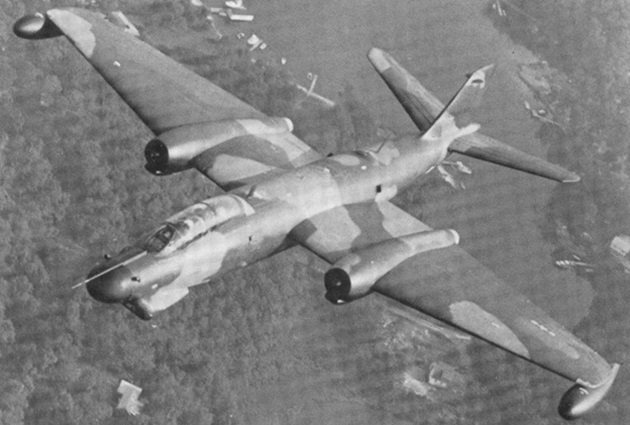
Despite the remarkably poor weather at that time, the B-57G, in 543 sorties, spotted 759 trucks, attacked 565 and destroyed 363. Only one aircraft was lost due to a service accident, with its crew rescued. The B-57Gs carried out combat strikes until the wide scale pull out of US forces (“Vietnamization”) from the war effort began in April 1972.
By the end of their service, the B-57G had, in 1,202 sorties, spotted 2,841 trucks, and destroyed 1,931. After their return to the US, the B-57Gs were handed off to the Kansas ANG until their retirement in early 1974. The B-57G proved to be a successful, but overall it did not leave much of an impact on the battlefield when compared to the Lockheed AC-130 gunship, which proved itself a far more effective truck-killing platform.
Video: The Martin B-57G; Laid the Groundwork
Film: B-57G Tropic Moon III
PAVE-Gat Project
Combat experience with the B-57Gs bomb load showed that a successful sortie could average about 6 to 8 kills using the standard configuration of 4 M36 incendiary cluster bombs, and two Mk.82 laser-guided bombs. The gun-turret equipped AC-119 and AC-130 gunships were averaging about six times more kills, due to their loitering capability and numerous gatling gun turrets, using different combinations of the M134 Mini-gun (7.62mm) and M61 Vulcan 20mm.
To bolster the B-57Gs capabilities, a gun-based solution was sought, resulting in the PAVE-Gat project. Emerson Electric was tasked to develop a gun turret featuring the M61 Vulcan 20mm rotary cannon, and controlled by Shed Light’s sensor systems. Two turret systems were developed and mounted on test aircraft. The TAT-161 turret was mounted on a B-57B using the Tropic Moon II underwing pod.
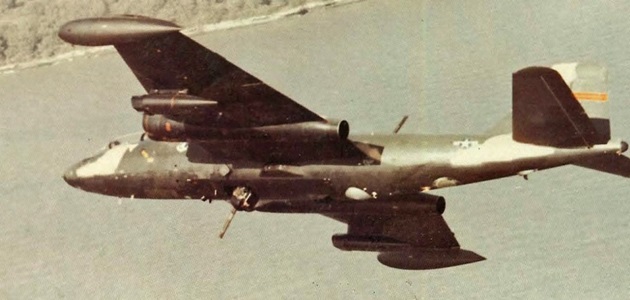
Film: B-57G Canberra/Pave Gat 20mm Vulcan Test Fire
The definitive PAVE-Gat aircraft was the B-57G retained in the US, fitted with the TAT-157 turret. Using this system’s far more effective sensors and weapons control suite, it was theorized that a combination of the sensors, the aircraft’s flight performance, and an M61A1 turret fed with 4000 rounds of 20mm ammo would combine the best of both the bomb-only B-57G and the two gunships in service. By March 1970, the turret was ready for mating with the B-57G. The turret was to be controlled by the back seater, using the same weapons control system used for sensor observation and Laser Guided Bomb guidance. In October 1970, Westinghouse received the B-57G, and proceeded with installing the turret.
In January 1971, testing was ready to get underway at Eglin AFB in Florida but serious problems with the B-57G radar system required the tests to be delayed, as the test platform had to be used to design the fixes for the radar system problems. A series of issues with the plane, unrelated to PAVE-Gat itself, continued to delay testing until May 1971. Then Testing immediately began, and the results were promising.
The modified B-57G was scoring 20 kills per sortie, triple that of the bomb-laden B-57G. With the positive test results, the USAF wanted to deploy the PAVE-Gat B-57G to Southeast Asia with the next aerial campaign. However, in August 1971, Vietnamization of the war meant that the US was to withdraw a significant portion of its military resources by early 1972. Due to the costs of deploying the PAVE-Gat B-57G, and the imminent withdrawal, it was decided that it would remain in the US and it was never used in combat.
In 1969, B-57B 53-3906 (which Captain Mason flown in 1966) was sent back to Martin and was converted to a B-57G. It again was returned to combat and continued flying. As part of Project “Tropic Moon III”, it was modified to a RB-57G for night interdiction missions. During Project PAVE-Gat, it was used to test the downward-firing 20mm cannon turret mounted in the bomb bay.
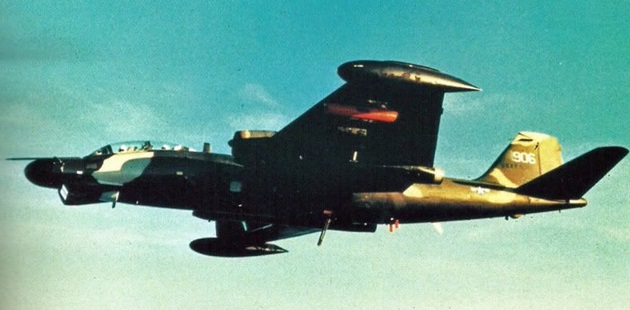
Film: B-57Canberra Mission in Vietnam 1960s
Film: Martin B-57 Canberra – Vietnam
B-57 Losses
By the end of the Vietnam War, 58 of 96 B-57s deployed had been lost.
| DD/MM/YY (Date) | Variant Serial # (Unit) | Cause |
|---|---|---|
| 04/08/64 | B-57B 53-3884 (8th BS) | Collided with B-57B 53-3877 while landing in bad weather |
| 06/08/64 | B-57B 53-3870 (8th BS) | Shot down by ground fire, Sang Dong Nai River |
| 01/11/64 | B-57B 52-1555 (8/13th BS) | Mortar Attack |
| 01/11/64 | B-57B 53-3892 (8th BS) | Mortar Attack |
| 01/11/64 | B-57B 53-3894 (8th BS) | Mortar Attack |
| 01/11/64 | B-57B 53-3914 (8/13th BS) | Mortar Attack |
| 01/11/64 | B-57B 53-3924 (13th BS) | Mortar Attack |
| 11/03/65 | B-57B 53-3890 (8th BS) | Crashed on low Bombing Run, caught in bomb blast |
| 07/04/65 | B-57B 53-3880 (8th BS) | Hit by Ground Fire |
| 16/05/65 | B-57B 52-1568 (8/13th BS) | Airfield Explosion |
| 16/05/65 | B-57B 53-3867 (8/13th BS) | Airfield Explosion |
| 16/05/65 | B-57B 53-3871 (13th BS) | Airfield Explosion |
| 16/05/65 | B-57B 53-3873 (8/13th BS) | Airfield Explosion |
| 16/05/65 | B-57B 53-3893 (13th BS) | Airfield Explosion |
| 16/05/65 | B-57B 53-3905 (13th BS) | Airfield Explosion |
| 16/05/65 | B-57B 53-3913 (8/13th BS) | Airfield Explosion |
| 16/05/65 | B-57B 53-3915 (8th BS) | Airfield Explosion |
| 16/05/65 | B-57B 53-3930 (13th BS) | Airfield Explosion |
| 16/05/65 | B-57B 53-3937 (8/13th BS) | Airfield Explosion |
| 08/06/65 | B-57B 53-3882 (13th BS) | Hit by Ground Fire |
| 19/06/65 | B-57B 53-3910 (8th BS) | Shot down by AAA during night flare mission |
| 29/06/65 | B-57B 53-3895 (8th BS) | Hit by Ground Fire, Crash Landed |
| 30/06/65 | B-57B 52-1589 (8th BS) | Crashed on Take Off |
| 05/08/65 | RB-57E 55-4243 (6250th CSG) | Hit by Ground Fire, Patricia Lynn |
| 06/08/65 | B-57B 53-3919 (8/13th BS) | Hit by Ground Fire |
| 06/09/65 | B-57B 52-1544 (8/13th BS) | Engine Fire during close air support mission |
| 20/10/65 | B-57B 53-3920 (8th BS) | Hit by Ground Fire |
| 14/12/65 | B-57B 52-1565 (8th BS) | Hit by Ground Fire |
| 13/01/66 | B-57B 53-3876 (13th BS) | Crashed on Take Off, Nose Wheel Failure |
| 16/01/66 | B-57B 53-3903 (13th BS) | Engine Failure, crashed into sea off Da Nang |
| 10/02/66 | B-57B 52-1575 (13th BS) | Unknown, Lost on Combat Mission |
| 21/02/66 | B-57B 52-1523 (8th BS) | Hit by Ground Fire |
| 07/04/66 | B-57B 52-1530 (8th BS) | Hit by Ground Fire |
| 14/04/66 | B-57B 53-3925 (8th BS) | Mid-Air Collision with 53-3926 |
| 14/04/66 | B-57B 53-3926 (8th BS) | Mid-Air Collision with 53-3925 |
| 17/04/66 | B-57C 53-3833 (8th BS) | Hit by Ground Fire |
| 13/06/66 | B-57E 55-4268 (13th BS) | Hit by Ground Fire |
| 19/09/66 | B-57C 52-1541 (8th BS) | Hit by Ground Fire |
| 06/10/66 | B-57B 53-3888 (8th BS) | Hit by Ground Fire |
| 08/10/66 | B-57B 52-1512 (8th BS) | Hit by Ground Fire |
| 08/12/66 | B-57B 52-1590 (8th BS) | Hit by Ground Fire |
| 21/01/67 | B-57B 52-1557 (13th BS) | Hit by Ground Fire |
| 22/04/67 | B-57B 53-3859 (13th BS) | Hit by Ground Fire |
| 03/06/67 | B-57B 53-3862 (8th BS) | Unknown |
| 09/06/67 | B-57B 53-3908 (8th BS) | Hit by Ground Fire |
| 19/08/67 | B-57B 52-1550 (13th BS) | Hit by Ground Fire |
| 10/09/67 | B-57B 52-1510 (8th BS) | Hit by Ground Fire |
| 25/03/68 | B-57B 52-1592 (8th BS) | Hit by Ground Fire, Crash Landed |
| 03/04/68 | B-57B 52-1586 (8th BS) | Damaged by Ground Fire, Written Off |
| 23/09/68 | B-57B 52-1498 (8th BS) | Hit by Ground Fire |
| 03/10/68 | B-57B 52-1570 (8th BS) | Engine Failure, Crew ejected and rescued |
| 21/10/68 | RB-57E 55-4264 (460th TRW) | Hit by Ground Fire, Patricia Lynn |
| 13/12/68 | B-57E 55-4284 (8th BS) | Mid-Air Collision with C-123K Flare Ship |
| 13/01/69 | B-57B 52-1561 (8th BS) | Lost during night mission over Laos |
| 22/02/69 | B-57B 52-1532 (8th BS) | Hit by Ground Fire |
| 15/03/69 | B-57B 52-1567 (13th BS) | Hit by Ground Fire |
| 27/03/69 | B-57B 52-1508 (8th BS) | Hit by Ground Fire |
| 12/12/70 | B-57G 53-3931 (13th BS) | Mid-Air Collision with O-2A FAC over Ban Vangthong |
Note: Two B-57Es were converted to operational bomber configuration to replace losses.
Pilot Captain Russell “Bear” Barnett (age 32) and navigator Captain Thomas Taylor “Tom” Walker (age 30) of the 8th Bomb Squadron was the crew of B-57B 52-1530. On 7 April 1966, Barnett and Walker took off from Da Nang Air Base on a combat mission over the Savannakhet Province in Laos (west of Dong Ha and Hue). Their plane was the second plane in a 2-ship flight. After reaching their target, Barnett made three dive-bombing attacks on the target. On the fourth pass, their plane was hit by ground fire and it crashed into a mountain, disintegrated and burned. No parachutes were seen, and the hostile threat in the area prevented any search and rescue or ground inspection of the site. Following the crash, Barnett and Walker were declared KIA, non-recovered.
In January and May 2005, a joint US/Laos People’s Democratic Republic (LPDR) team visited the crash site. In late 2014 and early 2015, three excavations of the site were conducted, recovering possible human remains, life support items and material evidence. Scientists from the US Defense POW/MIA Accounting Agency used circumstantial evidence and dental comparisons to identify the remains. They found remains that matched Barnett’s records. However, Walker’s remains were not found.
Captain Barnett was repatriated and buried with full military honors at the Texas State Cemetery in Austin, Texas on 7 April 2017, 51 years after his plane crashed in Laos.
On 13 January 1969, pilot Lieutenant Colonel Norman Dale Eaton and navigator Captain Paul Everett Getchell was flying B-57B 52-1561, call sign Yellowbird 52, on a night bombing mission over Laos. In the target area, Yellowbird 52 was cleared to attack the target by the Forward Air Controller (FAC). They made one dry-run pass and then one successful napalm pass. Eaton was then cleared by the FAC for a third pass. At the time, the FAC was on a heading which precluded him from observing the third pass. However, he noticed an explosion shortly after Yellowbird 52 radioed “Off target.” No further contact was made with Yellowbird 52. Another FAC in the area reported picking up a two-second beeper signal. Search and rescue efforts were initiated but neither voice nor beeper signals were heard. These efforts were suspended at 1900 hours the next day, following negative contact with the crew and no crash site located. Both crewmen were declared MIA.
Thirty-five years later, during January-February 2005, a joint Lao-US team visited the area and began an excavation of a suspected crash site, 10 miles (16 km) west of the A Shau Valley in Laos. Human remains recovered from these efforts were positively identified the following year as those of Eaton and Getchell. The cause of the crash is unknown.
Australian Canberras
The Canberra was chosen by the RAAF for licence production in Australia. In 1951, the Australian Government Aircraft Factory (GAF) was authorized to build 48 Canberra B.20 bombers, which was the equivalent of the RAF English Electric Canberra B.2.
Five RAF Canberra B.2s were sent to Australia as pattern aircraft: WD935 (A84-1); WD942 (A84-2), WH710 (A84-3), WD983 (A84-125), and WD939 (A84-307). Although A84-1 appeared on RAAF records, it was not flown to Australia. The first Canberra B.2s received was A84-307, which arrived in August 1951, followed by A84-125. The other two, A84-2 and A84-3, arrived in November 1951 and June 1953 respectively, and both were returned to the UK in October 1957.
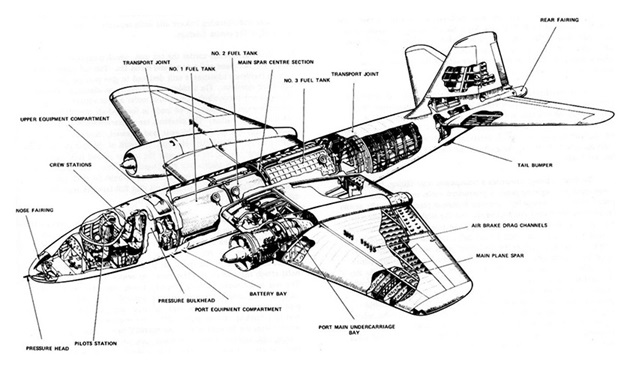
The Canberra B.20 bomber was a cantilever mid-wing monoplane two-seat jet bomber with an aluminum alloy air frame. The wings were symmetrical high speed aero foils which had additional fuel tanks. The tail plane was variable incidence, hinged at its leading edge. It had a crew of two. The pilot sitting on a Martin Baker Type 13 ejection seat offset to the port side of the fuselage, and the navigator’s seat was enclosed in the fuselage behind the pilot. During a visual strike, the navigator crawled forward past the pilot and laid in the nose section while using the bomb sight.
It carried offensive loads in both the fuselage bomb bay and on the wingtip pylons. The bomb bay was able to hold six 454 kg (1000 lbs), or one 1814 kg (4000 lbs) and two 454 kg (1000 lbs) bombs; or eight 227 kg (500 lbs) bombs internally; plus up to 907 kg (2000 lbs) of stores on the wingtips. It had no cannons or machine guns.
The first Australian-built Canberra B.20 A84-201 made its first flight on 29 May 1953 and the last one built A84-248 was first flown on 30 September 1958. The first 28 aircraft (A84-201 to A84-228) were powered by two 28.9 kN (6500 lbs) thrust Rolls-Royce/CAC Avon Mk.1 turbojet engines, and the remainder (A84-229 to A84-248) by two 33.3 kN (7500 lbs) thrust Avon Mk.109 turbojet engines. RAAF Canberra engines were fitted with fuel accumulators that ensured a fuel supply when flying inverted.
The RAAF No.2 Squadron, call sign “Magpie”, was equipped with Canberra B.20s. A magpie is an Australian bird of the Australasian butcher bird family with black-and-white plumage.
Commanding Officers:
- Group Captain Rolf Basil Aronsen (April 1967 to ?)
- Wing Commander Selwyn David Evans (1967 to 1968)
- Wing Commander John Alan Whitehead (1968 to November 1969)
- Wing Commander Jack Robert Boast (5 November 1969 to 6 November 1970)
- Wing Commander Francis John Leonard Downing (1 November 1970 to April 1971)
- Wing Commander Thomas Hugh Thorpe (7 April 1971 to 7 June 1971)
In July 1958, No.2 Squadron deployed to RAAF Base Butterworth in Malaysia as part of the Commonwealth Far East Strategic Reserve near the end of the Malayan Emergency. The Canberra B.20s flew a few bombing missions against communist insurgents.
The squadron remained in Malaya until 1967 when it was re-deployed to Phan Rang Air base in South Vietnam where it was attached to the USAF 35th Tactical Fighter Wing which included the 8th and the 13th TBSs. The first of the squadron’s Canberra bombers landed at Phan Rang on April 19th and they flew their first mission on April 23rd.
During four years of operations in Vietnam, the squadron flew 11,696 bomb missions and dropped 76,389 bombs (26,730 tons). After its return to Australia in 1971, the squadron was re-designated as a photo-reconnaissance squadron based at Amberley, QLD. Five of the squadron’s Canberras were fitted with RC10 cameras and they surveyed New Guinea, Irian Jaya, Sumatra and central northern Australia.
The RAAF retired the Canberras from service in June of 1982.
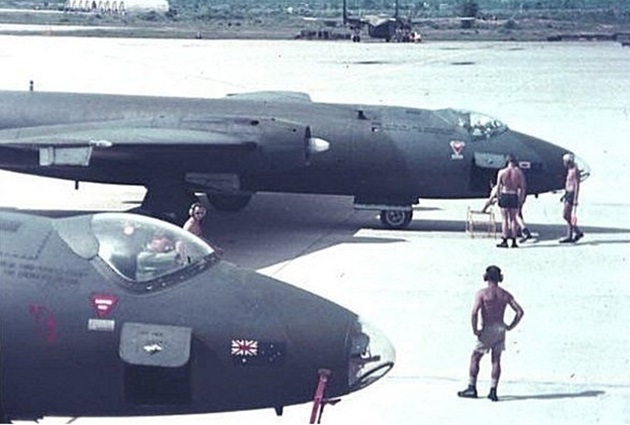
Canberra B.20s A84-231 and A84-233 on the ramp at Phan Rang Air Base. The Canberra in the foreground has a bomb mounted on its starboard wingtip pylon.
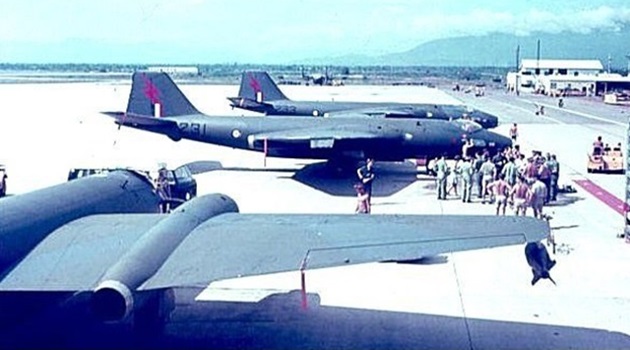
A closeup of the two Canberra B.20s in the above photo.
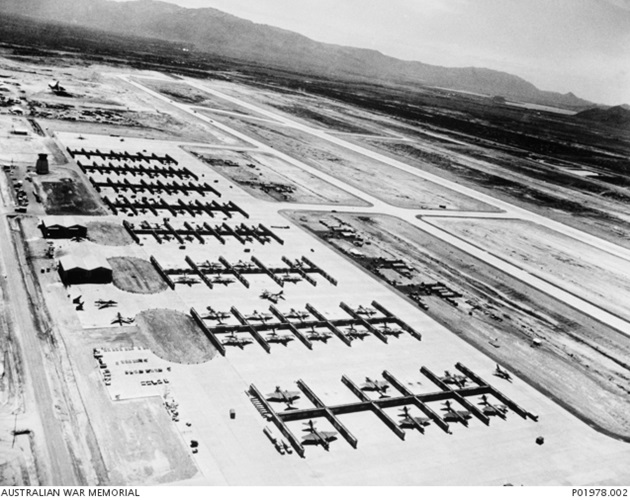
Aerial view of the aircraft revetments at Phan Rang Air Base in July 1967. No.2 Squadron Canberras are parked in the bays located in the immediate foreground.
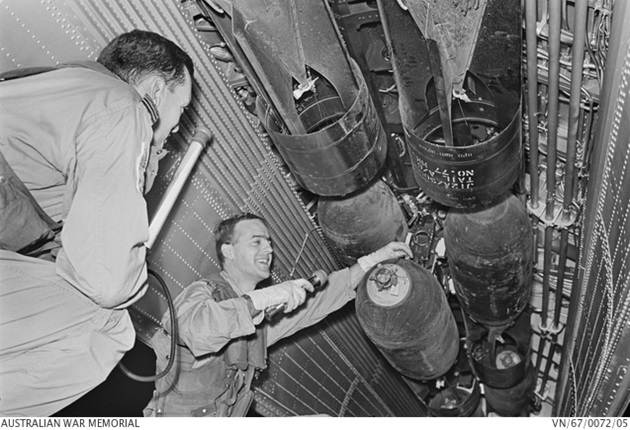
AWM has the incorrect caption information for this photo stating work is being done on an engine of a Canberra Bomber in the hangar at Phan Rang in May 1967. There is no engine in the photo. On the left, is an officer with three wide stripes on his shoulder board so he is most likely a Wing Commander and the pilot of the bomber. On the right, would probably be the navigator holding a torch (flashlight) checking the bomb load. Not able to determine the identity of the two officers.
AWM VN/67/0059/09 appear to have the appropriate text but no photograph. Both have the same Maker and were taken in June-May 1967.
Film: A bombing mission [2 Squadron RAAF South Vietnam 1967] AWM F10869
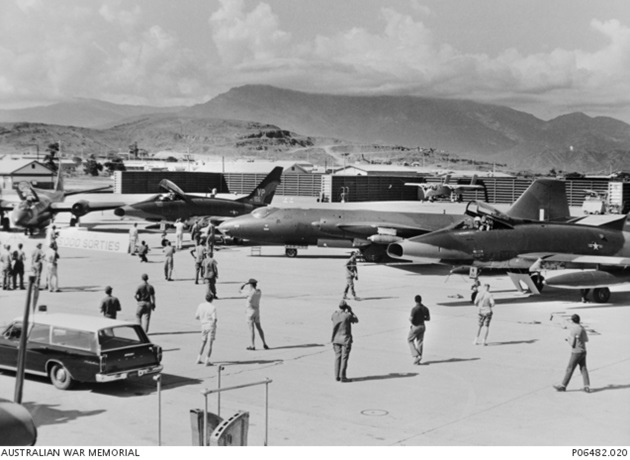
A line up of aircraft from the squadrons of the USAF 35th TFW as the wing celebrates 75,000 operational sorties flown in Vietnam in 1968. The aircraft are from left to right; an USAF B-57B of the 8th or 13th TBS, an F-100D Super Sabre of the 614th TFS (tail code VP), a No.2 Squadron Canberra B.20 and another F-100D. An OV-10 Bronco FAC aircraft is parked in a revetment in the background.
Film: No. 2 Squadron RAAF Phan Rang bombing-up Canberra bombers (AWM F03545)
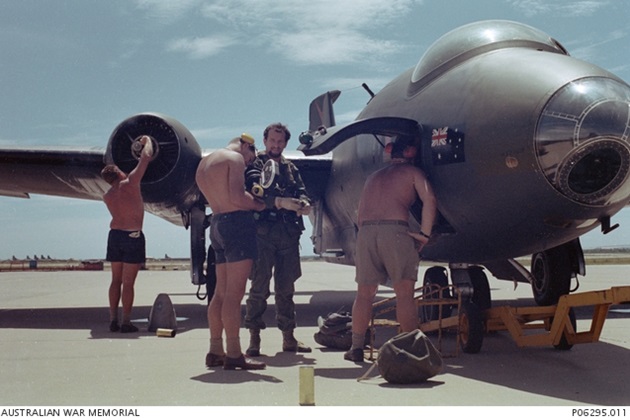
Ground crew preparing a Canberra B.20 bomber for a mission on 16 October 1968. One of the ground crew is fitting Coffman cartridges to the starboard jet engine.
Film: No 2 Squadron RAAF bomber strike in Vietnam (AWM F02746)
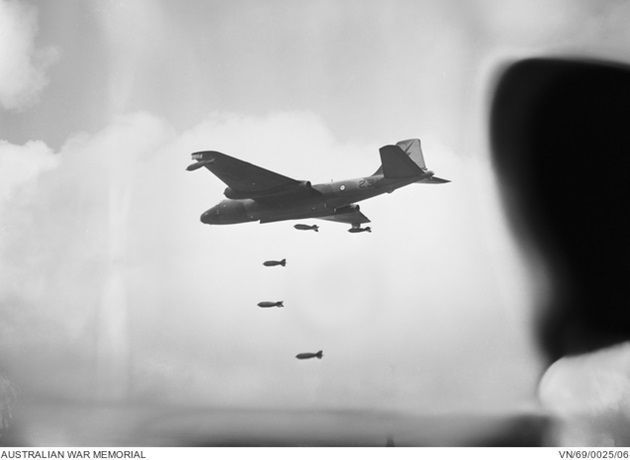
Canberra B.20 A84-231 drops load of six 750-pound (340 kg) bombs on a VC “cement factory” in the Mekong Delta in April 1969.
Film: General activities of No 2 Squadron RAAF in Vietnam (AWM F02751)
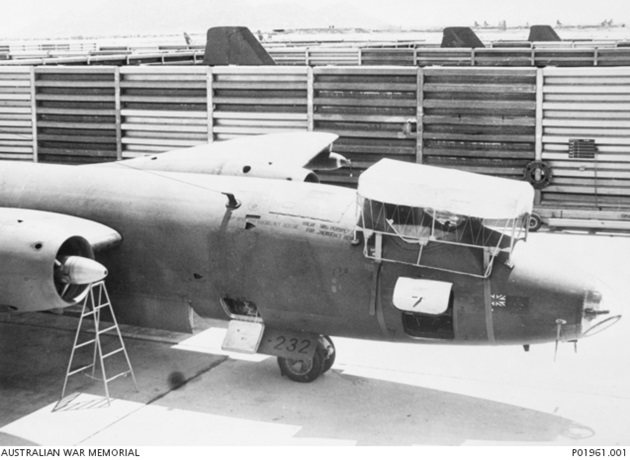
A canvas sun cover shields the perspex canopy of Canberra B.20 A84-232 from the hot sun while it sits in its revetment in 1969. Note the plexiglass nosecone and the escape hatch behind the nose gear.
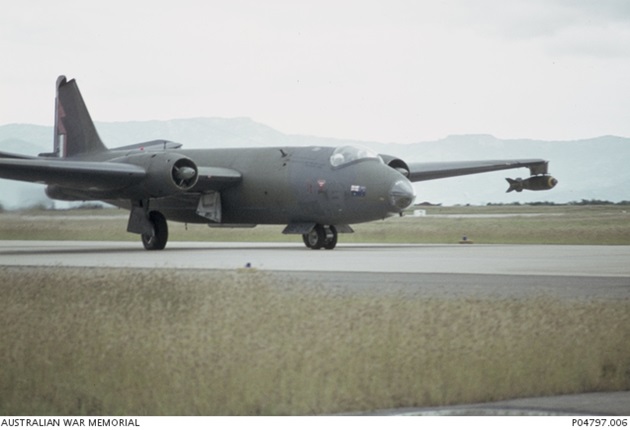
A Canberra B.20 bomber with a bomb mounted on the port wing tip pylon sitting on the runway at Phan Rang in July 1970.
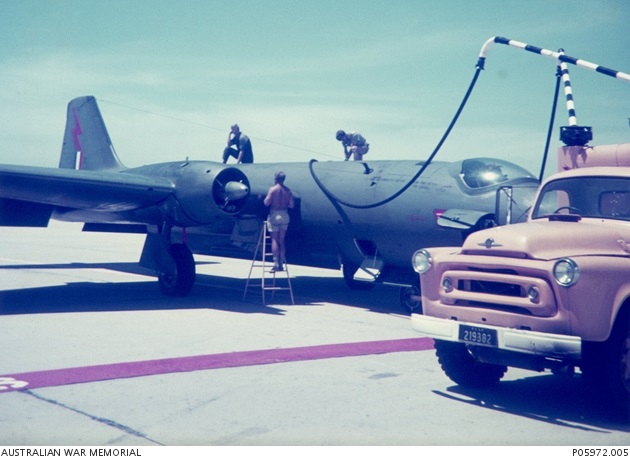
A Canberra B.20 bomber refueling in July 1970. The refueler truck is based on a 1956 International Harvester ASW 120 truck chassis.
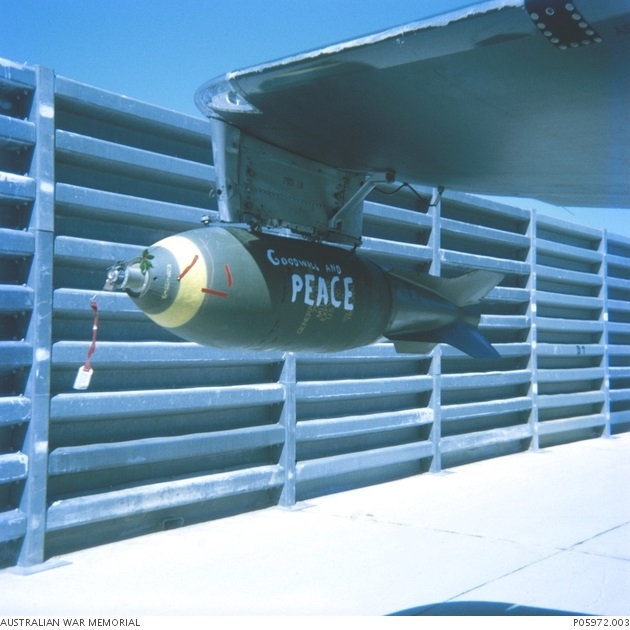
Message “Goodwill and PEACE” is painted on a bomb mounted on the Canberra B.20’s starboard wing tip pylon at Phan Rang in July 1970.
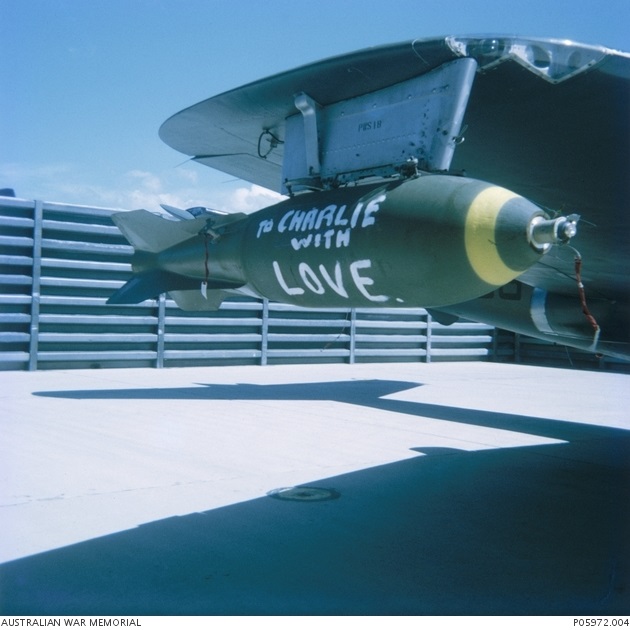
Message “To CHARLIE with LOVE.” is painted on a bomb mounted on the Canberra B.20’s starboard wing tip pylon at Phan Rang in July 1970.
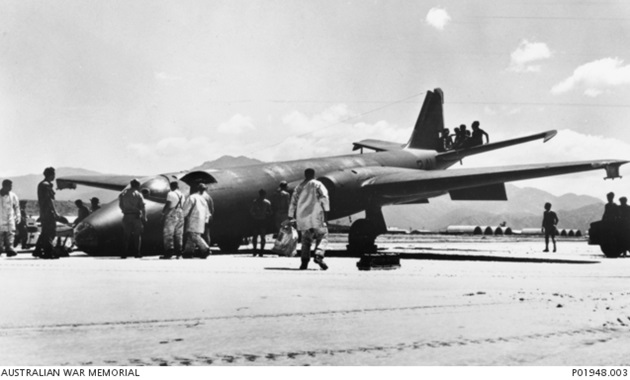
On 11 July 1970, the nose wheel of Canberra B.20 A84-241 failed to lower during its landing at Phan Rang. The aircraft was piloted by Pilot Officer (PO) Michael Brendon Birks and Flying Officer (FO) Alan Joseph Curr was the navigator. The aircraft suffered very little combat damage except for the nose wheel gear, and the crew climbed out of their aircraft not jured. When the USAF base commander arrived on the scene, he was prepared to have it bulldozed away to remove the obstruction it was causing to flight operations. RAAF personnel mounted a hurried effort to remove their damaged aircraft from the runway.
Damaged Canberra B.20 A84-241 sitting in the middle of Phan Rang’s runway on 11 July 1970. Note the RAAF personnel sitting on the tail plane trying to raise the bomber’s nose up.
Film: Canberra bomber strike (AWM F02800)
On 1 November 1970, Wing Commander Downing officially took over command of No.2 Squadron at Phan Rang Air Base. To the right of Downing’s head on the fuselage is the navigator’s small window. The panel behind the cockpit canopy on top of the fuselage blows off when the navigator ejects.
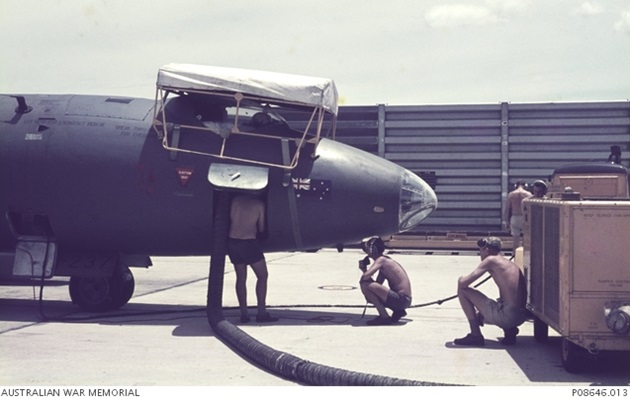
RAAF ground crew performing final checks on Canberra B.20 A84-237 at Phan Rang in November 1970.
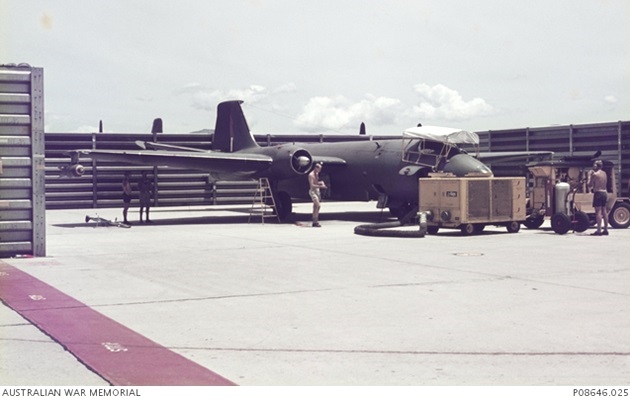
A Canberra B.20 just prior to engine start up at Phan Rang in March 1971. The air conditioning unit and Auxiliary Power Unit (APU) are in front of the jet.
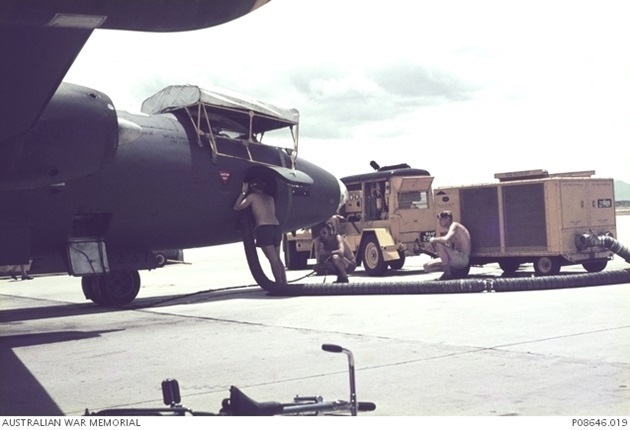
Canberra B.20 A84-237 just prior to engine start up at Phan Rang in April 1971. The ground crew await last minute instructions from the aircrew before starting the engines.
On 31 May 1971, Canberra B.20 A84-244 flew squadron’s last bombing mission in Vietnam. It was piloted by Flying Officer (FO) David Smith and FO Peter Murphy was the navigator.
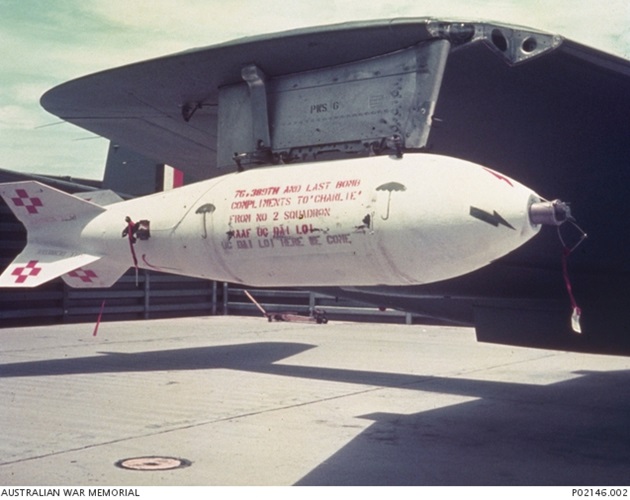
The last bomb dropped by the squadron in Vietnam was mounted on the right wing tip pylon of Canberra B.20 A84-244. The bomb was painted white and on the side the armourers had painted in red “76,389th and last bomb compliments to ‘Charlie’ from No. 2 Squadron RAAF UC Dai Loi” and below it in black is “UC Dai Loi HERE WE COME.” Two black umbrellas are on both sides of the message.
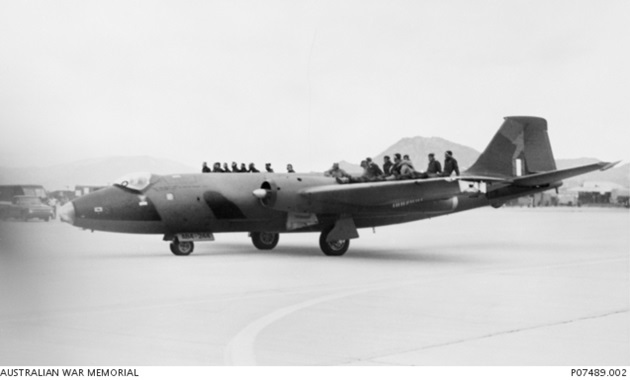
After Canberra B.20 A84-244 landed after completing the squadron’s last bombing mission in Vietnam on 31 May 1971, members of the squadron climbed aboard the Canberra’s wing to celebrate its return.
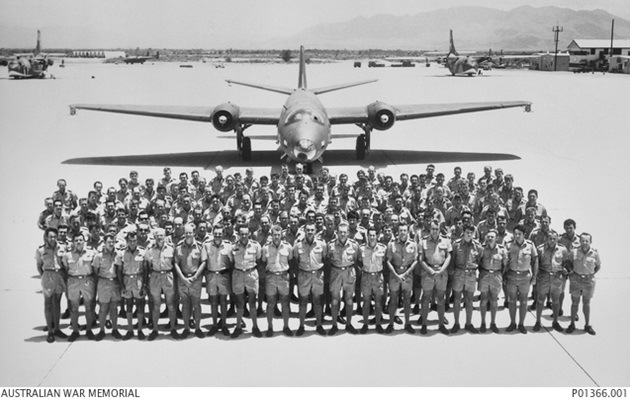
On 4 June 1971, the full complement of RAAF No.2 Squadron personnel at Phan Rang Air base posed for this photo, just before returning to Australia. In the background are a Canberra B.20 bomber (immediately behind the group) and two Fairchild C-123 Providers (background left and right). In the far background (behind the two C-123s and the Canberra) is a Fairchild C-119 Flying Boxcar.
Combat Losses
The RAAF No.2 Squadron only had two combat losses during its tour in Vietnam.
During the evening of 3 November 1970, Flying Officer (FO) Mike Herbert and Pilot Officer (PO) Bob Carver took off in Canberra B.20 A84-231, call sign “Magpie 91”, from Phan Rang Air Base on a night “Combat Skyspot” mission. Combat Skyspot was a ground-directed bombing (GDB) operation using a combination radar/computer/communications system (“Q” system) where the Canberra crew is given the order when to drop their bombs.
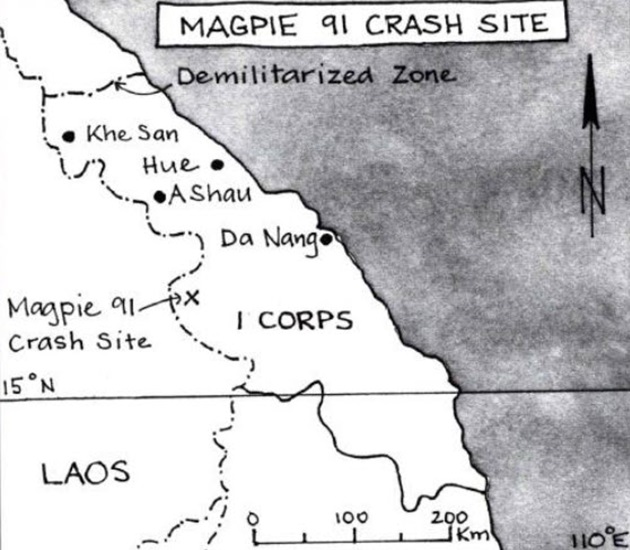
Magpie 91 made radio contact with the US radar officer who was directing them to a target in the Quang Nam Province. The target was believed to be a concentration of NVA regulars or a NVA headquarters. At 2022 hours in poor weather, they dropped six bombs on a target southwest of Da Nang and and just east of the Laotian border. After the bomb run, Magpie 91 turned about 80 degrees off its run-in heading and started to return to Phan Rang.
Canberra B.20 A84-231
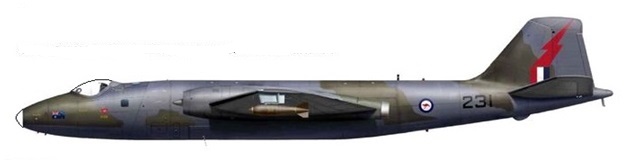
Exactly 70 seconds later, without any warning, Magpie 91 suddenly vanished from radar. Dozens of intensive search-and-rescue missions carried out over the next 72 hours by both Australian and US aircraft failed to find any trace of Magpie 91. A court of inquiry held in Vietnam in subsequent days could not find a reason for the disappearance. Herbert had been flying above the range of anti-aircraft artillery, and there were no known North Vietnamese SAM sites near the flight path. Herbert and Carver were listed as MIA.
On 14 March 1971, Wing Commander Downing was flying his 100th bombing mission with his navigator Flight Lieutenant Allan John Pinches in Canberra B.20 A84-228. They were flying at 14,000 feet (4267.2 meters) near the DMZ performing a Combat Skyspot mission that was supposed to be a “milk run.” They were more than 600 km (372.8 miles) northwest of Phan Rang AB.
Arriving in the vicinity of the target under Skyspot direction, they were ordered to turn very steeply onto the target. About halfway through the turn, the Canberra was suddenly hit by a Surface-to-Air Missile (SAM). Then a second SAM flew past the burning jet, high to the right. Downing ordered Pinches to eject before he transmitted a “Mayday” distress call, then he ejected himself.
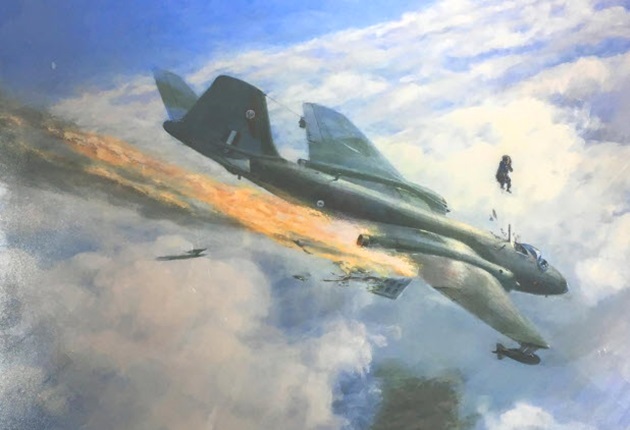
They ejected at medium altitude and while Downing’s parachute opened as “planned”, at 12,000 feet (3,657.6 meters), Pinches’s parachute did not; after a “lengthy” delay, it finally opened. Both sustained injuries on landing and after spending an anxious night in the jungle evading the enemy, they made contact with a US rescue helicopter on their survival radios. 27 hours after ejecting, they were winched up from the jungle.
This was the first RAAF aircraft to be shot down by a SAM. RAAF Canberras were not equipped with a Missile Early Warning System (MEWS). After this event, RAAF aircraft without a MEWS were to not allowed to fly into areas with probable SAM sites present.
Audio: Allan Pinches Interview (AWM S01122)
In April 2009, an Australian Army History unit, supported by Vietnamese forensic specialists, found the wreckage of Magpie 91 A84-231 southeast of the original target. It crashed in dense jungle on a hillside near the border with Laos. It is still unknown what caused the crash of Magpie 91.
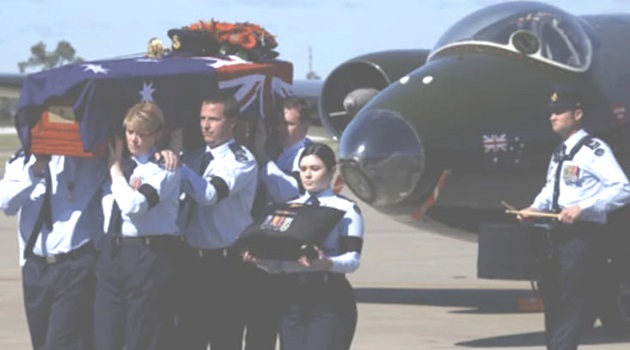
On 31 October 2009, the remains of FO Herbert and PO Carver were returned to RAAF Richmond Air Base in Australia. They are the last Australian soldiers of the Vietnam War to have been found and repatriated. In the background is probably the English Electric Canberra TT.18 (target tug) from the Temora Aviation Museum.
Today
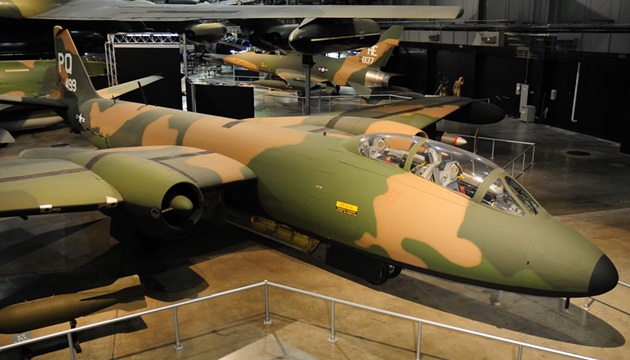
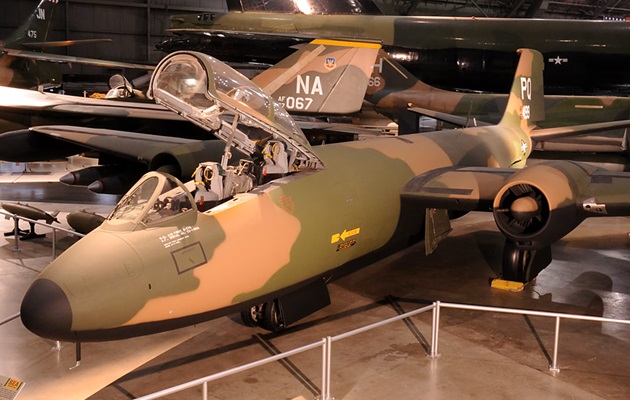
Martin B-57B 52-1499 is on display at the National Museum of the United States Air Force, Wright-Patterson AFB, Dayton, Ohio. It was originally converted to a JB-57B and used as a target for high-altitude platforms and for calibration of cameras. Then it was converted back to its B-57B bomber configuration to replace combat losses in Vietnam. In 1967, it was assigned to the 8th Bomb Squadron at Phan Rang Air Base and flew in combat there for 2-1/2 years. After returning to the US, it was converted to an electronic countermeasures (ECM) EB-57B. It was flown to the museum in August 1981, and restored back to its bomber configuration in 2010.
Video: Martin B-57B Canberra video walk around
Video: Martin B-57B Canberra
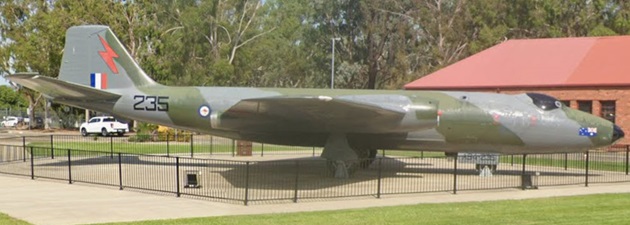
This Australian GAF Canberra B.20 A84-235 is on display at the front gate of the RAAF Base Wagga in New South Wales, Australia. It was placed on display after the completion of restoration work in 2011. Facing the opposite direction on the other side of the gate (to the left) is a Gloster Meteor F.8 in Korean war markings for A77-871 of the RAAF No.77 Squadron.
Video: Flying the legendary Canberra Bomber
Video: Screaming and Solid: Former RAF English Electric Canberra Bomber
Model Kits and Decals
1/48:
Airfix A10104 Martin B-57B Canberra – 2009
Classic Airframes 4130 Martin B-57B Canberra – 200?
Classic Airframes 4141 B-57B Canberra Night Intruder – 200?
Xtradecal X48-076 Martin B-57 Canberra USAF: B-57B (x2), B-57E; SVAF: B-57B – 2010
Xtradecal X48-077 B-57B RB-57E WB-57C B-57G Canberra Pt 2
Zotz Decals 48040 B-57 Canberras in Vietnam
1/72:
Airfix 05018 Martin B-57B/RB-57E Canberra – 1995
Italeri 144 Martin B-57 B Canberra – 1985
Italeri 174 B-57G Night Hawk – 2013
Italeri 1387 B-57B Canberra – 2017
High Planes Models HPK072061 GAF Canberra B.20 1, 2, 6 Squadron RAAF – 201?
Caracal Models CD72119 B-57 Canberra in Vietnam (Decals) – 2025
Xtradecal X72-103 Martin B-57 Canberra Pt. 2 – 2011
1/144:
Amodel 1428 E.E. Canberra B. Mk-20/Mk-62 – 2009
Amodel 1432 Martin B-57B/C – 2011
Amodel 1482 Martin B-57G Canberra – 2023
OzMods OMKIT14408 Martin B-57B Canberra – 2021
 Mike's Research