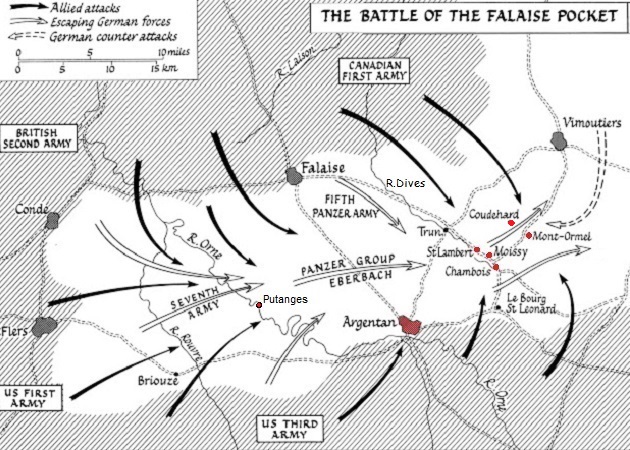
The Falaise Pocket (12 to 21 August 1944) was the last decisive battle in Normandy during WWII. The Allied Armies formed a pocket around Falaise, Calvados, in which German Army Group B, consisting remnants of the 7th Army and the 5th Panzer Army (the tattered remains of 11 panzer divisions, including the 1st, 2nd, 9th, 10th, and 12th SS Panzer-Divisions) were encircled. The battle was an Allied victory which resulted in the destruction of most of Army Group B west of the Seine River, which opened the way to Paris and to the French-German border.

On 1 August 1944, Lieutenant General George Smith Patton, Jr. commanding the newly recommissioned US Third Army, had broken through the German lines along the coast near Avranches (west of Fiers). The US Third Army quickly pushed south and then east, meeting light resistance. Concurrently, the British/Canadian forces pushed south in Operation Bluecoat, attempting to keep the German armor engaged. Four depleted panzer divisions were insufficient to defeat the US First Army, driving the Germans deeper into the Allied envelopment.
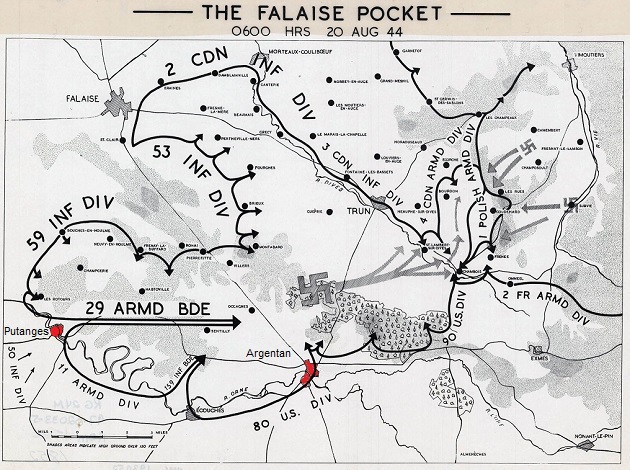
On August 8th, Allied ground forces commander General Bernard Law Montgomery ordered the Allied armies to converge on the Falaise–Chambois area to envelop Army Group B, with the US First Army forming the southwest arm, the US Third Army forming the southeast arm, the British the base, and the Canadians/Poles the northern arm of the encirclement. The Germans began to withdraw on August 17th, and on August 19th the Polish and Americans linked up in Chambois.
Video: How the Allies trapped the Germans
Film: Fall of Falaise (1944)
Film: Battle of the Falaise Gap – 1944
Film: Kessel von Falaise 1944 – Das ist das Ende (Age restricted)
Putanges
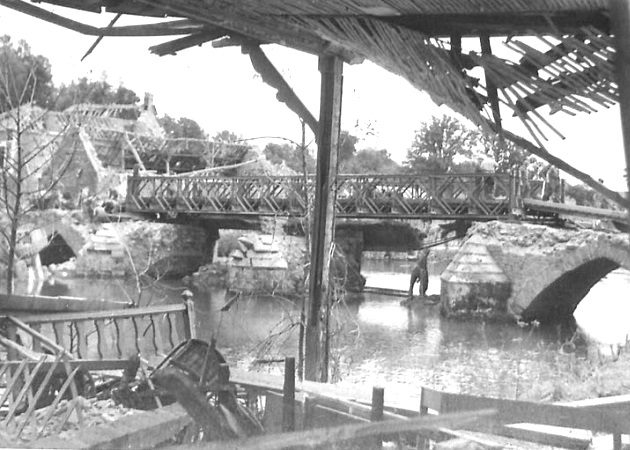
The British 11th Armoured Division liberated the town of Putanges. On August 18th, B Squadron of the Inns of Court Regiment entered Putanges and discovered that the Germans had blew up the bridge over the Orne River impeding their advance. During the following night, with A and B Companies downstream and C and D Companies upstream, the troops of the 3rd Battalion Monmouthshire Regiment undertook the crossing of the river. There was no enemy opposition, but the means used to cross were light, two soldiers drowned when their boat sank under their own weight. A bridgehead was established on the opposite bank. At dawn, the engineers began to the repair the bridge.
British engineers quickly erected a Bailey bridge over the collapsed span on August 20th.

A German 75mm Sturmgeschütz III assault gun laying on its side in the Orne River after falling from the bridge. Note the rubble from the bridge.

A British Sherman crossing the newly erected Bailey bridge.

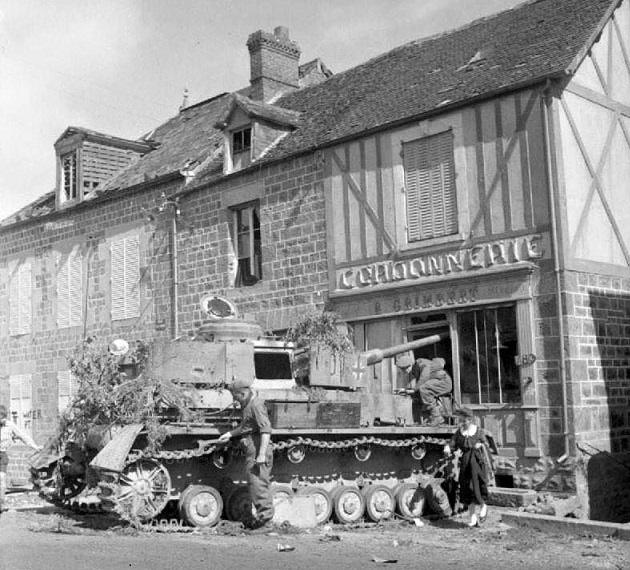
British soldiers examine an abandoned German 75mm Pz.Kpfw. IV (probably an Ausf. J) with its gun protruding into the front of a wrecked shop in Putanges. A French woman is walking around the panzer, not paying attention to it.
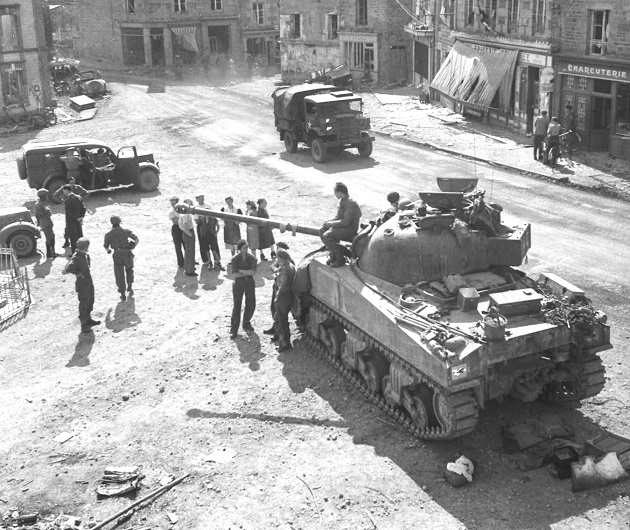
A 17-pounder Sherman Ic (M4) Firefly and other vehicles in the square of Putanges. Note the wheel spacing and the air cleaner on the rear of the Firefly. The photo was taken from an upper story window.
The 86th (East Anglian) (Hertfordshire Yeomanry) Field Regiment, Royal Artillery, was attached to the 11th Armoured Division to provide artillery support. The regiment had three batteries (341, 342 and 462) equipped with Canadian built 25-pounder Sexton Self Propelled guns. This regiment landed on Gold Beach on D-Day supporting the British 50th (Northumbrian) Infantry Division.
A British Sherman of the 86th Field Regiment driving through Putanges. In front of the co-driver’s hatch is the Arm of Service (AoS) number 1147 on a red over blue square with a bar underneath indicating the 86 Army Field Regiment of the British 2nd Army.

My close up of IWM B 9461.
A 25-pounder Sexton of the 86th Field Regiment driving through Putanges. Due to the swift German retreat, their guns did little firing during the reduction of the pocket.

My close up of IWM B 9460.
One of the churches in Putanges which escaped the ravages of war.

Today, it is the Catholic church, Église Saint-Ouen de Pont-Écrepin. The street is Rue de la Roche, southeast of the church.

Argentan
The German 116. Panzer-Division consolidated Argentan’s defenses in order to keep the evacuation corridor open for as long as possible. On August 18th, an offensive was launched by the US 3rd Army. The 318th Infantry Regiment of the US 80th Infantry Division “Blue Ridge”, supported by the 610th Tank Destroyer Battalion (towed 3-inch guns), was ordered to take Argentan. The French covered the southwest approach of the city. Four Sherman tanks of the 702nd Tank Battalion supporting the 318th Regiment were destroyed in the first few minutes of the attack and the infantry suffered heavy casualties due to German machine gun and mortar fire. After five assaults, all of which failed, Major General Horace Logan McBride (80th Division commander) decided to temporarily halt the advance and have the artillery break the German defensive line. Although the 116. Panzer-Division began its retreat, its elements still held the city, but the situation was further deteriorating for the Germans, who on the same day lost the city of Trun and consequently its main axis of escape. For the next 48 hours, they held their positions in the ruins of Argentan which continued to be targets of Allied bombardments. On August 20th at 0900 hours, the Germans withdrew to the forest of Grande Gouffern to the northeast, abandoning Argentan to the US 80th Division.
US soldiers sitting around a 116. Panzer-Division Panther among the ruins in Argentan on August 20th. The building on the right with sign “Office de Placement” is an Employment Office.

This photo of the same Panther was taken by a British photographer on August 21st.

This a close view of the front of the above Panther. Note the church in the background.

The church is Église Saint-Germain d’Argentan located on Rue Saint-Germain. The Church faces north and the Panther was facing east.

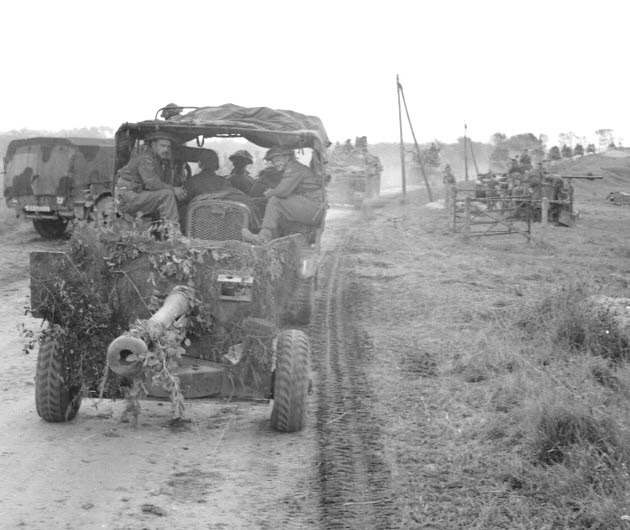
A Loyd carrier towing a 6-pdr 57mm anti-tank gun following Sherman tanks near Argentan on August 21st. Note the foliage camouflage on the gun shield and barrel.
A universal carrier of the Royal Horse Artillery (RHA) tows a captured German staff car and flags near Argentan on August 21st. The unit was the 13th Regiment, RHA (Honourable Artillery Company), equipped with 25-pounder Sexton self-propelled guns belonging to the British 11th Armoured Division.

A British Cromwell tank and troops passing US troops near Argentan on August 21st. The US troops are probably the 318th Infantry Regiment and the truck is a Dodge 1-1/2 ton 6×6 WC-63 Weapons Carrier with a winch on the front bumper.

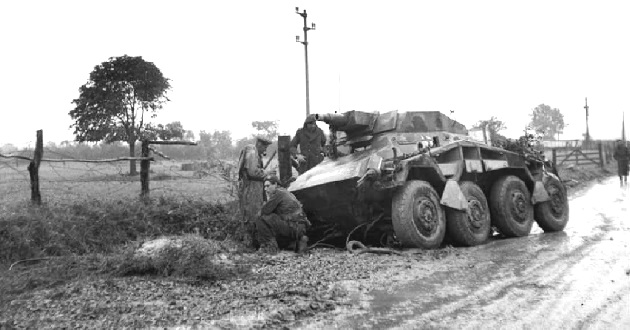
An abandoned German Sd.Kfz. 234/3 (8-Rad) armored car with an open-topped superstructure armed with a short-barreled 75mm K51 L/24 gun. Only 88 were built between June and December 1944. Photo was taken on August 22nd.
A British soldier examines an abandoned German 15cm Panzerwerfer 42 auf Selbstfahrlafette Sd.Kfz.4/1 (based on the Opel Maultier, or “mule”, half-track) in the Falaise-Argentan area on August 22nd. Around 300 were built.

A Pz.Kpfw. II Ausf. L “Luchs” (German for Lynx) number “41 34” abandoned near Argentan. It was armed with a 2 cm KwK 38 L/55 cannon and a coaxial 7.92 mm MG34(P) machine gun. Only 100 were built. This one probably belonged to the Pz.Afkl.Abt.9 (9th Reconnaissance Battalion) of the 9. Panzer-Division.

This is my close up of the turret of the above Luchs. Note how the turret numbers were painted on shaped sheet metal and mounted over the turret stowage.

Film: THE 11TH ARMOURED DIVISION ADVANCES TO ARGENTAN – IWM A70 130-1
Saint Lambert-Sur-Dives
When the Canadian First Army captured the town of Falaise and the US Army was fighting at Argentan, the only German escape route was the Falaise Gap, a 7 km (4.35 miles) stretch running along the Dives River from Trun southeast to Chambois. The only bridge that could support armoured vehicles over the Dives between Trun and Chambois was at Saint Lambert-sur-Dives. On the afternoon of August 18th, General Guy Simonds ordered the 4th Canadian Armoured Division to push on from Trun through Saint Lambert and then to Moissy.
David Vivian Currie, a 32 year old Major commanded C Squadron, 29th Armoured Reconnaissance Regiment (The South Alberta Regiment) of the 4th Canadian Armoured Division. At 1500 hours, Currie was summoned to regimental HQ and was given his orders. Currie had only very limited forces at his disposal. B Company of The Argyll and Sutherland Highlanders of Canada (Major Ivan Martin) was placed under Currie’s command and accompanied his C Squadron of the South Alberta Regiment. His C Squadron was down to 15 tanks and the accompanying Highlanders mustered only 55 soldiers. In total Currie’s small force numbered approximately 130. As the supporting artillery had not kept up with the advance and flying conditions were temporarily abysmal with rain and clouds throughout the area, the small force had to attack without artillery or air support. While Currie’s force was engaged in Saint Lambert, Regimental Headquarters; together with the Reconnaissance Troop, Anti-Aircraft Troop and the troop of M10 tank destroyers, was situated at Point 117, which was located approximately 1000 yards (914.4 m) north of the village.
At 1800 hours on Friday, August 18th, Currie’s task force set out. After covering 4 km (2.49 miles) with no casualties nor any contact as they approached the northwest edge of Saint Lambert, flares lit up the night, a 88mm gun fired, and Currie’s small force was quickly down to 13 tanks. Both tank crews survived, but half a dozen were wounded. Currie proposed deploying his tank crews as combat infantry and to immediately start fighting into the village. However, his regimental CO, “Swatty” Wotherspoon ordered Currie to retreat 1000 meters (1093.6 yards) to Point 117 and renew the attack in the morning. Demonstrating the courage that would carry him through the next two days, Currie, alone and on foot, reconnoitered the German positions locating armour, antitank guns and weapons positions.
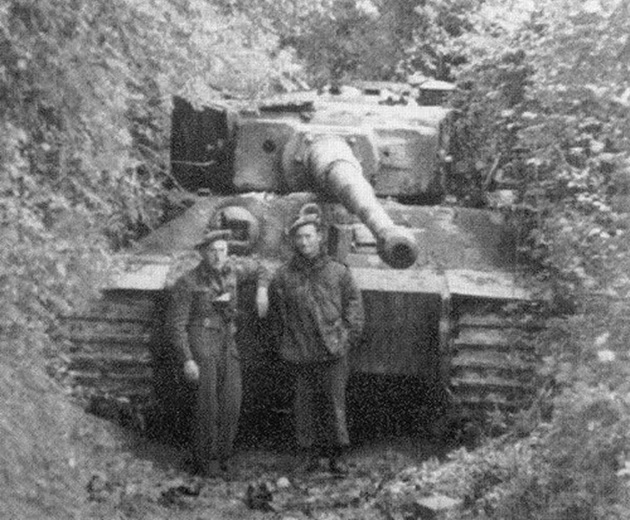
Canadian soldiers posed next to a knocked out Tiger I in the Saint Lambert-sur-Dives area on August 18th. The Tiger probably belonged to schwere SS-Panzerabteilung 102.
At first light on August 19th, Currie’s small force attacked Saint Lambert again. Almost immediately another Sherman was hit and brewed up. C.S.M. Mitchell, together with Private M. R. Holmes ran forward out of cover, and under the direct fire of the enemy, climbed onto the burning tank. After a full five minutes, while risking death or injury from exploding ammunition, they managed to pull the driver out alive.
A South Alberta Regiment Sherman past a burning squadron mate in Saint Lambert-Sur-Dives on August 19th.

This is my close up of the above Shermans. The AoS 45 on a Green-over-cobalt blue square is for an Armoured Recce Regiment.

A South Alberta Regiment Sherman pokes its nose out from cover in Saint Lambert-Sur-Dives on August 19th. On the side of the road is the remains of a Tiger I.

This my close up the the destroyed Tiger above. It has suffered a massive internal explosion which had blown its turret into the hedgerow, with only the gun barrel visible.

Subsequently, Captain John Redden located a Pz.Kpfw. IV and rushed to Currie’s tank and pointed it out. Currie’s gunner destroyed the panzer, earning the SAR’s first confirmed kill and a bottle of rum from “Swatty”. The advance had slowed and a PIAT team from the Highlanders 10 Platoon set off to stalk a second German panzer, a Panther. Team leader, Lieutenant Gil Armour, was able to disable it. Lieutenant Armour climbed on top of the Panther with a grenade in his hand. Just as he was about to drop the grenade in the turret, a German officer looked out. Lieutenant Armour was the first to recover from their shock. He forced the German to come out. But the German was armed with an automatic pistol and closed with him. The enemy officer was quickly shot by another Highlander. A second crewman was gunned down when he opened his hatch and finally the patrol was able to drop a grenade in an open hatch. After six hours of fierce fighting they were only halfway through the village.
Two knocked out Panthers pushed off the road in Saint Lambert-sur-Dives.

Early that evening Currie was reinforced by C Company of the Argyll’s and C Company of The Lincoln and Welland Regiment (with a platoon of D Company under command) at 1800 hours. But in the face of opposition from superior numbers, his force could make no further progress. Currie’s force now amounted to only a dozen tanks and 60 infantrymen. They dug in and was soon battling furiously against one counterattack after another, refusing to give ground and accounting for hundreds of the enemy. The Argyle’s commanding officer, Major Ivan Martin, was fatally wounded that day; while conferring with a German medical officer about handling wounded German prisoners, an artillery shell landed nearby killing both of them. August 20th was the fiercest day of the fighting in Saint Lambert.
At one point a Canadian Sherman, overrun by German infantry, was compelled to swivel its turret to wipe them off the hull. Currie himself used a rifle from the tank turret to fire at snipers while the main gun engaged German armor at a greater distance. At about 0800 hours, waves of German Infantry began moving against the Canadian positions. It could not be called an attack as there was no covering fire, simply a mass movement of infantry. From a captured German, it was ascertained that the attack was a mass recce to find any holes in the Canadian lines to enable the German forces trapped in the pocket to escape.
A dozen reinforcements arrived from an unusual source. C Squadron freed 12 American POWs from the Germans and put them to work with ground weapons. Highlander Arthur Bridge reported that at one point his platoon encountered a Universal Carrier whose driver was held hostage by two Germans who forced him to drive them through the Canadian lines to their own lines. As night approached on the 20th, the disorganized but desperate German assaults began to taper off.
The fighting in Saint Lambert ended on August 21st. In total, Currie’s troops destroyed 7 panzers and 40 other vehicles. A total of 300 Germans were either KIA or WIA and 2100 others were taken prisoner. Currie’s force of less than 150 had caused almost 3000 German casualties.
Three months after the battle, Major David Currie was awarded the Victoria Cross (VC) and it was the only VC ever awarded to a member of the Royal Canadian Armoured Corps.
Film: Action at St Lambert-sur-Dives. Major Currie VC
Film: Falaise falls to 1st Canadian Army – Normandy 1944
Film: Major David Currie Tells the Story of Closing the Falaise Gap
Moissy
There were only two places on the Dives River in the pocket where vehicles were able to cross. The bridge at Saint Lambert-Sur-Dives and the other was a ford southwest of Moissy (Gué de Moissy). While under constant artillery fire and attacks by Allied air forces, thousands of German soldiers and vehicles tried to squeeze into a narrow passage to the ford. Tempers flared and was not uncommon for men to come to blows to force their passage. SS officers, with weapons drawn, tried to give a semblance of order to the chaos that reigned around them.
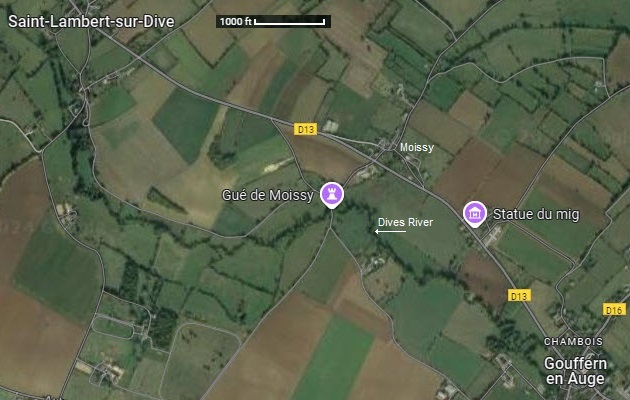
Chambois was merged into the new commune Gouffern en Auge.
“Statue du mig” is a statue of Fabrice Miguet (the “Mig”) who was a famous French motorcycle road-racer who died during the 2018 Ulster Grand Prix. He was born on 29 July 1969 in Argentan and is buried in Chambois.
A German column heading to the ford was destroyed by Allied fighter-bombers. Only a single horse survived.
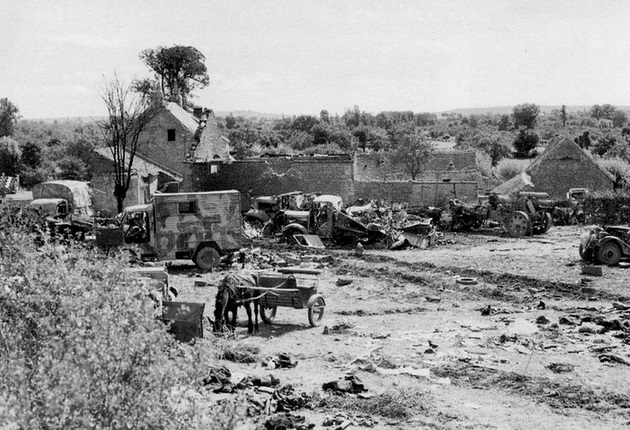
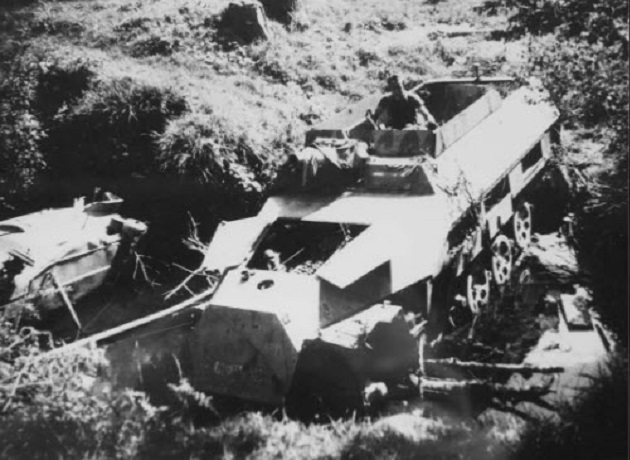
While under fire, many German units were stopped by the Dives River and were forced to abandon their vehicles and guns.

A Sd.kfz. 251/9 Ausf. D half-track got stuck when attempting to cross the Dives River. Its 75mm L/24 gun on the right side of the hull is covered with a canvas.
Chambios
Operation Tractable (August 14 – 21) was the final attack in Normandy conducted by Canadian and Polish troops supported by a British tank brigade. The operation was to capture the tactically important French town of Falaise and then the smaller towns of Trun and Chambois. On August 18th, when the Canadians secured Trun, the Polish 1st Armored Division (1 Dywizja Pancerna) commanded by General Stanisław Maczek advanced towards Chambois. The “Zgorelski” Battle Group was the Polish force which made advance to Chambios.
“Zgorelski” Battle Group
- 10th Dragoon Regiment (Motor Battalion) – M5/M9 Half-tracks
- 24th Lancer Regiment – Sherman V/Vc tanks
- 10th Mounted Rifles Armoured Recce Regiment – Cromwell tanks
- Self-Propelled Antitank Battery – M10c Achilles SP 17pdrs
The Zgorelski Battle Group was to seize and hold the village of Chambois, thereby linking up with the US XV Corps advancing north from Le Mans. The Divisional HQ and both Brigade HQs remained a distance behind throughout the battle. They were all in a defensive “box” (along with the two Artillery Regiments, the Light AA Regiment and the Engineer Battalion) somewhere near Jort, where the division had crossed the River Dives.
Cromwell tanks of the Polish 10th Mounted Rifle Regiment drive pass a knocked out Panther.

Film: INVASION SCENES EUROPE (1944) (Warning: contains graphic scenes)
At the same time, south of Chambois, US troops of the 90th Infantry Division “Tough Ombres” commanded by Brigadier General William Gaulbert Weaver advanced north. After the Canadians captured Saint Lambert-sur-Dive on the morning of August 19th, the Poles launched an assault in the direction of Chambois at noon. The 10th Dragoons took positions on the heights of Hill 111 located northwest of Chambois. It was soon reinforced by tanks of the Polish 1st Armoured Regiment, commanded by Lieutenant-Colonel Aleksander Stefanewicz, which opened fire and destroyed several German elements. General Maczek then gave the order for the 10th dragoons and the 24th Lancers Regiment to seize Chambois. The ruins of the city were occupied by hundreds of routed German soldiers from various units.
The Poles reached the eastern outskirts of Chambois where they linked up with the 2nd Battalion, US 359th Infantry Regiment (US 90th Division), commanded by Major Leonard Dull. The 359th was supported by the 712th Tank Battalion and M10s of the 773rd Tank Destroyer Battalion. The Falaise Pocket was closed but the fight for the liberation of Chambois really began against elements of the 116. Panzer-Division as well as the 5. Armee and 7. Armee which were trying to reach the Seine River. Generaloberst Paul Hausser, commander of the trapped German forces, ordered a new offensive on the evening of August 20th but it was doomed for failure. The Allies had increased artillery fire and air strikes against the trapped German troops. On the same day, Chambois was finally liberated.
A knocked out Pz.Kpfw. IV Ausf. H and a Sd.Kfz. 7 half-track on a street in Chambois.

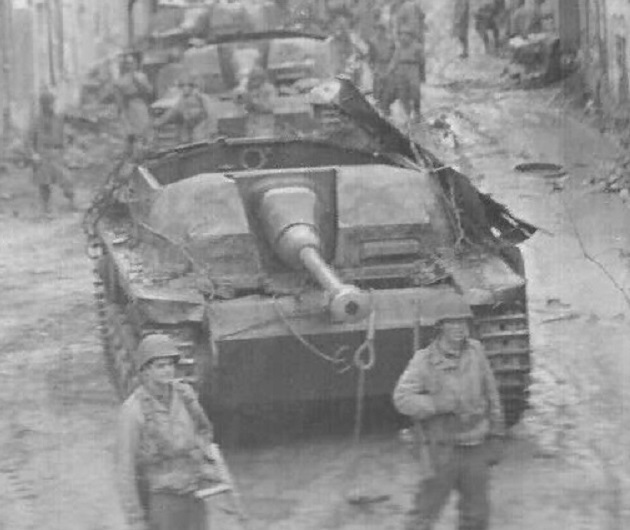
A column of German Sturmgeschütz III Ausf. Gs being examined by US troops in Chambois.

This is my close of the StuG III with concrete armor above. The first two has their roofs completely blown off. The crews probably set internal charges and before abandoning them.
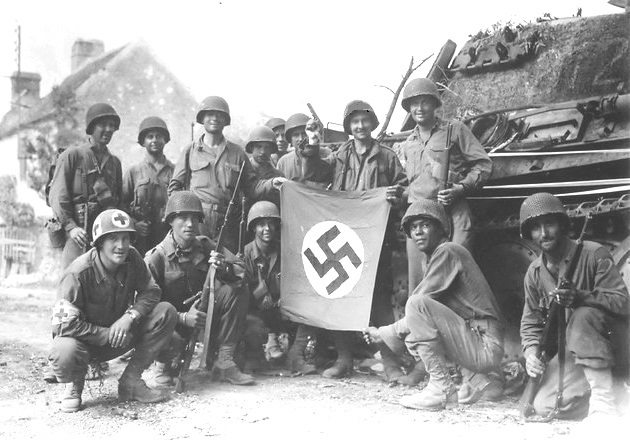
Troops of the US 90th Infantry Division pose in front of Panther number 212 with their captured Nazi flag in Chambois on August 20th. Note the kneeling soldier holding the lower right corner of the flag is an African-American.
Film: United States 90th Infantry Division occupies Chambois in France.
Film: US 90th Infantry Division occupies Chambois
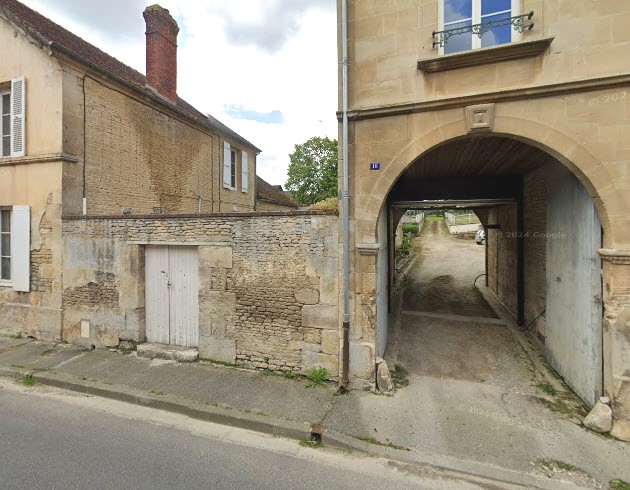
Unloading Germans from a captured Sd.Kfz. 251 Ausf. D half-track in Chambois on August 20th. The trident symbol on the half-track’s rear door was used by the 2. Panzer-Division in 1944. Through the archway was an US HQ that many German wounded and prisoners passed through.

The location is 18 Av. Gambetta (D16), 61160 Gouffern en Auge, Normandy. Located on the south side of Gouffern en Auge. Southeast of the intersection of D16 and D113 (Rue Emaile Zola). The arch is a driveway which goes through the building. From the overhead satellite view of the area, behind the building is parking space and around the corner to the right are a couple of buildings. The ramp in the back accesses crop fields south of Gouffern en Auge.
General Eisenhower examines a destroyed German Tiger II in the vicinity of Chambois on August 23rd. The general is without a close security escort, a routine occurrence as Ike did not like being “crowded.” The Tiger probably belonged to s.Pz.Abt. 503 (schwere Panzerabteilung 503). One of the first 14 Tiger IIs, 12 with the “Porsche” turret.

Film: US General Eisenhower inspects wrecked German equipment
Hill 262
Hill 262, or the Mont Ormel ridge, elevation 262 meters (860 feet), is an area of high ground east of the village of Coudehard. Northeast of Chambois and overlooking the Dives River valley, it is an elongated, wooded ridge which runs roughly north to south. The ridge’s two highest peaks, Points 262 North (262N) and 262 South (262S) lie on either side of a pass which the hamlet of Mont Ormel, from which the ridge takes its name, is located. One of the few westbound roads in the area runs from Chambois through the pass, heading northeast towards Vimoutiers and the River Seine. Point 262N provides a spectacular views over much of the Falaise Pocket. The Poles nicknamed it the Maczuga, Polish for “mace”.
While Zgorzelski’s Battle Group was advancing towards Chambois to link up with the US forces there, General Maczek sought to take the high ground of Coudehard – Mont-Ormel which commanded the plain and the valley of the Dives, where the Germans were still fighting savagely. He ordered two Battle Groups to setup defensive positions on the ridge.
“Stefanowicz” Battle Group
- 1st Armoured Regiment – Sherman V/Vc tanks
- Elements (minus 2 Companies), 1st Podhalian Rifle Battalion
“Koszutski” Battle Group
- 2nd Armoured Regiment – Sherman V/Vc tanks
- 8th Rifle Battalion
When Stefanowicz advanced on Hill 262 and was getting ready to occupy the crest he found the German army in full flight using the Chambois-Vimoutiers road to escape from the encirclement. This road was their last exit since, with US/Polish forces holding Chambois, it was no longer possible to flee southeast towards Gacé.
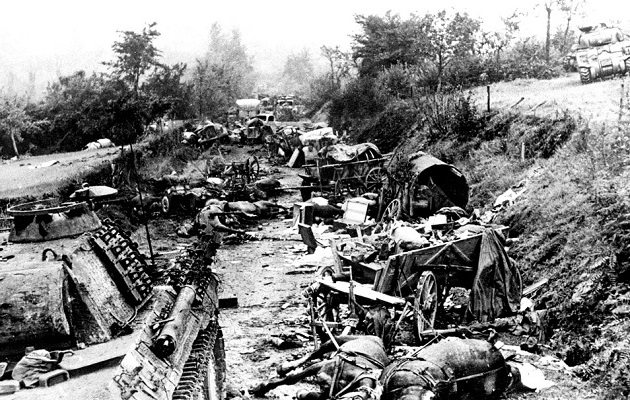
The Poles moved their tanks into position, and commenced firing. The German columns came to a standstill under the persistent Polish fire. In panic, Germans abandoned their equipment, setting fire to whatever would burn, cars, tanks and other vehicles. Then they went on foot to save themselves. The bodies of men and horses strewed the road. When night came, the smoke of burning war material was so dense and impenetrable that visibility was reduced to nil and the Poles could advance no further. On August 19th, Koszutski’s group, reinforced by the 9th Battalion of the Light Infantry, arrived on Hill 262. On the night of August 19th/20th, 2 armoured regiments and 3 battalions of light infantry held this strategic position. The Germans were completely surrounded and hemmed in on the plain. They had no option but to attack at this point, apparently the most vulnerable in the tightening ring.
The tanks were in action for more than 70 hours. The fire was continuous. The terrain was crawling with men slipping stealthily along the hedgerows. At dawn, German armoured cars from Staint Lambert burst through. SS troopers, trapped in the pocket which was becoming a hellish cauldron, assaulted Hill 262 in waves. Their ferocious attacks pinned down the Polish units which were unable to close the whole width of the breach. It was then that 2nd SS Panzer Korps, which had reached Vimoutiers the previous day after fighting its way out of the cauldron, received the order to turn back and attack the Poles from the rear. Some Panthers, in a surprise attack, broke through the Polish perimeter and in a few minutes 5 tanks of the 1st Armoured Regiment were set ablaze while their exhausted crews were still asleep. Supporting the Panthers were panzer grenadiers. The surprise was complete. There was an indescribable mêlée with vicious hand-to-hand fighting. Hard pressed, the Poles requested air support. They were told that the aircrews could not tell friend from foe and the air forces were ordered to concentrate on the roads and the valley.
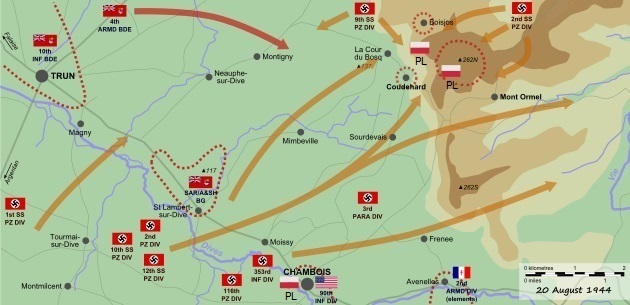
When daylight came on Sunday August 20th, all the German attacks had been repulsed but their losses during the night had been considerable. Their dominating positions ensured that they could not be surprised. They fired without stopping, their machine guns and rifles grew red hot. In the end, the Germans pulled back but were still a threat. The Poles had exhausted their rations, there was scarcely half a bottle of water left per man and ammunition was scarce. Suddenly, over on their left, they heard the sounds of numerous tanks approaching. Expecting they were Canadians, they looked for green flares but there were none. They were German panzers advancing towards their positions. The best defense was to attack and the Poles set off to meet the enemy with only 12 tanks. They soon saw the silhouettes of 16 panzers. The battle began and within three minutes of the start they had lost 6 tanks to one panzer.
Only the artillery could save them. A request for an artillery barrage was radioed in providing map coordinates. The leading panzer was approaching as they waited. Then, suddenly, a hurricane, rolls of thunder, and the ground trembling. Their artillery was firing. The Germans hesitated. Five panzers were burning like haystacks. The Polish gunners had orders to fire all their ammunition. The attack was broken and the Germans retired, pursued by the Poles who destroyed another three panzers. The German attack was soon renewed and their losses mounted constantly. The Poles let them come to within 50 yards (45.72 meters), then they mowed down their ranks. More waves followed. When they were out of ammunition, the Poles charged them with bayonets fixed. During the day they repelled eight attacks.
The Poles took prisoners. Some of those from the Wehrmacht were of Polish birth. They were asked if they would join them. Any of them who accepted was given a rifle and a pay book from of one of the dead. They were unexpected reinforcements. The SS and those whose pay books showed that they had taken part in the invasion of Poland in 1939 received no mercy.
Around 1800 hours, the attacks ceased. The battlefield was a scene from a nightmare. On the flanks of the hill thousands of corpses made a veritable rampart. They had been forced back to the top of Hill 262. Around the wood, which was about 600 meters (656 yards) long and 300 meters (328 yards) across, were filled with wounded, they had to dig trenches which were to be held at all cost. Allied aircraft tried to drop supplies to them but all the containers fell behind enemy lines.
There were no more than 110 fit men left. There was no food and not much ammunition. There were only five shells per gun and fifty rounds per man. Suddenly, in the distance, they heard the rumble of tanks. This time there was no mistake, they were Shermans, but they were still far off. The Poles dug in for the night and waited.
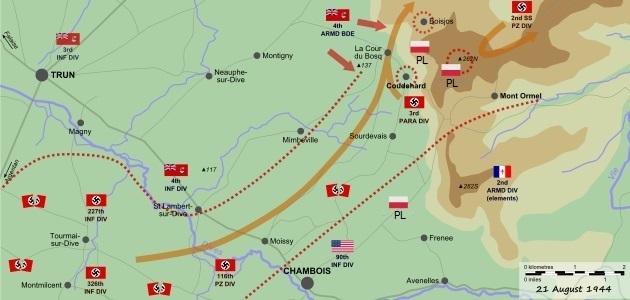
Around 0400 hours in the morning on August 21st, there was a sudden burst of machine-gun fire and a quarter of an hour later, a new German attack. The Poles were losing a lot of men, among them were two lieutenants and there was only one left. Half an hour later it was dawn. The Poles then heard the sound of tanks approaching from the west. Then they could clearly distinguish two green flares.
Between the Allied tanks and them on the side of the hill lay a small, thick wood and the Germans still occupied it. They feared if the Allied tanks encountered resistance the likelihood was that they would pull back and look for another route. The Poles decided to attack the Germans in the wood and link up with their relief no matter what it cost. At the blast of a whistle they went forward and advanced quickly despite branches, craters and the SS. Nothing could stop the wrath of the Poles. They attacked and made their way to the bottom of the hill to see six Shermans firing on them. The Shermans finally recognized them and, with their strength increased, they were soon climbing back up Hill 262. Their victory was total, but at a heavy price.
The Poles, who went into this fight with 87 Sherman tanks against all the remaining weaponry of the German Seventh army surrounded on the plain of Tournai – Aubry – Saint Lambert, 325 were KIA, 16 of whom were officers, 1002 were WIA and 114 were missing. Only 70 Poles survived the slaughter uninjured. Eleven tanks were destroyed. The Germans had about 2000 KIA, 5000 taken prisoner, including a general, six colonels and 80 officers. They left on the battlefield 55 panzers, of which 14 were Panthers and 6 Tigers, 44 guns and 152 armored vehicles, 359 vehicles of all types were destroyed.
Boisjos Manor
The Manor of Boisjos is located at the northwestern end of the Maczuga (Hill 262) and towers over the exit route of the pocket. The Polish used the manor as a bastion and field hospital. German parachutists of the 3. Fallschirmjäger-Division joined a counter-attack with the 2nd SS-Panzer-Korps with the goal to open a gap in the pocket. The attack allowed a few thousands German soldiers to escape. Despite the constant attacks, the manor was never seized by the Germans.
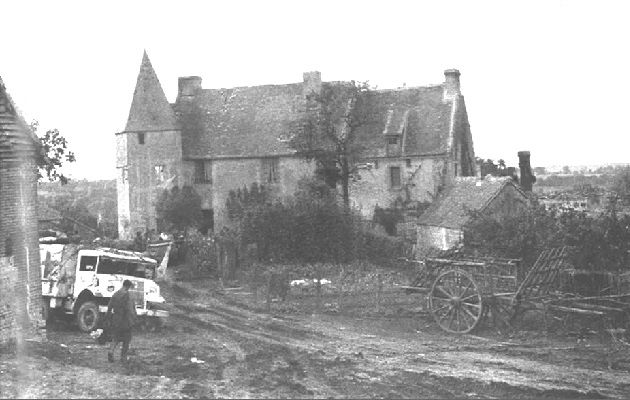
This is the manor today. An extension had been added to the east side of the building.

A Polish Sherman and a Panther knocked out during the fighting around Hill 262.

A view of the carnage on the Chambois-Vimoutiers road heading northeast. On the slope to the upper right are a couple of Sherman tanks which probably belonged to the Canadian 4th Armoured Brigade. The turret of a Panther is at the lower left.
A Polish soldier pose in front a knocked out Panther and a Sd.Kfz. 251 half-track.

“Annihilation Of The Falaise Pocket” August 1944 From the LIFE Magazine Archives, Photographer: George Rodger. Ducks walking pass a knocked out Hummel (German: “bumblebee”) self Propelled gun mounting a 15 cm sFH 18/1 L/30 howitzer which belonged to the 12. SS Panzer-Division “Hitlerjugend”.
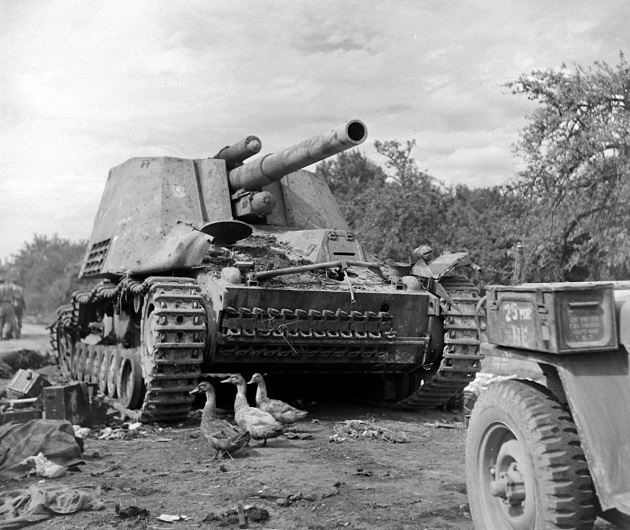
This is a closer view of the Hummel. In the background is a Morris Mk II Light Reconnaissance Car (LRC).

A German column destroyed by Allied air attacks on August 21st. The nearest two panzers are Pz.Kpfw. IV Ausf. Js and the closest one has turret number 723.

A German lorry carrying a naval torpedo captured by Polish soldiers in the pocket. Your guess is as good as mine as to why it is there.

Today
The Canadian Battlefield Foundation Saint Lambert-sur-Dives Vistapoint (Belvédère des Canadiens) is located northwest of Saint Lambert-sur-Dive on D13.
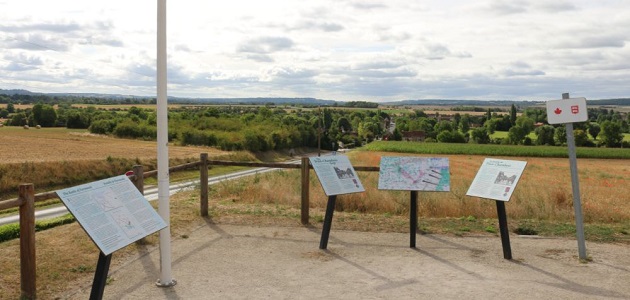
The Major David Vivian Currie Memorial (8 July 1912 to 20 June 1986) is located northwest of Saint Lambert-sur-Dive on D13.

Today, Gué de Moissy is a peaceful spot on a lonely country road which has a single picnic table for the tourists. There is also a foot bridge to cross the river. It is located south of La Droitière road (southwest of Moissy).

The Coudehard-Montormel Memorial (Les Hayettes, 61160 Mont-Ormel, France) has two sites, an open-air monument at the hill’s summit (overlooking the vallée de la Dives and the plain where the last phases of the battle took place) and the museum itself.
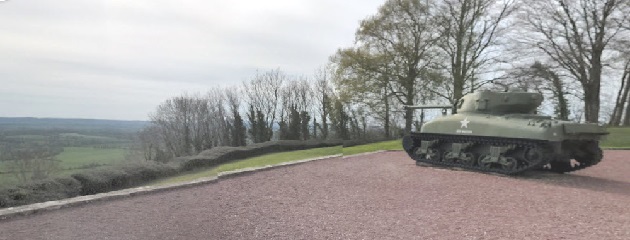
The Manoir de Boisjos (8 Boisjos, 61160 Coudehard, France) is located on Rte de Boisjos (D242) southeast of Coudehard.
Model Decals
1/35
Armo 35404 1st Polish Armoured Division 1944-1946 Part 1 Decals
Armo 35410 1st Polish Armoured Division 1944-1946 Part 2 Decals
ToRo Model 35D10 Polish Sherman tanks 1st Armoured Division NWE 44-45 vol.1
ToRo Model 35D14 Polish Sherman tanks 1st Armoured Division NWE 44-45 vol.2
ToRo Model 35D16 Cromwell & Centaur tanks in Polish service vol.1
ToRo Model 35D17 Cromwell & Centaur tanks in Polish service vol.2
1/48
ToRo Model 48D10 Polish 1st Armoured Division 1944-46 vol.1 Decals
ToRo Model 48D12 Polish 1st Armoured Division 1944-46 vol.2 Decals
ToRo Model 48D13 Polish 1st Armoured Division 1944-46 vol.2 Decals
1/72
ToRo Model 72D10 Polish Sherman tanks 1st Armoured Division Decals

 Mike's Research