The Sturmpanzerwagen A7V was the only tank Germany built during WWI. It was used in combat from March to October 1918, and was the first operational German panzer. On 24 April 1918, the first Tank vs Tank engagement took place at Villers-Bretonneux, France. Throughout the war, the Germans employed more captured British Mark IV tanks than A7V tanks.
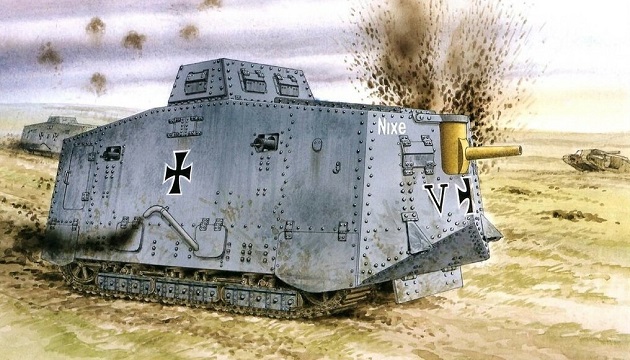
After the first British tanks appeared on the Western Front, in September 1916, the German War Ministry formed a committee, under the supervision of the Allgemeines Kriegsdepartement, Abteilung 7 Verkehrswesen (“General War Department, Section 7, Transportation”), to investigate tank development. The project to design and build the first German tank was placed under the direction of Joseph Vollmer (1871 to 1955), one of Germany’s foremost automobile designers and a reserve Hauptmann (Captain) in the Imperial German Army.
After the initial plans were shared with the Imperial Army in December 1916, the design was modified to have an universal chassis that could be used as a base for both an armored tank and a cargo carrier. In early 1917, 100 A7V chassis were ordered, 10 to be finished as armored fighting vehicles (tanks), and the remainder as cargo carriers. The number of armored fighting vehicles to be built was later increased to 20. The running gear of the chassis was based on the US built Holt tractor, designed from examples on loan from the Austro-Hungarian Army.
Two engines were mounted in the center with the Commander and Driver positions located above the engines. The Commander and Driver seats swivel allowing the tank to be driven in both directions without turning.

The first tank prototype was completed and made its first test trials on 30 April 1917 at Belin Marienfeld. A wooden mockup of a final version was completed in May 1917 and demonstrated in Mainz with 10 tons of ballast to simulate the weight of the armor. After successful trials in Mainz, the design was modified once more to incorporate two more machine guns and a better observation post.
The tank’s name “A7V” was derived from the department of its parent organization: Allgemeines Kriegsdepartement, Abteilung 7, Verkehrswesen (General War Department, Section 7, Transport). In German, the tank was called a Sturmpanzerwagen (roughly “armored assault vehicle”).
Specifications

Length: 7.34 m (24 ft 1 in)
Width: 3.1 m (10 ft 2 in)
Height: 3.3 m (10 ft 10 in)
Weight: 31.5 t (31.0 long tons; 34.7 short tons) battle weight
Armor: 5 to 30 mm (0.20 to 1.18 in)
Main Armament:
One 57mm (2.24 in) Maxim-Nordenfelt gun (initially 180 rounds; later 300).
Secondary Armament:
Six 7.9mm Maschinengewehr 08 (MG 08) machine guns (36,000 rounds).
Engines:
Two Daimler 4-cylinder petrol engines, 75 kW (101 hp) each.
Maximum Speed:
On roads: 15 km/h (9.3 mph)
Cross-country: 6.4 km/h (4.0 mph)
Operational Range: 30–80 km (19–50 miles)
Basic Crew (18):
1x Commander
1x Driver
1x Mechanic/technician (also reserve driver)
1x Mechanic
12x MG Gunners (2 per MG)
1x 57mm Gunner
1x 57mm Loader
Additional crewmen:
1x Assistant (Gefechtsordonnanz)
1x 57mm Gun Commander (Geschützführer)
1x Blinker or Signaler
1x Pigeon Handler
1-2x Runners
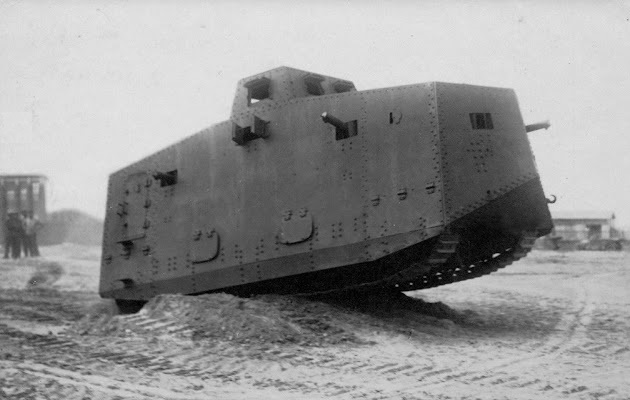
Compared to other WWI tanks, the road speed was quite high, but the A7V had very poor off road capability. The high center of gravity of the A7V caused it to be prone to tipping over onto its side. The large overhang at the front and the low ground clearance meant trenches or very muddy areas were impassable. This was worsened by the fact that the driver sitting on top of the tank could not see the terrain directly in front of the tank, due to a large blind spot of about 10 meters (32.8 feet).
A7V Production
Production of the A7V tank was at Daimler-Motoren-Gesellschaft (abbreviated as DMG, also known as Daimler Motors Corporation) in Berlin-Marienfelde. The first pre-production tank was built in September 1917, followed by the first production model in October 1917. The A7Vs were all mostly hand built and of great manufacture quality at a very high cost. Each tank had unique features as there was no standardization.
A7V No. 501 in trials at the Daimler Works in November 1917. At this time, the armament consisted of four MG-08 machine guns and two flammenwerfer (flame throwers). Note the absence of exhaust hole and tube on the hull side.
A7V tanks at different stages on the production line. The closest A7V shows the improvised trestle mounting for the 57mm gun, the so called buck-mount which is sitting on the chassis. It is too close to the engines. When the armored hull is added, the 57mm gun buck-mount would be moved forward and bolted down. Note the chassis number on the front hull of this tank is 506.

A7V tanks and cargo carriers at DMG. The original intention was to build half of the A7V tanks as “females” with machine guns only. A7V number 501 was the only female A7V tank delivered and used in combat. The female tank had two forward facing machine guns instead of the 57mm cannon with a basic crew of 20.

A7V tank names
Some of the A7V tanks had their name changed a few times.
| Serial No. | Names | Notes |
|---|---|---|
| 501 | Gretchen | Colloquial diminutive of Grete (Greta) which is a short form of Margarete (Margaret) meaning “the pearl”. |
| 502/503 | Faust | In English: Fist |
| 504 | Schnuck | In English: Sweetie |
| 505 | Baden Prinz August Wilhelm August Wilhelm | In English: Bathe Prince August Wilhelm of Prussia |
| 506 | Mephisto | Mephistopheles or Mephisto is a demon featured in German folklore. |
| 507 | Cyklop Prinz Eitel Friedrich Eitel Friedrich Imperator | In English: Cyclops, giant one-eyed creatures from Greek mythology. Prince Wilhelm Eitel Friedrich of Prussia Emperor |
| 525 | Siegfried | Legendary Germanic hero who killed a dragon. |
| 526 | No name | |
| 527 | Lotti | Diminutive of the name Charlotte which means “free man” or “petite”. |
| 528 | Hagen | Masculine German name meaning “enclosure” or “hedge”. |
| 529 | Nixe II | Water sprite (Nixe) or mermaid of the Danube, second tank with this name. |
| 540 | Heiland | In English: Savior |
| 541 | No name | |
| 542 | Elfriede | Female name meaning “elf-strength”. |
| 543 | Bulle Prinz Adalbert Adalbert | In English: Bull Prince Adalbert of Prussia |
| 560 | Alter Fritz | In English: Old Fritz |
| 561 | Nixe | Water sprite (Nixe) or mermaid of the Danube. |
| 562 | No name | |
| 563 | Wotan | A principal god in Norse mythology also known as Odin. |
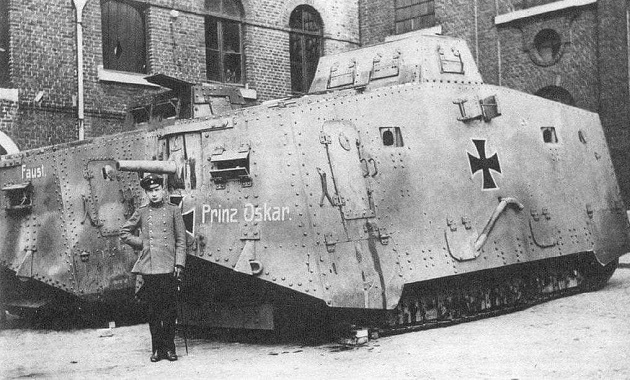
| 564 | Prinz Oskar Oskar | Prince Oskar of Prussia |
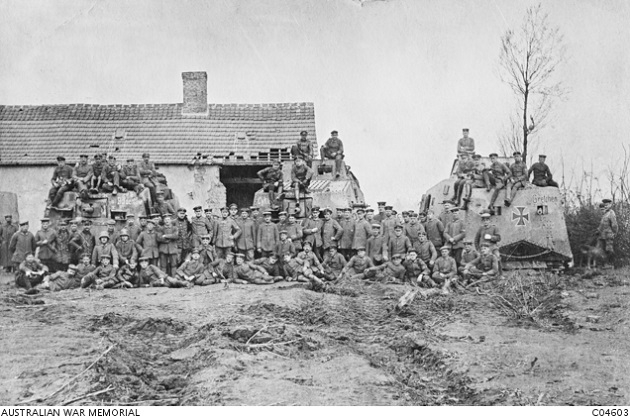
German officer standing in front of A7V No. 564 Prinz Oskar and behind it next to the building is A7V No. 502 Faust.
The crew posing with A7V No. 505 Baden. The number is painted in white on the inside of the open hatch.

Part of the crew posing with A7V No. 506 Mephisto.

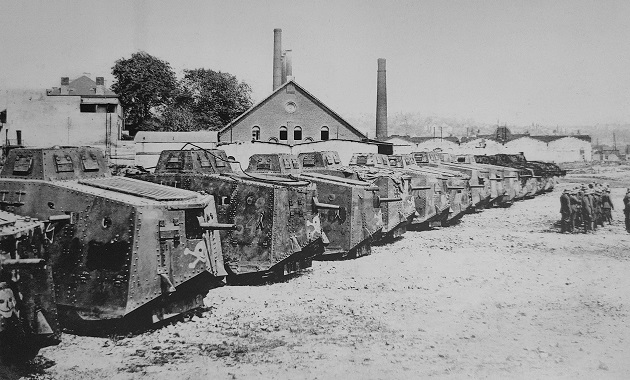
A line up of about 14 A7V tanks. On the right, crews are standing at attention. The location and date unknown.
A7V First Combat
The objective of Operation MICHAEL in the Spring of 1918 was to break through the Allied (Entente) lines and advance in a north-westerly direction to seize the Channel Ports, which supplied the British Expeditionary Force (BEF). It was designed to first separate the French and British Armies before continuing with the original concept of pushing the BEF into the sea.
The first combat of the A7V tank occurred on 21 March 1918. Five A7Vs were involved, from Assault Tank Detachment 1, Abteilung (Battalion) 1. These were tanks 501 (the only A7V female tank with no 57mm gun), 502, 505, 506, and 507. The attack was launched in an area south of the occupied city of St. Quentin and to advance west towards Amiens, a vital Allied railway junction. Although it was part of Operation MICHAEL, it was a small attack. The detachment commanded by Hauptmann Greiff composed of only 5 A7V tanks and 5 captured British Mark IV tanks tasked to support the attacking infantry.
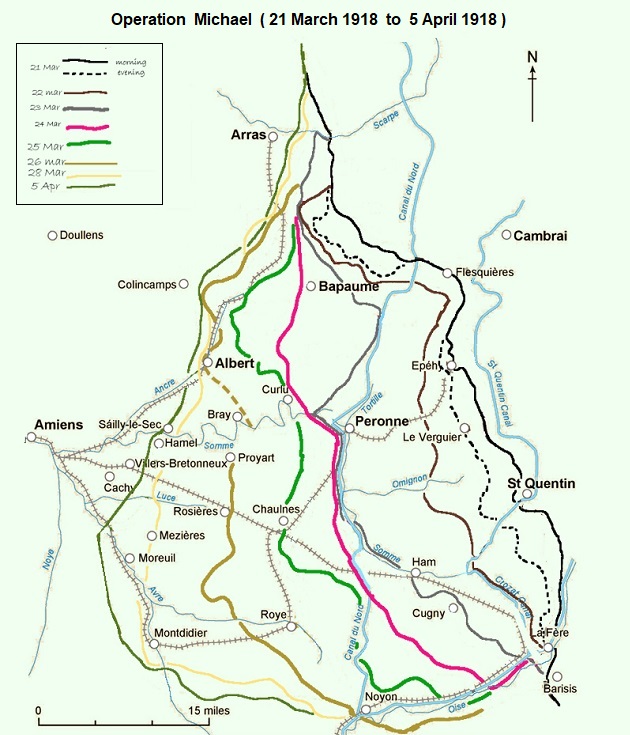
At the start of the attack, in darkness, tank No. 502 broke down and had to be left behind. The other four A7Vs continued on but after daybreak the tanks found themselves in thick early morning fog, worsened by smoke from a five hour artillery barrage. The view from the A7V driver’s position was not good most of the time, but in fog it was almost impossible. They then entered a barbed wire entanglement on the front line, tank 501 easily made its way through and Nos. 506 and 507 found their own way through, but No. 505 got tangled up and broke down. It could not start up again, so they were down to 3 tanks. Being lost in the fog, Hauptmann decided to call a halt until the fog has lifted.
Around 1130 hours, Greiff ordered the tanks to move forward again as visibility had improved. A bit later tank No. 507 fell by the wayside. While it was in the barbed wire some piping had been torn away between the rearmost radiator and the right side engine resulted in all the coolant drained out but a little later on, after clear of the wire, a fault developed in the transmission and the tank could not continue. Just 2 A7V tanks were left to continue the attack, No. 501 and No. 506.
The two tanks moved on and they came up behind their infantry who were pinned down by heavy defensive fire from the British trenches so the tanks took over and led the attack. Similar to the Germans in 1916 and 1917, the British troops recognized the futility of resisting tanks, they either retreated or surrendered. The tanks then advanced to a strong point known as the Pontchu-Ferme (Pontchu Farm), a fortified farmhouse and encountered another strong point that the infantry seem to have avoided.
Described as a fortified quarry, it was a nest of enemy machine gun and mortar positions supported by infantry, which held up the German attack until the tanks intervened. Tank 501 was credited with overcoming a number of enemy machine gun positions while 506 used its 57mm gun to fire grapeshot (antipersonnel shot) into the quarry. It is not known if either tank actually entered the quarry which may have been uneven ground, but the assault troops were sent in and they silenced all opposition. The assault troops returned with 6 officers and 150 soldiers of the London Rifles who were said to have been captured.
Now the tanks advanced towards their final objective for the day, the so-called “Entente Position” where they came across a similar situation; German infantry were held up by heavy defensive fire. Tank 501, the female A7V, carried a pair of short range portable flamethrowers that the crew were trained to use in the dismounted assault role, so they were deployed. This time the tanks attacked from the flank and cleared the trenches and before long the “Entente Position” was in German hands. By that time, the build-up of heat and fumes inside the tanks had reached alarming proportions so the tanks halted and ventilated. After gone as far as they were expected to go, they remained for the rest of the afternoon in case of a British counter-attack and only departed to make their way back to their own lines after their infantry released them.
A7V tank 526 driving through Roye, France which was captured on 26 March 1918. The soldiers riding on top of the tanks are likely most of the crew. Roye is located at the junction of the A1 and D934 about 30 miles (48 km) southeast of Amiens.

Bundesarchiv Bild 183-P1013-316
In mid April, tanks 501, 502 and 506 were returned to Charleroi (between Mons and Namur) in Belgium for refurbishment. No. 505 and No. 507 were handed over to the new Abteilung 3 for crew training and familiarity. However, tank No. 502 was beyond repair and the body was transferred to the only thing available, cargo carrier No. 503.
First tank vs tank battle
The second battle of Villers-Bretonneux took place during the German spring offensive from 24 to 27 April 1918 east of Amiens. It was the first time in which tanks fought against each tanks in combat and it was the largest and most successful tank action of the German Imperial Army during the war.
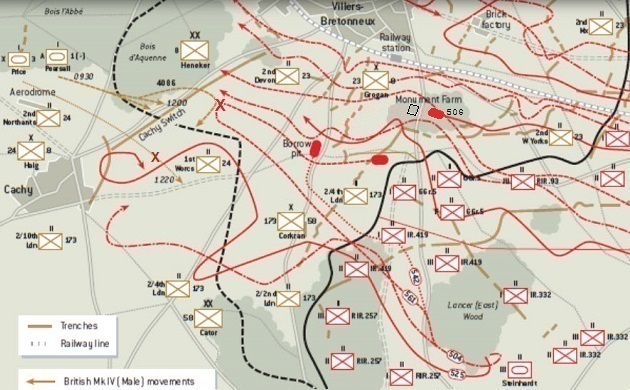
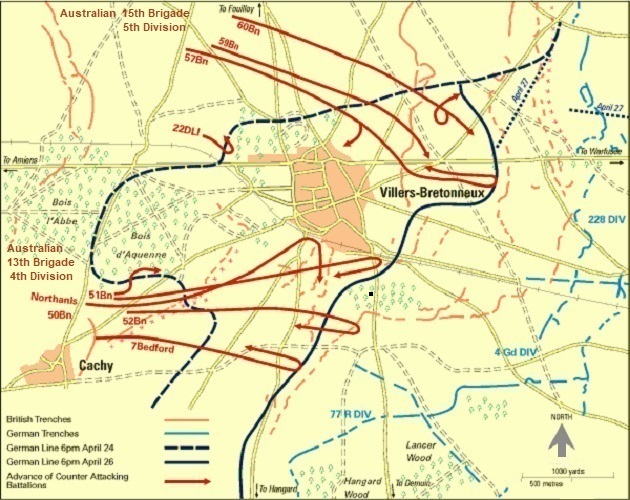
Starting from Marcelcave (southeast of Villers-Bretonneux), 14 A7Vs and supporting infantry led the final push towards the strategic allied supply hub of Amiens. The A7V tanks were divided into 3 groups, the first Skopnik with 3 tanks attacked and took Villers-Bretoneux. The second group Uihlein with 7 tanks struck towards the Bois d’Aquennes (Aquennes Woods), while the third group Steinhardt comprising of A7Vs “Elfriede”, “Nixe”, “Siegfried” and “Schnuck” drove towards Cachy. Cachy is situated on the D168 road, some 9 miles (14 km) southeast of Amiens and southwest of Villers-Bretonneux.
On 17/18 April, the Germans shelled the area behind Villers-Bretonneux with mustard gas, causing 1,000 Australian casualties. On the evening of 23/24 April, an artillery barrage was fired, using mustard gas and high explosive rounds. Next morning, the Germans attacked the village with four divisions. The German infantry supported by A7V tanks, broke through the British 8th Division and made a 3 mile (4.8 km) wide gap in the Allied line. The Germans captured Villers-Bretonneux and the railway junction of Amiens became vulnerable to capture.
After Villers-Bretonneux fell, the first engagement between opposing tanks took place. Three British Mark IV tanks from No. 1 Section, A Company, 1st Battalion, Tank Corps was dispatched to the Cachy switch line, at the first report of the German advance and were ordered to hold it against the Germans. One tank was a “male” No. 4086 (the No. 1 Tank of the section) armed with two 6-pounder guns and machine guns, under the command of 2nd Lieutenant Frank Mitchell. It was crewed by only four of the normal crew of eight, as the others had been gassed. The other two tanks were “females” armed with 0.303 in (7.7 mm) machine guns. All three British tanks were advancing when they encountered German A7V No. 561 “Nixe” of Abteilung 3 Imperial German Tank Force, commanded by Leutnant Wilhelm Biltz supporting the 257th Reserve Infantry Regiment, 77th Reserve Division.
A7V “Nixe” fired on the two Mark IV females, damaging them to the extent that it left holes in the hull leaving the crew exposed. Both of them retreated as their machine guns could not penetrate the armor on the German tank. Mitchell’s male Mark IV continued to fire at the A7V while on the move to avoid German artillery fire and the gun of the German tank. However, firing on the move, Mitchell’s gunner had difficulty in aiming the 6-pounder gun. The opposing tanks fired at each other on the move until Mitchell ordered his Mark IV to stop to allow his gunner to fire accurate shots. The gunner scored three hits out of a total of six shell fired. The first round hit the starboard front plate just beside the A7V’s main gun. The impact killed mortally wounded two crewmen and slightly wounded three others. Two additional rounds struck its starboard flank, which damaged an oil mechanism, and forced the A7V to a stop.
As the A7V carried ammunition, a box of hand grenades, and other potentially explosive materiel, fearing additional hits on the hull, the crew abandoned their tank. Mitchell responded by ordering his machine gunners to fire at the German tankers, including Biltz, as they baled out of the tank.
Mitchell’s 6-pounder gunner then switched to case-shot (Canister shot), and poured round after round into the advancing German infantry as the other two German A7Vs, No. 525 and No. 504, approached. Sensing sure destruction, Mitchell’s gunner desperately fired at one of them. The shots missed, but, to their amazement, the A7V slowly started to back away and its companion also turned and retreated. Momentarily victorious, Mitchell and his crew were still in no man’s land facing the German assault and were now the main target for the German artillery.
Mitchell kept his tank moving, zigzagging through no man’s land as German shells fell all around them. A German plane appeared overhead and dropped a bomb which exploded sending the front of the tank bounding up into the air. Fortunately, no real damage was done, but a few minutes later, while still zigzagging, the tank slipped into a large crater and became stuck, its engine stopped and its underbelly was exposed. In the distance, Mitchell could see the German infantry forming up for a fresh attack. As the shells came closer, Mitchell’s crew managed to get the tank restarted.
Their hopes soared at around 1220 hours, to their right, 7 British Mark A Whippet medium tanks of X Company, 3rd Battalion, 3rd Tank Brigade, armed only with four 0.303 caliber Hotchkiss machine guns, were charging at top speed 13.4 km/h (8.33 mph) towards the advancing German infantry.
Three British Whippet tanks traveling along a road near Villers-Bretonneux. Note the Royal Armoured Corps white/red/white stripes on the front and side.

A7V tanks No. 525 “Siegfried” commanded by Leutnant Friedrich-Wilhelm Bitter and No. 504 “Schnuck” commanded by Leutnant Albert Müller were driving towards the British trenches in front of the village of Cachy in support of the advancing infantry. The German infantry commander contacted Bitter and directed him towards the approaching Whippet tanks. At that time, Müller’s tank was too far south, out of range.
The Whippet tank commanders quickly realized that they were out gunned. They had no weapon that could knock out a tank, so they tried to escape. Bitter’s gunner’s first shot missed 2nd Lieutenant Harry Dale’s Whippet No. A256 but his second shot at a range of 200 m (218.72 yards) set it on fire. The gunner then fired at 2nd Lieutenant D.M. Robert’s Whippet No. A255 at a range of around 700 m (765.53 yards). Again his first shot missed but he hit it with his second round, knocking it out. The A7V’s 57mm gun firing pin’s striker springs then broke under stress and the gun was no longer functional. With only machine guns, Leutnant Bitter then engaged a third British Whippet No. A244 commanded by 2nd Lieutenant George Richie. The Whippet was damaged and could not move, then further machine gun fire hit either the fuel tank or ammunition and set it on fire.
The four remaining Whippets started to withdraw from the battlefield towards the protection of the woods near Cachy. As they went, they continually fired their machine guns at the advancing German infantry. Müller’s No. 504 Schnuck then emerged through the mist near Cachy and fired at the retreating Whippets. 2nd Lieutenant Thomas Oldham’s Whippet No. A236 “Crawick” was knocked out and caught fire. The other three Whippets, No. A286 “Crustacean”, No. A277 “Centaur III”, and No. A233 “Crossmichael”, made it back safely to the British lines at 1530 hours.
Lieutenant Mitchell Mark IV continued advancing and approached Cachy. A fourth German tank appeared 1000 yards (914.4 m) away and the two tanks fired away at each other while speeding across the battlefield. An artillery shell suddenly hit one of Mitchell’s tank tracks and the tank could only turn in circles. At that point, Mitchell decided to abandon the tank. The crew fired their last remaining shells and then escaped through the hatches, making their way to the nearest friendly trench.
The world’s first tank against tank encounter had ended. For his actions, Frank Mitchell was awarded the Military Cross. During pauses in the battle, the British managed to retrieve Mitchell’s disabled tank. Biltz and the crew of the A7V “Nixe” returned and noticed that the engines were still running. They managed to drive it about 2 miles (3.22 km) back towards their lines before it broke down again for good and had to be abandon again.
This is apparently A7V No. 561 “Nixe” which was able to return to the German lines after the battle but the engines failed. Attempts by the Germans to recover it were unsuccessful, and it was blown up.

Video: Tank vs Tank: Villers-Bretonneux, April 1918 | The Tank Museum
During the night of 24/25 April, the Australian 13th and 15th Brigades moved into positions northeast of Cachy and northwest of Villers-Bretonneux. The next morning, an Allied counter attack was launched against the German forces. By the evening of April 26th, the Allies re-captured Villers-Bretonneux and it remained in Allied hands to the end of the war.
A7V Elfriede
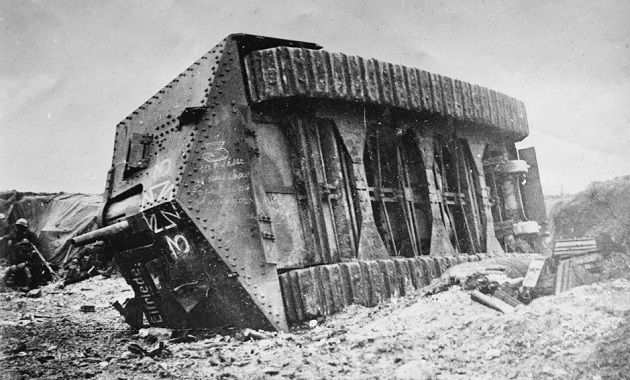
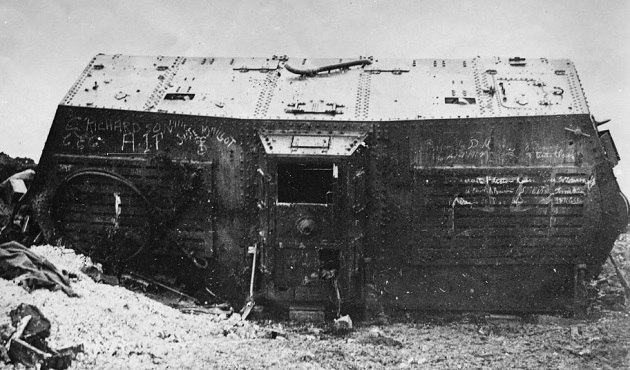
During the attack on April 24, A7V 542 Elfriede had drifted a little too far to the north. About 1 km (0.62 mile) south of Villers-Bretonneux, along the road to Hangard-en-Santerre. Driving over rough terrain, A7V Elfriede tipped over and came to rest on its right side. The commander was killed and after the crew abandoned the tank they continued the attack with three machine guns as an assault squad. These photos of the tipped over A7V Elfriede were taken on 8 May 1918.
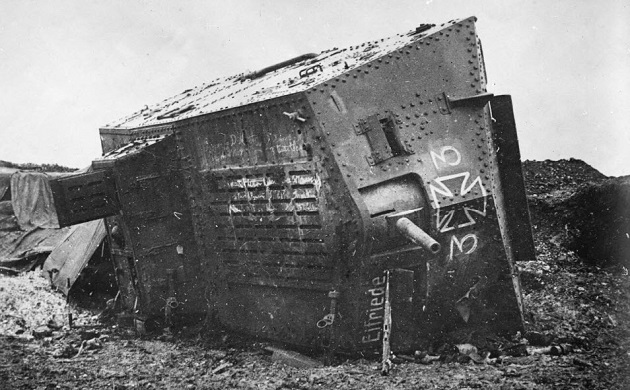
This photo shows the underside of A7V Elfriede. The bogie units and tie rods are visible between the tank’s tracks.
This photo is the top of the A7V tank. Note the open hatch.
This is the only area south of Villers-Bretonneux where A7V Elfriede could have tipped over. Sources called it a sandpit or a quarry. This is a borrow pit, an excavation where gravel, soil or sand had been removed for construction purposes. In this case, for building battlefield trenches and fortifications in the area.

British tanks uprighted and recovered A7V Elfriede on 15 May 1918 and handed it over to the French. French (left) and British (right) Officers posing beside A7V Elfriede at Saleux (southwest of Amiens and west of Villers-Bretonneux) on May 18th. Note the graffiti written all over the tank and the towing cable on the roof.

Film: Recovery of A7V Sturmpanzerwagen Elfriede, 15 May 1918
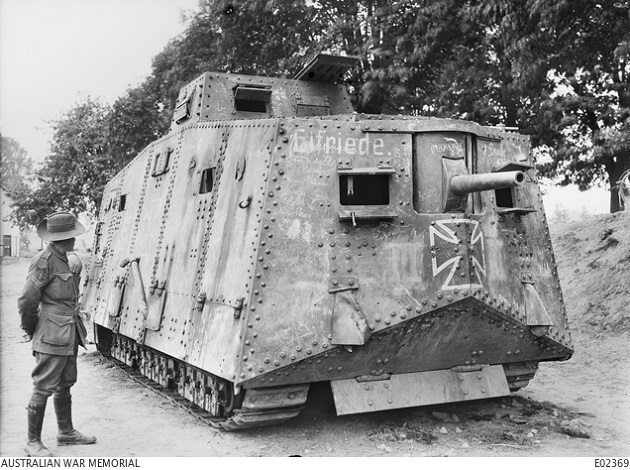
An Australian soldier examining A7V 542 Elfriede at Saleux on 26 May 1918.
Film: Testing WW1 German A7V Tank Elfriede
A7V 542 Elfriede is exhibited among other captured German equipment at Place de la Concorde-Paris in October 1918. Barricades were in place to prevent visitors from vandalizing Elfriede, taking souvenirs, etc.

Film: Crowds inspect captured German equipment in Paris.
In 1919, A7V Elfriede was scrapped.
A7V Mephisto
On 21 March 1918, A7V 506 took part in the A7V’s first attack near St. Quentin. After the battle, it was then transported to the German tank workshop near Charleroi, Belgium for minor repairs and repainting. It was reissued in mid-April and its new commander was Leutnant Heinz Theunissen. At that time, it had become fashionable to name the A7Vs after figures from German history or mythology, and it is believed that Theunissen chose the name “Mephisto”.
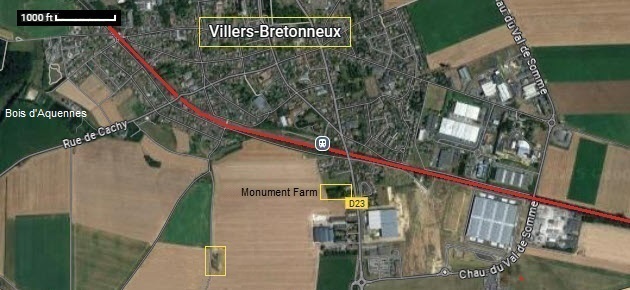
During the attack at Villers-Bretonneux on April 24th, A7V Mephisto was part of the middle group of tanks which advanced with the railway line on its right, towards their objective, the Bois d’Aquennes, west of the town. The first contact with Allied troops came when Mephisto’s group approached the settlement called by the Allies “Monument Farm” (French name Ferme de la Couture). The group advanced through an orchard in front of the fortified farm house, forcing the British troops to withdraw, but Mephisto suffered a fuel blockage and had to stop, while the other tanks continued on.
Theunissen and some of his crew advanced on foot to help with the attack on the farm house and returned to Mephisto after it had been repaired. They had now fell behind the other tanks, so Theunissen set off in pursuit. However, soon afterwards a shell landed immediately in front of the tank, creating a large crater. The tank pitched into the crater and became stuck. The crew had no option but to abandon the tank. By early morning on the April 26th, the front lines had returned almost to their previous positions, but the orchard at Monument Farm remained in German hands, with Mephisto, unbeknownst to the Allies, still immobilized but intact in the crater.
The front line was now a series of connected “outposts” rather than the continuous parallel deep trenches that had was common earlier in the war. In the weeks after the battle, units of the Australian Imperial Force (AIF) began a series of small raids on enemy outposts, surrounding and occupying them and killing or taking prisoner the occupants. The effect was to gradually push back the German front line. During one of these excursions, on July 9th, men of the 28th Battalion in Monument Wood came across Mephisto but had to retire after coming under enemy fire.
On the night of the July 13th, 26th Battalion took over the section of the front and soon completed the occupation of Monument wood. On July 14th, 26th Battalion reported that during their attack they had captured the derelict German tank No. 506 Mephisto. On the night of July 22nd, the Australians launched a recovery operation to retrieve A7V Mephisto from Monument Wood. Two vehicles of the 1st Gun Carrier Company, 5th Battalion Tanks accompanied by 23 men of the 26th Battalion traveled from Villers-Bretonneux towards Monument Wood.
The two recovery vehicles used were British Gun Carrier Mark Is designed to transport a 6-inch howitzer or a 60-pounder field gun. This was the first tracked self propelled gun used in combat.
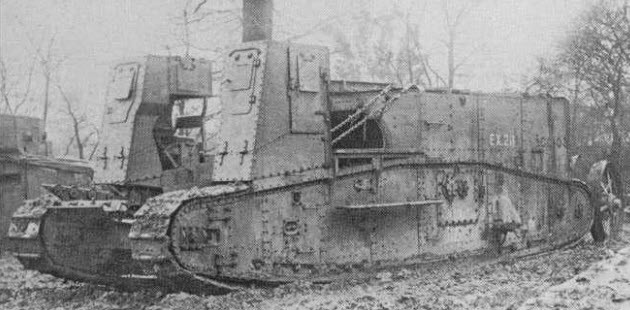
Film: British Gun Carrier Mark I
To cover the noise of the recovery operation, an aircraft flew low overhead and Allied artillery carried out sporadic shelling around the group. The Germans did launched an apparently pre-planned gas shell bombardment which forced the recovery party to wear their gas masks. A steel cable was attached to Mephisto, and it was towed about 4 km (2.5 miles) westwards to the temporary cover of Bois d’Aquennes. The recovery party obscured their trail and laid a false one to mislead German aircraft observers. Mephisto was then moved by stages to the 5th Tank Brigade training ground at Vaux-en-Amiénois.
Video: Capture of A7V Mephisto: 26th Battalion at Monument Wood
Today, it appears a portion of what was the Monument Farm still exist. The red line is the railway line and the bus icon is the location of the railway station.
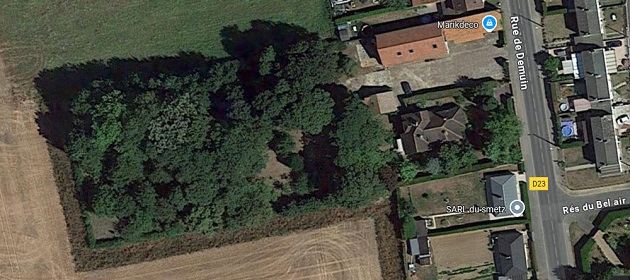
This a close up of the farm. The trees are probably what is left of the wood. The building is a fabrics/curtains store. The original farm buildings are probably long gone.
A7V 506 Mephisto after recovery from the Monument Wood in July 1918. The tank was covered with names and graffiti. Note the mis-spelled “Salvaged”.

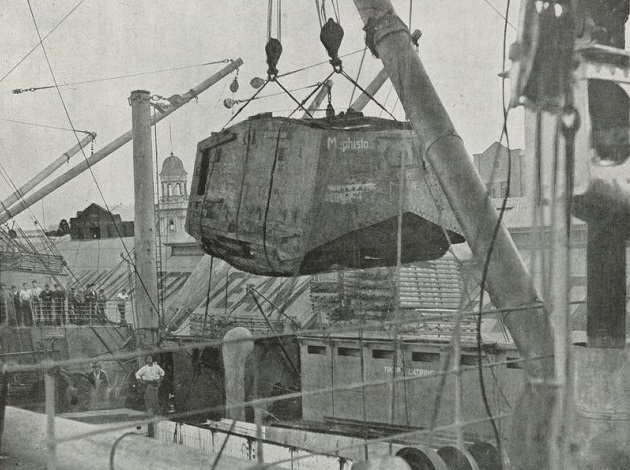
Mephisto being unloaded from the SS Armagh in Brisbane, Australia. It arrived on 6 June 1919 at the Norman Wharf (near the intersection of Creek Street and Eagle Street, approximately where the Eagle Street Pier ferry wharf is today) on the Brisbane River.
Three A7V tanks and their crews, from left to right “Baden”, “Cyklop” and “Gretchen” (female). After the battle at Villers-Bretonneux, they regrouped at the nearby town of Rozieres. In May/June 1918, A7V No. 501 Gretchen had its 57mm gun fitted.
A7Vs No. 528 Hagen and No. 504 Schnuck during the German Spring Offensive in Artois and Picardy, May 1918. These are the rear view of the tanks.
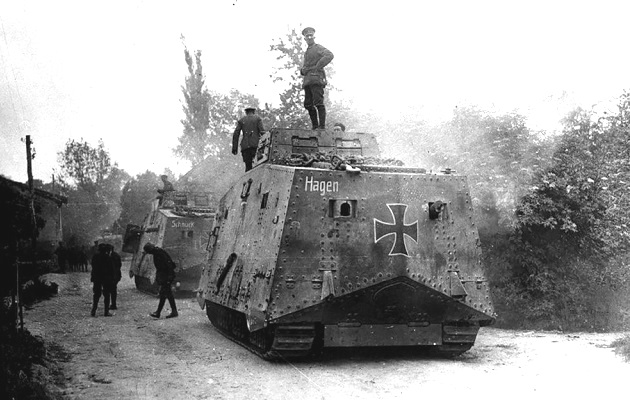
On 25 May 1918, an order was issued that names of Royal personages were not to be used and 526 “Alter Frit” became “Fritz”. Then badly worn out 526 “Fritz” was returned to a tank recovery unit in Charleroi, Belgium. In fact, 526 never appeared again and must have been used for replacement parts.
A7V No. 529 Nixe II was knocked out by French 75mm hits on the left side during an action north of Reims on 31 May 1918 and it was abandoned after unsuccessful salvage attempts. The tank had large hole cut in the front armor in an unsuccessful attempt by the French to remove the 57mm gun. The tank was handed over to the US Army in July 1919, transported to the USA and exhibited at the Aberdeen Proving Grounds until 1942 when it was scrapped.
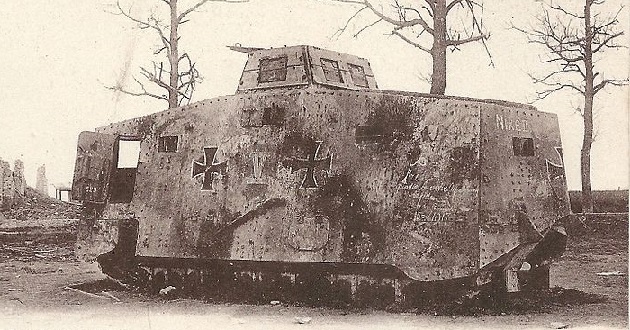
On 1 June 1918, in an attack on fort de la Pompelle, also known as Fort Herbillon (southeast of Reims), A7V No. 527 “Lotti” was knocked out. Note the large number 527 painted on the hull side.
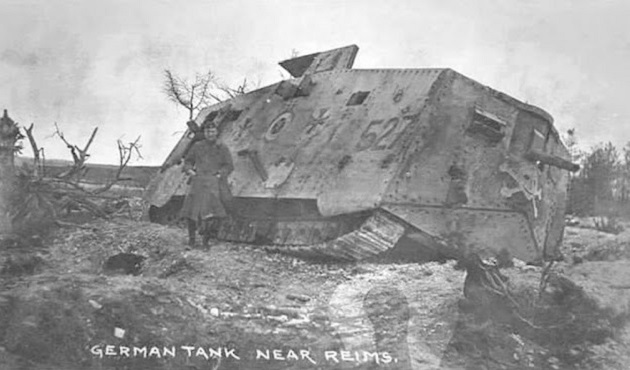
German A7V tanks, the first one is A7V 563 “Wotan”, passing through a town, June 1918.
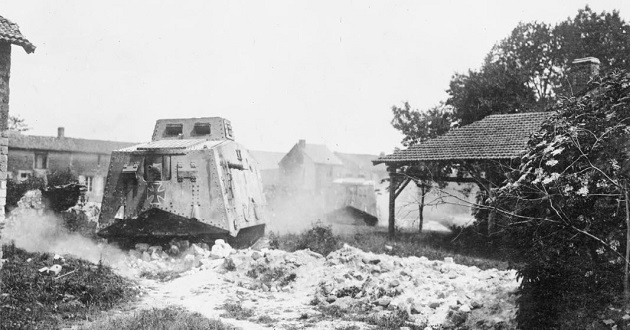
A7V 563 “Wotan” passing through a town, June 1918.

A German A7V tank moving along a road after being de-trained, July 1918. Most of the crew are riding on top.

A7V 525 Siegfried, July 1918. Most of the crew are also riding on top.

Bundesarchiv Bild 146-1974-050-12 CC-BY-SA 3.0
Frémicourt
The New Zealand Division of the 3rd Army recaptured the village of Frémicourt, 30-31 August 1918. Frémicourt lies 5 km (3.1 miles) northeast of Bapaume.
A7V tanks, probably in Frémicourt on 31 August 1918. The one on the right passing the tree is named “Hagen”, the other in the center is very likely “Schnuck”.

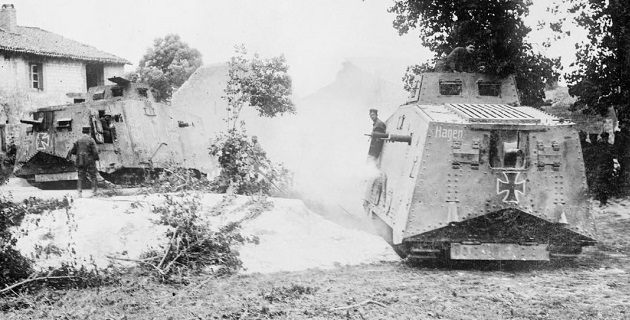
Sources state that these tanks have been disabled by German artillery fire at Frémicourt on August 31st. Most likely the crews abandoned their tanks when the artillery barrage began.
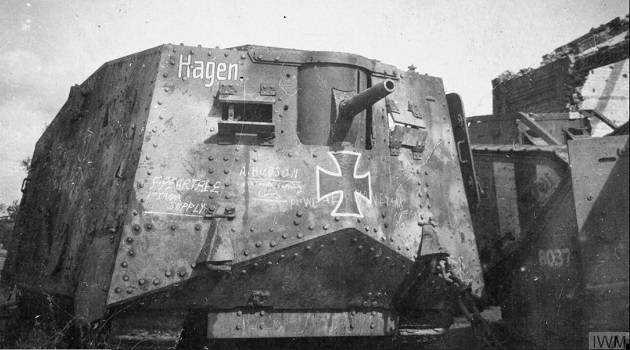
A7V 528 Hagen captured at Frémicourt on August 31st. Parked next to Hagen are two British Mark IV tanks. One male tank is number 8037.
Film: Capture of A7V Schnuck and Hagen, Fremicourt, 31 August 1918
Film: IWM 326 SEPTEMBER OFFENSIVE 6
A7V Hagen, Frémicourt, 31 August 1918

A7V No. 504 Schnuck abandoned at Frémicourt on August 31st. Note the number 504 on the inside of the hatch door.
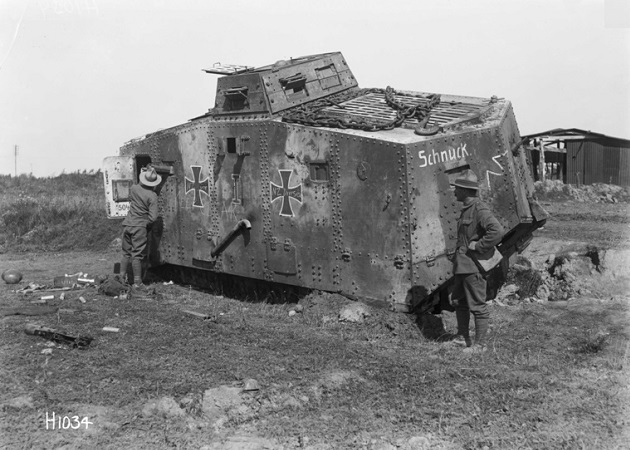
A captured German A7V tank at Bapaume (west of Frémicourt). On the right is the front of a British Whippet tank.

This is my close up of the above photo. The number 504 on the inside of the hatch door indicate that this is A7V “Schnuck”. It must have been towed back to Bapaume.

A7V Last Combat
The last combat use of the A7V tanks took place on 10 and 11 October 1918 at the village of Iwuy, 9 km (5.6 miles) northeast of Cambrai, against the Canadians.

On 9 October 1918, the Canadian Light Horse (CLH) regiment had crossed the Canal de l’Escaut to seize the high ground northwest of Naves. Their attack was halted with heavy losses, by concentrated machine gun fire coming from Naves and nearby Iwuy.
The next day was a rainy, misty day. A Squadron (19th Alberta Dragoons) and C Squadron (16th Light Horse) and the 19th Battalion went ahead for the attack on the town of Naves establishing a position about 0830 hours. In the afternoon, the cavalry came up to advance on the next ridge. They went over about 1400 or 1500 hours. They had to go down a hill and up another. A creek (River Erclin) ran between them and the Germans, who were on the other side in trenches on the hill. The cavalry went forward, the horses ringing wet (with sweat). They charged down the hill and over the creek, then the Germans opened up on them. They could not help but hit them with machine gun fire. All the men out of 75 or so went down but one, and he finally went down. But the horses were not all killed. The attack was a failure. The charge on October 10 cost the regiment 71 horses, of which 66 were killed. The losses among the men were considerably lighter, 5 KIA and 17 WIA. This was the last combat charge in the history of the Canadian cavalry.
On October 11th, the 4th Canadian Infantry Brigade continued the attack at 0900 hours, with the objective of capturing AVESNES-le-SEC (northeast of Iwuy) and move on to NOVELLES, and attempt to make a crossing over River Erclin. The action proceeded promptly with the 146th Brigade on the right of the 21st Canadian Battalion. As the advance continued on the high ground they suffered many casualties from German machine gun fire. As the allied infantry advanced, they were met by a bombardment of shells, and approaching tanks.
After a reconnoiter by the military officers, the infantry was on task again. The officers began to figure it out and they yelled “come on Canadians.” They charged and all the Imperials as well, they were all mixed up, and the rally was followed all along the line. It was in the open and there were thousands of men. The Germans were thick too. They had two tanks on their front. They went on to meet them and about half ways several of the tanks were shot at by Lewis guns and captured machine guns. The Germans had been stopped and were starting to go back. After the battle, the reports differ as to the number of tanks, ranging from 2 to half a dozen tanks during this attack. This was the last action for the A7V tanks during the war.
A7V 540 next to a beute (captured) British Mark IV tank.

This is the rear view of A7V 540. Note the open hatch which probably was an escape hatch.

This is A7V 540 abandoned or knocked out after the battle. Compare the two crosses with the above photos.
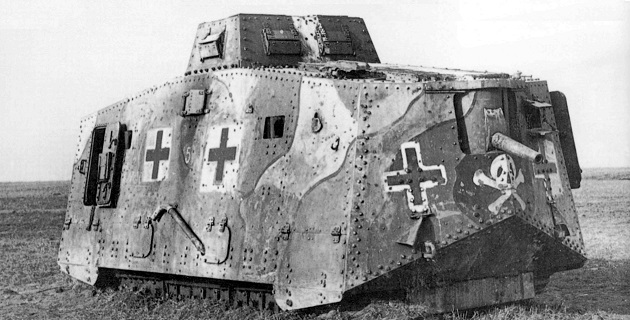
This is my close up of the above photo. It was originally named “Heiland” but it was renamed to “5”. Maybe the commander or the crew felt it was not their “Savior”.

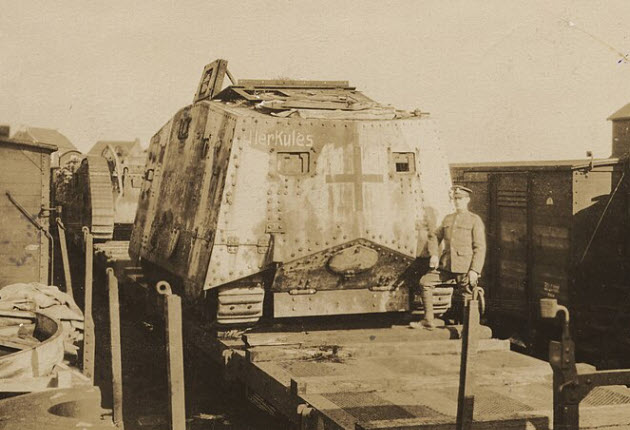
A7V 562 “Herkules” was captured after the battle and is on a rail car. In front of it is probably a captured British Mark IV tank used by the Germans.
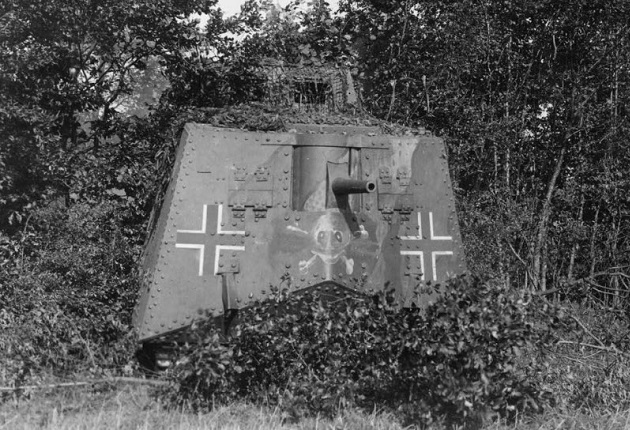
A partly camouflaged A7V No. 501 “Gretchen” emerging from a wood at the Sachy training ground near Sedan, France, October 1918. Gretchen supposedly was used in the making of the German propaganda movie “Die Abwehrschlacht” (The Defensive Battle). Note the more squared Balkenkreuz style crosses.

Captured German A7V tanks (one is named “Hagen”) on railway carriages at the Tank Corps HQ repair shop at Érin (north of Amiens and west of Arras), probably in December 1918. A7V Hagen was displayed on Horse Guards Parade in London and was scrapped in 1919.

A7V tank named “Schnuck” at the Horse Guards Parade off Whitehall in central London. The central cab for the officer and driver had been removed.
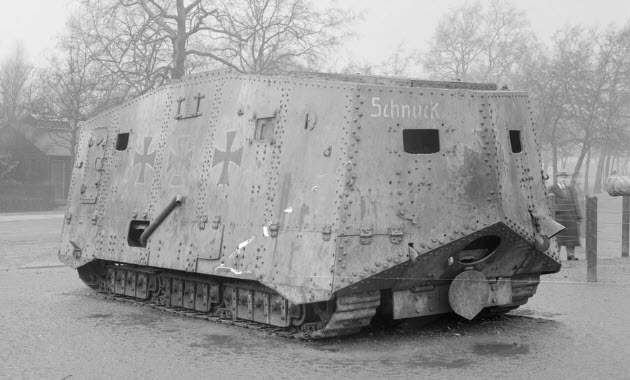
In 1922, A7V tank 504 “Schnuck” was broken up for scrap but its 57mm main gun was saved. Note the slots in the roof over the combat compartment. They appear to be for ventilation, a feature which the British tanks did not have.

A7V Cargo Carrier
In February 1918, the initial modified order for 100 A7V tanks was changed to just 20 finished units. The remaining A7V production chassis were diverted to building prime movers, tracked supply vehicles that could also tow guns and other broken down tanks. The “prime mover” supply vehicle based on the A7V chassis had a number of different names. The Germans made distinctions between Strassenwagen = “Road vehicle”. This vehicle crossed rough undulating ground and was called three different names A7V Geländewagen (“Terrain vehicle”), A7V Rauoenlastwagen (“Caterpillar vehicle”) and A7V Überlandwagen (“Overland Vehicle”). It had a crew of 3 (Commander, Driver and Mechanic).
The first 8 A7V Geländewagen vehicles (chassis numbers 508 – 515) were completed by September 1917. In November 1917, they were in use with the German Armee Kraftwagen Kolonne (Raupe) III – AKK(R)111 “111th Tracked Army Motor Vehicle Column (Caterpillar)” in Northern France. By September 1918, 30 were in service with the AKK(R)111 and the AKK(R)1122 Army transport columns.
The AKK(R) 111 unit swastika tactical symbol is painted on the front and the sides of the vehicles.
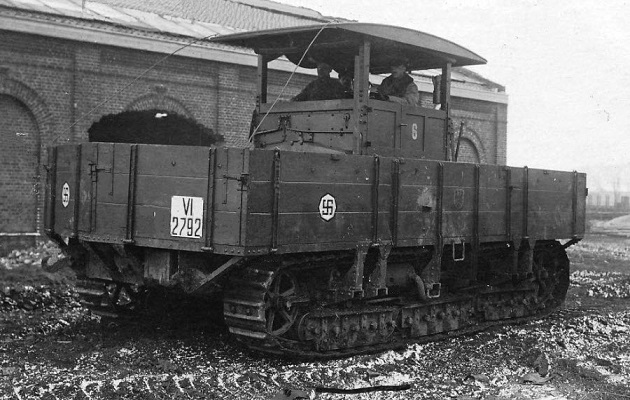
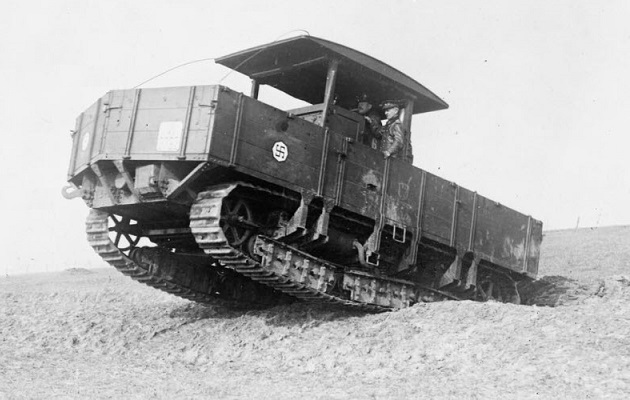

The A7V Überlandwagen’s carrying capacity was approximately 3 to 4 tons (2.7 to 3.6 tonnes). Although it was able to handle muddy terrain, it had limited success due its slow speed, low ground clearance, poor rough terrain handling and lack of protection for the crew.
Fuel consumption was another big issue, especially in 1918 when fuel supplies were low. The A7V Überlandwagen required 10 liters (2.64 Gallons) of petrol/gasoline to travel 1 km (0.62 mile). A wheeled truck only required 3 liters (0.79 Gallon) of fuel to cover the same distance. As a result they were not heavily used.
For the Überlandwagen, a canopy was provided over the central control position and wood drop sides and ends were fitted fore and aft of the engine compartment.
On some vehicles, hoops were added to support a tarpaulin cover over the fore and aft cargo beds.

The vehicles which did make trips to the front were well received by the soldiers, as the supplies that the Überlandwagen brought were vital to the men. These supplies included clothes, medicine, munitions and food.
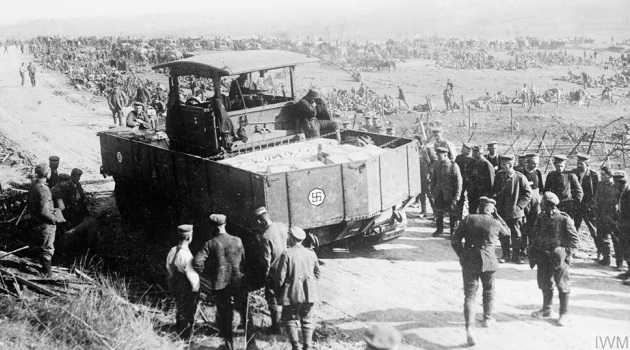
Note the sides drop down to allow loading or unloading.

An A7V Überlandwagen following a A7V tank along a road. This Überlandwagen does not have a canopy over the central control position. Note the tarpaulin cover on the rear allowed more gear to be carried.
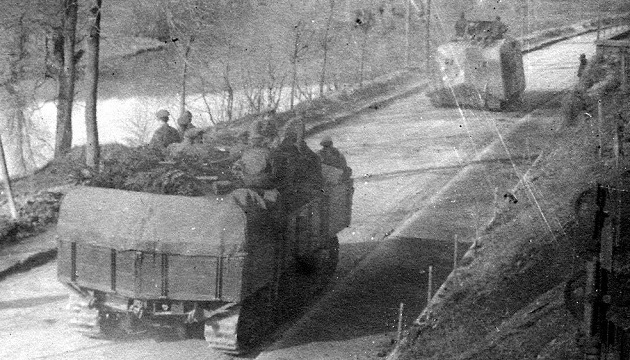
The fate of the A7V Überlandwagens after WWI is unknown. They were probably used for as long as possible and then they were eventually scrapped.
A7V Flakpanzer
The German Imperial Army needed something that could fend off the enemy planes, but also be able to quickly relocate to a more defensible position. Little is known about the A7V Flakpanzer except for a few photographs. Three prototypes were being tested during the closing stages of the war. It is believed that two of the prototypes were equipped with captured Russian M1902/30 76.2mm (3 in) field guns. They were mounted on a modified trunnion and elevation assembly to enable high-elevation. The Germans had captured a large number of these guns from the Russians and pressed them into service. They also manufactured the ammunition for them.
The crew consisted of around 10-11 men. Four men were needed to service each gun. There was also a commander, driver and a mechanic. It is not clear if some of these positions were somehow combined.

The third prototype was equipped with a German Krupp-manufactured gun which is believed to been a 77mm (3.03 in) German leichte Feld Kanone (l.F.K.) 1896 (77mm light field cannon). Only one gun was fitted to this vehicle.
Whether these guns were effective against aerial targets is unknown, as no documents related to these guns use has been found.
A7V Trench Digger
The German engineering company Lübecker Maschinenbaugesellschaft (LMG) based in Lubeck in northern Germany built the A7V Schützengrabenbagger (Trench digger). They mounted their equipment on the Holt caterpillar-tractor A7V tank chassis. The crew was 3. Only one prototype was built and tested in 1918.
LMG A7V Schützengrabenbagger with the bucket jib in the raised position.

LMG A7V Schützengrabenbagger during digging trials.

German Pioniertruppe (Pioneer troops) would have used this machine for cutting defensive front line trenches and rear communication trenches on pre-planned lines of withdrawal away from enemy fire.
A7V-U Tank
The A7V-U Umlaufende Ketten (“tracks running all the way round”) was an attempt to reproduce the all-terrain capability of the British tanks. The A7V-U was also based on the Holt chassis but had a rhomboidal hull and all-round tracks. The cab was similar to, but bigger than, that on the A7V and was mounted on top of the forward part of the hull. Two 57mm guns were carried in sponsons similar to the British design.

The prototype was built in June 1918. The trials showed that it was nose heavy and had a high center of gravity, and the 40 ton weight caused maneuverability problems.
On the assumption that the problems could be rectified, 20 were ordered in September 1918, the same month work on the design was halted. Drawings for two improved designs were prepared, but the war ended before they were built.
Today
Video: Tankfest 2013 German and British WW1 tanks in action.
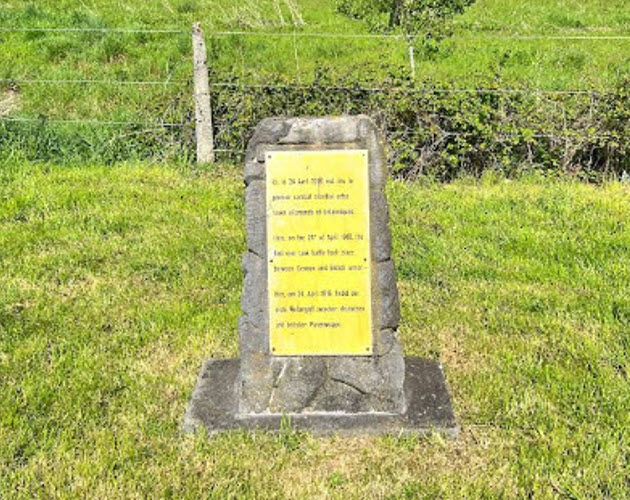
Mémorial de la première bataille de chars contre chars (Memorial to the First Tank Versus Tank Battle). Address: D168, 80800 Villers-Bretonneux, France.
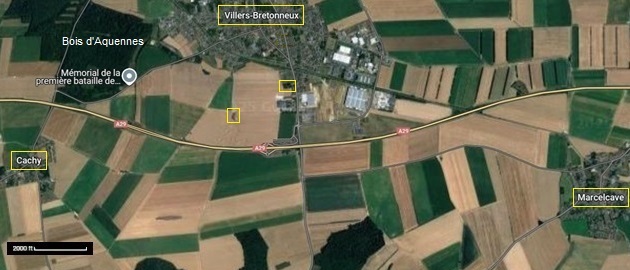
It is a small Memorial on the side of the D168 with a plaque that says “Here, on the 24th of April 1918, the first ever tank battle took place between German and British armor.” The top sentence is in French. The middle in English and bottom is in German.
In 1919, A7V No. 504 “Schnuck” was given to the Imperial War Museum in London. In 1922, it was scrapped and only the 57mm main gun was saved. This gun knocked out the British Whippet tank No. A236 “Crawick” on 24 April 1918 southwest of Villers-Bretonneux.
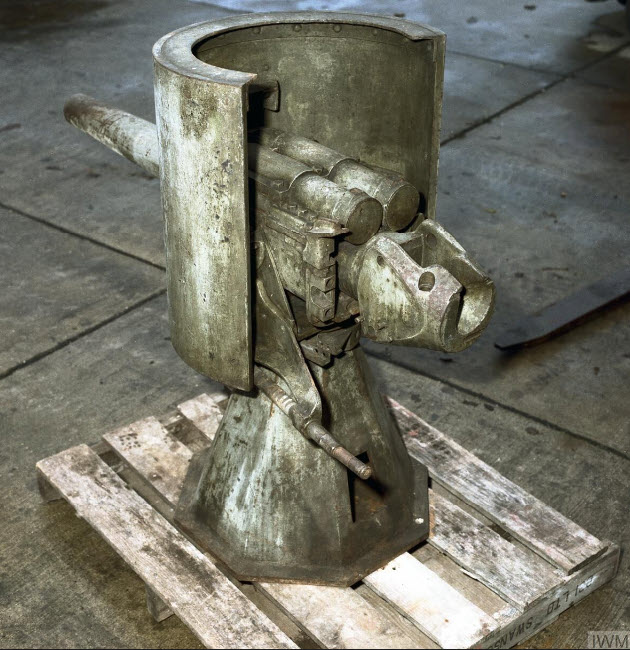
Today, the 57mm Maxim-Nordenfelt gun from A7V 504 “Schnuck” is on display at the Imperial War Museum, Manchester, UK.

A7V “Mephisto”, the only original German Imperial Army A7V Sturmpanzerwagen in existence is now available for viewing by the general public in the Anzac Legacy Gallery at Brisbane’s Queensland Museum in Australia.

Video: The Rarest Tank In The World?
Model Kits and Decals
1/35
Meng Model TS-017s German A7V Tank (Krupp) & Engine – 2022
PanzerShop PS35C171 Überlandwagen A7V w/76.2mm Putilov M.1902 AA guns (Resin) – 2014
PanzerShop PS35289 Uberlandwagen A7V Supply WW1 vehicle Meng TS-017 (Detail Set) – 2020
PanzerShop PS35290 Uberlandwagen A7V w/ 76.2mm Putilov AA guns Meng TS-017 (Detail Set) – 2020
Custom Hobby Decals WS-000855-S035-R1 German WWI A7V Tank – 506 ‘Mephisto’
Custom Hobby Decals WS-000854-S035 German WWI A7V Tank – 506 ‘Mephisto’ Late War
1/48
Gaso.line GAS50116K A7V German Heavy Tank 1917-18 (Resin)
F&A Miniatures FA-48014 German Heavy Tank A7V (Resin) – 2022
1/72
Blitz Workshop GW-03 German A7V Tank /with interior
EMHAR 5003 A7V Sturmpanzer German WWI Tank – 2016
Kora Models A7205 A7V German WWI Tank – (Röchling) Early Production
Kora Models A7206 A7V (Krupp) Mid Production
Kora Models A7207 A7V German WWI Tank (Krupp) Late Production
Military Scales (IDAP Technology) PMI0003B A7V Geladewagen – 2024
Black Lion Decals 72050 WW1 German tank A7V – 2014

 Mike's Research