The US entered into World War I on 6 April 1917, more than two and a half years after the war began, without any tanks of its own. The Tank Corps of the American Expeditionary Forces (AEF) was formed and the first US tank units began to see combat in September 1918.

Artist: David Pentland
For nearly three years, the US was neutral but did played a major role in providing much needed supplies, raw material, and money to the UK, France, and the other Allied powers. After the US entered the war, there was a slow start in mobilizing its armed forces, economy and labor forces.
On 10 May 1917, General John Joseph Pershing (13 September 1860 to 15 July 1948) nicknamed “Black Jack” became the commander of the AEF. Pershing chose Chaumont, France as the location for the AEF headquarters. After studying the British and French tank theories and operations, Pershing decided that both light and heavy tanks were essential for the conduct of the war and they need to be acquired as soon as possible.
A joint Anglo-American program was set up to develop a new type of heavy tank similar to those then in use by the British. However, it was expected that sizeable quantities would not be available until April of 1918. Because of the wartime demands on French industry, the Inter-Allied Tank Commission decided that the quickest way to supply the US forces with sufficient armor was to manufacture the Renault FT tank in the US.
Some Renault FT tanks, plans, and various parts were sent to the US for study. The design was to be carried out by the Ordnance Department, under the project title “Six-ton Special Tractor,” and orders for the vehicles were placed with private manufacturers. However, the project was beset by problems. The French specifications were metric and incompatible with American (imperial) machinery. Coordination between US military departments, suppliers, and manufacturers was poor and bureaucratic inertia, lack of cooperation from military departments, and other vested interests delayed the project.
In December 1917, Brigadier General Samuel Dickerson Rockenbach (27 January 1869 to 16 May 1952), was appointed by Pershing, to command the AEF’s Tank Corps. In 1918, Rockenbach organized, trained, equipped, and deployed the first US tank units to the European Western Front.
In April 1918, the US Army in France was expecting the first 100 US built tanks but US tank production had not started yet. It was then decided that Britain and France will begin supplying tanks to the US Army until US built tanks become available.
The initial plan was for 2000 Renault FT light tanks and 200 British Mark V heavy tanks. Then the plan was changed to 20 battalions of 77 FT tanks each (1540 total) and 10 battalions of 45 Mark V tanks each (450 total). A total of 8 heavy battalions (301st to 308th) and 21 light battalions (326th to 346th) were raised.
Only four US tank battalions saw combat in 1918:
1st Provisional Tank Brigade (on 6 November 1918, redesignated as the 304th Tank Brigade):
- 326th Light Tank Battalion (later re-designated as the 344th Light Tank Battalion)
- 327th Light Tank Battalion (later re-designated as the 345th Light Tank Battalion)
306th Tank Brigade:
- 331st Light Tank Battalion
British 4th Tank Brigade, British Fourth Army:
- 301st Heavy Tank Battalion
Both types of battalions (Light and Heavy) had three companies of three platoons each and a battalion headquarters platoon. All platoons were equipped with 5 tanks.
George Patton
Captain George Smith Patton, Jr. (11 November 1885 to 21 December 1945) was commanding the AEF Headquarters Company at Chaumont when on 10 November 1917 he was assigned the task to establish the AEF Light Tank School. Having no experience with tanks, he left Paris and reported to the French Army’s tank training school at Champlieu near Orrouy (northeast of Paris) where he undergone two weeks of accelerated training on the Renault FT light tank.
On 20 November 1917, the British launched their offensive against Cambrai, employing an unprecedented number of tanks. At the end of his tour on December 1st, Patton went to Albert, 30 miles (48 km) southwest of Cambrai, and was briefed on the results of the Cambrai attack by the chief of staff of the British Tank Corps, Colonel John Frederick Charles Fuller. On his way back to Paris, Patton visited the Renault factory to observe the French FT tanks being manufactured.
On 26 January 1918, Patton was promoted to Major. On 23 March 1918, he received the first 10 Renault FT tanks at the light tank school at Bourg, a small village south of Langres on the Dijon road (today D974) in the Haute-Marne département. Being the only US soldier with tank driving experience, Patton personally drove 7 of the tanks off the train. At the post, Patton trained the tank crews to operate in support of the infantry, and he promoted the tanks to the reluctant infantry officers.
Patton was promoted to Lieutenant Colonel on 3 April 1918, and attended the Command and General Staff College in Langres.
While waiting for their FT tanks, US soldiers assigned to the Light Tank School constructed plywood trainers mounting Hotchkiss machine guns to begin their training. The soldier standing at the rear of the trainer on the right, jumps up and down on the trainer. The trainer rocks forward, backward while bouncing to the left and right simulating movement over rough terrain.

Film: AEF Tank Corps Demonstration, 22 April 1918
Film: Renault FT tank capabilities demonstrated to AEF troops
Film: Renault FT tank demonstrated in wooded area
On 15 July 1918 at the Light Tank School, tank crews are receiving instructions from officers, from left to right: Captain Ranulf Compton, Chief Instructor, and Lieutenant Colonel Patton (center, with his back towards the camera).

US tank crews stand by their Renault FT tanks at the Light Tank School.

Lieutenant Colonel Patton posed beside a Renault FT tank on 15 July 1918.

St. Mihiel
The first combat of US tanks occurred at the battle of St. Mihiel. The Germans took the St. Mihiel salient in 1914 and, despite repeated French failed attempts to reduce the salient over the next four years, the Germans had not budged. To eliminate the salient in 1918, the plan called for a pincer maneuver around St. Mihiel with two French divisions attacking from the west and south of the town. The US divisions attacked along the southern line to the east of St. Mihiel and closed the pincers by linking up with the French forces at Vigneulles.
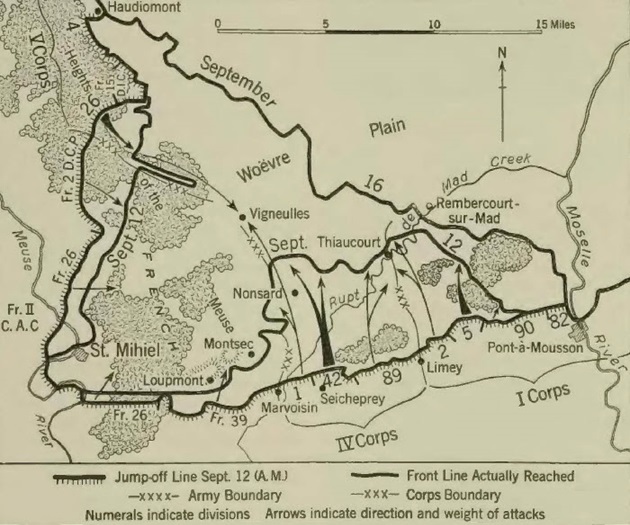
In September 1918, Patton commanded the US 1st Provisional Tank Brigade and it was part of Brigadier General Rockenbach’s Tank Corps in the US First Army. While overseeing the logistics of the tanks, Patton personally reconnoitered the target area for their first attack which began on 12 September 1918.
Two US Army cavalrymen watch a Renault FT tank towing a truck loaded with bicycles moving forward on the first day of the battle.

A US crewed Renault FT tank climbs out of a trench near Seicheprey.
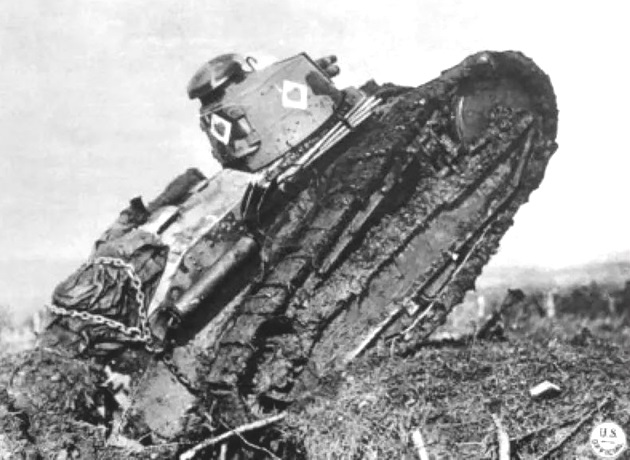
Patton lead the tanks from the front for much of the attack. Initially, the 326th was assigned to the 1st Division and the 327th to the 42nd Division, with 16 tanks from the 326th and 25 from the 327th composing the brigade reserve.
Patton walked in front of the tanks towards the German-held village of Essey (today Essey-et-Maizerais), and to inspire his men he rode on top of a tank during the attack north into Pannes.
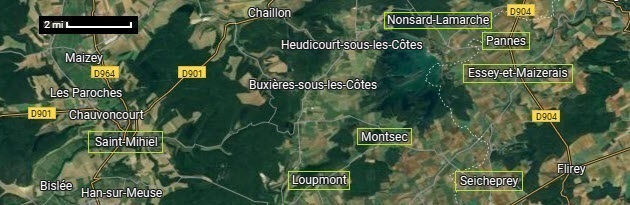
While walking along side the tanks, Patton would get the tank commander’s attention by striking on the side of the tank. Here a tank commander is receiving instructions.

While outside the village of Essey, Patton had his first chance meeting with Brigadier General Douglas MacArthur, then commanding the 84th Infantry brigade of the 42nd “Rainbow” Division, who, at 38 years old, was already one of the most highly decorated officers in the AEF.
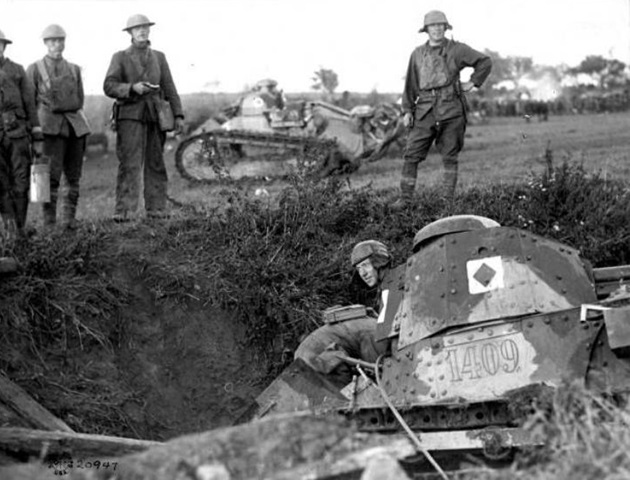
Muddy conditions, caused by heavy rain the night before the offensive, resulted in a much greater consumption of fuel than anticipated. Although the mud, lack of fuel, and mechanical failures caused many tanks to stall but the attack succeeded and much valuable experience was gained. In most actions the tanks supported the infantry, but at times they also executed some reconnaissance tasks.
A group of US soldiers assist in pulling a tank out of a ditch where it had tumbled into during the attack. Note the number 1409 on the hull side.
By coincidence, the Germans, wanting to straighten up their lines, began withdrawing from the St. Mihiel Salient just as the Allied offensive began. This resulted in German troops being scattered outside their fortifications with their artillery heading east, and they were unable to effectively defend against the Allied attack.
Film: ST. MIHIEL OFFENSIVE, SEPT. 10-25, 1918, 42ND DIVISION
Film: The St. Mihiel Drive – WWI, Pershing 22730
Meuse-Argonne
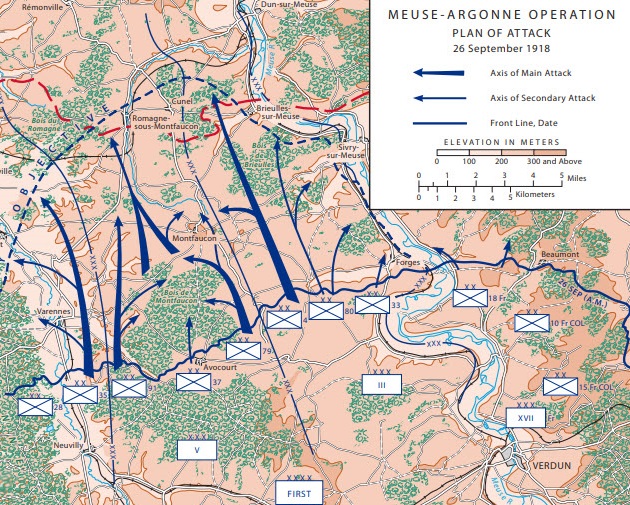
The Meuse–Argonne offensive was the largest in US military history, involving 1.2 million US soldiers and marines, along with 800,000 French and 850 Siamese personnel. It is also the deadliest campaign in the history of the US Army, resulting in over 350,000 casualties, including 28,000 German lives, 26,277 American lives and an unknown number of French lives lost.
The 326th and 327th Light Tank Battalions which fought at St. Mihiel Salient were re-designated as the 344th and 345th Battalions just before the offensive was launched on 26 September 1918.
Patton’s tank brigade was moved 60 miles (96.56 km) to the northwest to support I Corps for the offensive.

A US tank commander and his driver sit in their FT tank with the hatches open. The noise inside the running tank was so loud the commander could not communicate with the driver. The commander used a series of kicks to give instructions to the driver seated below him.

While Patton was trying to move his reserve tanks forward, some of the reserve tanks got stuck in some trenches. Patton went back and made some US troops hiding in the trenches dig a passage for the tanks. One of the soldiers would not work, Patton got angry and he hit him over the head with a shovel. It is not known if the unwilling soldier was wearing his steel helmet or not at the time. Close to 25 years later after the Sicily campaign in early August 1943, there were two incidents of Patton striking US soldiers whom suffered from “battle fatigue”.
Map of the Meuse–Argonne offensive.

AEF Renault FT tanks advancing towards Bourevilles.
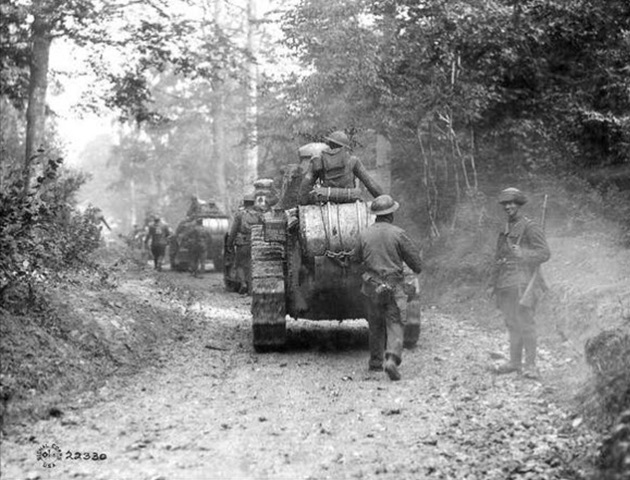
AEF Renault FT tanks advancing towards the 35th Division headquarters near Bourevilles on September 26th.

Patton personally led a troop of tanks through thick fog as they advanced into the German lines. Around 0900 hours, Patton was wounded while leading 6 soldiers and a tank in an attack on German machine gun positions near the town of Cheppy. His orderly, Private First Class Joe Angelo, gave Patton first aid and later he was awarded the Distinguished Service Cross (DSC). The bullet hit the front of Patton’s left leg and came out of his rear end. Patton commanded the battle from a shell hole for another hour before being evacuated.
Patton stopped at a rear command post to submit his report before heading to a hospital. Major Sereno Elmer Brett (31 October 1891 to 9 September 1952), commander of the 344th Tank Battalion, took over command of the brigade. While recuperating from his wound, Patton was promoted to temporary Colonel in the Tank Corps of the US National Army on October 17th. He returned to duty on October 28th but saw no further action before the war ended on his 33rd birthday. For his actions at Cheppy, Patton received the Silver Star, which later was upgraded to the DSC.
The 35th Division of which Patton’s tank troop was supporting captured Varennes (southwest of Cheppy) with heavy losses. The commander of Battery D, 129th Field Artillery Regiment, 35th Division, was Captain Harry S. Truman (he became the 33rd President of the United States on 12 April 1945). Truman’s battery provided support for Patton’s tank brigade during the Meuse–Argonne offensive and he was at an observation post west of Cheppy.
US tank men in their Renault FT tanks. Note their markings based on playing cards colors, hearts and diamonds.
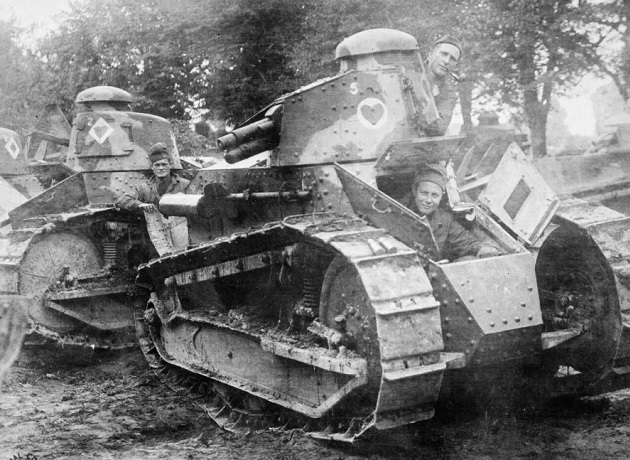
A US tank driver in his Renault FT tank near Varennes.

A US Renault FT tank at Varennes on 1 October 1918. Note the circle marking on the turret and the white band painted on the cupola. Their meaning is unknown.

On October 4th, the second phase of the Meuse-Argonne offensive began. The first US assault divisions (the 35th, 37th, 79th, and 91st) were replaced by the 1st, 3rd and 32nd Divisions. The 1st Division created a gap in the lines when it advanced 2.5 km (1.6 miles).
Soldiers of the 18th Infantry Regiment, US 1st Division supported by a US tank had captured one end of the village Exermont (north of Varennes) on 7 October 1918. The small building to the right of the tank is probably a public latrine or a communal wash house.

A moment after the above photograph was taken, a warning screech of a German artillery shell was heard and the soldiers who had been loitering in the street which they had just captured are now running for cover. The crew of the tank most likely “buttoned up” and waited out the shelling.

This is the location (Goggle Maps Street View March 2011). The church is the Église Saint-Pierre d’Exermont facing north on Rue Principale (D142).

Chain mail face protector worn by US and French tank crews, Ricicourt (west of Verdun), 12 October 1918.

The third US light tank battalion, the 331st, joined the AEF during the final weeks of the war. It was located at Varennes during early November 1918 and was credited with participation in the Meuse-Argonne Campaign as part of V Corps. It probably was still moving up to the front line when the war ended on November 11th. There are no known combat photos of this battalion or any details of their actions.
301st Tank Battalion
The “1st Separate Tank Battalion, Heavy Tank Service, 65th Engineers” was raised at Camp Meade, in Maryland, USA. It was transported to the British Tank School at Wareham, England for training from April until August 1918. When its arrival in the UK, it was re-designated the “41st Tank Battalion.” In June 1918, the AEF changed their naming system which gave the unit its final name, the 301st Heavy Tank Battalion. The British agreed to provide 47 Mark V and Mark V* tanks to the 301st Battalion but only if the unit was attached to the British Fourth Army.
The New York National Guard’s 27th Division and the 30th Division (made up of National Guard Soldiers from several Southern states) were “loaned” to the British Fourth Army and were under British command as the II Corps.
On 29 September 1918, the II Corps fought in the Battle of St Quentin Canal along side the Australians.

The US 27th and 30th divisions attacked followed by the two Australian divisions, with approximately 150 tanks of the 4th and 5th Tank Brigades of the British Tank Corps (including the newly trained US 301st Heavy Tank Battalion) supported the four Allied divisions. The Australian 3rd Division (behind the US 27th) and 5th Division (behind the US 30th) were intended to “leapfrog” through the US forces and press on. The US 301st Battalion was assigned only to the US 27th Division during this battle. Each Company of the 301st (A, B, & C) were assigned to lead one of the 27th Division’s regiments (107th, 105th, & 108th) and the Australian Corps Reserve.
At 0530 hours on 27 September 1918, the 27th US Division carried out their attack on the UN-captured Hindenburg Outpost Line under a barrage and supported by the tanks. The main objectives were the trench system around the Quennemont and Gillemont Farms (fortified positions). Although the attack reached its objective, it was several hours late and considered as unsuccessful. Heavy mist and haze made visibility extremely poor, but the failure was attributed mainly to lack of tank and infantry co-ordination. Many battle-green Americans did made it to the German trench line but they were surrounded until they were relieved by the Australians days later. The failure appeared to be due to over eager troops rushing on and not “mopping-up” correctly, a lesson learned the hard way by the British and Australians.
The 301st suffered large casualties in the battle as part of the British 4th Tank Brigade, under the control of the Australian Corps. Efforts were made to hide the tanks moving up to the front lines by having planes fly over German lines. Some tanks were hit by enemy shelling before the start line, while others were lost crossing an unreported British minefield. Of the 34 participating tanks, only 10 reached their objective. Of the crews of the tanks in the 301st Battalion, there were 112 casualties. The numbers broke down as 3 officers and 20 enlisted men were KIA, 7 officers and 55 enlisted men were severely wounded and 8 officers and 15 enlisted men were slightly wounded, and one officer and 6 enlisted men were reported missing.
A US Mark V tank escorted by an Australian soldier on horseback enters Bellicourt on 3 October 1918 after the attack. It was accompanied by long trains of ammunition, supplies, and tanks carrying Australian and British troops to the front lines.

The 301st next engagement was on 8 October 1918 supporting the 30th Division near Brancourt (today Brancourt-le-Grant). Due to heavy losses on September 29th, the 301st had only 23 tanks with no reserve. Visibility was perfect, with a light breeze blowing the battle smoke forward over the Germans.
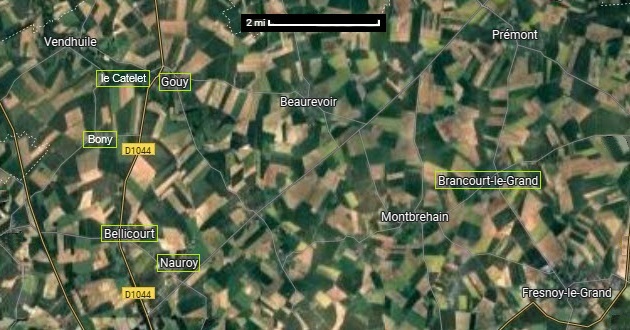
The tanks were bombed from the air, and received heavy shelling from the Germans, but 11 tanks reached their objective, 4 received direct hits and were destroyed; 5 had mechanical problems; and 3 did not make it past the jump off point. Generally speaking, the battle was a success with the objectives achieved by 1415 hours.
Battle of the Selle
The 301st third engagement was fought on 17 October 1918 during the Battle of the Selle River between Le Haie Meneresse to Mazingbien. The Selle River flows north from Molain, zig zagging through the country side passing through the west side of St. Souplet. The Allied forces faced three problems: crossing the Selle river, a railway embankment on the far side and a ridge above the embankment. The 301st’s tanks were parceled out for this attack. This time being split between the 27th and 30th Divisions.
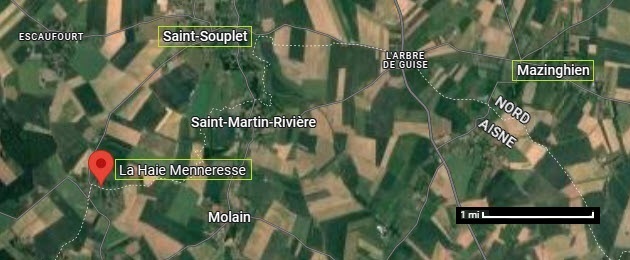
With 25 tanks available, the tank commanders were able to view the battle field prior to engagement, and made note of the best routes and river crossings. In spite of the excellent planning, on the day of the battle the visibility was very poor. A light breeze blew the smoke over the Dough-boys, and communication was even poorer. By the time the visibility cleared, most tanks were lost or were out of fuel. Of the 25 tanks that started, 8 had mechanical trouble, 2 tanks ditched in the Selle River, a couple had direct hits, and one caught fire. Only one tank reached the objective. After the battle, there were only 12 tanks operational.
Tanks of the 301st Tank Battalion going into action near St. Souplet on the morning of 17 October 1918. Note Old Glory flying on the closest tank.

Film: Battle of the Selle 17/10/1918 St Souplet Molain 27th 30th divisions
The 301st fourth and final battle was a night attack on October 22–23 in the vicinity west of the Sambre Canal. Nine Tanks from the 301st were assigned to support the British 1st Division on the German lines near Bazuel, southeast of Le Cateau (today Le Cateau-Cambrésis).

H hour was at 0120 hours, taking advantage of the full moon. All nine Tanks moved forward rapidly, taking out German strong points. They moved so fast that their supporting infantry had trouble keeping up with them. All the tanks reached their objectives with only five casualties when one of the tank crews was gassed but were successfully treated.
US Tank Production
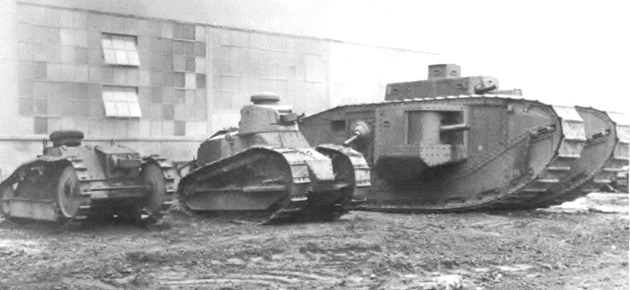
Mark VIII Tank
Also known as the Liberty or The International, it was a British-American tank design intended to overcome the limitations of the earlier British designs and was to be a collaborative effort to equip France, the UK and the US with a single heavy tank design. The planned production levels would have equipped the Allied armies with a very large tank force that would have broken through the German defensive positions in the expected Allied offensive in the spring of 1919.
This is the pilot British Mark VIII Liberty tank in mid 1918. On the hull side just behind the door with machine gun port is “N.B.L. Co. Ltd.”

Specifications:
Crew: 8
Weight: 37 long tons (38 t) (dry weight)
Length: 34 ft 2 in (10.41 m)
Width: 11 ft 8 in (3.56 m), Sponsons retracted: 9 ft (2.7 m)
Height: 10 ft 3 in (3.12 m)
Operational Range: 50 miles (80 km)
Maximum Speed: 5.25 mph (8.45 km/h), governed to 6.25 mph (10.06 km/h)
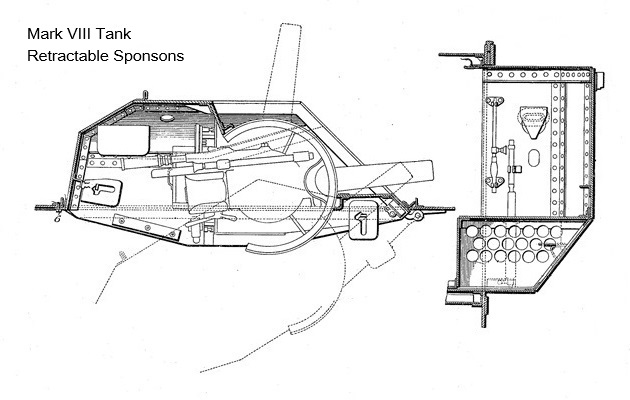
The Mark VIII was not built in a female or male configuration like the earlier tanks. There were no machine guns in the side sponsons, only the 6-pounders each manned by a gunner and loader. The side machine guns were to the rear of the sponsons mounted in the hull doors. Five more machine guns were in the hull superstructure: two at the front (left and right) next to the driver and one on each of the other sides.
The sponsons were designed to be retractable to reduce the width of the tank for transportation. They swung in at the rear by the crew, being pivoted at the front. The starboard (right side) sponson is shown here retracted into the hull.

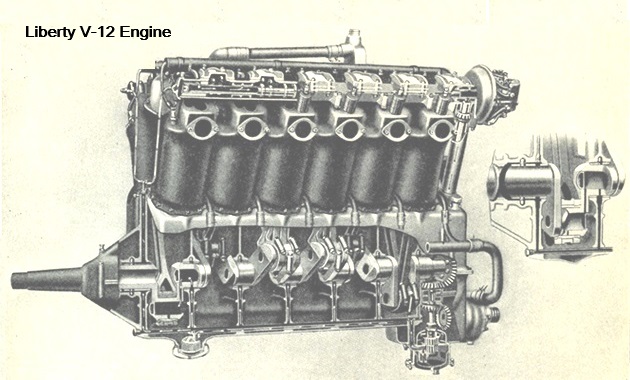
The US version used an adaptation of the Liberty V-12 aircraft engine of 300 hp (220 kW). The engine developed for the tank was less expensive than the aircraft engine, using cast-iron cylinders rather than drawn steel and developing 300 hp compared to 400 for the aircraft version. The British version of the tank used a British built V-12 Ricardo 300 hp (220 kW) engine.
The Liberty tank had a bulkhead between the fighting compartment and the engine compartment, making it slightly less deafening and less fumes exposed to the crew than other tanks of the period.

Liberty V-12 tank engine
A production site in France was expected to take advantage of US industrial capacity to produce the automotive elements, with the UK producing the armoured hulls and armament. In the US, the internal Mark VIII components would be manufactured at the Rock Island Arsenal on the Mississippi River between the cities of Davenport, Iowa, and Rock Island, Illinois. In the UK, production would be at the North British Locomotive Company located at the neighboring Atlas and Hyde Park Works in central Springburn, as well as the Queens Park Works in Polmadie.
Film: Mark VIII tank tested in Bridgeport, Connecticut
Film: More Mark VIII tests in Bridgeport
Film: Mark VIII tree smashing and climbing tests in Bridgeport
Film: Mark VIII drives over a stone wall in Bridgeport
Manufacturing was slow and only a few vehicles were produced before the end of the war in November 1918. Only 5 British Mark VIII tanks were delivered to the British Army and they were only used for training. All the remaining British Mark VIIIs were eventually scrapped.
In 1919, the US manufactured only 100 Mark VIII tanks at the Rock Island Arsenal and delivered them to the US Army. The US Liberty tanks equipped a single unit, the 67th Infantry (Tank) Regiment. The designation of the unit had its origin in the fact that since 1920, by law, all tanks had to be part of the Infantry branch. Water-cooled M1917 Browning machine guns were used.
US Army Mk VIII Liberty tanks training at Fort Meade in Maryland, in 1922.

Despite many modifications, the Mark VIII tank suffered from overheating and poor reliability, causing a prejudice in the US Army against the use of heavy tanks. From 1932 onward, they were phased out and all surviving Mark VIII tanks were in storage by 1934.
M1917 Tank
The M1917 was the first US mass-produced tank, entering production shortly before the end of WWI. It was a license built near copy of the French Renault FT.
Main Armament:
- 37mm M1916 gun (French Canon d’Infanterie de 37 modèle 1916 TRP designed by the Puteaux arsenal)
OR
- Marlin Rockwell M1917 machine gun, later replaced by the M1919 Browning machine gun.
Engine:
Buda HU modified 4-cylinder gasoline engine, with forced water cooling 42 hp (31 kW). Built by the Buda Engine Company in Harvey, Illinois.
The M1917 can be distinguished from the Renault FT by means of several external features.
- The exhaust pipe is on the left-hand side instead of on the right on the FT.
- On both sides is a lifting hook mounted to the hull just behind the turret.
- Additional vision slits are added to aid the driver.
- All M1917s had a polygonal turret; none used the circular turret types fitted to the FT.
- The FT mantlet for the 37mm cannon or machine gun had a new design.
- The frontal armor below the turret was slightly modified.
- Solid steel idler wheels replaced the steel-rimmed wooden or seven-spoke steel ones on the FT.
Only 64 M1917 tanks had been completed by the end of WWI. Two M1917s would be sent to France 9 days after the armistice on 20 November 1918 and 8 more arrived in December. None of these tanks saw active service but they were stationed at the Langres tank school in France.
In 1919, the Van Dorn Iron Works Co., the Maxwell Motor Co., and the Clarence Leo Best Co. built 950 M1917s, 374 had cannons, 526 had machine guns, and 50 were signal (wireless) tanks.
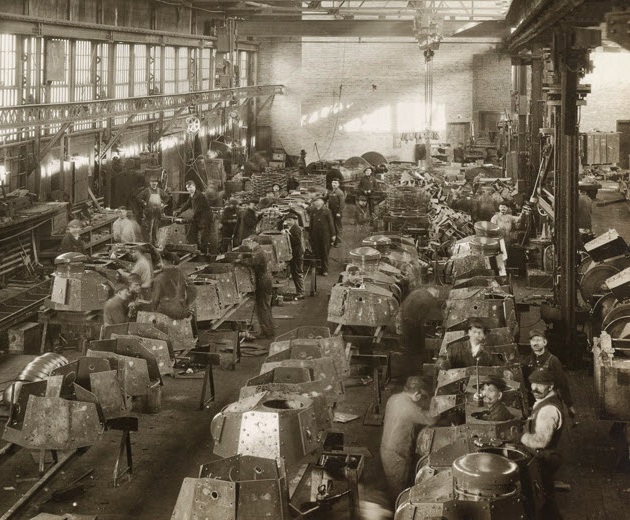
M1917 tank production at the Van Dorn Iron Works Company in Cleveland, Ohio.
The 37mm M1916 gun mount for the M1917 tank showing its eccentric breech block.


M1918 Tank
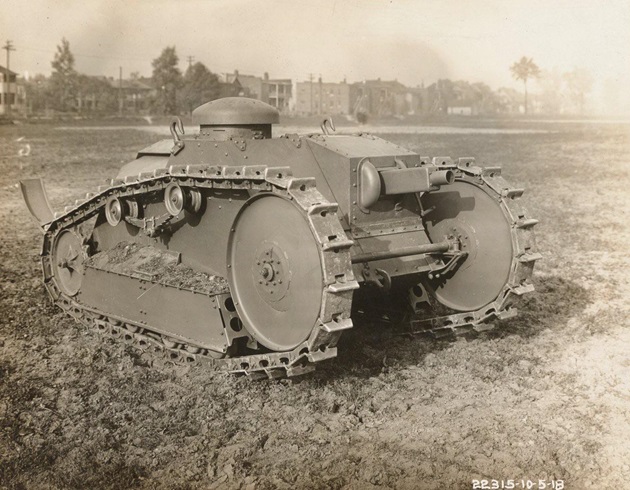
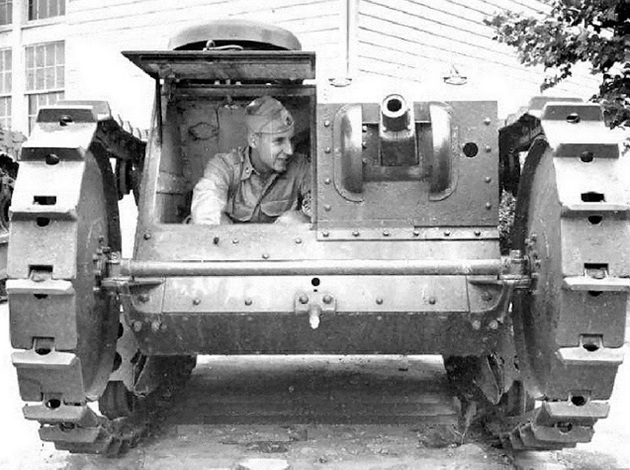
The Ford 3-ton tank, also known as the Ford Model 1918 was one of the first indigenous US tank designs. It was a small two-man, one-gun tank. Essentially the first tankette armed with an M1917 Marlin machine gun, later an M1919 Browning machine gun, which could reach a maximum speed of 8 mph (13 km/h). The 3-ton had a 17 US gallon (64 Liter) fuel tank that gave it a maximum range of 34 miles (55 km).
The French Army evaluated the Ford 3-ton tank and found it to be inferior to the Renault FT. However, the 3-ton tank was seen to have potential as a cheap, light, all-terrain artillery tractor, especially for towing batteries of the Canon de 75 modèle 1897. The war ended before any were delivered.
Film: US officials test Ford 3-ton M1918 tanks in Michigan
Film: M1918 tanks tested to cross gullies and climb earth banks
Film: M1918 tanks drives on a rough field
Film: Ford 3 ton light tank M1918
Pikes Peak
The M1917 tank’s most impressive feat stemmed from a publicity stunt in April 1919, when a M1917 tank climbed Pikes Peak, a mountain in Colorado where it plowed along at an altitude of 10000 feet (3048 meters). It broke all altitude records for war machines when it reached a height of 11200 feet (3413.76 Meters). It also broke records for continuous distance traveled and penetrated farther into the snow than any other vehicle has ever done at that time of the year. It drove through snow drifts of 4 to 20 feet (1.2 to 6 meters) deep.

Film: The Tank That Climbed a Mountain (1919)
For financial reasons, the US Tank Corps was demobilized in June 1920. The M1917 tanks were issued to tank companies of Regular Army and National Guard Infantry regiments.
In this 1920 photograph there is a mixture of camouflaged M1917 tanks (only used in 1919) and M1917 tanks in dark olive drab waiting for shipment to their new posts.

Over time, the number of operational M1917s available started to diminish due to accidents, fires and mechanical failures. Some M1917s were cannibalized to provide spare parts for other tanks. A few M1917s were scrapped, whilst others were mothballed and kept in storage.
M1917 Movie Prop
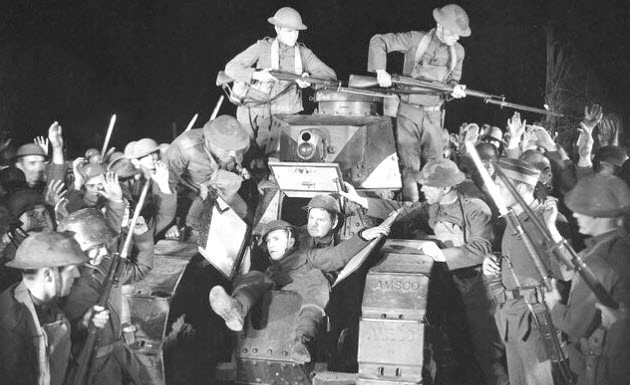
Actual M1917 tanks were used as props in a number of films in the 1920s and 30s. One notable film is the Laurel and Hardy (comedy duo) 1932 feature length film “Pack Up Your Troubles” which was released on 17 September 1932. The M1917 tank is only seen on screen for roughly 2 minutes of the 68 minute film. The tank was not crucial to the story but Laurel and Hardy used it as part of a gag in the film.
This is a frame shot from the movie. Laurel and Hardy are sitting in the driver position.
Film: Pack Up Your Troubles | Laurel & Hardy | FULL MOVIE | 1932
Canadian M1917s
After the fall of France in June 1940, the Canadians were in a desperate need of tanks to train their new tank crews for war. The US agreed to sell 250 tanks to Canada for training Canadian Army tank crews. The Canadians were offered Mark VIII and M1917 tanks, but they only agreed to purchase the M1917s. At the time of the deal, the US was a neutral nation and could not officially provide weapons to any of the combatants, so the Canadian Government purchased the obsolete WW1 era tanks as “scrap metal” and paid only S240 US dollars for each tank. The Canadian Army took delivery of 236 M1917s, transported by rail to Camp Borden, Ontario, Canada.
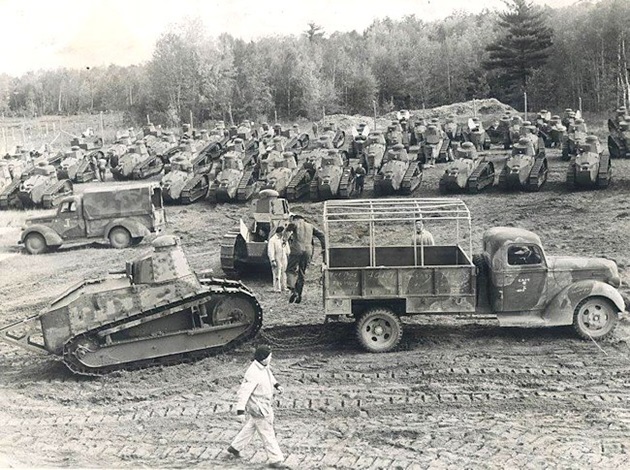
A train load of M1917 tanks arrived at Camp Borden and awaiting to be de-trained.

This photograph was taken on 10 October 1940. The tanks were towed from the train to this site by Army trucks. Mechanics tune the engines and serviced 180 tanks that arrived that day. At the rear of the truck in the foreground, a soldier has jumped off the cargo bed and the photo has captured him in mid air. Between the truck and tank on the ground are the towing chains.
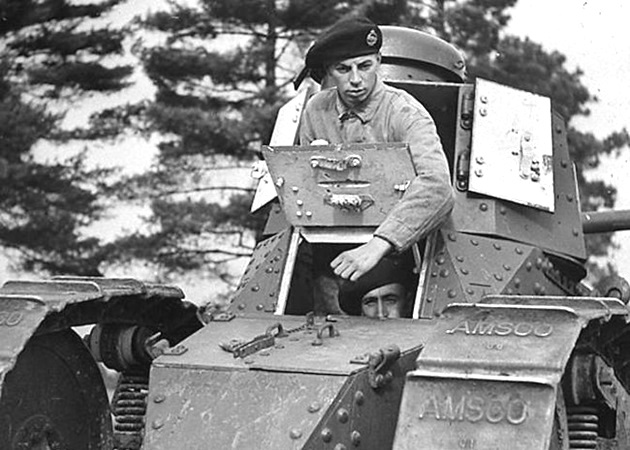
A Canadian M1917 tank crew training at Camp Borden. Note the large manufacturer’s forging stamps AMSCO (American Manganese Steel Company) on each track link. The foundry was located in Oakland, California.
The first M1917 tank in this photograph is armed with a 37mm M1916 cannon, while the others are fitted with .30 Cal Browning M1919 machine guns.

In 1943, many unarmed M1917 tanks were sold to private industry and to farmers, the rest were scrapped. Only two Canadian M1917 tanks survived. One is located at the Canadian Forces Base Museum at Borden, Ontario, and the other is on display at the Canadian War Museum in Ottawa.
Pershing
On 6 October 1917, Major General (2 star) Pershing was promoted to full general in the National Army. He bypassed the three star rank of lieutenant general, and was the first full general (4 stars) since Philip Henry Sheridan in 1888.
In September 1919, in recognition of his distinguished service during WWI, the US Congress authorized President Woodrow Wilson to promote Pershing to “General of the Armies”, the highest rank possible for any member of the US armed forces, which was created especially for him. General of the Armies is described as a six-star general, no six-star insignia was ever officially created for this rank. Pershing was the only soldier to hold this rank during his own lifetime and he was authorized to create his insignia for the new rank but he chose to continue wearing four silver stars for the rest of his career.
Besides Pershing, there were two other US Generals to be promoted to the rank of General of the Armies. In 1976, Congress authorized President Gerald Ford to posthumously promote George Washington to this rank as part of the United States Bicentennial celebration. On 19 April 2024, President Joe Biden and the secretary of defense Lloyd Austin approved and issued a memorandum to the secretary of the Army to posthumously advance Civil War Union Army commander Ulysses S. Grant to General of the Armies.
Pershing was the only US general (retired) to have a US tank named after him during his lifetime. In March 1945 when Pershing was 84 years old and living at Walter Reed General Hospital (US Army’s flagship medical center 1909 to 2011) in Washington, D.C., the 90mm gun M26 heavy tank was christened the Pershing.
Today
The 66th Armor Regiment is the oldest armored unit in the US Army today. Its lineage can be traced back to the 301st Heavy Tank Battalion in WWI.
Two battalions of the regiment are still in service in the Regular Army:
- 1–66 AR, 3rd Brigade Combat Team, 4th Infantry Division, at Ft. Carson, Colorado.
- 3–66 AR, 1st Brigade Combat Team, 1st Infantry Division, at Ft. Riley, Kansas.
Video: Tank Chats #25 Mark VIII | The Tank Museum
Video: Two 100 year old tanks lifted and moved Ft. Benning, 24 July 2022
Video: National Museum of Military Vehicles WWI M1917 Tank, 24 January 2024
Video: Inside the Chieftain’s Hatch: 3-ton M1918
Video: Tank Talk: Ford M-1918 Two-Man Tank
Model Kits
Some Renault FT-17 tank kits listed in my “Renault FT 1917-1945” post has US markings.
1/24:
FC Model Trend 24405 Ford 3 Ton Tank, M1918 – 2022
1/35:
Takom 2034 WWI Heavy Battle Tank Mk V [3 in 1] – 2015
FC Modeltips 35541 Ford 3-ton tank M1918 (Resin kit) – 2019
FC Model Trend 35541 Ford 3 ton tank M1918 (Resin kit) – 2019
Vargas Scale Models R3D-35-023 M1918 Ford 3-ton Tank – 2020
F&A Miniatures FA-35001 Ford 3-Ton M1918 (3D Printed) – 2021
Vargas Scale Models R3D-35-070 Liberty or International Tank Mark VIII – 2022
Vargas Scale Models R3D-35-157 US M1917 6-ton Light Tank or FTS – 2024
1/48 3D Printed Kits:
F&A Miniatures FA-48005 Mark VIII Liberty – 2021
ToRo Model FA005 US Army WW.I Mark VIII Liberty – 2022
1/72:
RPM 72207 US “six-ton” M1917 light tank (late) – 2003
RPM 72211 US M1917 Signal Tank Command – 2003
RPM 72210 US “six-ton” M1917 light tank (early) – 2006
F&A Miniatures FA-72003 Mark VIII Liberty (3D Printed) – 2021
F&A Miniatures FA-72005 Ford 3-Ton M1918 (3D Printed) – 2021
FC Model Trend 72410 Ford 3 ton, M1918

 Mike's Research