The US M108 and M109 Self-propelled Howitzers (SPH) were generally employed to Fire Support Bases (FSB) which provided artillery support to Allied infantry units in the field. Because the M108 and M109 howitzers could traverse their main gun 360 degrees, unlike towed artillery and other SPs, they were ideal for FSB positions which might be subjected to an enemy attack from any direction.
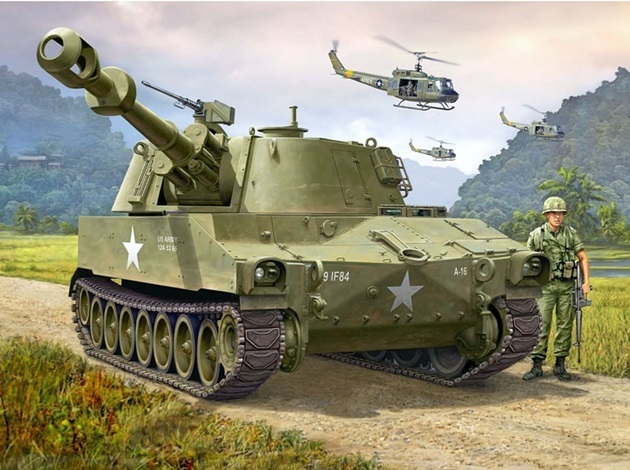
In the early 1960s, the M108 and M109 SPHs were developed to replace the 1950s M52 (105mm) and M53 (155mm) SPHs that were based on the M46/M47 Patton tank chassis. Both the M108 and M109 were designed with the same turret and chassis and they shared common components with the M113 APC such as the engine, transmission, and tracks. They were also air-transportable.
M108 SPH
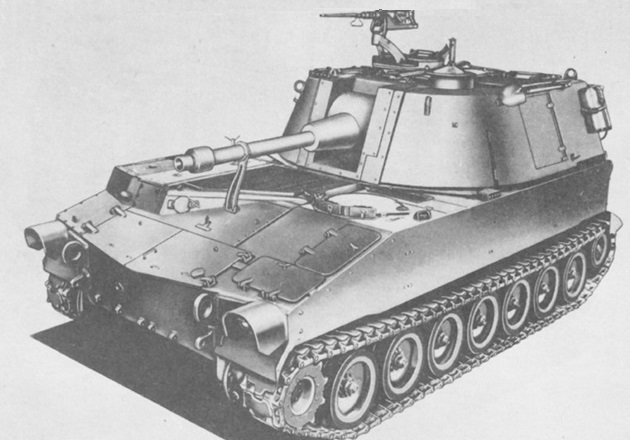
Manufacturer: Cadillac Motor Car Division of General Motors Corporation
Number built: Approximately 355
Production of the M108 started in October 1962 and continued until 1963 when the US Army cancelled the M108 contract. The decision was made because the 105mm howitzer was considered too light for the battlefield fire support role and NATO had standardized the 155mm howitzer.
Specifications:
Weight: 21 t (20 long tons; 20 short tons)
Length: 6.11 m (20 ft 1 in)
Barrel length: 3.15 m (10 ft 4 in) L/30
Width: 3.15 m (10 ft 4 in)
Height w/ AA MG: 3.28 m (10 ft 9 in)
Armor: 25.4 mm (1 in)
Engine: Detroit Diesel turbocharged 8V-71T 8-cylinders 425 hp (300 kW)
Fuel capacity: 511 Liters (135 gallons)
Operational range: 360 km (200 miles)
Maximum speed: 56 km/h (30 mph)
Main Armament: M103 105mm Howitzer with M139 mount in turret
Ammunition: 86 rounds (16 ready)
Round Weight: Average 32 lbs. (14.5 kg)
Gun Elevation: +75° to -6° (manual)
Rate of fire: 3-4 rounds/min
Effective firing range: 11.5 km (7 miles)
The M103 105mm Howitzer fired all the standard rounds. In 1966, the M546 anti-personnel tracer (APERS-T) “Beehive” round was first used in combat. It was direct fired from a near horizontally leveled 105mm howitzer and it ejected 8000 flechettes during flight by a mechanical time fuse.
Secondary Armament:
1x Browning .50 Caliber (12.7 mm) M2 machine gun with 500 rounds.
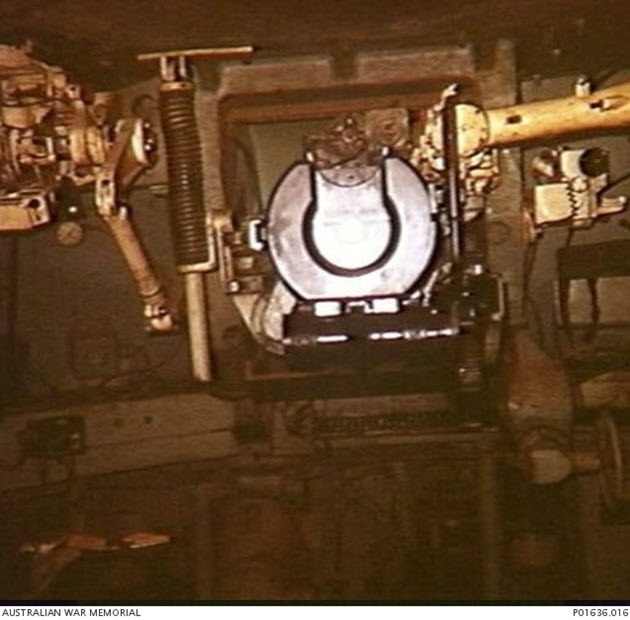
The breech and sighting apparatus of a 105mm Howitzer in a M108 SPH of 7 Troop, 3rd Cavalry Regiment, 1st Australian Task Force (1ATF) in 1967.
M108 Crew: 5-7
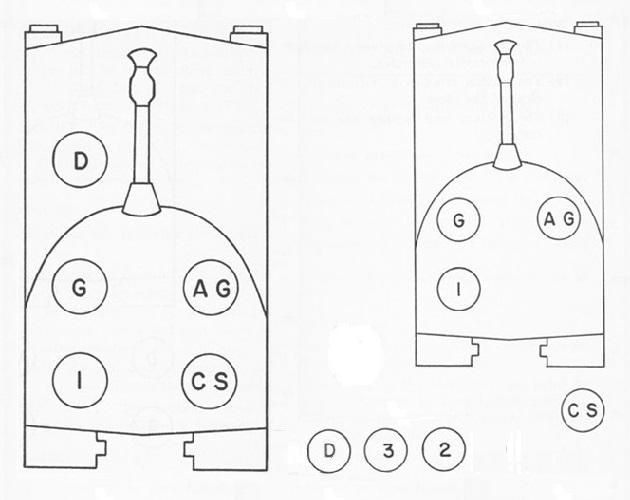
Crew mounted (left):
(D) – Driver in hull left front
(G) – Gunner in turret left front
(AG) – Assistant gunner in turret right front
(1) – Cannoneer #1 in turret left rear
(CS) – Chief of section in turret right rear
Additional crew dismounted for sustained firing (right):
(2) – Cannoneer #2
(3) – Cannoneer #3
The additional crewmen were transported in another vehicle.
Video: M108 Self-Propelled 105mm Howitzer
M108s in Vietnam
M108 Self-Propelled Howitzers equipped the first two US Army field artillery units deployed to Vietnam.
The 3rd Battalion, 6th Field Artillery Regiment was deployed to Pleiku on 17 June 1966. Based at Camp Saint Barbara (later Artillery Hill) outside of Pleiku, the 3/6th Artillery “Centaurs”, was part of the I Field Force Artillery (IFFV), 52nd Artillery Group.
The 1st Battalion, 40th Field Artillery Regiment was deployed to the Dong Ha Combat Base in October 1966. It was part of the II Field Force Artillery (IIFFV), 108th Artillery Group. In July 1969, the 108th Artillery Group was part of the I Field Force Artillery.
Note:
The I Field Force’s area of responsibility was II Corps Tactical Zone (later renamed Military Region 2) comprised of 12 provinces in the Central Highlands. The II Field Force’s area of responsibility was III Corps Tactical Zone (later renamed Military Region 3) comprised of 11 provinces surrounding Saigon.
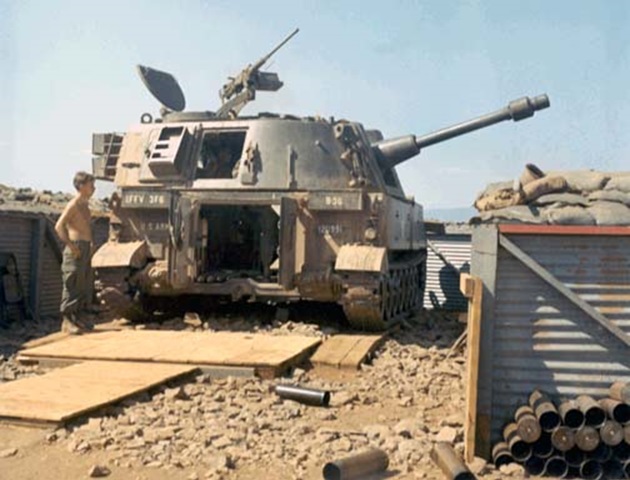
A M108 SPH of Battery B, 3/6th Artillery. The unit code on the hull left rear is “IFFV 3F6”.
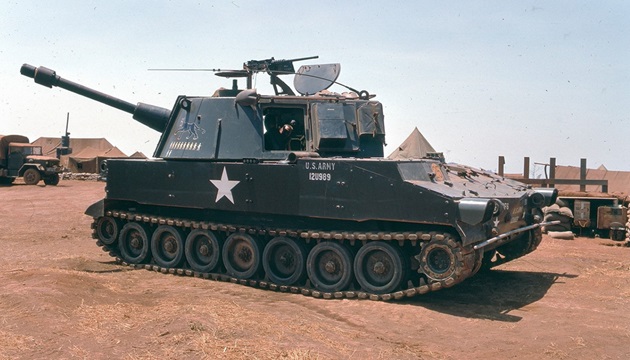
Another M108 SPH of Battery B, 3/6th Artillery. The turret is rotated to the rear.
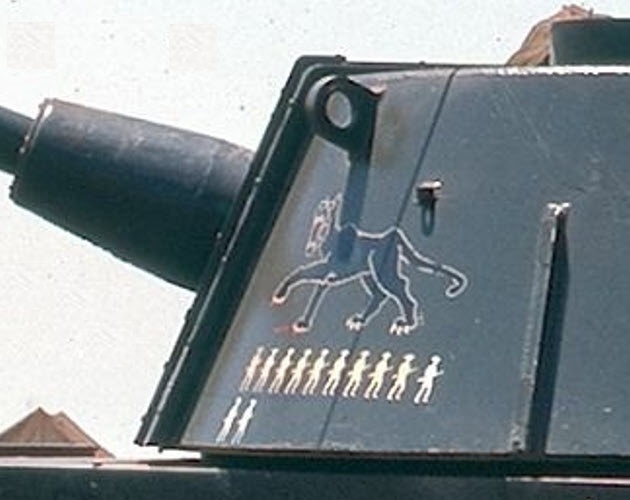
This is my close up of the M108 turret side in the above photo. It appears to be some kind of black panther with bloody front claws. Below it are kill markings for enemy soldiers. Note the top row of ten are slightly faded and the bottom two appear more recently painted.
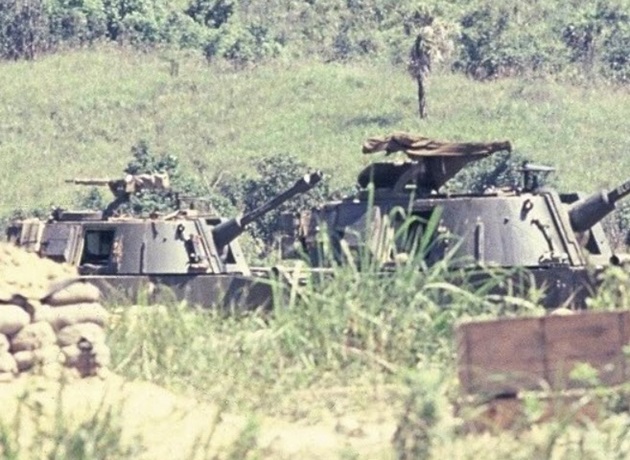
A pair of M108 SPHs of the 1st Battalion, 40th Artillery in camouflaged positions in a grass field. The M108 on the right is closer to the camera.
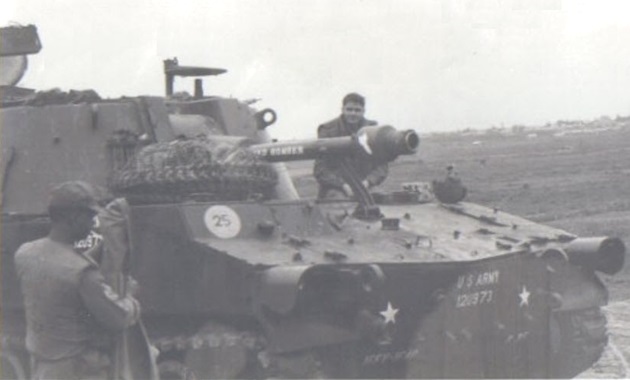
A M108 SPH of the 1/40th Artillery. The name on the howitzer barrel is illegible and there is a finned bomb painted on the fume extractor. Lying on the engine deck next to the howitzer appears to be a coil of concertina wire (barbed wire). The yellow bridge Classification disc on the front hull has a black number 25. The bumper codes are on the lower edge of the front hull beneath the two white stars and they are also illegible.
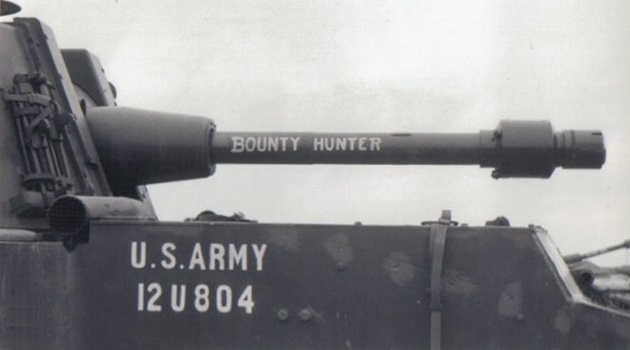
A M108 SPH named “BOUNTY HUNTER” of B Battery, 1/40th Artillery. This M108 received some enemy fire indicated by the diagonal line of six bullet holes on the side hull which were painted over. In the lower right corner of the photo there is the barrel of another M108 in the background.
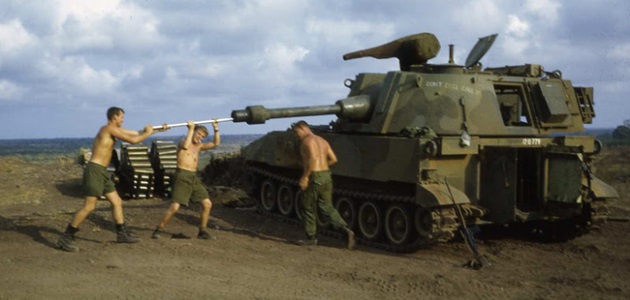
A M108 SPH named “DON’T CUSS CALL US” (painted on the side of the turret). The crew is cleaning the 105mm howitzer barrel.
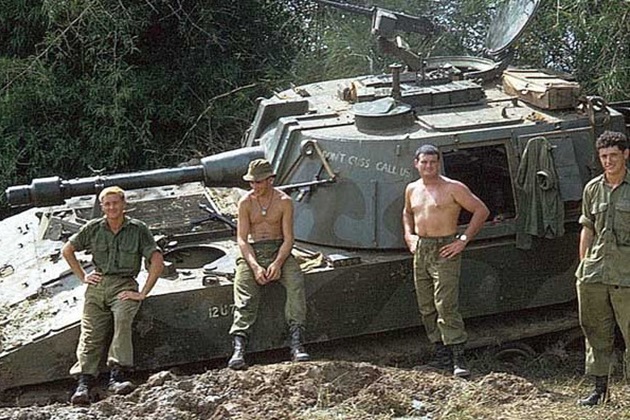
The crew posing beside their M108 “DON’T CUSS CALL US” in a dug-in position.
Film: US soldiers fire M108 Howitzer at Fire Support Base Alpha 4
Australian M108s
The US Army lend four M108 105mm SPHs to the 1ATF at Nui Dat (southeast of Saigon) in the Phước Tuy Province (today Ba Ria-Vung Tau Province) during 1967-68. The vehicles were manned by an ad hoc team of Australian infantry men commanded by a member of the Royal Australian Armoured Corps (RAAC). They formed the Howitzer Troop of A Squadron of the Australian 3rd Cavalry Regiment.
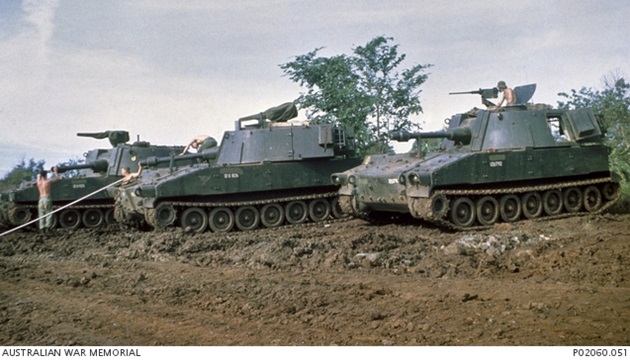
Three Australian M108s parked on the side of a road in September 1967. The soldiers on the left are cleaning the howitzer barrels.
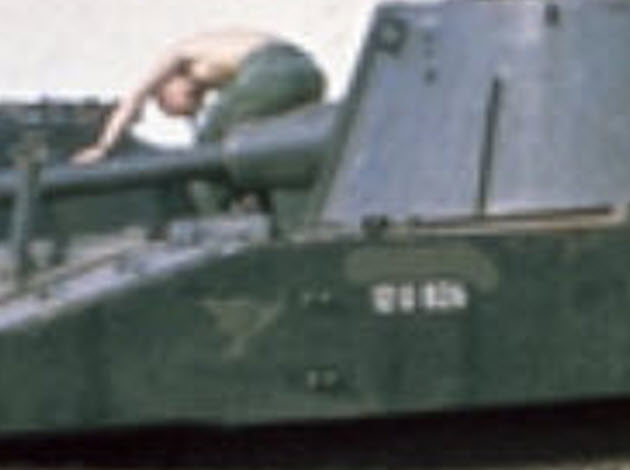
This is my close up of the hull side of the middle M108 in the above photo. The US registration number was over painted and an Australian number (illegible) was painted below it. Note the Kangaroo insignia on the left.
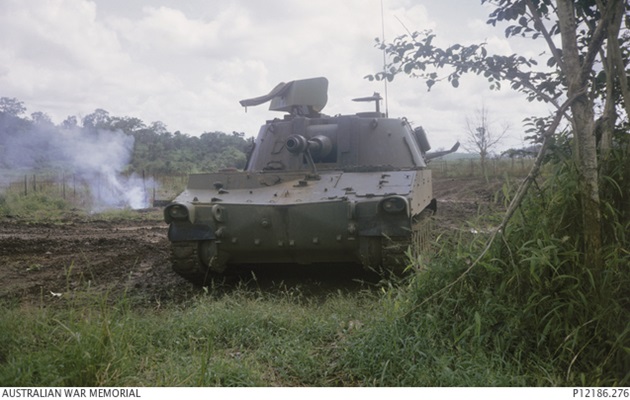
A M108 SPH at Nui Dat guarding the air field in October 1967. In the background is the tail boom of a helicopter.
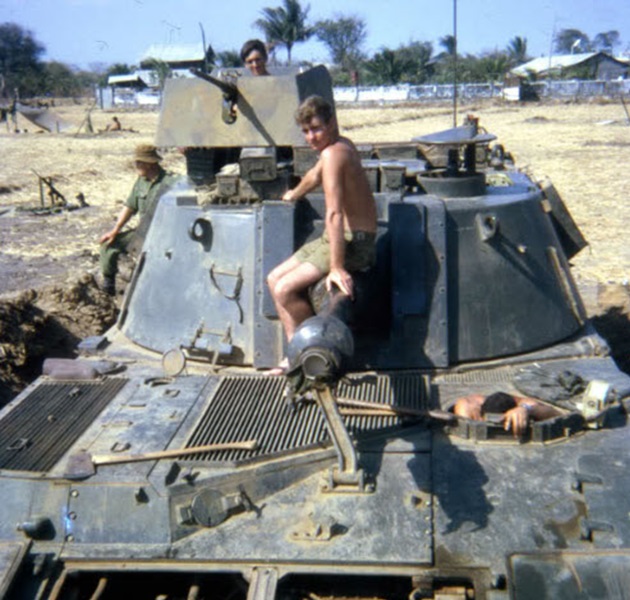
This high angle photo of an Australian M108 gives a good view of the engine deck. The commander’s .50 Caliber machine gun has a gun shield from a M113 ACAV.
An Australian M108 providing fire support.
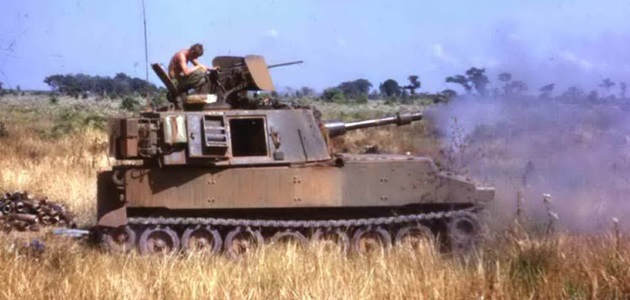
Troops of the 3rd Cavalry Regiment carrying out routine servicing of a M108 SPH. Leaning on the side of the turret is the large engine cover.

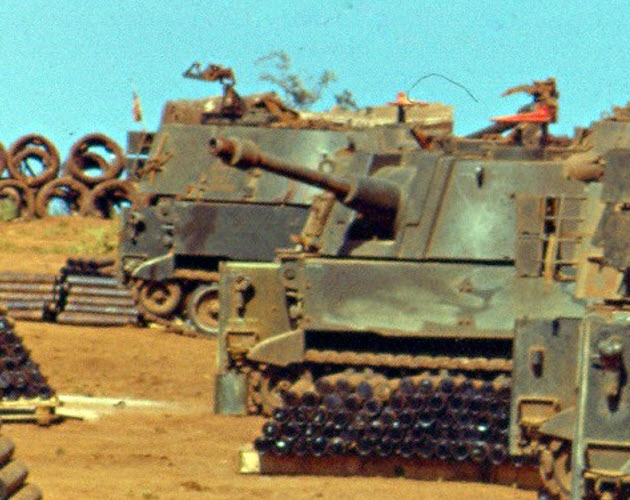
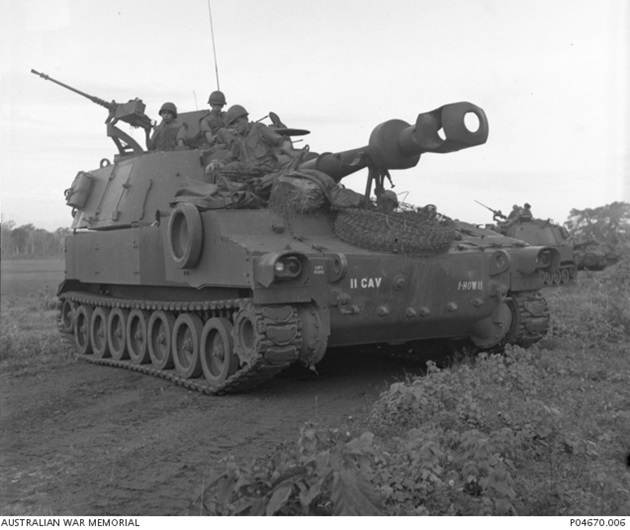
This photo is incorrectly captioned as being M109 155mm SPHs of the US 11th Armored Cavalry Regiment (ACR) Blackhorse at Xuan Loc (east of Saigon) in 1967. The stacked ammunition behind and next to the SPHs are too small to be 155mm rounds.

This is my close up of the above photo. The 105mm Howitzer barrel indicate that they are M108 105mm SPHs and they most likely belonged to the 1/40th Artillery of the II Field Force Artillery. Xuan Loc was 28 km (17.4 miles) northeast of Nui Dat.
Ben Het Camp
The US 5th Special Forces “Green Berets” Group Detachment A-244 first established the camp at Ben Het, then a hill tribe village, in the early 1960s to monitor North Vietnamese infiltration along the Ho Chi Minh Trail. The base was located approximately 13 km (8 miles) from the Vietnam-Laos-Cambodia border area, 15 km (9.3 miles) west of Đak To and 53 km (32.9 miles) northwest of Kon Tum (north of Pleiku).
In early 1969, there were about 440 Civilian Irregular Defense Group (CIDG) personnel, 511 ARVN soldiers and 25 US Green Beret advisors at Ben Het. All of the CIDG forces were Montagnards (mountain dwellers) except the commanding officer who was South Vietnamese. A number of CIDG soldiers had their families (wives and young children) living with them in the camp.
Also included at Ben Het were two M42A1 40mm Dusters and a US artillery battery of M107 175mm self-propelled guns (6th Battalion, 14th Artillery) manned by 207 US Artillery troops. To counter a buildup of enemy forces in the area, a unit of the 1st Battalion, US 69th Armor Regiment, equipped with four M48A3 90mm Patton tanks was sent to reinforce the camp.
On the night of 3-4 March 1969, the camp was attacked by enemy forces supported by Soviet-built PT-76 amphibious light tanks (76mm guns). One PT-76 detonated an US antitank mine 1100 meters (1203 yards) southwest of the camp, which tripped flares, alerted the camp, and lit up the other PT-76s attacking the base. One PT-76 scored a direct hit on the turret of a M48A3 tank, killing two crewmen and wounding two. By sighting in on muzzle flashes, a M48A3 destroyed a PT-76 with its second shot. At daybreak, the wreckage of two PT-76s and one soviet-built BTR-50 armored personnel carrier were found on the battlefield, but no enemy KIAs. Intelligence later revealed that the main object of the enemy attack was to destroy the battery of 175mm guns at the camp.
On 20 April 1969, US President Nixon issued the order to began withdrawing US troops from South Vietnam over a period of 12 months in a gradual policy of Vietnamization which put more responsibility for the war effort on the South Vietnamese. In May 1969, the Vietnamization policy began at Ben Het. The US command in Saigon (most likely MACV) wanted to conduct an “experiment” at Ben Het to test the South Vietnamese ability to fight the North Vietnamese on their own. It appears the four M48A3 tanks and the battery of 175mm SP guns were withdrawn from the Ben Het camp, and they were replaced with ARVN M41 76mm Light tanks and Battery A of the 3/6th Artillery equipped with M108 105mm SPHs manned by US crews. If the enemy overran the camp, the two Dusters, M41 tanks and M108 SPHs were considered expendable.
In late May, about 2000 enemy soldiers had surrounded Ben Het camp cutting its overland supply route from Dak To. For over a month, the enemy bombarded the camp daily with heavy artillery and mortar fire. Due to heavy monsoon rain and enemy fire, the camp’s muddy airstrip was unusable. Supplies had to be air dropped and brave US helicopter pilots flew through heavy ground fire to bring in replacements and medevac’d the wounded. Daily, USAF B-52s and fighter bombers flew air strikes dropping bombs and napalm on the enemy positions surrounding the camp.
Diagram of the Ben Het camp in June 1969.

Casualties in the US artillery battery on the North Hill had passed the 100 mark in a two week period, leaving the battery at times at half strength due to the lack of replacements but they did managed to complete their fire missions. Their lives depended on it. The 105mm ammunition resupply was slow, each day the battery fired three times more rounds than what they received from the air drops which were delivered to them by the Vietnamese troops.
A M108 105mm SPH on the North Hill firing at the enemy on 18 June 1969. On the lower edge of the photo on the rear hull of the M108 is the code “A-35” (A Battery). In the background is a truck and another M108.
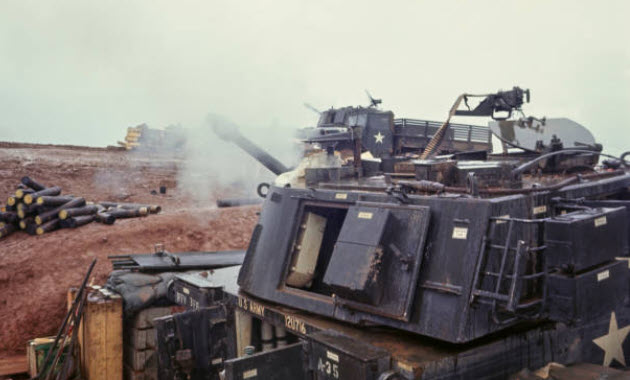
Besides firing their howitzers, the battery crewmen had to defend their tiny perimeter on the North Hill themselves, assisted by 15 Cambodian-born civilian irregular troops. During three nights in a roll, enemy sappers were spotted and killed. One night, eight enemy sappers penetrated the perimeter and sapped the No. 2 SP gun (most likely M108 A-32) with a satchel charge killing one of the seven crewmen and wounding five.
For several days, the battery was out of fresh water. Six thirsty casualties in the first aid bunker waiting to be medevac’d were given warm soda. The only fresh water available at the time was the cordite-flavored dusty liquid the men caught in their ponchos during the monsoon downpours.
During the constant shelling, an incoming enemy shell knocked out the one luxury the artillery men had left on the North Hill – a 12-inch television set (telly) which they took turns watching in the early evening hours.
On Thursday June 26th after a four day sweep by South Vietnamese troops and M41 tanks, the road (Route 579) from Dak To had been re-opened for supply convoys. At least 214 of the enemy were killed in the operation. On that day, US reporters arrived at the North Hill and they took a number of photos and interviewed the US artillery troops. The reporters were not able to access the rest of the camp because it was still being shelled by the enemy.
A photo of a M108 SPH at Ben Het which appeared on the front page of the Friday 27 June 1969 issue of the Daily Intelligencer Journal in Lancaster, Pennsylvania (the seventh-oldest newspaper in the US). This newspaper ran a series of articles on the besieged Ben Het camp from the beginning.
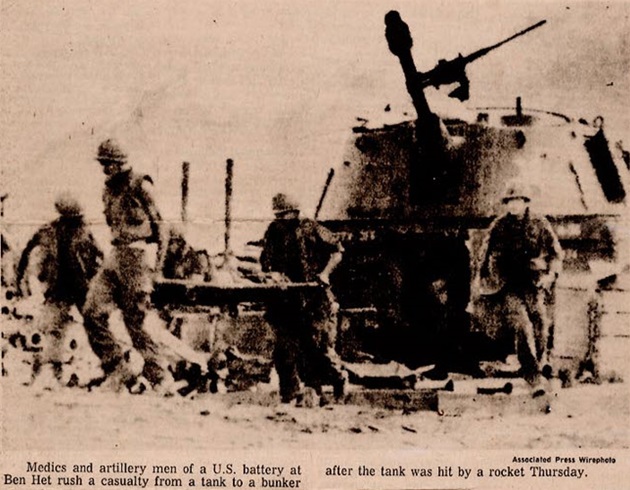
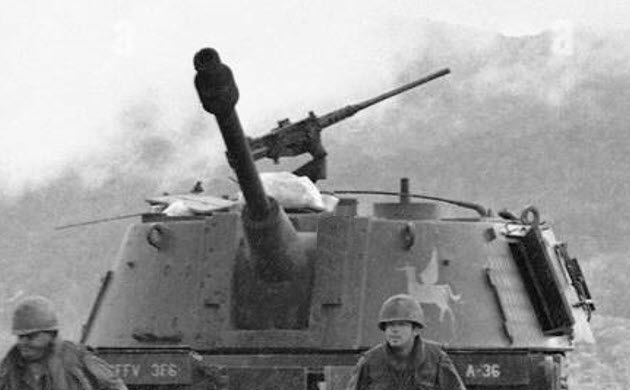
This is my close up of a photo of the actual M108 taken on June 26th. The figure painted on the M108’s turret is a Pterocentaur, a race of creatures with origins in Greek mythology. It is described as a Pegasus-centaur where the upper body is a man while the lower body is that of a winged horse, known as a Pterippus. My guess the two white lumps on the turret roof are nylon parachutes. The M108 turret is rotated to the rear. Note the code “A-36” on the rear hull of the M108.
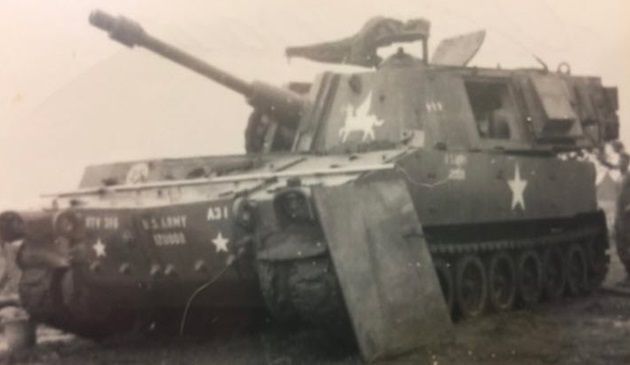
A M108 of the 3/6th Artillery with code “A-31”. The yellow Bridge Classification disc with a black number 25 is on the front hull. Note the two small white stars on the front hull beneath the bumper codes.
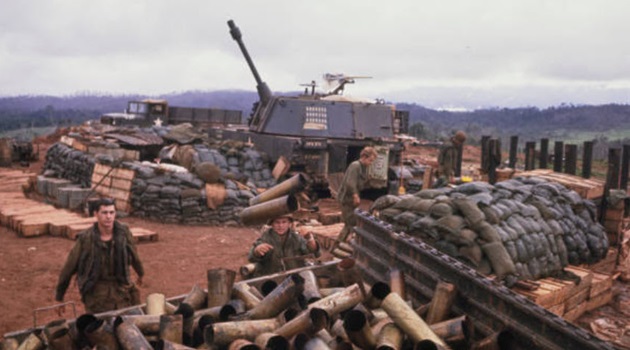
A M108 SPH on the North Hill at Ben Het on 30 June 1969. In the foreground, two artillery men are tossing spent 105mm shells into the cargo bed of a truck.
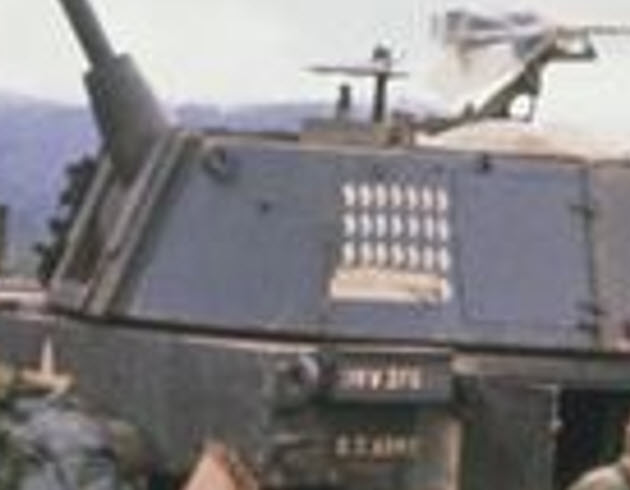
This is my close up of the M108’s turret side in the above photo. There are 21 kill or fire mission markings painted on the turret side.
Film: SYND 3-7-69 VIETCONG ATTACK ON GREEN BERET CAMP
This is my screen shot of a M108 on the North Hill at Ben Het in the above film on 3 July 1969. There is a soldier standing on the top of the sandbag wall to the right of the M108 examining the muzzle break of the 105mm howitzer.
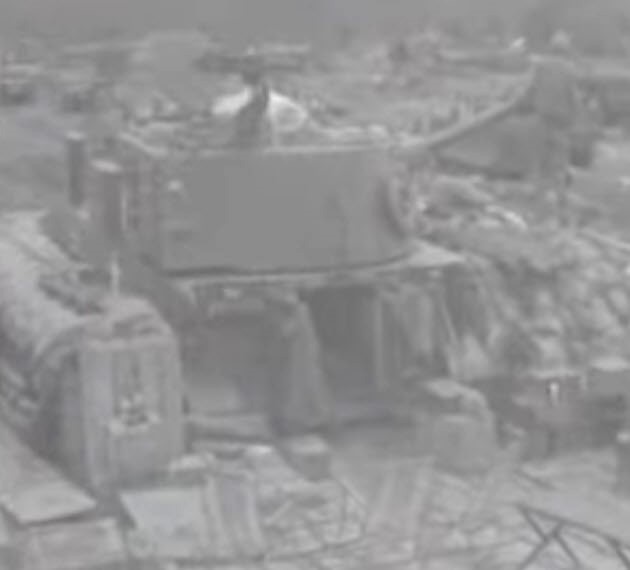
Both M108 battalions were withdrawn and phased out of US Army service in 1975. The M108 was used by several NATO countries.
- Belgian Army: 95, until the 1980s.
- Brazilian Army 72 M108APs, withdrawn, 10 donated to Uruguay and 6 donated to Paraguay.
- Cambodia: Khmer National Army, withdrawn.
- Spanish Army: 48, withdrawn.
- Taiwan: Republic of China Army: 100.
- Tunisian Army: 48.
- Turkish Army: 26 M108T, withdrawn.
M109 SPH
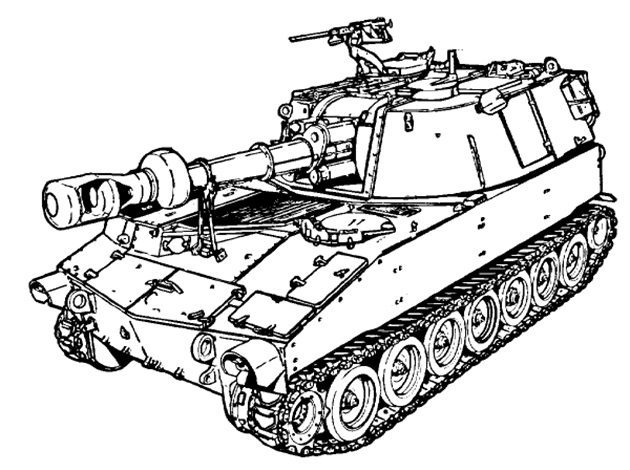
Manufacturers:
- Cadillac Motor Car Division of General Motors Corporation
- Chrysler Corporation
- Allison Division of General Motors Corporation
Number built: 3786
Date of first acceptance: November 1962
Specifications:
Weight: 52,461 lbs. (23,796 kg)
Length w/o gun: 240.7 in (611.4 cm)
Howitzer overhang forward: 19.7 in (50.0 cm)
Width: 124.0 in (315.0 cm)
Height w/ AA MG: 129.1 in (327.9 cm)
Armor: 1.25 in (31.75 mm)
Engine: Detroit Diesel 8V71T 8-cylinder water-cooled turbocharged diesel engine 390 hp @ 2,300 rpm
Fuel capacity: 135 gallons (511 Liters)
Operational range: 216 miles (350 km)
Maximum speed: 35 mph (56 km/h)
Main Armament: 155mm Howitzer M126 or M126A1
Ammunition: 28 rounds
Round Weight: Average 95 lbs. (43 kg)
Gun Elevation: +75° to -3° (manual and hydraulic)
Rate of fire: Maximum: 4 rpm/3 min, Sustained: 1 rpm
Effective firing range: 18.1 km (11.2 miles)
The M126 Howitzer fired all the standard 155mm rounds.
A 155mm Anti-Personnel shell was not available in Vietnam.
Secondary Armament:
1x Browning .50 Caliber (12.7 mm) M2 machine gun with 500 rounds.
M109 Crew: 6-10
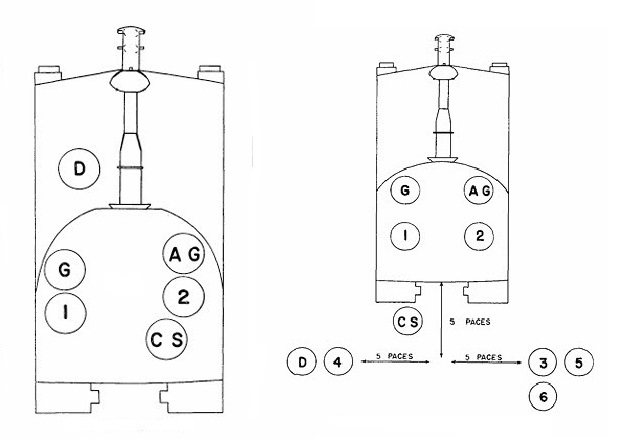
Crew mounted (left):
(D) – Driver in hull left front
(G) – Gunner in turret left front
(AG) – Assistant gunner in turret right front
(1) – Cannoneer #1 in turret left
(2) – Cannoneer #2 in turret right
(CS) – Chief of section in turret right rear
Additional crew dismounted for sustained firing (right):
(3) – Cannoneer #3
(4) – Cannoneer #4
(5) – Cannoneer #5
(6) – Cannoneer #6
The additional crewmen were transported in another vehicle.
M109s in Vietnam
The M109 saw its combat debut in Vietnam. Around 200 M109s were first deployed in 1966.
US ARMY
I Field Force Artillery:
- 25th Infantry Division Artillery: 3rd Battalion, 13th Artillery (January 1968)
- 108th Artillery Group: 2nd Battalion, 138th Artillery (July 1969)
- 5th Infantry Division Artillery: 5th Battalion, 4th Artillery (July 1968)
II Field Force Artillery:
- 1st Infantry Division Artillery: 8th Battalion, 6th Artillery
- 4th Infantry Division Artillery: 5th Battalion, 16th Artillery
- 9th Infantry Division Artillery: 1st Battalion, 84th Artillery
- 11th Armored Cavalry Regiment: 3rd Squadron Howitzer Battery
- 23rd Artillery Group: 1st Battalion, 27th Artillery
- 25th Infantry Division Artillery: 3rd Battalion, 13th Artillery (July 1969)
- 54th Artillery Group: 2nd Battalion, 35th Artillery
- 108th Artillery Group: 2nd Battalion, 138th Artillery (January 1968)
US MARINES
- 4th Battalion, 12th Marine Regiment, US 3rd Marine Division
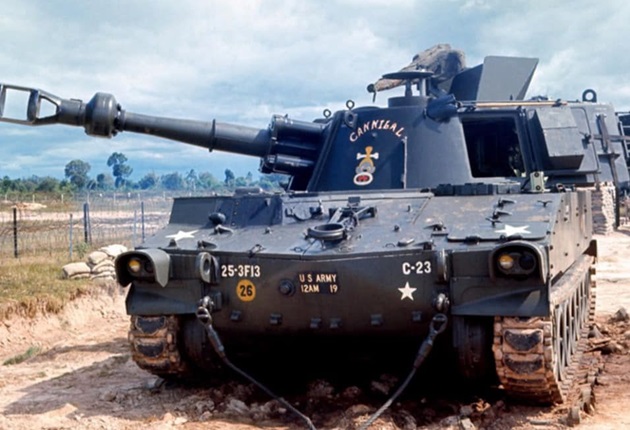
M109 named “CANNIBAL” of 25th Infantry Division, 3rd Battalion, 13th Artillery, C Battery. Note the two white stars painted on top of the front hull behind the headlight mounts.
The crew on top of their M109 of the 25th Infantry Division, 3/13th Artillery, A Battery at their base camp in Cu Chi, approximately 25 km (15.5 miles) northwest of Saigon in 1970.
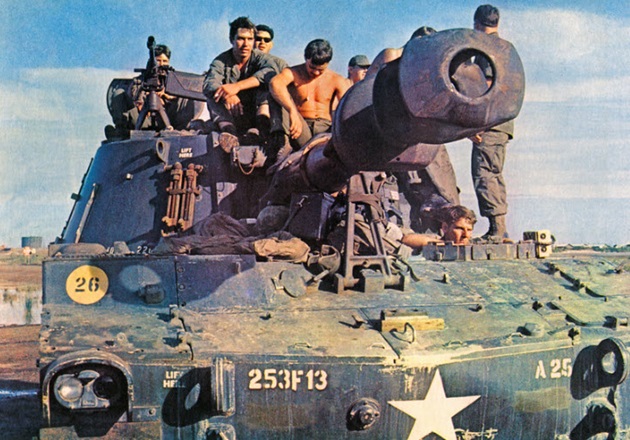
M109 named “CONGCOFFIN” of Battery C, 2nd Battalion, 138th Artillery on Hill 88 (AKA FSB Denise) on 19 March 1969. The 2/138th Artillery was a Kentucky National Guard unit.
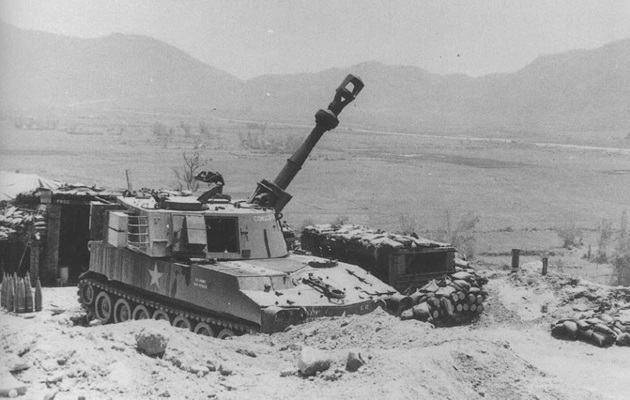
Film: XXIV Corps V Artillery Sites 03/19/1969 – 03/20/1969
(Includes Hill 88 and M108s of 1/40th Artillery at FSB Alpha 4)
A M109 SPH named “CRUEL DEATH.” in a defense position at an unknown Fire Base. The sandbag covered bunker in the foreground obscures most of the front hull. Only the top edge of the letters “IFFV” can be seen. It either belonged to the 25th Division, 3/13th Artillery or to the 108th Artillery Group, 2/138th Artillery. If the date of the photo was known, it could help determine the unit. Since the name begins with the letter “C”, it most likely belonged to C Battery.
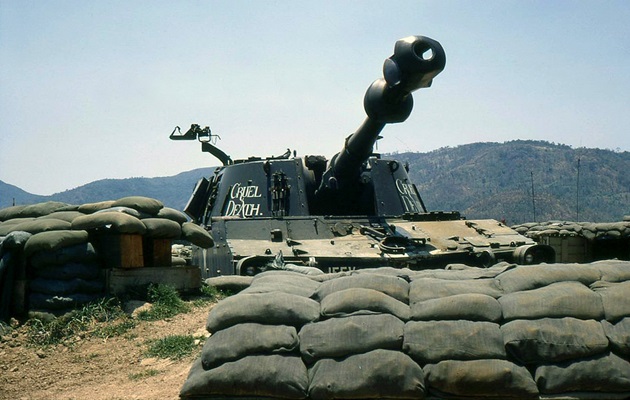
A M109 of the 4th Infantry Division, 5th Battalion, 16th Artillery, B Battery. Note the white star painted on the turret roof above the howitzer. Note the howitzer muzzle has red lips painted on it.
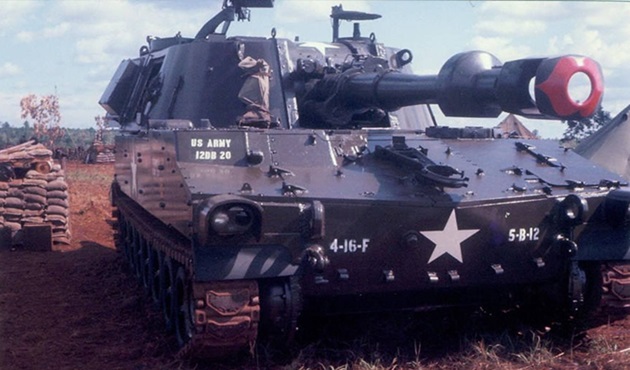
A M109 of A Battery, 5/16th Artillery in 1968. The diamond on the side of the turret is the insignia of the US 4th Infantry Division, the “Ivy” division. The Division’s nickname is a play on words of the Roman numeral IV or 4.
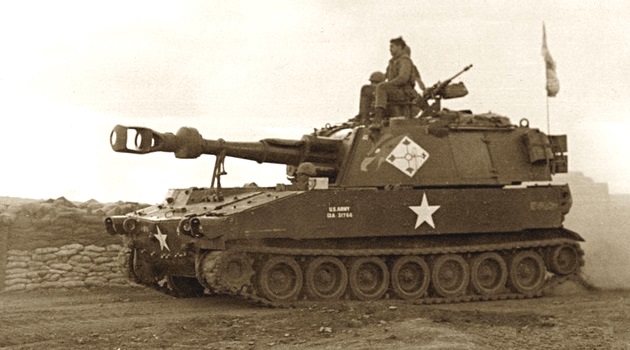
This is my close up of the above M109 turret in color. The stylized red and yellow depiction of a cardinal or similar bird is probably an insignia for one of the infantry regiments of the 4th Infantry Division. The cardinal is the state bird of Illinois, Indiana, Kentucky, North Carolina, Ohio, Virginia, and West Virginia.

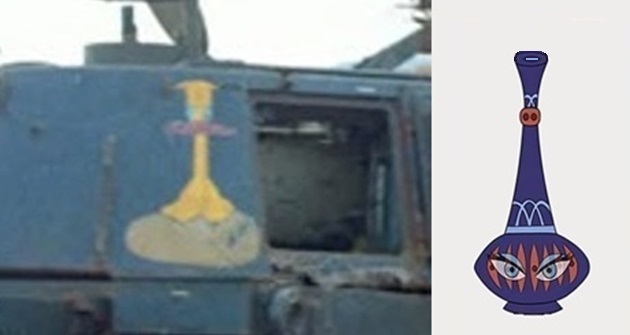
A M109 of the 5/16th Artillery on the perimeter of Camp Enari in 1968 which served as the main base for the US 4th Infantry Division. The camp was near the Dragon Mountain (Núi Hàm Rồng) and Highway 14, 12 km (7.5 miles) southeast of Pleiku. The squatting crewman on the left is preparing 155mm rounds for firing. In the background on the left is a dug-in M113 APC with a MG gun shield.

This is my close up of the M109 turret in the above photo. The artwork appears to be an Arabian Genie bottle with a M109 155mm howitzer barrel as the bottleneck. On the right side of the bottle on the turret appears to have two eyes. The crew probably had seen the US 1965-70 Television series “I Dream of Jeannie” which starred Barbara Eden and Larry Hagman. On the right, I added the cartoon genie bottle (without cork) seen at the end of the program’s introduction. Around the bottle’s neck on the turret appears to be a ring of pink smoke, not a name.
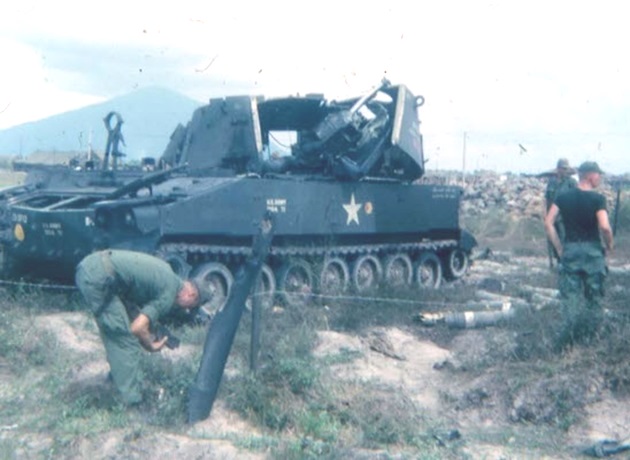
The howitzer of this M109 appear to had exploded. The crew probably did not change the barrel as often as they should have. There could been a crack in the barrel which shattered upon firing or a round detonated prematurely in the barrel. The soldier in the foreground is examining the shattered barrel. The unit, location and date are unknown.
11th ACR M109s
The Howitzer (HOW) Battery was the organic artillery support for the US 11th ACR.
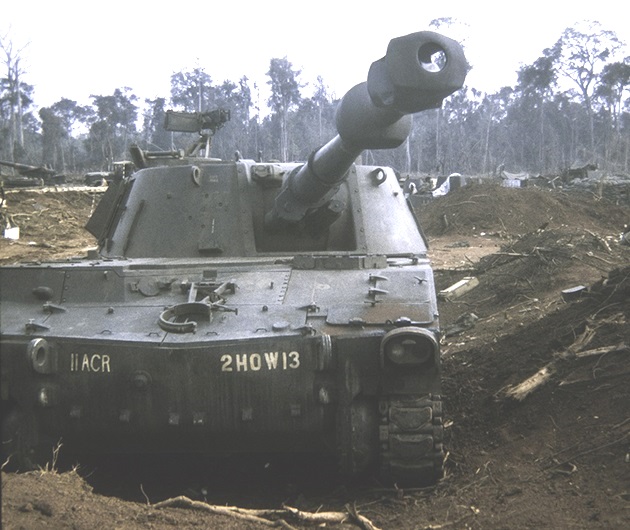
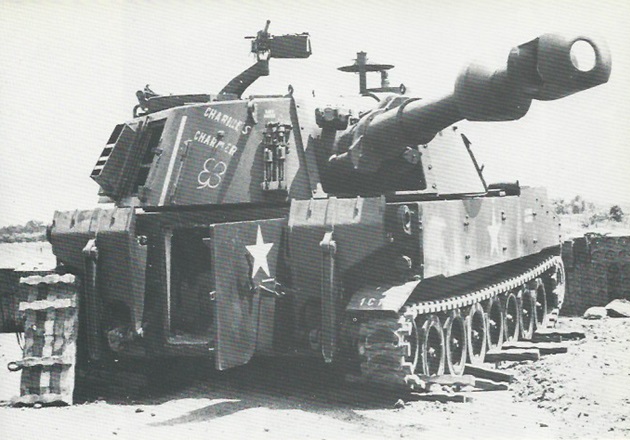
M109 named “Charlie’s Charmer” of the 11th ACR at a Fire Support Base in 1969. Below the name on the turret is a four leaf clover for good luck. Note the recoil spades are folded up on the rear hull. Pieces of wood were placed against the road wheels as chocks to prevent the vehicle from moving when the howitzer fired.
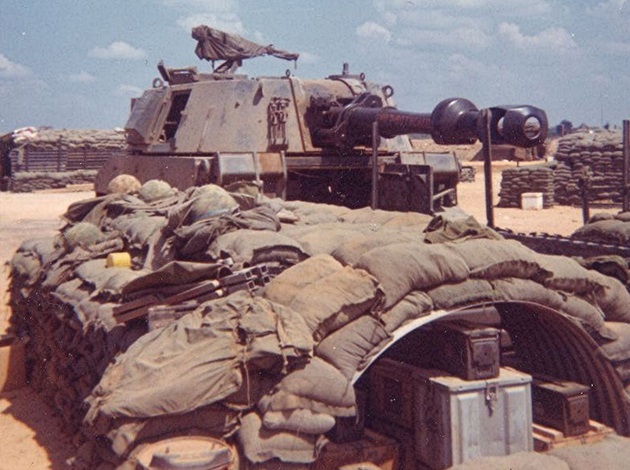
A M109 of HOW Battery, 2/11 ACR at FSB “Fiddler’s Green” in the Hau Nghia province (west of Saigon and bordered on Cambodia) in 1971. Note the arc shelter covered with sandbags in the foreground.
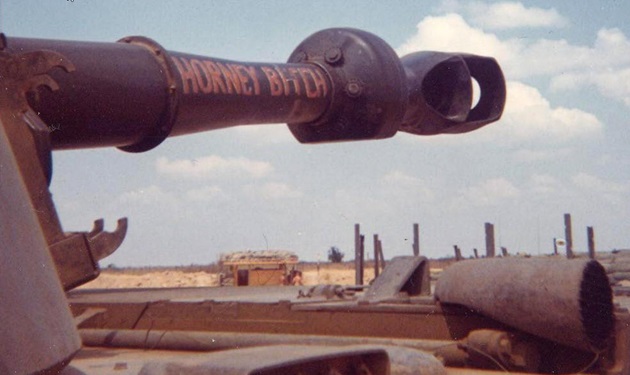
M109 named “HORNEY BITCH” of HOW Battery at a Fire Support Base, either FSB Andrews or Fiddler’s Green.
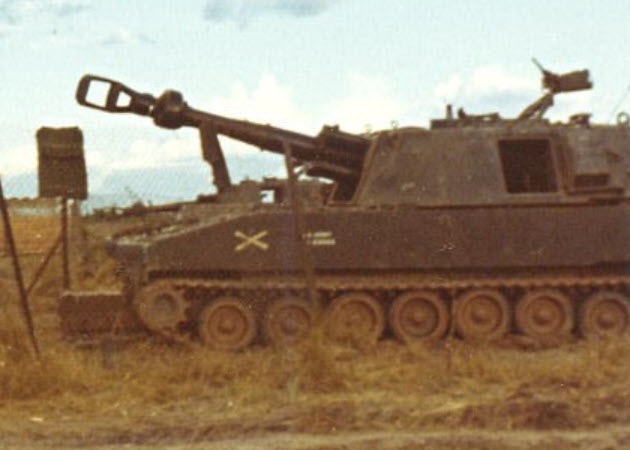
Another M109 of HOW Battery. This M109 has the Cavalry’s crossed sabers insignia painted on the hull side. In the background is another M109 with its howitzer elevation at about -3°.
This is a camouflaged M109 at a Fire Support Base (location and date unknown) which appears to be dug in deep. The recoil spades on the rear hull had been lowered and they appear to be buried in the ground. A couple of hoops had been attached to the tracks and they are holding the pole used for cleaning the howitzer barrel.
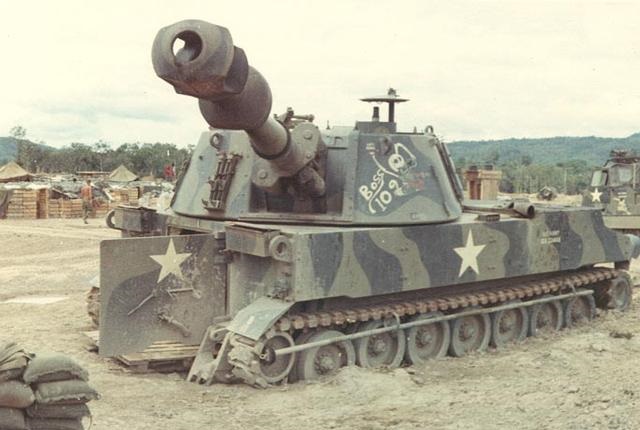
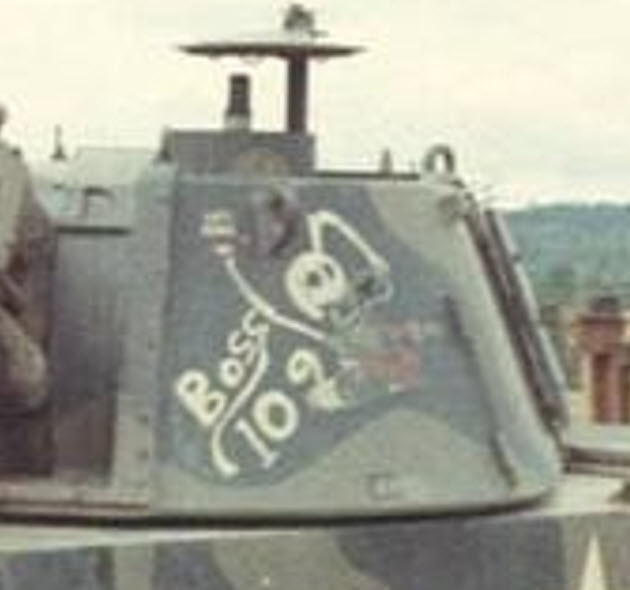
This is my close up of the M109 Turret in the above photo. The name is “Boss 109” and it has some kind skeleton with a skull drawing.
US Marines M109s
The 12th Marine Regiment of the US 3rd Marine Division served in Vietnam from May 1965 to November 1969. The regiment’s history in Vietnam paralleled its role in providing artillery support to the III Marine Amphibious Force. The regiment’s first units landed in the South Vietnam in early March 1965, with the first major operations being Operation STARLITE in August 1965 and Operation HARVEST MOON in late 1965. The regiment was involved in numerous combat missions, including search and destroy operations, and also engaged in civic action projects such as building repairs and food distribution. By the end of 1966, units of the regiment were stationed in various locations in the northern sector of South Vietnam, including Da Nang, Cam Lo, Phu Bai, Khe Sanh, Con Thein, Camp Carroll and the Rockpile.
The 12th Marine Regiment was mainly equipped with the M53 155mm and M55 8-inch (203.2mm) SPGs. The US Marines received only a small number of M109s to supplement their older SPGs which had a limited gun transverse. Batteries K, L, and M of the 4th Battalion are known to had M109s.
Three M109s of M Battery, 4/12th Marine Regiment move into positions 3 miles (4.83 km) south of Phu Bai before firing upon suspected Viet Cong areas in January 1966.

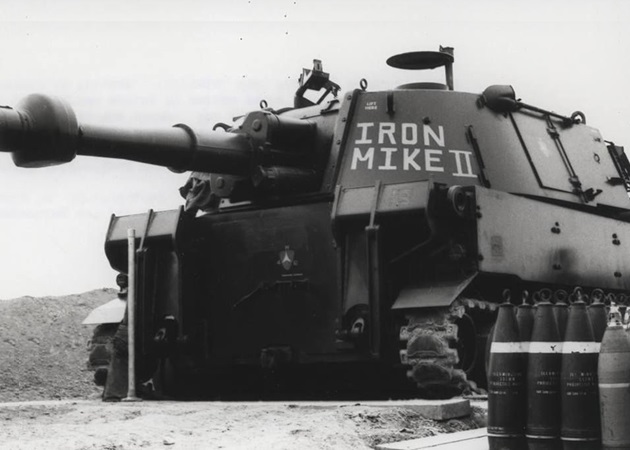
A M109 of the 4/12th Marine Regiment with rows of shells behind it. The shells with the ring on the nose have a shipping plug instead of a fuse.
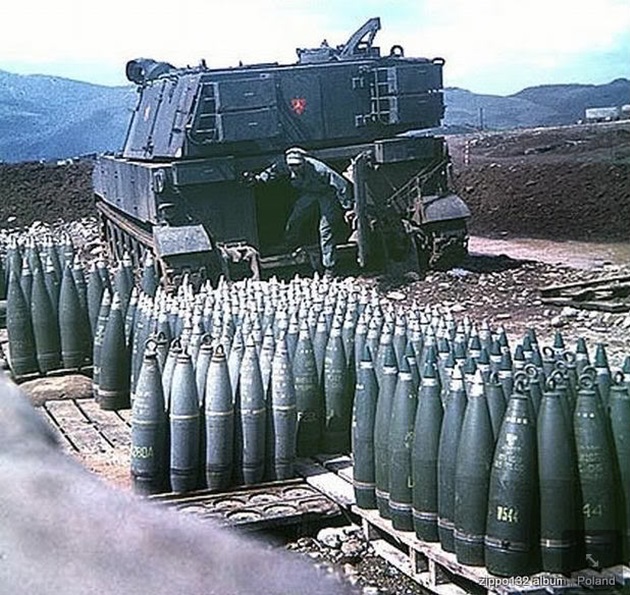
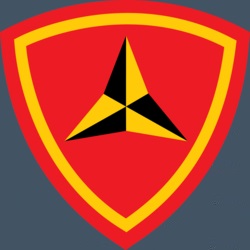
The markings on the M109 turret side and rear in the above photo is the insignia for the US 3rd Marine Division, the “Caltrap” division.
M109 named “IRON MIKE II” of M Battery, 4/12th Marine Regiment in 1969.
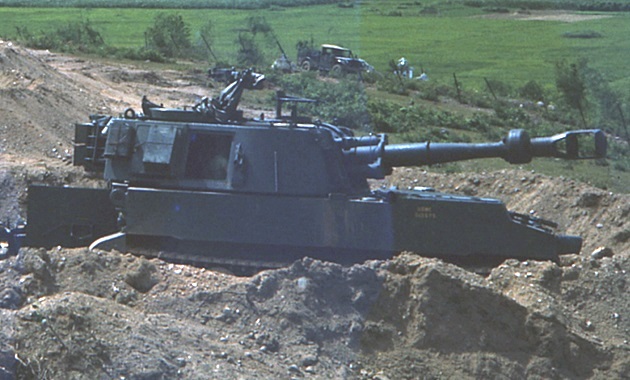
A M109 of 4/12th Marine Regiment on Hill 65 located southwest of Da Nang, north of the Song Vu Gia River. In the background is a Dodge M37 3⁄4-ton 4×4 truck.
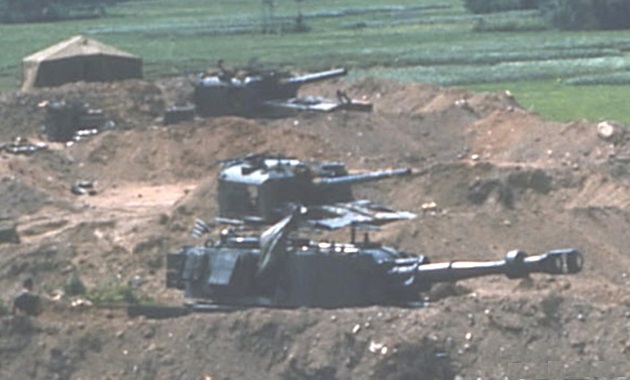
Another M109 of 4/12th Marine Regiment on Hill 65. Behind it are M53 and M55 SPGs.
After the 1968 Tet Offensive, the 1st Brigade, US 5th Infantry (MECH) Division “Red Diamond” was dispatched to South Vietnam to replace a US Marines unit. In July 1968, the brigade arrived at Quang Tri (IFFV) and it operated in the area known as “Leatherneck Square,” assisting the US 3rd Marine Division in denying the enemy from infiltrating south through the demilitarized zone (DMZ).
The boundary of Leatherneck Square was Con Thien to Gio Linh in the north, and Cam Lo to the Đong Ha Combat Base along Route 9 in the south, making it about 6 miles (9.7 km) wide (west to east) and about 9 miles (14 km) deep (north to south).

A camouflaged M109 in a dug-in position at a fire base somewhere in “Leatherneck Square”. The only identifiable marking is the red diamond on the turret which is the insignia of the US 5th Infantry Division. The unit code on the left rear fender is illegible.
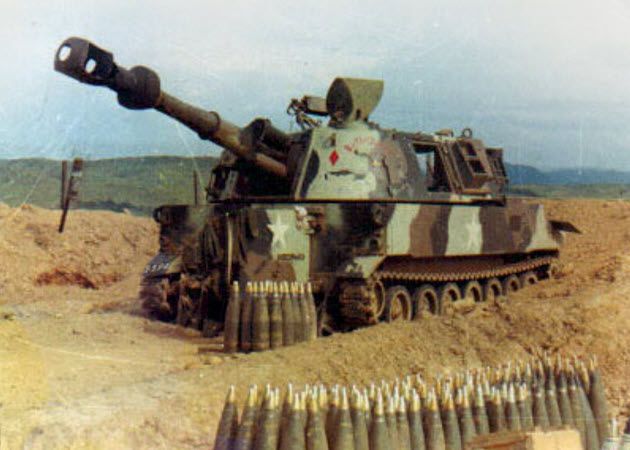
In January 1971, the reinforced brigade initiated Operation Lam Son 719. The brigade opened the QL-9 Road from Dong Ha to the Laotian border while engineers constructed access roads from the Rock Pile to Khe Sanh. Following this, a large ARVN Task Force moved to the Laotian border. The 1st Brigade’s mission was to secure QL-9 as a supply route and provide mobile defense for the huge forward support area of FSB Vandergrift and Khe Sanh.
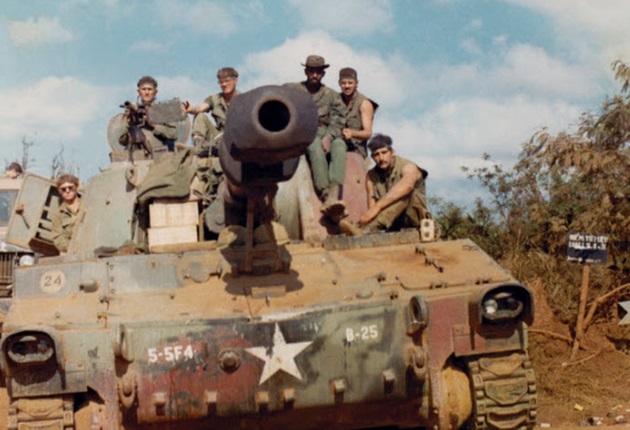
The crew poses on their M109 of B Battery, 5th Battalion, 4th Field Artillery (“5-5F4”) near Khe Sanh in 1971. The reddish-brown color is the dirt prevalent in Vietnam. The yellow Bridge Classification disc with the number 24 is odd, other M109s have the number 26 or 27. It could be a M108 rebuilt as a M109 and the bridge classification was not changed.
Australian M109s
The 2nd Battalion, 35th Artillery arrived in Vietnam on 17 June 1966 from Fort Carson, Colorado, USA. It was first stationed at Xuan Loc (Located on Highway 1 east of Saigon) with the 23rd Artillery Group. While at Xuan Loc, the battalion was later transferred to the 54th Artillery Group. From 1966, six M109 155mm SPHs of A Battery “The Huskies”, 2/35th Artillery were located at the 1ATF base at Nui Dat. The battery supported Australian and New Zealand operations in that area. In April 1970, the battery moved to Long Binh, where it remained until leaving Vietnam on 13 March 1971.
The six US M109s helped support Company D, 6th Battalion, Royal Australian Regiment (6RAR) on 18 August 1966 in what became known as the Battle of Long Tan which took place on a rubber plantation near Long Tan in the Phước Tuy Province. This battle involved a small contingent of 108 Australian soldiers who faced an overwhelming force of 1500 to 2500 Viet Cong guerrillas. Despite being extremely outnumbered, the Australian troops managed to hold their ground with artillery support from Nui Dat, resulting in significant casualties for the Viet Cong and marking a defining moment in the Vietnam War.
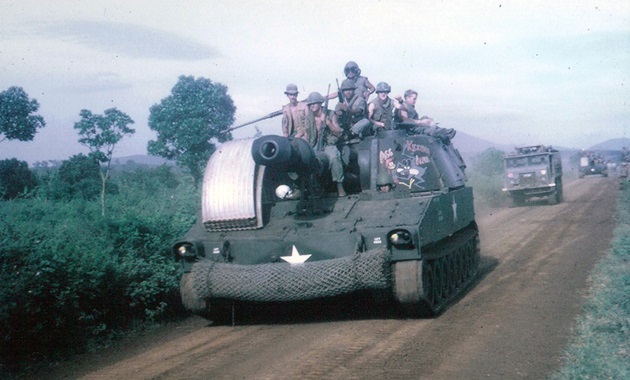
The crew riding on top of their M109 traveling in a column. Following it appears to be an Australian International No.1 Mk.3 2-1/2 ton 4×4 cargo truck, indicating that the M109 most likely belonged to the 2/35th Artillery. On the M109 engine deck, it is carrying curved sections of corrugated sheet metal. When assembled, they would create an arc shelter and most likely be covered with sandbags. In the background, down the road is another M109 carrying the same curved sections. Hanging on the front hull is rolled up chain-link fencing and the white markings on the front hull are the standard “LIFT HERE”.
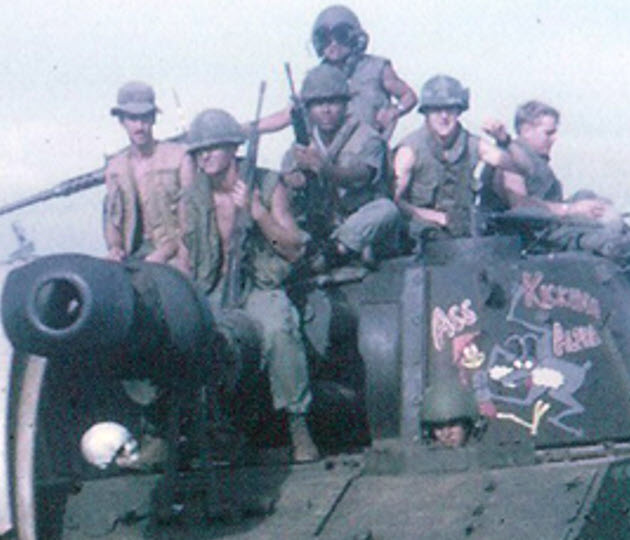
This is my close up of the M109 turret in the above photo. On the turret side appears to be the cartoon character Wile E. Coyote strangling the Road Runner who is wearing an Asian conical hat. Most of the text is illegible. Sitting on the engine deck on the left appears to be a white human skull but it is too large to be real. The head was probably from a statue.
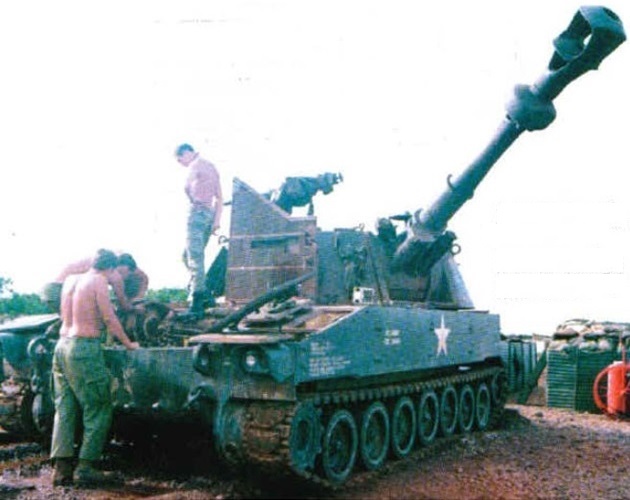
A M109 of A Battery, 2/35th Artillery being serviced at Nui Dat. Leaning on the side of the turret is the large engine cover.
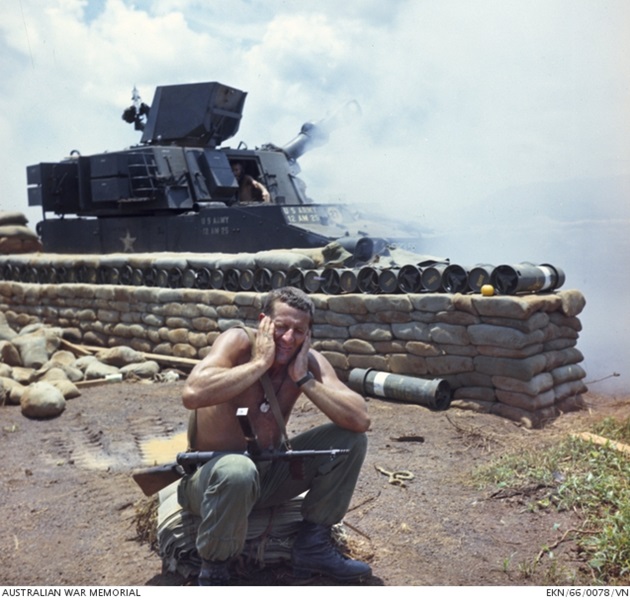
An Australian soldier of the Liaison team with the 2/35th Artillery supporting the 1ATF, covers his ears while the M109 fires its 155mm howizer in the background in 1966. He is armed with an Australian Owen submachine gun (produced in 1942-44).
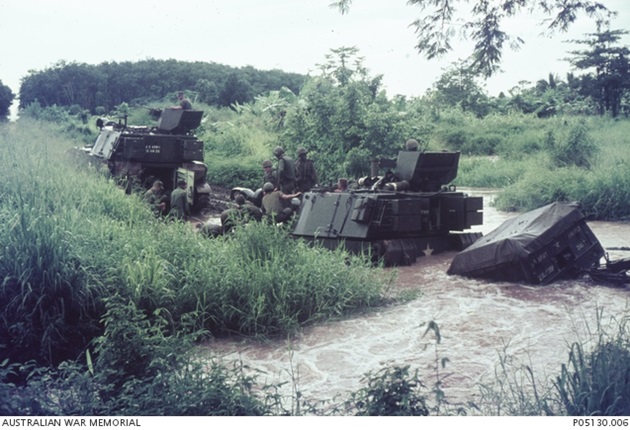
The following three photos are M109s of A Battery, 2/35th Artillery, crossing a flooded creek, as they return to Nui Dat after completing an operation supporting Australian troops at Bin Ba village 5 km (3.1 miles) north of Nui Dat in 1966. Some of the M109s towed ammunition trailers.

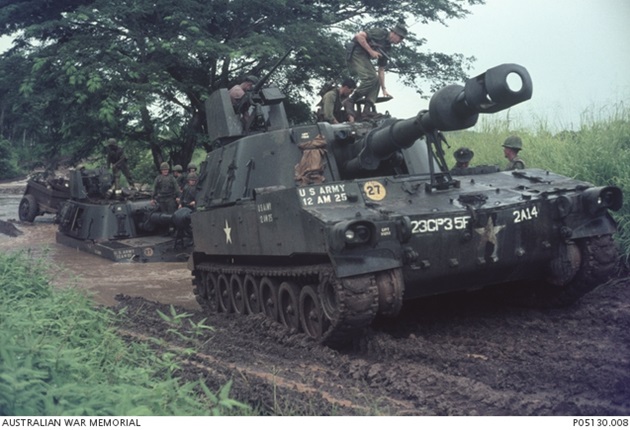
This is the view of the leading M109 driving up the muddy bank. Note the codes “23GP35F” AND “2A14” on the front hull.
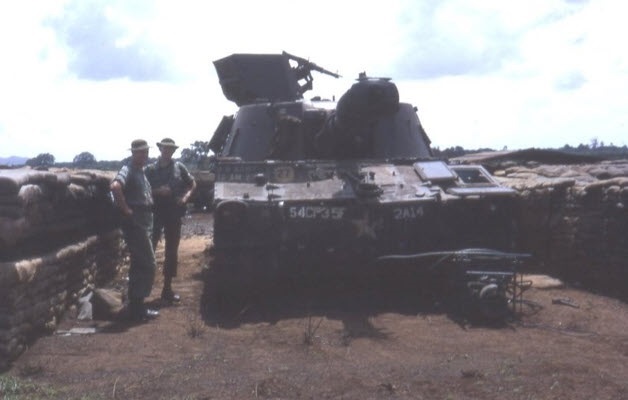
This is the same M109 as in the above photo at Nui Dat after the battalion transferred to the 54th Artillery Group. It now has “54GP35F” on the front hull.
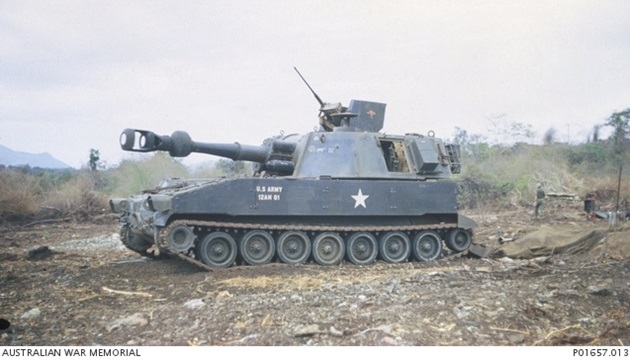
A M109 of A Battery, 2/35th Artillery at a Fire Support Base located on a 60 meter hill near Dat Do in March 1967.
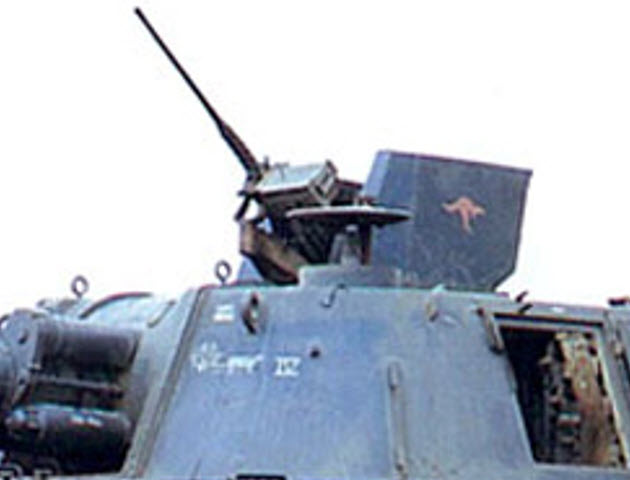
This is my close up of the M109’s turret in the above photo. The text next to the lifting ring is the standard “LIFT HERE”. The meaning of the markings below the lifting ring are unknown. Note the kangaroo insignia on the side of the commander’s machine gun shield.
Operation Paddington (8-15 July 1967) was a large search and destroy operation involving nearly 15000 US, South Vietnamese, and Australian troops based in the Bien Hoa Province. Allied forces for the operation Paddington included the 1st Brigade, US 9th Infantry Division, the 2nd Battalion, US 47th Infantry Regiment (Mechanized), the US 11th ACR, Task Force B Marine Corps (Republic of Vietnam), and the 1ATF, as well as various supporting arms including two artillery batteries.
A M109 near the Song Rai bridge which US units crossed during Operation Paddington. To the right of the lifting ring on the front hull a number 11 is visible. The M109 most likely belonged to the HOW battery of the 11th ACR.
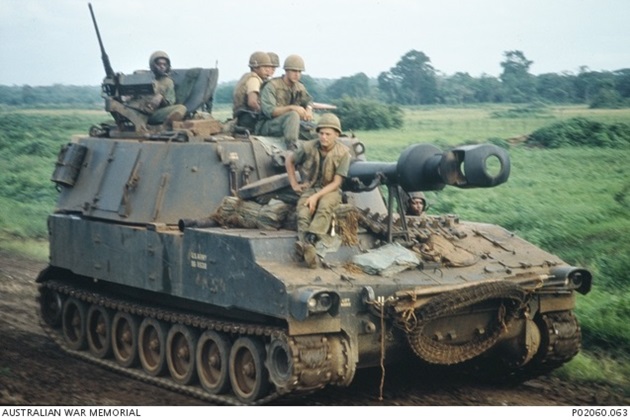
Part of a large column of armored vehicles, M109s of the US 1/11th ACR takes up defensive positions along Route 23 during a pause in its move towards the staging point for Operation Paddington near Xuyen Moc approximately 105 km (65.2 miles) southeast of Saigon in July 1967.
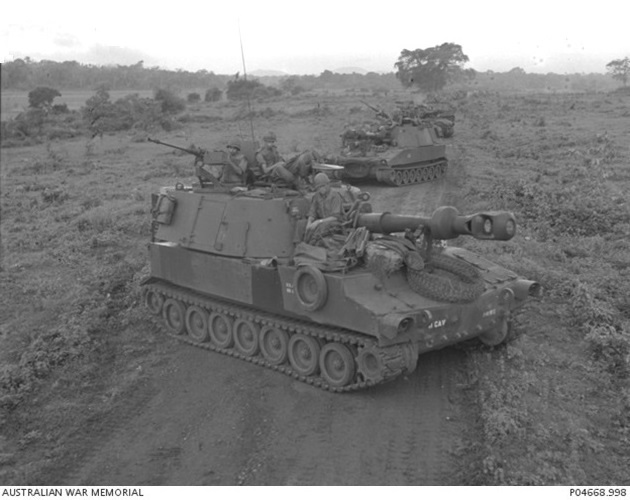
On 13 May 1968, M109s of A Battery, 2/35th Artillery arrived at Australian FSB Coral, 40 km (25 miles) northeast of Saigon.
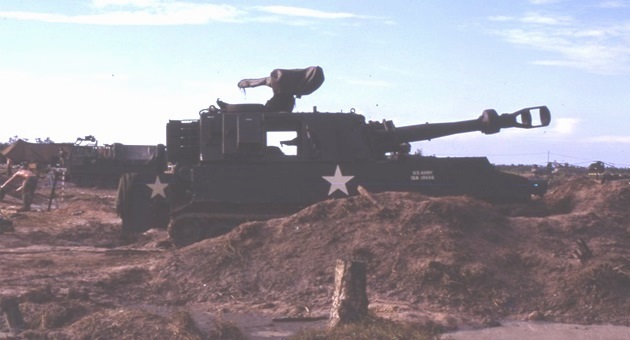
M109s of A Battery, 2/35th Artillery in defense positions at Nui Dat.
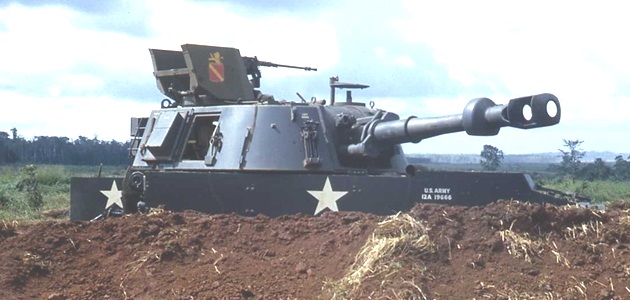
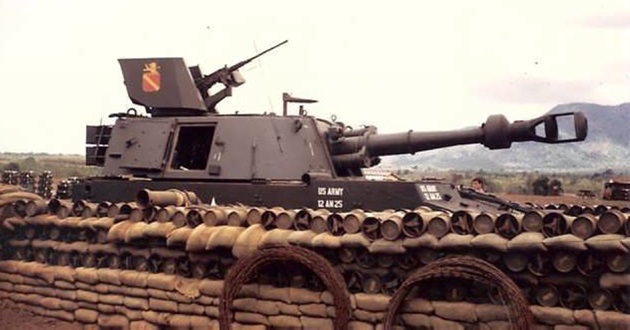
The 35th Field Artillery crest painted on the MG shields in the above two photos.

Film: US Army helicopters and defensive positions of the 54th Field Artillery Group, 28 February 1969
Video: US Self Propelled Howitzers Vietnam War M108, M109
Post Vietnam
After the Vietnam war, the M109 was upgraded to such extent that it is still in US service today. Over the past decades, it was upgraded integrating the best technologies each era had to offer. It was sold to about 40 countries worldwide, including several NATO’s members. Its best equivalent in popularity was the Soviet 2S1-2S3 family. It saw action in the Israeli Yom Kippur War, Iran-Iraq war, the gulf war and invasion of Iraq until 2014. Today, the Ukrainians are using M109s against the Russians.
Video: How The M109 Became A Battlefield Legend
Video: M109 Paladin Howitzer in Action – Live Fire Mission
Video: This Is What Makes the M109 Paladin Self-Propelled Howitzer So Badass
Today
A M108 is on display at The Texas Military Forces Museum, Camp Mabry, Austin, Texas. Next to it is a camouflaged M107 175mm SPG.
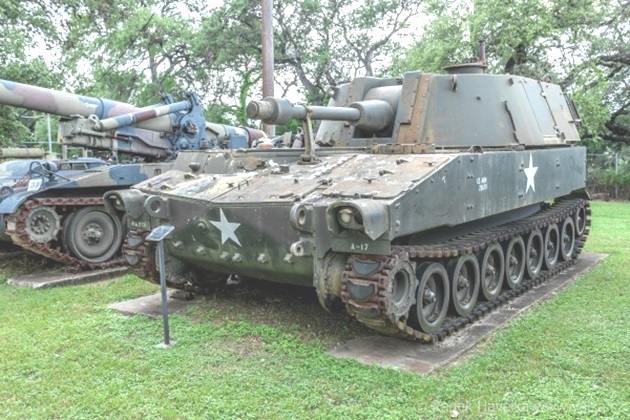
A M109 is on display at the US Army Field Artillery Museum. Location: 34° 40.022′ N, 98° 23.18′ W in Fort Sill, Oklahoma, in Comanche County. It is at the intersection of Corral Road and Randolph Road, on the right when traveling west on Corral Road. The M109 is located in the central section of the Artillery Park.
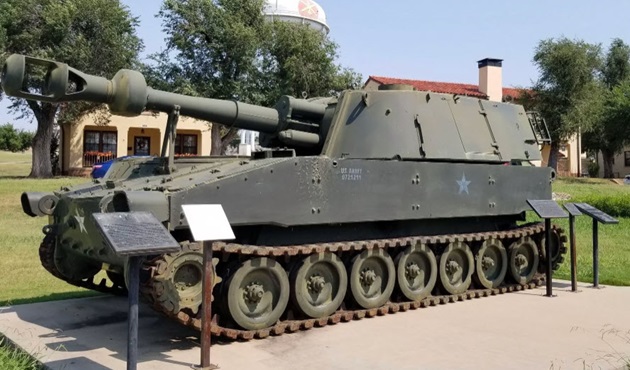
A M109 of the 5/16th Artillery, 4th Infantry Division is on display at the National Museum of Military Vehicles, 6419 US Highway 26, Dubois, Wyoming.
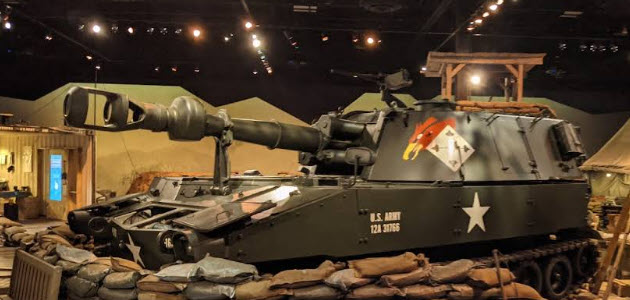
US M109A7
The M109A7, produced by BAE Systems, replaced the M109A6 Self-Propelled Howitzer, formerly known as the Paladin Integrated Management program. The M109A7 has an entirely new chassis, built at the BAE Systems’ facility in York, Pennsylvania, married with the reworked Anniston components at the new BAE Systems production facility in Elgin for final assembly. It shares common chassis components with the M2/M3 Bradley (IFV/CFV) such as the engine, transmission, and tracks. This creates commonality with other systems and maximizes cost savings in production, parts inventory, and maintenance personnel.
The M109A7 provides armored brigade combat teams with a highly responsive indirect fire system capable of keeping pace with the Abrams tank and Bradley Fighting Vehicles on the battlefield. The US Army took delivery of the first low-rate initial production M109A7 Self-Propelled Howitzer on 9 April 2015. An estimated of 300 M109A7s were built as of January 2025.
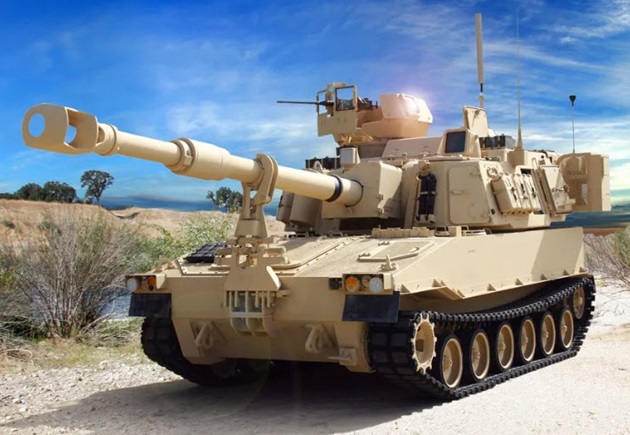
A M109A7 155mm SPH being tested at the Yuma Proving Ground in Arizona.
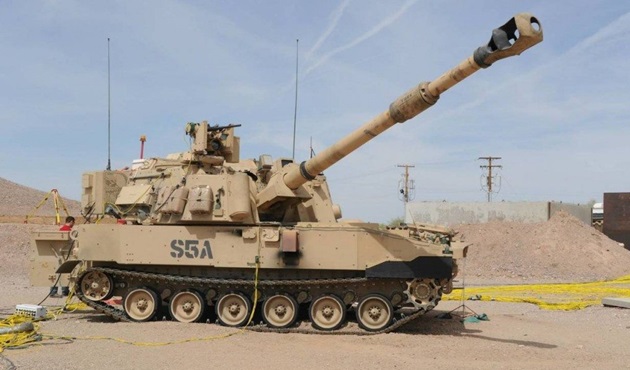
A production M109A7 155mm SPH.
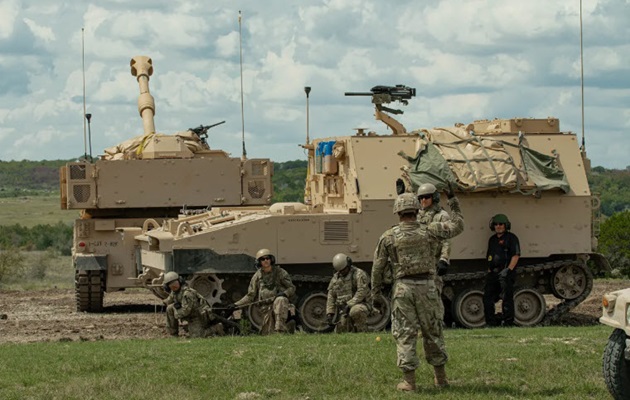
On the right is the rear of a M109A7 and in the foreground is a M992A3 carrier, ammunition, tracked (CAT). The CAT has a hydraulically-powered conveyor system designed to allow the quick uploading of rounds or their transfer to the M109A7.
The US Army had increased the capabilities of the M109A7 by developing the XM1113 Rocket-Assisted Projectile (RAP). The XM1113 increased the range from 30 to 40 km (19 to 25 miles) from a 39-caliber barrel using a large high-performance rocket motor delivering nearly three times more thrust, along with a streamlined exterior profile shape for lower drag. It also has better safety by replacing the traditional TNT explosive with an insensitive munitions warhead that is less likely to be accidentally set off. It can also be fired from the M777A2 Lightweight Towed 155mm Howitzer. The XM1113 RAP began Limited Rate Initial Production in 2022. The new rocket-assisted projectiles are assembled at the Iowa Army Ammunition Plant, where metal components from places like the General Dynamics operations in Scranton, Pennsylvania, are combined with propellant from Nammo Defense Systems (a Norwegian-Finnish company) in Mesa, Arizona.
Brazilian M108s
Brazil purchased 72 M108s from the US Army in the early 1970s. These vehicles remained in Brazilian Army service for decades, supported by local modernization efforts carried out in the early 1980s, notably by Moto Peças, which replaced the original US Detroit Diesel power plant (re-designated the M108AP). Over time, the limitations of the 105mm howitzer and the age of the M108 led Brazil to phase the type out of service. Brazilian M108s were decommissioned between 2017 and 2018 and were replaced by 35 M109A5+ 155mm Self-Propelled Howitzers.
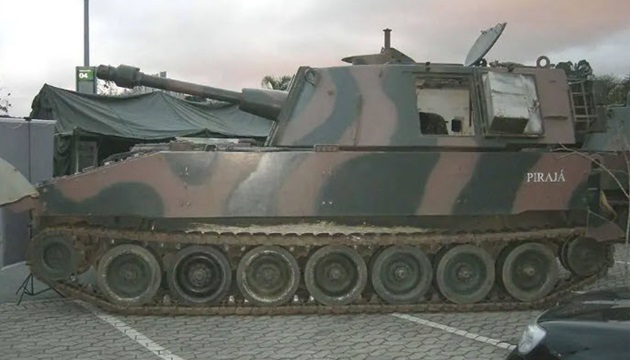
A M108 105mm SPH of the Brazilian army. The name “PIRAJA” most likely refers to the 8 November 1822 Battle of Pirajá where the Brazilians defeated Portuguese forces during the Brazilian War of Independence. Today, Pirajá is a neighborhood in the city of Salvador, Bahia (on the east coast of Brazil).
On 16 December 2025, Radio Nacional AM announced that the Paraguayan Army is preparing to introduce 105mm self-propelled artillery for the first time in its history, following a planned donation from Brazil announced by Army Commander General Manuel Rodríguez. According to the statement broadcast on the Paraguayan public radio, Brazil intends to transfer six M108 tracked self-propelled howitzers, a move that would mark a significant shift in the structure of Paraguay’s land-based fire support. The six M1098APs will supplement the Paraguayan Army’s existing M101 105mm towed howitzers.
Video: Why Brazil Is Sending M108 Self-Propelled Howitzers to Paraguay – A Strategic Move Explained
Model Kits and Decals
1/35:
AFV Club AF35108 U.S. Self-Propelled Howitzer M108 105mm/L30 Howitzer – 2020
AFV Club AF35329 M109 155mm L23 howitzer – 2020
Italeri 6518 M108 Self-Propelled Artillery – 2014
Tamiya 37013 U.S. Self-Propelled Howitzer M109 (Vietnam War) – 2013
Star Decals 35-C1284 Big Guns in Vietnam #1 USMC M109 & M110 – 2020
Star Decals 35-C1285 Big Guns in Vietnam #2 US M107 & M108 Decal set – 2020
Star Decals 35-C1286 Big Guns in Vietnam #3 US M109 155mm SP Howitzers – 2020
1/72:
Revell 03265 M109 US Army – 2018
OKB Grigorov 72002 USA Self Propelled Howitzer M109 (Photoetched & Resin kit)

 Mike's Research