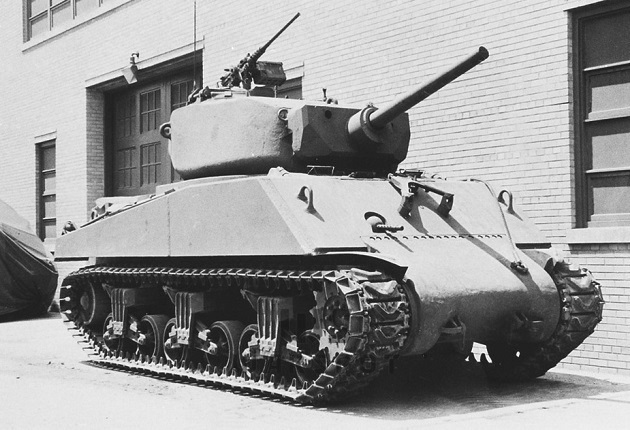
In early 1944, the US military began preparations for the upcoming invasion of Normandy. The need for a well armored tank to support the infantry became obvious. The T14 heavy tank was a failure and work on the new T26E1 Pershing tank could not be completed before the summer. In February 1944, the Army Ground Forces requested that the existing light and medium tanks designs be modified in order to create an assault tank to be used for infantry support against the expected German fortifications. Research showed that the then current M4A3 Sherman tank could be converted into an assault tank. In March 1944, the tank received the designation Assault Tank M4A3E2 and the production was approved.
Video: Assault Tank M4A3E2 “Jumbo” Sherman
The Conversion
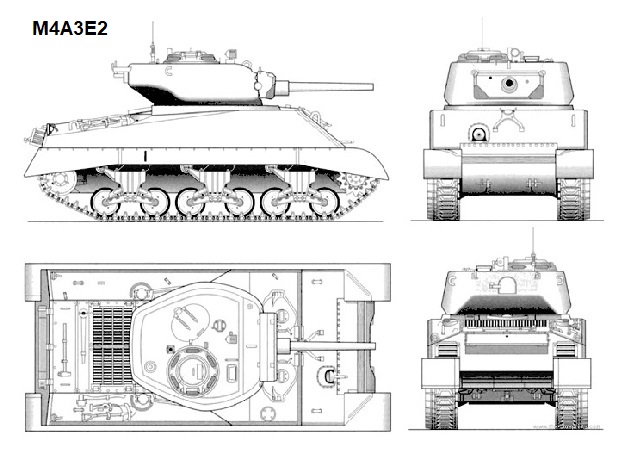
The tank’s armor was strengthened by welding rolled armor plates 38.1 mm (1.5 inches) thick onto the glacis plate and sides of the hull. As a result, the total armor thickness was 101.6 mm (4 inches) on the front and 76.2 mm (3 inches) on the hull sides. The armor thickness of the differential cover and final drives was increased to 139.7 mm (5.5 inches). The remaining parts of the hull armor remained unchanged. The head lights and siren were eliminated.
The turret was based on the T23 76mm turret with a similar internal layout and a full basket. The thickness was approximately 152.4 mm (6 inches) all around but it was reduce to 63.5 mm (2.5 inches) at the rear below the bulge. To increase armor protection, the firing port (pistol port) was eliminated. The gun mantlet was essentially a standard M62 mantlet with an additional armor plate welded on the front, giving a total of 177.8 mm (7 inches) of armor. The new mantlet did not allow the hatches of the driver and assistant driver to fully open, so the lower corners of the mantlet were cut off.
All the additional armor on the M4A3E2 increased its weight by over 11000 pounds (4989.6 kg) in comparison to the standard M4A3. The increased pressure on the ground was compensated by extended end connectors “duck bills”, which were added to the outer edge of the tracks increasing the width of the tracks. The specific pressure of the M4A3E2 with the extended T48 tracks was 14.2 psi, which was even lower than that of the lighter M4A3 tank, 14.3 psi. Sand shields were fitted that were extended from the hull so that they fit over the wider tracks.
Walk Around: Prime Portal M4A3E2 Sherman
To help extend the life of the automotive components of the much heavier M4A3E2, the gear ratio of the final drive was increased. This reduced the maximum speed of the tank from 26 mph (41.8 kph) for a standard M4A3 to about 22 mph (35.4 kph). The additional weight of the M4A3E2 overtaxed the standard Sherman Vertical Volute Spring Suspension (VVSS) system, particularly in the front which was not changed on M4A3E2. During testing and its service life, the M4A3E2 experienced suspension component failures.
The M4A3E2 tank was armed with the 75mm M3 tank gun for infantry support. The 76mm M1 gun had only one advantage over the 75mm M3 gun being better armor penetration, but the 76mm was also inferior to the 75mm gun. The 76mm high-explosive shell had 0.39 kg of explosives where as the 75mm high-explosive shell had 0.66kg of explosives and the external ballistics of the 75mm gun were also better than those of the 76mm gun. In general, the old 75mm M3 gun was more universal. The turret was equipped with a T110 carriage, which was a modified version of the standard M62 carriage. Since the differences between the carriages were minimal, if necessary, it was easy to rearm the M4A3E2 with the more powerful 76mm gun. The secondary armament and equipment remained the same as the M4A3, including a 2-inch smoke mortar on the left front on the turret roof.
Relative Armor Thickness
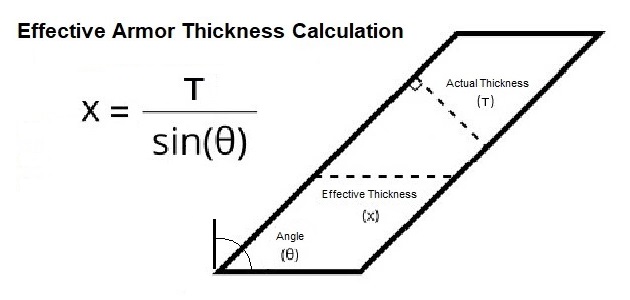
The relative armor thickness (X) can be calculated by dividing the actual armor thickness (T) by the sine of the angle (θ). The large hatch sloped glacis plate of the M4A3E2 is 47 degrees from the vertical. For this calculation, we need to subtract 47 from 90 degrees, 90 – 47 = 43 degrees. It is important to use degrees, not radians, when doing this calculation. The relative armor thickness (x) is 4 inches (101.6 mm) divided by Sin(43 Degrees) which equals 5.86 inches (148.84 mm) for the M4A3E2.
Video: PANTHER vs M4A3E2 SHERMAN JUMBO
M4A3E2 Production
Production of the M4A3E2 began in May 1944 at the Grand Blanc Tank Arsenal also known as the Fisher Body Tank Plant. It was a General Motors (GM) automotive body metal fabricating facility in Grand Blanc, Michigan, which built M4 Sherman tanks (April 1942 to May 1945) and M26 Pershing tanks (November 1944 to June 1945).
M4A3E2 tanks built in 1944
| Month | # Built | Serial Numbers | Registration Numbers |
|---|---|---|---|
| May | 40 | 50326 to 50365 | 3082923 to 3082962 |
| June | 110 | 50366 to 50475 | 3082963 to 3083072 |
| July | 104 | 50476 to 50579 | 3083073 to 3083176 |
| Total | 254 |
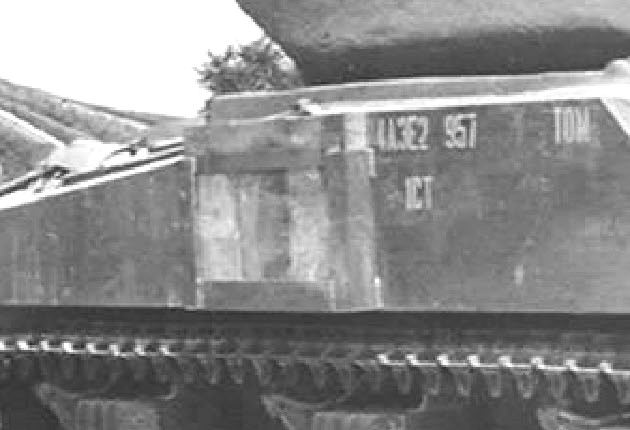
On June 8th, M4A3E2 Sherman, serial number 50326, USA 3082957, was shipped to the Chrysler Tank Arsenal Proving Ground in Detroit for endurance trials. After the endurance testing, tank 50326 was sent to the Aberdeen Proving Grounds (APG) in Maryland for ballistic testing. This photo shows “TOM,” Serial Number 50360, on the test course at APG on 26 June 1944.
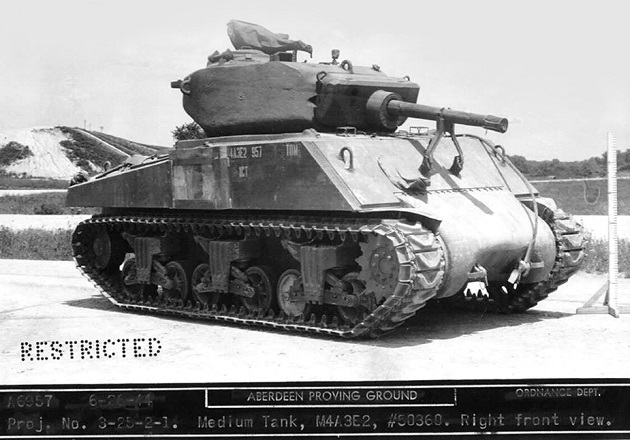
This is my close up of the M4A3E2 “TOM” above. Weights were mounted to each side of the tank to simulate a fully loaded tank with crew (minus the driver) for the endurance trials. The ballistic testing took place in September 1944 after the M4A3E2s were released for overseas shipment. The tests were for “information purposes only” and this tank was tested to destruction.
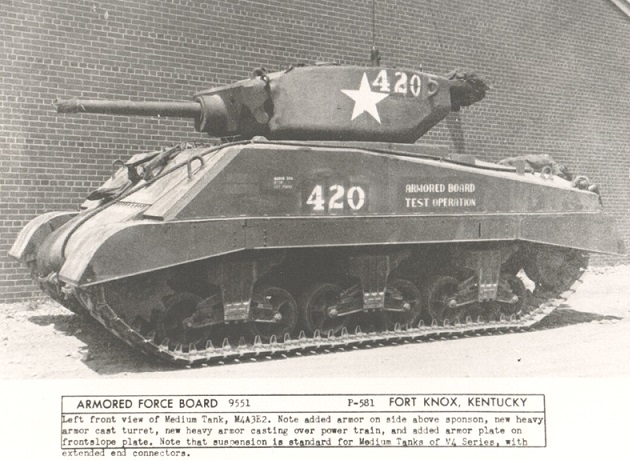
This M4A3E2 was tested by the Armored Force Board at Fort Knox, Kentucky. The number 420 is the last three numbers of the tank’s serial number 50420.
On 29 August 1944, the US 12th Army Group was informed that 250 M4A3E2 tanks were ready for shipment.
Deployment
During WWII, it took on average from 4 to 5 months to get a new tank from the factory to the units on the front line. The M4A3E2s began to arrive at the New York Port of embarkation around mid August. By September 8th, 208 had been shipped out. The initial shipments began to arrive at the port of Cherbourg, France around September 22nd. Some time was required for the acquisition of berthing spaces, for unloading, processing for combat, and final delivery to the selected units. The pace seem to have been somewhat leisurely for such a high priority project. This may have been due in part to the strained logistical situation that existed in the European Theater of Operations (ETO) at the time.
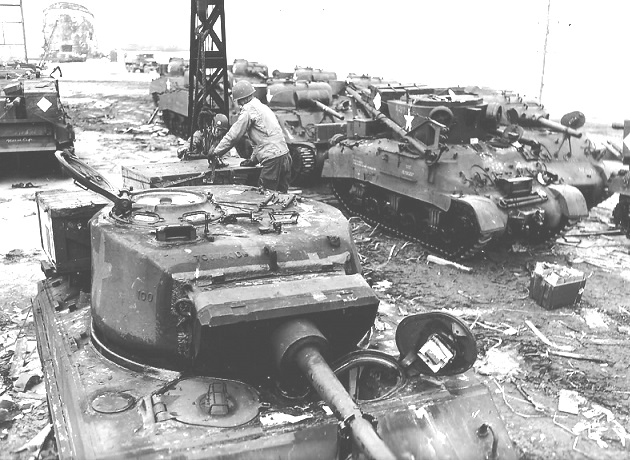
US tanks, immediately after being put ashore at Cherbourg are being readied by ordnance crews to be transported to the units. All external fixtures and loose equipment for the tanks were packed in crates and carried on the tank’s engine deck. In the background are M4 Shermans, a M4(105mm) Sherman and a M32B1 ARV.
A M4A3E2 tank on a M19 Tank Transporter (12-ton 6×4 M20 Diamond T tractor and a 12-wheel 45-ton M9 Rogers trailer). Note the dented front fender and the shipping crate still on the engine deck. The location and date are unknown.
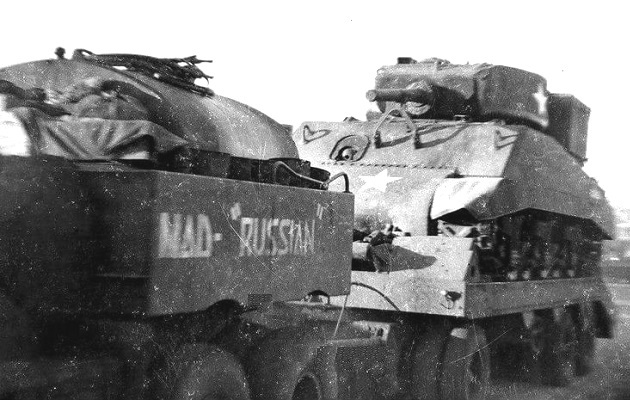
Photo: Recon Collection
On October 14th, the US 1st Army received the first 36 M4A3E2 tanks.
They were issued to:
- 743rd Tank Battalion (15)
- 745th Tank Battalion (15)
- 746th Tank Battalion (6)
Note: By November 9th, the 746th received and issued 9 more M4A3E2s giving the 3 battalions 15 each and the US 1st Army at least 45 on that date.
By October 18th, the beach depots had 17 M4A3E2s on hand, 24 were delivered to the armies and 19 were en route to the US 3rd Army for a total of 60. On October 20th, it was reported that 99 M4A3E2s were with US armor units.
On October 24th, the allocation for the delivery of M4A3E2s was confirmed as lots of 15 each until the following was achieved:
- US 1st Army (105)
- US 3rd Army (90)
- US 9th Army (60)
It is unclear why they planned for 255 when only 250 were being shipped. The US Army may have been under the impression that more were to be built and delivered.
In Service
A new M4A3E2 Sherman of the 745th Tank Battalion supporting the US 1st Infantry Division in Aachen Germany, October 1944. Note the part of the sand shield on the side hull and shipping stencils and chalk markings are still visible. Units in the field usually removed the sand shields because they get clogged with dirt/mud and they made it difficult for the crew to do maintenance on the tracks and the suspension.
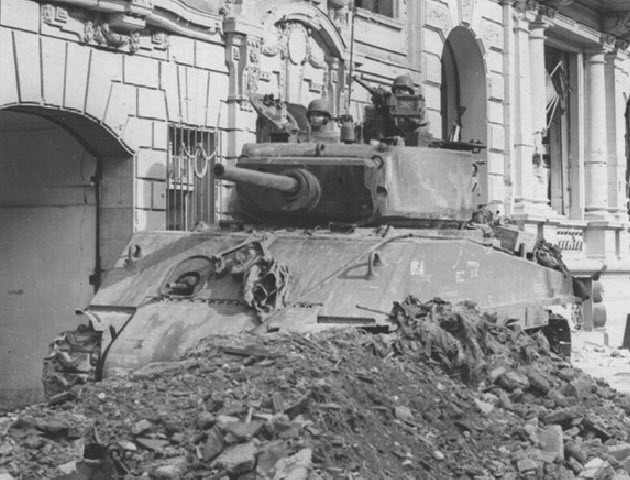
The M10 in the film below is from the 634th Tank Destroyer Battalion also supporting the 1st Infantry Division in Aachen on 14 October 1944. The M4A3E2 is from the 745th Tank Battalion.
Film: M10 Tank Destroyer and M4A3E2 in the outskirts of Aachen, Germany, October 1944
In November 1944, the 743rd Tank Battalion was supporting the US 30th Infantry Division. This 743rd M4A3E2 was knocked out near Fronhoven, Germany (northeast of Aachen), after being hit by FOUR 88mm rounds fired from an anti-tank gun at about 800 yards (731.5 m) away near Lohn (today Neu-Lohn). One round bounced off the glacis plate, and two off the mantlet before the fatal hit entered through the gun mantlet’s telescope aperture. Note the chalk markings on the turret.
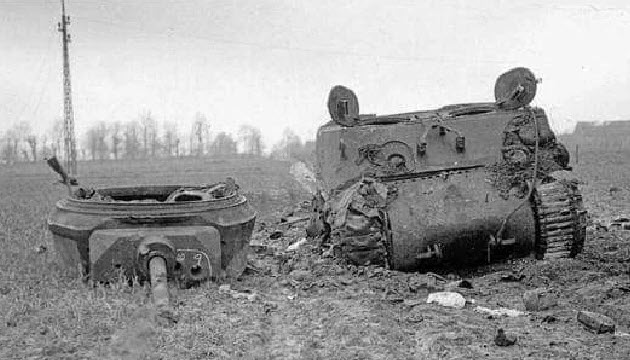
This 743rd M4A3E2 was also in late November near Fronhoven after it ran over a US Army mine which immobilized it. It was then hit by EIGHT 88mm anti-tank rounds at a range of about 800 yards. One round penetrated the right sponson which set the tank on fire but the other rounds failed to penetrate.
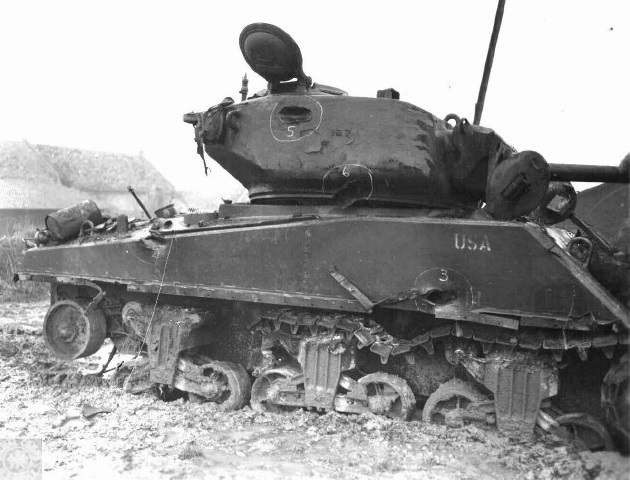
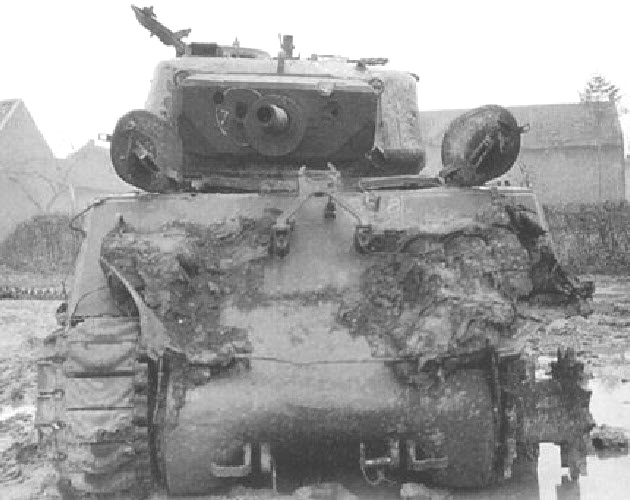
This is the front view of the M4A3E2 above. An 88mm hit on the glacis plate obliterated some sandbags on the front hull. Three other hits are evident on the front including one near the gun barrel, one on the upper edge of the mantlet, and one on the upper edge of the glacis plate.
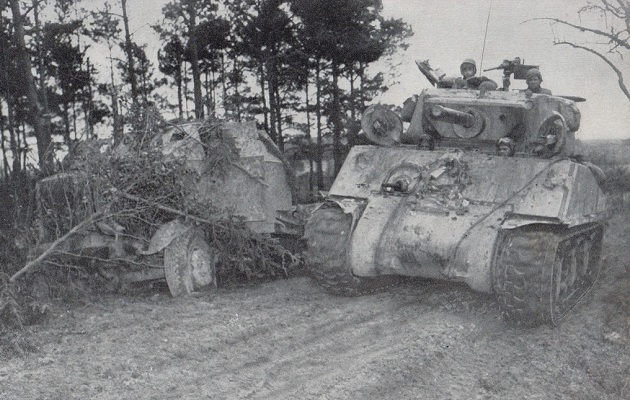
A M4A3E2 passes a wrecked German SdKfz 7/1 (or 7/2) armoured half track which mounted an anti-aircraft gun (which is missing). The tank is pushing east towards the Rhine River from Bitburg which is approximately 25 km (16 miles) northwest of Trier and 50 km (31 miles) northeast of Luxembourg city.
On November 22nd, 40 M4A3E2s were reported as been issued to these US 3rd Army units:
- 10th Armored Division (5)
- 702nd Tank Battalion (5)
- 712th Tank Battalion (5)
- 735th Tank Battalion (5)
- 737th Tank Battalion (15)
- 761st Tank Battalion (5)
Even with the additional armor, the M4A3E2 crews began to add MORE additional protection to their tanks. As they moved deeper into Germany, they were encountering less anti-tank guns and more hand held anti-tank weapons. The Panzerfaust “tank or armour-fist” and the 88mm Panzerschreck “tank fright” both can be fired at close range from concealed positions in wooded areas or from buildings in a town.
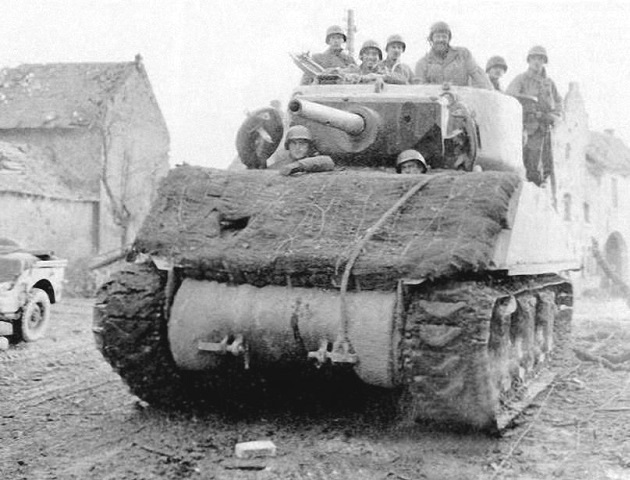
A M4A3E2 of the 743rd Tank Battalion in Alsdorf, Germany (northeast of Fronhoven) on November 27th. Sandbags on the glacis are covered with wire mesh and/or camouflage netting.
A M4A3E2 with concrete applique on the glacis. The date and location are unknown. This is a frame from a US Army Signal Corp film.
This is another M4A3E2 with concrete applique on the glacis. It has a solid slab of concrete with NO hole for the hull machine gun. The date and location are also unknown.
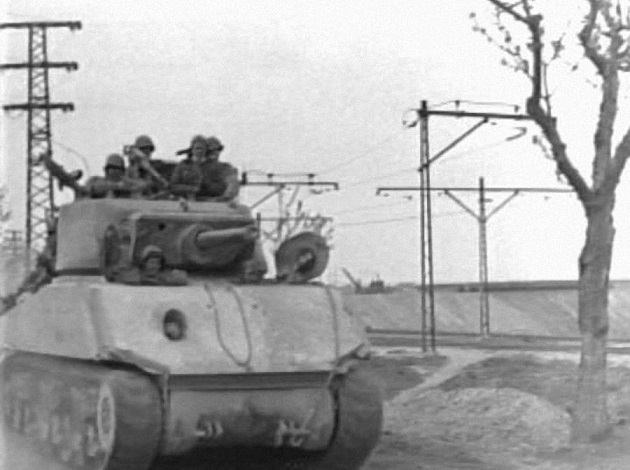
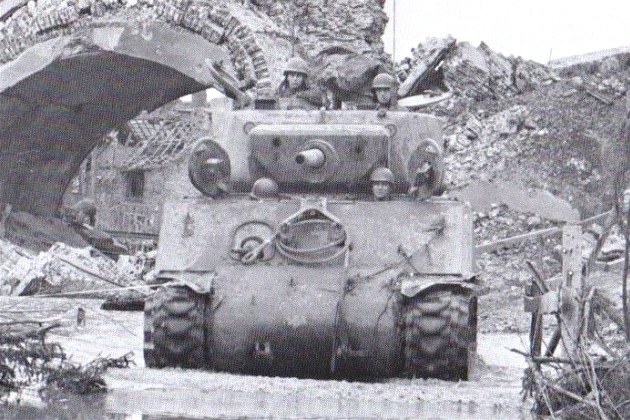
Between 5–7 December 1944, the 746th Tank Battalion supported the US 9th Infantry Division’s move back into the front line to relieve the US 1st Infantry Division. This 746th M4A3E2 is passing under a destroyed railroad viaduct on December 7th following the fighting for Langerwehe, the industrial town that was the gateway from the Hürtgen forest. Langerwehe is located approximately 10 km (6.2 miles) west of Düren, Germany, and it is a twin town of Exmouth in the United Kingdom.
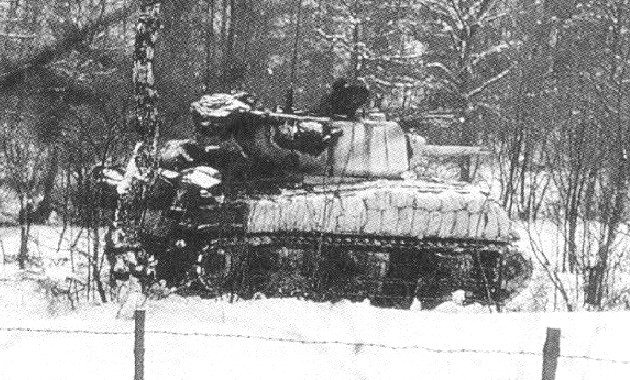
This is a M4A3E2 with sandbags on the hull side moving through a wooded area. The snow on the ground would indicate probably during the Ardennes offensive. The exact date and location are unknown.
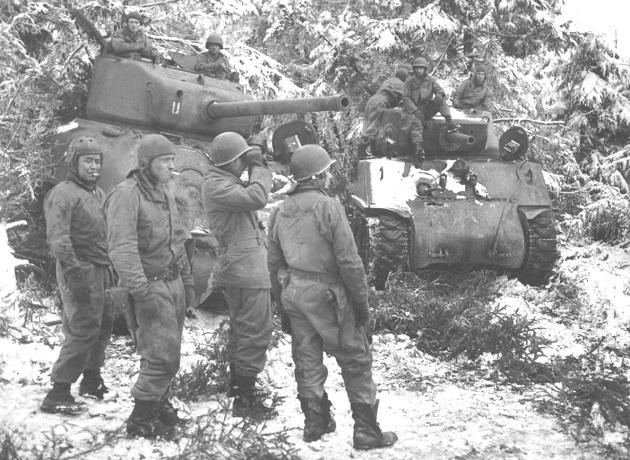
Shermans of the US 3rd Armored Division in the Ardennes, December 1944. A M4A1(76)W Sherman is on the left and a M4A3E2 is on the right. There appears to be a letter “U” on the M4A1(76)W Sherman’s gun mantlet. Its meaning is unknown.
Cobra King
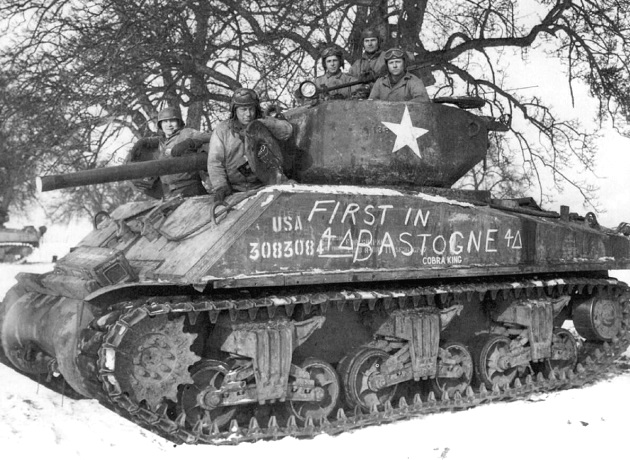
The most famous of all the M4A3E2s was “Cobra King”, registration number USA 3083084, the first tank to reach the besieged paratroopers of the US 101st Airborne Division in Bastogne, Belgium. On October 24th or 25th, Cobra King was issued to 37th Tank Battalion of the 4th Armored Division, US 3rd Army and was assigned as the company commander’s tank of Company C. On November 7th during an attack outside Fontany, France (today Fontenay-le-Comte), Cobra King took a shell hit to the final drive assembly that disabled the tank. The final drive assembly was repaired but the tank was left with a permanent battle scar.
During the German Ardennes offensive (Battle of the Bulge), the important crossroads town of Bastogne, Belgium had been cut off and surrounded by German forces. The US 101st Airborne Division held out against enemy forces for 5 days and refused a surrender ultimatum from the German commander with the famous reply “Nuts!”. Patton’s 3rd Army was tasked with trying to break through the German lines from the south with the 37th Tank Battalion, 4th Armored Division as the main spearhead of this counterattack. Under temporary command of XO, Captain William A. Dwight (S-3), the column took a secondary road leading from Clochimont through Assenois to Bastogne.
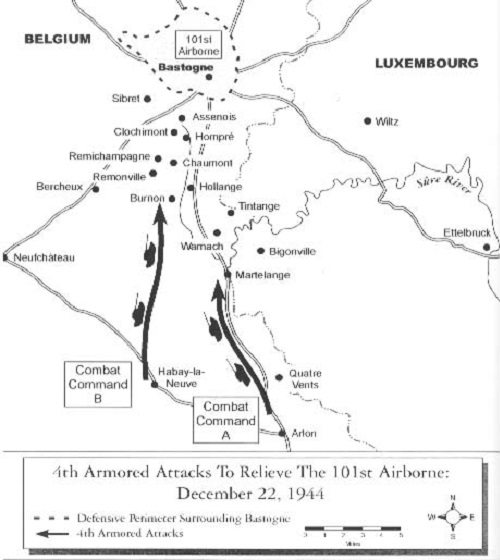
Cobra King was the lead vehicle with 8 tanks, half-tracks, and some other vehicles following. The column moved at full speed, firing straight ahead, with the other tanks firing left and right and they did not stop for anything. As soon as they cleared the first small town, artillery support was called (4 artillery battalions were available) to fire on Assenois which was ahead. The column entered Assenois while still under friendly fire. After clearing Assenois, they ran into more enemy resistance, and mopping up was required by the accompanying troops of C Company, 53d Armored Infantry Battalion. They then came across a large pillbox, which was destroyed immediately. There was a lot of confusion, since the Germans did not expected a break through along the secondary road, nevertheless enemy fire was considerable, and 4 Shermans were knocked out on the way. As King Cobra cleared the following woods, it came upon an open field with colored canopies (from previous supply drops) which indicated they were approaching friendly lines. The column subsequently slowed down, on the look out for friendlies, and spotted a number of foxholes with helmeted figures. Taking no chances, they called out to them, shouting for them to come out. They yelled that they were the 4th Armored Division. After several calls, an officer emerged with a smile, and said “I’m Lieutenant Webster, 326th Airborne Engineers, glad to see you guys!” At 1650 hours on December 26th, the 4th Armored Division, had broken through enemy lines and reached its objective – the siege of Bastogne was over although the fighting was not.
This is the well known photo of Cobra King. Note the large ammunition box on the front hull.
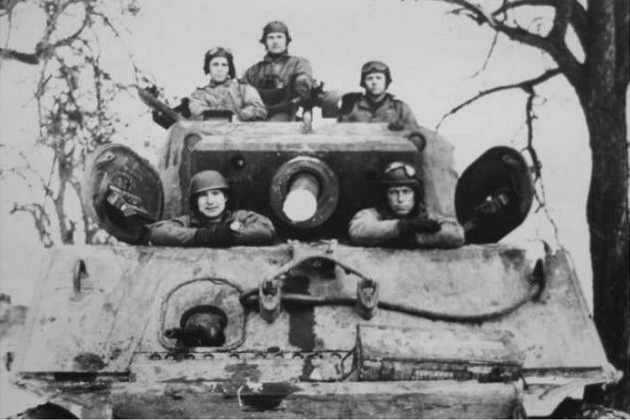
This a the front view of Cobra King. The crew were:
Commander: 1st Lieutenant Charles Perry Boggess
Gunner: Corporal Milton B. Dickerman, Newark, New Jersey
Loader: Private James G. Murphy, Bryan, Texas
Driver: Private Hubert J.J. Smith
Co-Driver: Private Harald D. Hafner
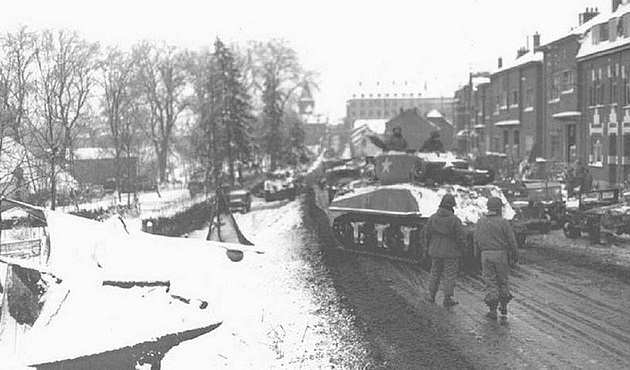
This is a M4A3E2 Sherman in Bastogne after the 4th Armored Division arrived on December 26th. It could be Cobra King before the markings were applied.
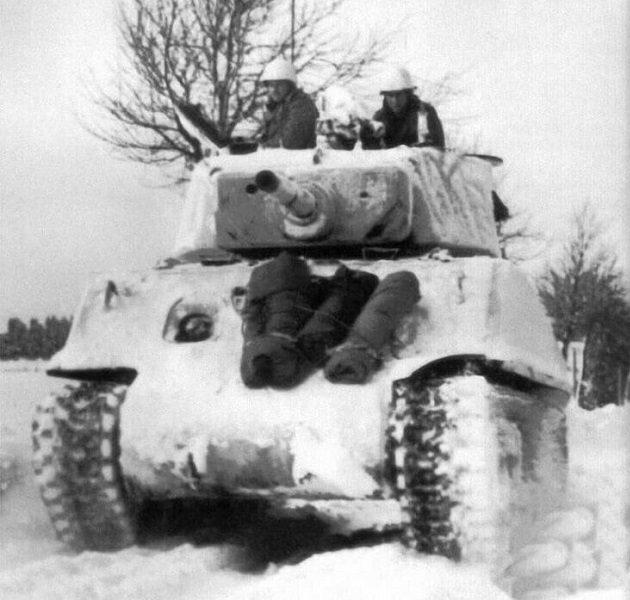
A winter camouflaged M4A3E2 is driving along a snow packed road. Note that the crewman had also painted their helmets white. Carrying the dark colored rolled up tarp/canvas on the front hull sort of defeats the purpose of the white camouflage. The unit, location and date are unknown.
January 1945
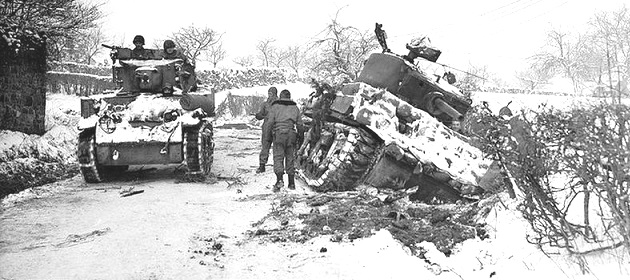
Hard going for US tanks at Amonines (southwest of Manhay), Belgium, on the northern flank of the Ardennes in January 1945. A M5A1 Stuart light tank (left) passes a M4A3E2 which slid off the icy road and got stuck in the ditch. The fresh dirt/mud on the snow in front of the tank indicate that the crew was trying to dig it out. Note that the M5A1 has a single track grouser mounted on each track which improved its traction on muddy or icy roads.
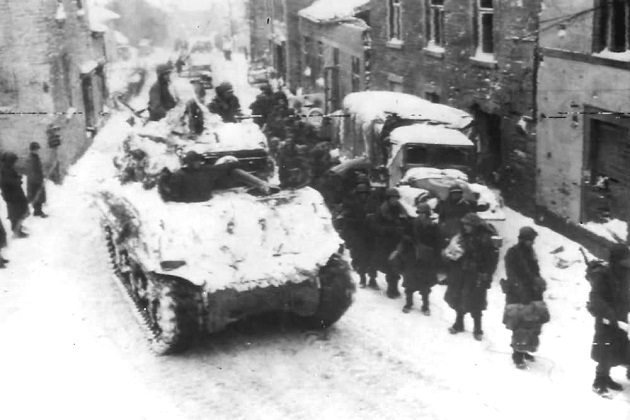
A snow covered M4A3E2 of the 3rd Armored Division supporting the US 83rd Infantry Division moves through Lierneux (north of Bastogne), Belgium.
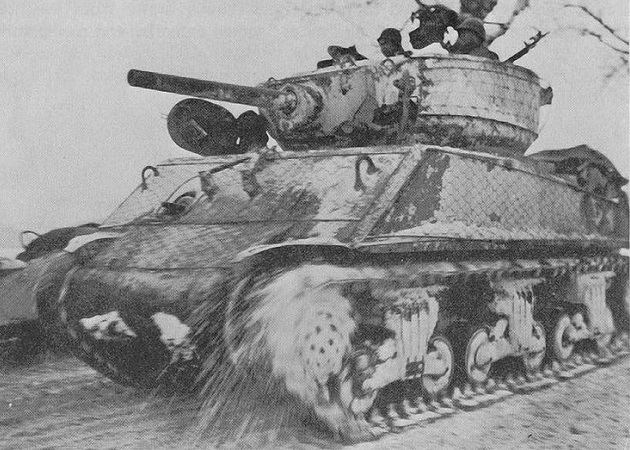
This M4A3E2 of the 737th Tank Battalion drives at high speed through Gralingen, Luxembourg on January 22nd. The 737th supported the US 5th Infantry Division on the south flank of the Ardennes. Note it still has Sommerfeld matting on the hull and turret for camouflaging the tank with foliage.
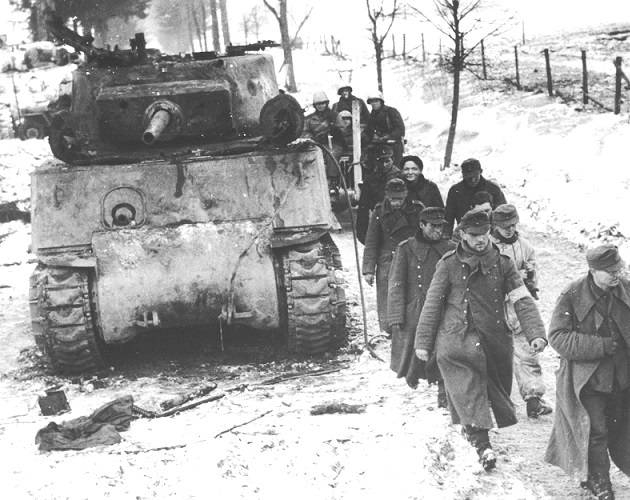
Germans POWs marching past past a knocked out M4A3E2 north of Foy, Belgium on January 25th . Note behind the M4A3E2 is another snow covered Sherman on the side of the road.
February 1945
During February 1945, approximately 100 M4A3E2s were upgunned with 76mm guns which were recovered from knocked out 76mm armed Shermans or in the normal supply stocks. The upgrade was a straight forward field modification, as the gun mount was originally designed for this gun. The most complicated part of the conversion was the modification of the main gun ammunition stowage. This required removing the turret and the fitting of 76mm racks in place of the shorter 75mm racks. The replacement racks were then secured in place with a series of fabricated welded braces. Records indicate that the conversion took 75 man hours per tank.
M4A3E2 Cobra King was one of the M4A3E2s to receive the 76mm gun upgrade and the .30 cal coaxial machine gun was also upgraded to a .50 cal (12.7 mm) machine gun.
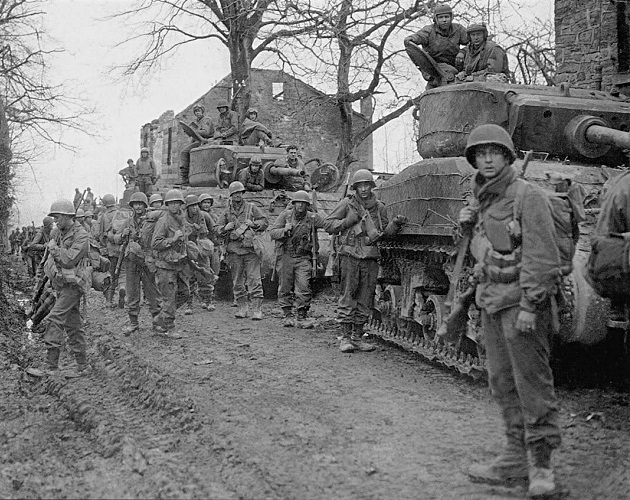
Accompanied by M4A3E2s of the 746th Tank Battalion, GIs of the 39th Infantry Regiment, US 9th Infantry Division “Old Reliables” prepare to move forward near Rath (Nideggen), Germany between 28 February 28 to 2 March 1945. Rath is about 15 km (9.3 miles) south of Düren, Germany, east of the Roer River.
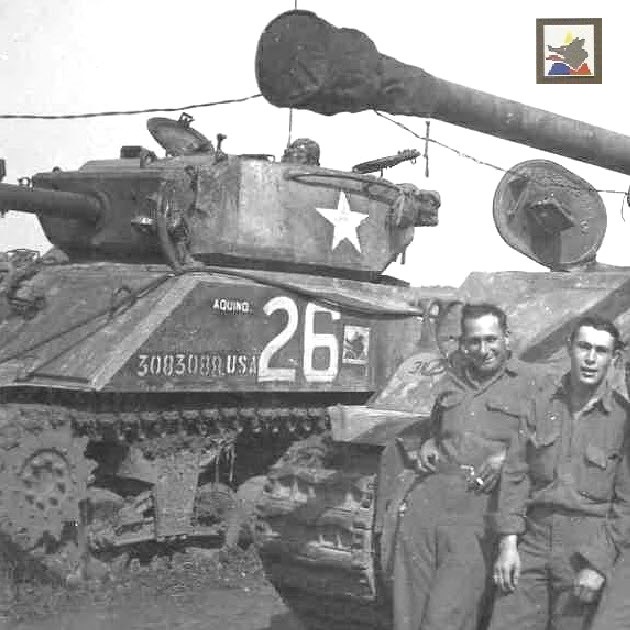
This M4A3E2, registration number 3083088, named “Aquino” belonged to A Company of the 15th Tank Battalion, US 6th Armored Division. To the right of the tank’s “speed” number 26 is the grey wolf head insignia (inset) of the 15th Tank Battalion. Aquino is a surname of Italian, Spanish, and Portuguese origin. It is a Christian name in honor of Thomas Aquinas (1225 to 7 March 1274), an Italian Dominican friar and a Doctor of the Church (Latin: doctor “teacher”).
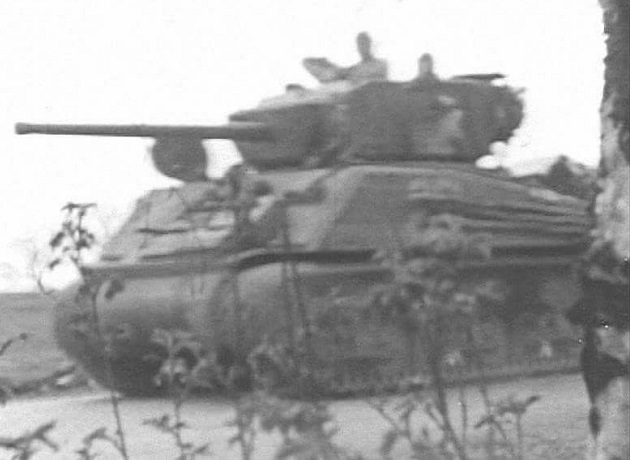
This is another photo of M4A3E2 “Aquino” taken from a film frame. The logs on the hull side are partially covering the large 26 speed number. This photo shows that M4A3E2 “Aquino” was also upgraded with the 76mm gun.
March 1945
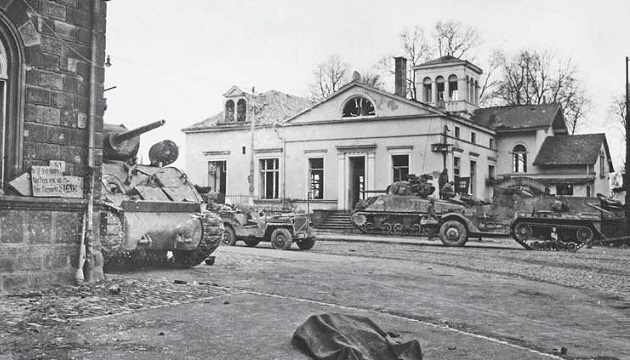
A M4A3E2 of the US 10th Armored Division in Trier, Germany on 3 March 1945. The Jumbo is parked next to the building on the left.
A 76mm armed M4A3E2, tactical number “E-2,” leading other Shermans of 2nd Battalion, 32nd Armored Regiment, US 3rd Armored Division in the cathedral city of Cologne (German: Köln), Germany on 6 March 1945. The location is at the intersection of Venloerstraße and Spichernstraße. Some units of the 3rd AD painted the USA number on the front and rear of their tanks. It was censored in this photo but this scene is in the film below, and individual frame captures show that the registration number was USA 3083173.
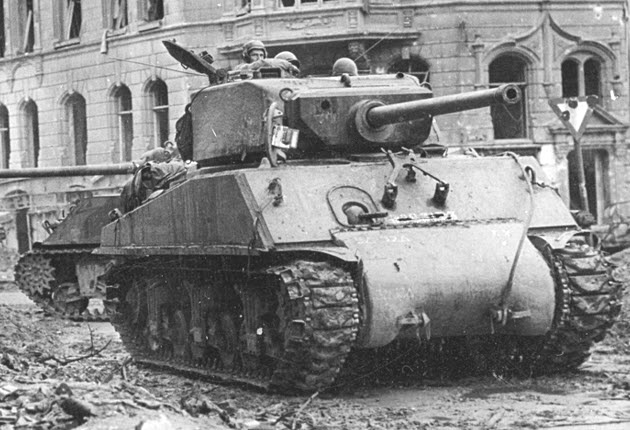
Film: First Army Captures Cologne March 1945 (3rd Armored Division/104th Infantry Division)
This is the rear of a M4A3E2 moving down a street in Cologne on March 6th. Note the two logs on the hull side. On the rear of the turret, the .50 Cal machine gun is covered with canvas.
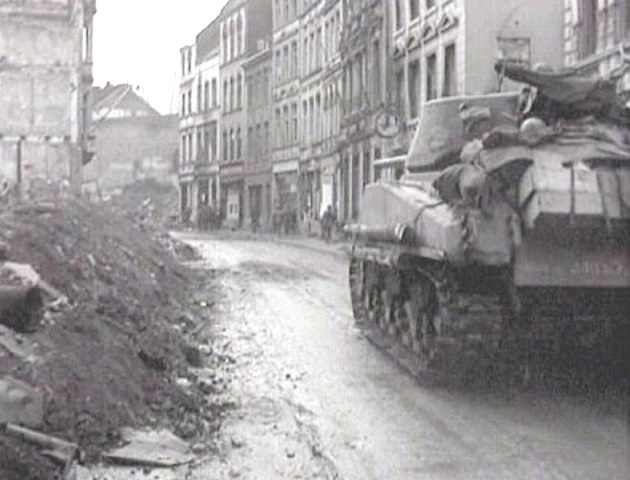
This another view of the street in the photo above. The M4A3E2 Sherman with logs on the hull side is in the background.
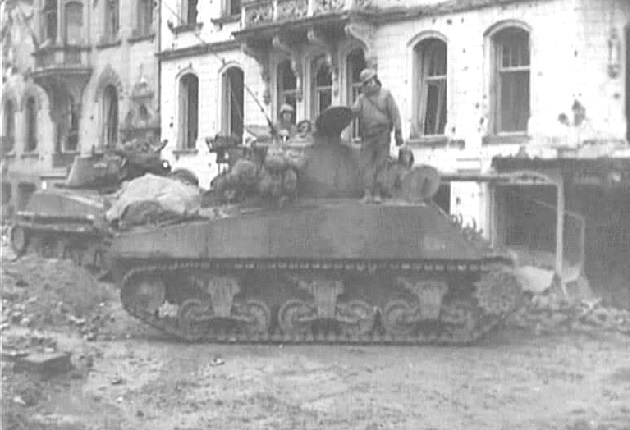
A M4A3E2 of the US 4th Armored Division driving through Koblenz on 9 March 1945. The 76mm gun is secured in the gun travel lock on the front hull. Note the white flags on the buildings on the right.
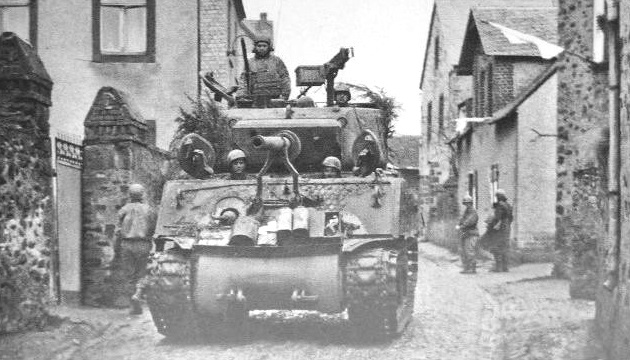
A M4A3E2 Sherman of the 37th Tank Battalion, US 4th Armored Division entering Alzey, Germany on 20 March 1945. The town is about 30 km (18.6 miles) southwest of Mainz and about 22 km (13.7 miles) northwest of Worms.
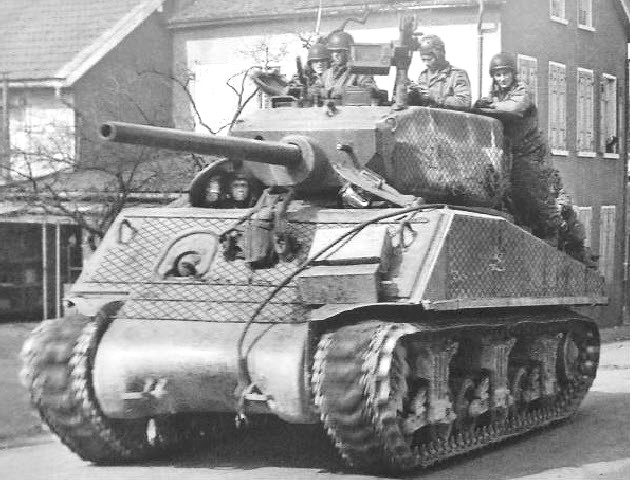
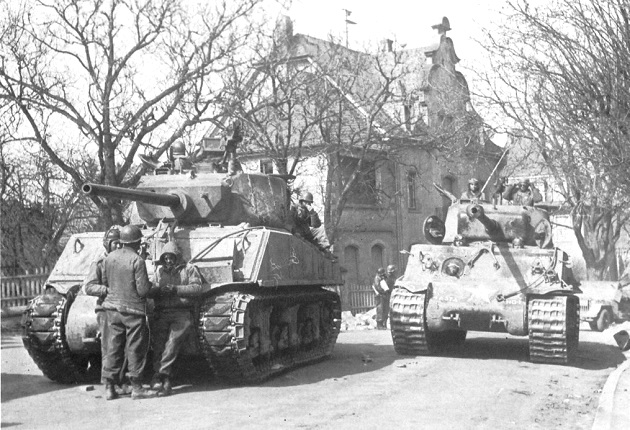
This is the same M4A3E2 in the above photo halted in Alzey. Moving up along side it is a M4A3E8 HVSS Sherman armed with a 76mm gun with a muzzle break but has thinner armor.
Task Force Baum
Task Force Baum, also known as the “Hammelberg raid” or “Operation Hammelburg” was a secret and controversial task force set up by General Patton in March 1945. The objective was to penetrate 50 miles (80 km) behind German lines and liberate the US POWs in camp Oflag XIII-B, 3 km (1.9 mi) south of the town of Hammelburg and return safely with the US officers held there. Controversy surrounds the true reason of the mission which most likely was to liberate Patton’s son-in-law, Lieutenant Colonel John Knight Waters, who was captured at Kasserine Pass, Tunisia in 1943. Patton feared that retreating Germans might kill the prisoners in the camp as Allied forces approached.
The task force comprised of men and vehicles from the 37th Tank Battalion and 10th Armored Infantry Battalion commanded by Captain Abraham Jasper “Abe” Baum, was formed. It consisted of M4A3 Shermans, M5A1 Stuarts, M4/105 Shermans, Jeeps and half tracks. The total strength was 314 men and 57 vehicles. The operation took place between March 26-28. After the war in the book “RAID!: The Untold Story of Patton’s Secret Mission” by Richard Baron, Major Abe Baum and Richard Goldhurst, Baum stated that a tank named “Cobra King” commanded by Lieutenant Nutto was knocked out on March 27th as it approached Hammelburg. Cobra King was hit by a Panzerfaust round that penetrated its armor. It started a fire in bow machine gun ammunition storage and the crew abandoned the tank.
The task force fought through German lines with serious losses and liberated the camp, but Waters was wounded and had to be left behind. The mission became a complete failure when German forces in the area eventually overwhelmed the small task force. Roughly 300 men of the task force, 32 were KIA during the raid and only 35 made it back to Allied controlled territory, with the remainder being taken prisoner. All of the 57 tanks, jeeps, and other vehicles were lost. On April 6th, just 9 days later the US 14th Armored Division liberated the camp.
April 1945
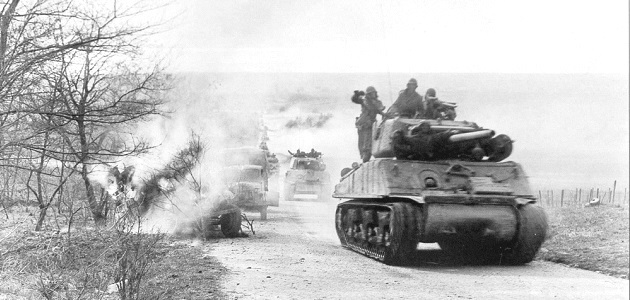
A M4A3E2 leads an armored column of the US 6th Armored Division into Oberdorla, Germany on 4 April 1945. The column is passing burning German vehicles. The M4A3E2 is still armed with the 75mm gun.
French Jumbo
Due to the low numbers of M4A3E2 issued to the ETO, most went towards the US Army units. There is one known M4A3E2 that was with the French 1st Armoured Division (1re Division Blindée), French 1st Corps, French 1st Army. It was an unusual case as all the M4A3E2s were sent to the US 12th Army Group, whereas the French 1re Division Blindée was in the US 6th Army Group which landed in Southern France. The serial number of this M4A3E2 was “422 12C” and it served in the headquarter platoon of the 2nd Squadron of the 2nd African Chasseur Regiment (2e régiment de chasseurs d’Afrique) in CC3 (Combat Command 3). There is no information on how, when or why the French received this M4A3E2.
Lieutenant Amédée Georges Jean FALGAYRAC was commander of the 1st platoon of the 2nd Squadron. In early April 1945, he was promoted to the rank of Captain but he did not received the order. On April 16th in Ortenberg, Germany, FALGAYRAC dismounted from his tank and climbed to the top of the tower of Ortenberg castle. He went to the observatory in order to get a better view of the German positions. Sometime afterwards, he was killed by two shrapnel wounds. He was awarded the Croix de Guerre, Médaille du Levant, and the Chevalier de la Légion d’Honneur (posthumously).
Lieutenant FALGAYRAC standing beside his M4A1(76) Sherman named “COLMAR”. The tanks of the 2nd squadron were named after towns in France. Note the T47E1 bar cleat tracks with extended end connectors “duck bills”.
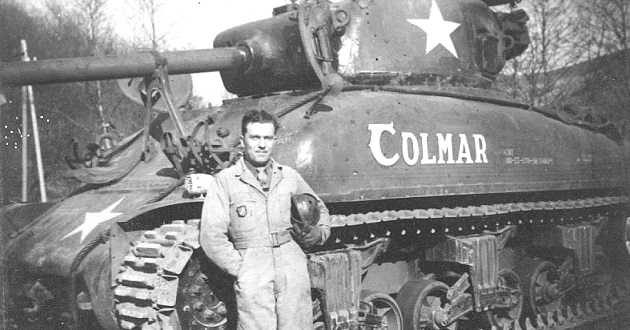
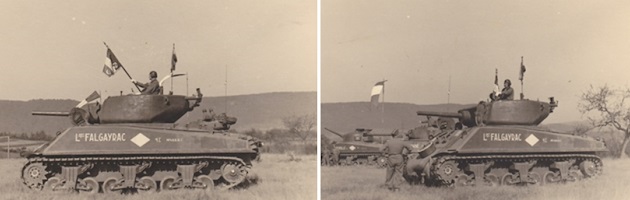
A few days later, the M4A3E2 was renamed “Lt FALGAYRAC” in his honor. Beside the name on the hull side is a 1804 Napoleonic French regimental flag which was typical for tank units of the French 1st Army.
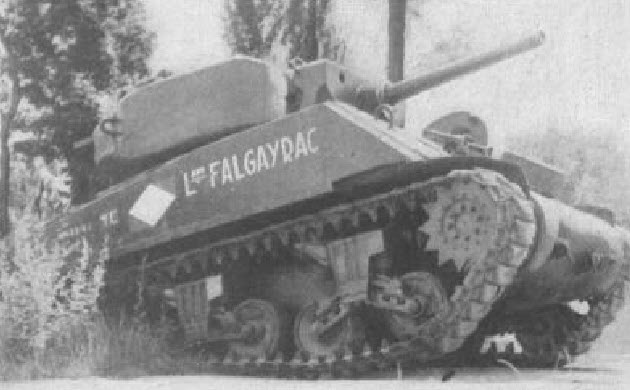
These are two photos of M4A3E2 “Lt FALGAYRAC” taken sometime after VE day, 8 May 1945.
May 1945
This is the well known photo of a column of the US 11th Armored Division, CCA crossing the Muhl River near Neufelden, Austria on 4 May 1945. In the background, driving down the river bank is a M4A3E2 Sherman.
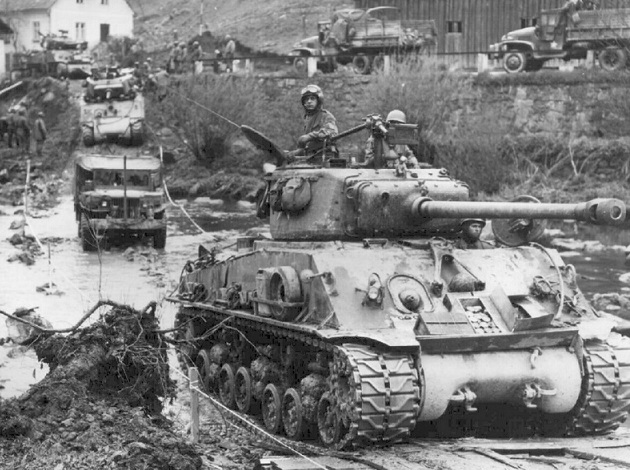
This is my close up of the M4A3E2 in the photo above. It appears it does not have the extended end connectors “duck bills” on the tracks and the right track is installed backwards. The chevrons should be pointing down not up.
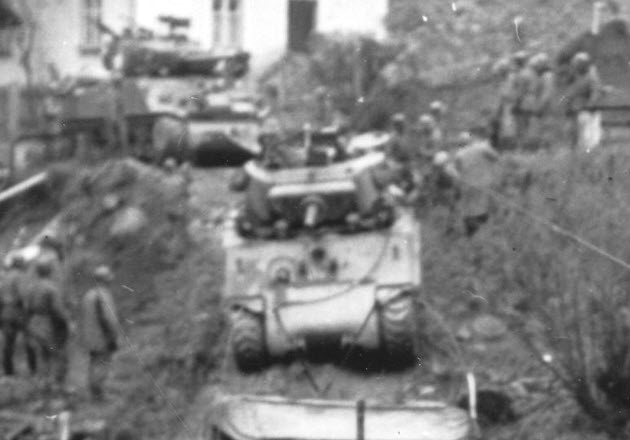
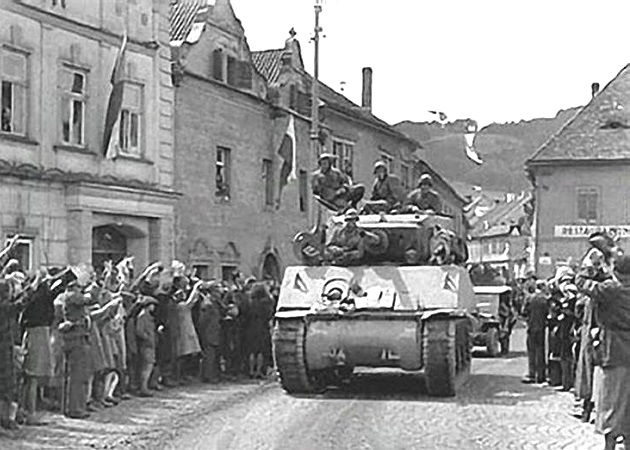
A M4A3E2 drives through the town of Sušice, in the Sudetenland in Western Czechoslovakia while its citizens are cheering on Czechoslovakia’s liberation day, 6 May 1945.
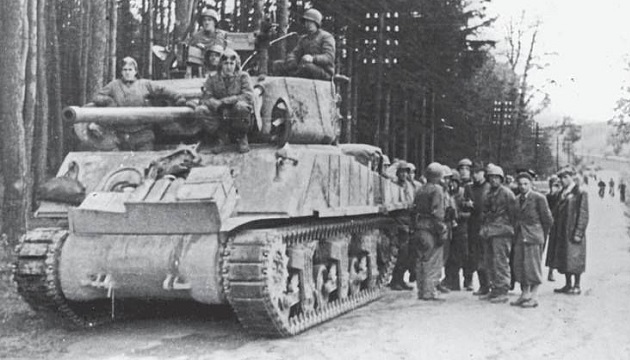
A M4A3E2 with a 76mm gun of the US 4th Armored Division near Pisek Czechoslovakia, 80 km (50 miles) south of Prague, 9 May 1945.
With the advent of the new T26E3 tanks, later standardized as the M26 Pershing, the M4A3E2 Jumbo lost its importance. With good armor and a powerful 90mm cannon, the new Pershings took over the functions of the assault tank from the M4A3E2. Nevertheless, it managed to do its job and successfully completed the tasks assigned to them. Out of the total 250, it been estimated that about 61 were lost in combat.
The combat history of the M4A3E2 seems to have ended on VE Day. For the upcoming planned invasion of Japan, it was requested that as many of the Pershings and M4A3E8s in Europe be shipped back to the US. Shermans with VVSS were not wanted as they were considered obsolete.
Post War
A number of the M4A3E2s were shipped back to the States. Records indicate that, in August 1948, there were 96 M4A3E2s in US Depots – NRFI (Not Ready for Issue). During the 1950s, Shermans were re-manufactured giving them a thorough overhaul of their mechanical and electrical systems, so they were ready for issue. The spare track holders on the upper rear hull plate were removed, and track blocks were fitted to the turret sides. An infantry phone was installed on the right rear. The smoke mortar had been eliminated and the holes were welded shut. The spotlight was also eliminated, but a few M4A3E2s still had the fittings, probably because the E2 did not have head lights. Wet ammo stowage was eliminated by sealing up the liquid containers in the ammo racks. If not present, a sheet metal cover was installed over the vent between the drivers’ hatches. Gun travel locks were retrofitted with the later one piece locking arm. The M4A3E2s were not equipped with extended end connectors because supplies were no longer available. After re-manufacture, some of the M4A3E2s were issued to National Guard units as training tanks.
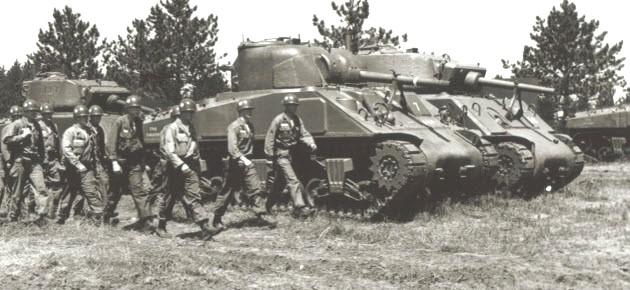
This is the 194th Tank Battalion of the Minnesota National Guard in 1955. Behind the M4(75) Sherman are two M4A3E2s.
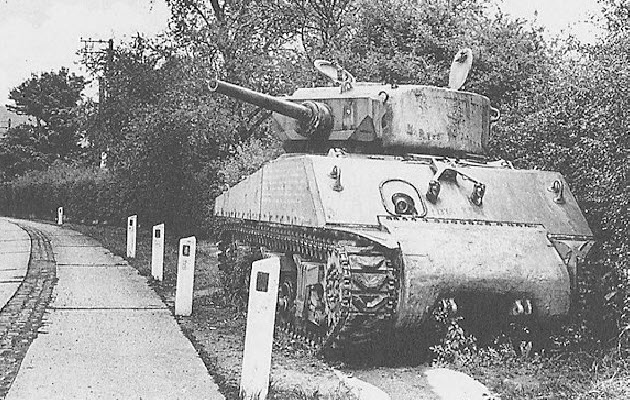
Hermeton-sur-Meuse Jumbo
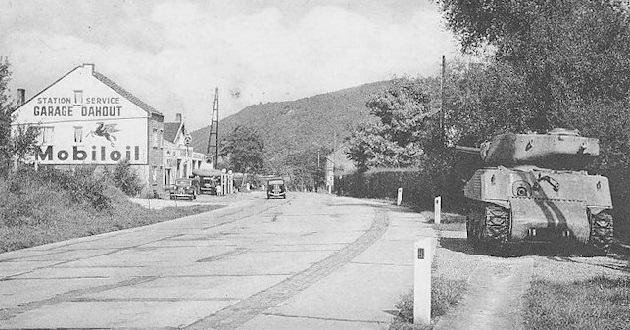
In 1948, this abandoned M4A3E2(75) Jumbo was offered to Doctor Paul Michel, a local dentist in the village of Hermeton-sur-Meuse, Belgium, for use as a war memorial. He helped save many lives during the battle for the River Meuse 1944-45 as he turned his house into a medical center. After he passed away, the heirs of his estate claimed the Jumbo tank as their own. When the ownership of the tank was investigated it appeared that the US Army still owned the tank.
The US government started negotiations to have it shipped back to the US because it was rare and worth a lot of money. The village was not happy, it was just left by the side of the road as a war memorial just rusting away. After a year of talking, a strange deal was agreed to. The Jumbo tank would stay in Belgium. It would be restored but kept by the Royal Museum of Armed Forces and Military History Brussels (Le Musee royal de l’Armee et d’Histoire Militaire).
This is the restored M4A3E2(75) Jumbo that was previously in Hermeton-sur-Meuse photographed at the Royal Museum of Armed Forces and Military History Brussels.
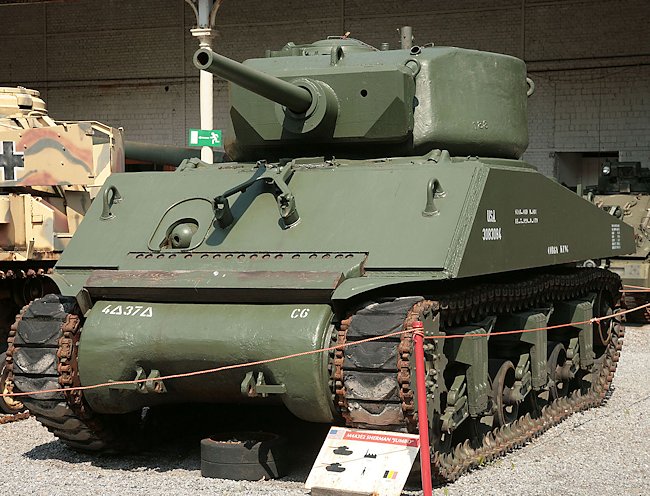
The M4A3E2(75) Jumbo was moved from the Brussels Military museum during the redistribution of some of its exhibits and was held at the depot of the Royal Museum of the Armed Forces, in Landen, Belgium. Its Serial Number is 50511, the correct Registration Number is 3083108. It is currently on display at the Bastogne Barracks.
Video: Sherman JUMBO unloading in Bastogne
Video: Sherman M4A3E2 Jumbo Cobra King FIRST IN BASTOGNE
Bastogne Barracks Belgium M4A3E2
Rue de La-Roche 40, 6600 Bastogne, 0478/782498
Email: booking.bastogne@warheritage.be
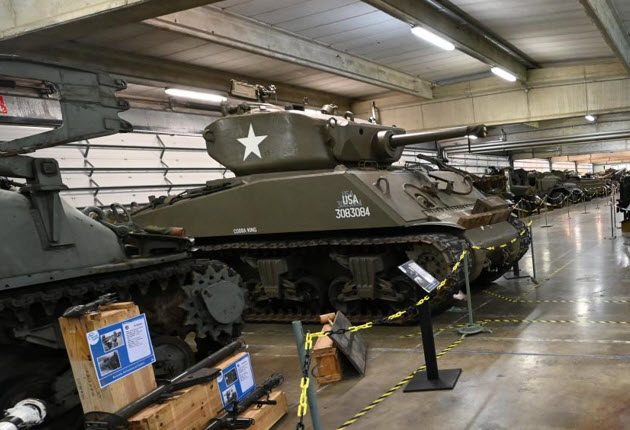
Jacques Littlefield M4A3E2
Jacques Littlefield was the founder of the Military Vehicle Technology Foundation (MVTF), also called the Littlefield collection. He had collected over 220 vintage military vehicles and restored them. After a decade long battle with colon cancer, Littlefield passed away on 7 January 2009.
On July 11 and 12, 2014, 160 vehicles of the Littlefield collection were auctioned off to fund the creation of a new museum to display the collection. The American Heritage Museum at the Collings Foundation headquarters in Stow, Massachusetts, had its grand opening in May 2019 and it displays over 85 vehicles of the Littlefield collection.
Auction: Assault Tank “Jumbo Sherman”
Cobra King Found
After the war, a shell-pitted and gutted M4A3E2 was recovered from a repair depot in Lager Hammelburg and was displayed as a “gate guard” at McKee Barracks in Crailsheim, Germany (1957-1967); at Ferris Barracks in Erlangen, Germany 1967-1993; and later, at Rose Barracks in Vilseck, Germany (1993-2008). As Army historians slowly investigated the backstories of old WWII tanks remaining in Europe, Army chaplain Keith Goode began to suspect that the anonymous tank rusting at Rose Barracks was Cobra King. In 2008, Army historians concluded that it was. They were able to confirm a direct match of the serial number and the Army registration number proving that it is Cobra King.
In July 2009, the United States Army Center of Military History shipped Cobra King from Germany to the Patton Museum at Fort Knox for restoration. Restoration work included the difficult task of finding parts from original sources, such as an original Ford V-8 engine, 75mm gun, and tracks identical to Cobra King’s originals. The exterior was restored, but no attempt was made to render the tank drive-able and only minimally clean and restore the fire damaged interior (dozens of cartridge cases and spent bullets that were cooked off in the fire were found under the turret basket).
After a two year restoration, Cobra King was as finished as possible before it was shipped out to its new temporary home at Fort Benning, Georgia in August 2011. On 3 August 2017, Cobra King was shipped to the construction site of the new National Museum of the United States Army at Fort Belvoir, Virginia, 20 miles south of Washington, DC.
Cobra King and some other vehicles were literally placed on the foundation of the new museum and the building was built up around them.
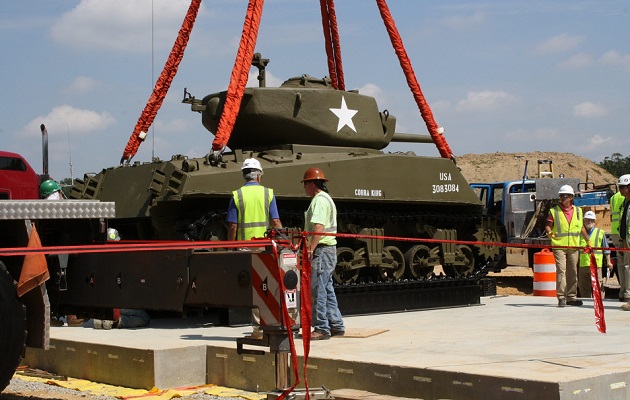
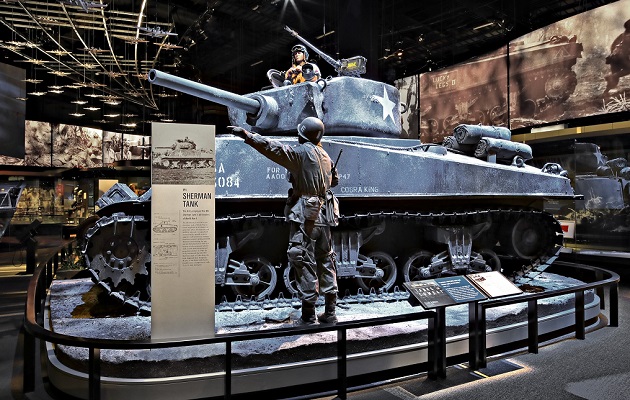
The National Museum of the United States Army was opened to the public on Veterans Day, 11 November 2020. This is the M4A3E2 Cobra King display. Note the Sherman tank photo on the information placard is not a M4A3E2 Sherman.
Video: Guns of the National Museum of the US Army
Website: National Museum of the United States Army
Model Kits and Decals
1/35
Tamiya 35139 U.S. M4A3E2 “Jumbo” Assault tank – 1987
ASUKA Model 35-021 U.S. Assault Tank M4A3E2 Sherman “Jumbo” – 2015/2016
Academy 13527 U.S. Army M4A3E2 “Cobra King” – 2019
Meng Model TS-045 U.S. Assault Tank M4A3E2 Jumbo – 2019
DEF.MODEL DM35052 US M4A3E2 JUMBO CONCRETE FRONT ARMOUR /W M1A1C BARREL
(FOR 1/35 ASUKA KIT, Resin and metal barrel)
1/72
Extratech EXM 72036 Sherman M4A3E2 Jumbo – 200?
Italeri 6113 Bastogne December 1944 Diorama Set – 2015
Fine Scale Factory Sherman M4A3E2 Jumbo
MR MODELS MR72002 M4A3E2 Sherman Jumbo conversion for Italeri
Braille Strike 72002 M4A3E2 Sherman Jumbo Decalset – 2017

 Mike's Research