In early 1945, the Japanese leaders recognized their nation’s military situation was worsening, but they rejected any form of surrender. Instead, they devised a military and political strategy called Ketsu-Go (Operation Decisive.) Its fundamental premise was that the US possessed superior material power but their morale was brittle. Their plan was to meet the initial invasion of Japan (which they anticipated would be on southern Kyūshū) with massive ground, naval and air forces. They would either defeat the invasion attempt or at least inflict such horrific casualties, both US and Japanese, that the US will to continue the war would be broken. Then in the second phase of their plan, Japan would obtain a negotiated settlement of the war. That settlement would include the occupation of Japan and guarantee that the old order would continue.

The four main islands of Japan:
| Hokkaidō | The northernmost and second largest island. |
| Honshū | The largest and most populous island, with the capital Tokyo. |
| Shikoku | The smallest island, located between Honshū and Kyūshū. |
| Kyūshū | The third largest and second most populous island. |
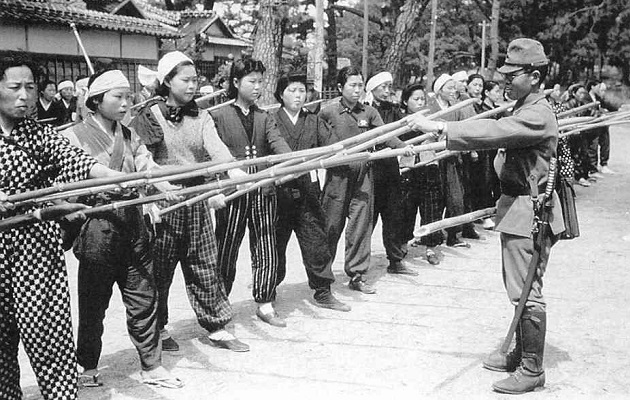
The Japanese armed forces had expanded in 1945 under an urgent mobilization from about 4.5 million men under arms to over 6 million by August. But in March, Japan inducted a vast additional body of combatants, every single male age 15 to 60 and every single female age 17 to 40. This was about a quarter or more of Japan’s total population, about 18 to 20 million people. They became the Volunteer Fighting Corps (Kokumin Giyū Sentōtai) which were armed civil defense units to help defend the Japanese home islands against the expected Allied invasion. They were the Japanese equivalent of the German Volkssturm and British Home Guard but they would not surrender and they would sacrifice their life for their country. They lacked uniforms or any other visible markings to distinguish these combatants from the remaining civilian population.
Two Japanese girls training with a Type 11 light machine gun (designed in 1922), Ryukyu Islands, Japan, June 1945.
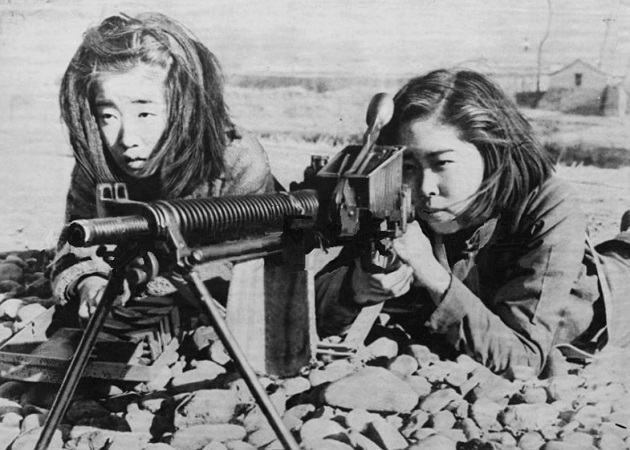
Many of the “volunteer” units were armed with obsolete weapons and some with only spears or sticks.
Video: Japan’s INSANE Plan to Defend their Home Islands
Japanese Defenses
The Japanese had extensive experience with how the US conducted amphibious assaults in the Pacific. In late 1944, the Japanese sent a team of officers to debrief the Germans on their defenses in Normandy, France and how the Allies gain their foothold in Europe. From these debriefs, the Japanese coastal defenses around the possible invasion beaches were divided into three zones.
- Beach Positions – These positions were used mainly for beach fighting and for firing against enemy landing craft. They were heavily fortified and concealed for protection against naval gunfire. Coastal fortifications were constructed in cave type shelters to withstand intense bombings and bombardments, especially from naval gunfire. They also had the ability to conduct close range actions and withstand attacks from flame-throwers, explosives, and gas. Their purpose was to defeat any landing attempt.
- Foreground Zone – If the beach positions could not stop a landing, then the assault would be delayed in this zone with localized counterattacks and raids. Obstacles, hidden positions, timed land mines, and assault tunnels utilizing natural terrain features were prepared to slow the attack and to fight within the enemy lines to limit the effectiveness of naval gunfire and air support.
- Main Zone of Resistance – This zone is where the main resistance was to be established. Battalions and larger units would occupy key terrain positions which were independent of each other. These positions were to be organized mainly for antitank warfare and the fields of fire were to be short. The installations were constructed as underground fortresses capable of coping with close range actions if flame-throwers, explosives, or gas were used. This zone was intended to stop the US advance and set up a major counterattack that was to decisively defeat the attackers. The Japanese paid special attention to camouflage of their positions even during construction. Defensive positions were concealed from air, land, and sea observation. Within all three zones, dummy positions were also constructed for deception. Cave installations were heavily reinforced and capable of withstanding a direct hit by naval gunfire. Pillboxes, assault positions, sniper positions, and obstacles were organized for close quarter combat and mutually supporting. Each position stored ammunition, fuel, antitank weapons, water, rations, salt, vitamin pills, and medical supplies.
Inland fortifications were constructed to provide cover and concealment for heavy equipment such as tanks, motor vehicles and artillery as well as bomb proof storage of ammunition and fuel. The storage shelters were impervious to US air attacks and naval bombardment.
Operation Downfall
The Allies did not know much about the Japanese leadership intentions despite the intelligence derived from intercepts of encoded Japanese diplomatic and military message traffic by “Magic” (US cryptanalysis project) and “Ultra” (British signals intelligence). The development of the US atomic bomb was a very closely guarded secret (not even then-Vice President Harry Truman knew of its existence until he became President), known only to a few top officials outside the Manhattan Project. The initial planning and build up for the invasion of Japan did not take its existence into consideration. When the atomic bomb became available, the US generals envisioned using it to support the invasion if sufficient numbers could be produced in time. They had no idea how powerful the atomic bomb would be.
The planning of Operation Downfall was done by US commanders: Fleet Admiral Chester Nimitz, General of the Army Douglas MacArthur and the Joint Chiefs of Staff—Fleet Admirals Ernest King and William D. Leahy, and Generals of the Army George Marshall and Hap Arnold (the latter being the commander of the US Army Air Forces).
Japan was a difficult target, distant from other land masses and with very few beaches suitable for a sea borne invasion. Only Kyūshū and the beaches of the Kantō Plain (both southwest and southeast of Tokyo) were ideal invasion landing zones. This map of Japan with 3D shade relief shows the mostly mountainous terrain which was ideal for the defense.

The operation was in two parts: Operation Olympic and Operation Coronet. X-Day was set for 1 November 1945 where Operation Olympic was intended to capture the southern third of the southernmost main Japanese island, Kyūshū, with the recently captured island of Okinawa used as a staging area. In March 1946, Operation Coronet would be executed, the planned invasion of the Kantō Plain, near Tokyo, on the main Japanese island of Honshū. Airbases on Kyūshū captured during Operation Olympic would allow land based air support for Operation Coronet. The US invasion force, with British participation, for Operation Olympic would had significantly exceeded that of Operation Overlord, the invasion of Normandy in June 1944, and Operation Coronet would have been a much larger operation.
The combined Allied naval armada for Operation Olympic would have been the largest ever assembled, including 42 aircraft carriers, 24 battleships, and 400 destroyers and destroyer escorts. Fourteen US divisions and a “division-equivalent” (two regimental combat teams) were scheduled to take part in the initial landings.
While the geography of Japan was known, the US military planners had to estimate the strength and locations of the defending military forces that they would face based on the limited intelligence gathered.

Video: The Insane American Plan to Invade Japan in 1945
Video: How would have WW2 gone if the US had not used nuclear bombs on Japan?
In May 1945, as heavy fighting continued on the island of Okinawa and M4 Sherman tank losses increased, orders were issued to ship 90mm Pershing tanks to Okinawa. On May 31st, a shipment of 12 M26 (T26E3) Pershing tanks were dispatched to the Pacific. Due to a variety of delays, the tanks were not completely offloaded on the beach at Naha (capital of Okinawa) until August 4th. By then, the fighting on Okinawa had ended. They became part of the buildup for Operation Olympic.
A M26 Pershing tank offloading from LCT 1380 on Naha beach, Okinawa. This was the first amphibious landing of Pershing tanks.
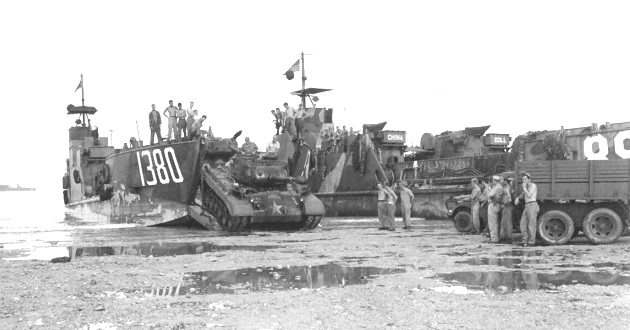
M26 Perishing tanks on Naha beach. These M26s have the T80E1 double-pin steel chevron tracks.

One of the 12 Pershing tanks in a vehicle depot on Okinawa. Note the shipping markings on the sand shield.

In preparation for the expected Allied invasion, the Japanese stocked piled large numbers of tanks, weapons, planes, boats and submarines. Included was some of their most advanced weapons and technology of the entire war. Following are some of the weapons which the Allied invasion forces would had probably encountered if Japan did not surrender and the invasion of Japan had happened.
Type 3 Chi-Nu Medium Tank
As more US M4 Sherman tanks arrived on the front lines in the Pacific, they increased the pressure on the Japanese armored forces. The Imperial General Headquarters (Daihon’ei) decided to develop a new medium tank to counter the enemy threat. The Army Technical Bureau had been working on the Type 4 Chi-To medium tank as a counter to the M4 Sherman, but there were problems and delays in the program and only two were completed. As a result, a stopgap tank was required. The Type 3 medium tank Chi-Nu was to counter the M4 Shermans and development was done in 1943. The low priority given to tank production meant that the Type 3 did not enter production until 1944, by which time raw materials were in very short supply, and in 1945 much of Japan’s industrial infrastructure had been destroyed by US strategic bombing. This caused its production run to be severely curtailed. A total of between 144 and 166 tanks were built. The Type 3 Chi-Nu was the last tank that was fielded by the Imperial Japanese armed forces, and was still in production at the end of the war.
Video: The Last Samurai | Type 3 Chi-Nu of the Imperial Japanese Army
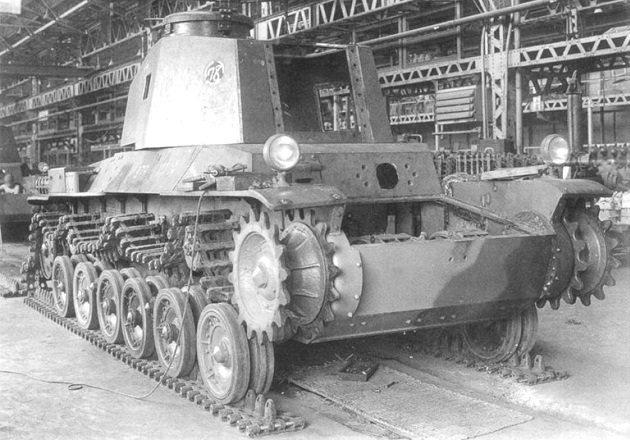
The Type 3 Chi-Nu had the same chassis and suspension of the Type 1 Chi-He, but with the addition of an enlarged turret ring for the new large hexagonal gun turret with a commander’s cupola. It was the last design based directly on Type 97 lineage. The thickest armor used was 50mm (1.96 inches) on the front hull with 25mm on the turret, 25mm on the hull sides and 20mm on the rear.
The main armament was a 75mm Type 3 tank gun. It had a caliber of 75mm (3.0 in), barrel length of 2.850 m (9 ft 4.2 in) (L/38). Elevation was from -10 to +25 degrees. It fired a 6.6 kg (14.5 lbs) projectile at a muzzle velocity of 680 m/s (2200 ft/s) with armor penetration of 90 mm (3.5 in) at 100 m (110 yd) and 65 mm (2.6 in) at 1000 m (1,100 yd). The gun was based on the Japanese Type 90 field gun which in turn was loosely based on the French Schneider et Cie Canon de 85 mle 1927. The Type 3 gun was license built by the Osaka Arsenal. Secondary armament was one 7.7 mm (.303 inch) Type 97 machine gun.
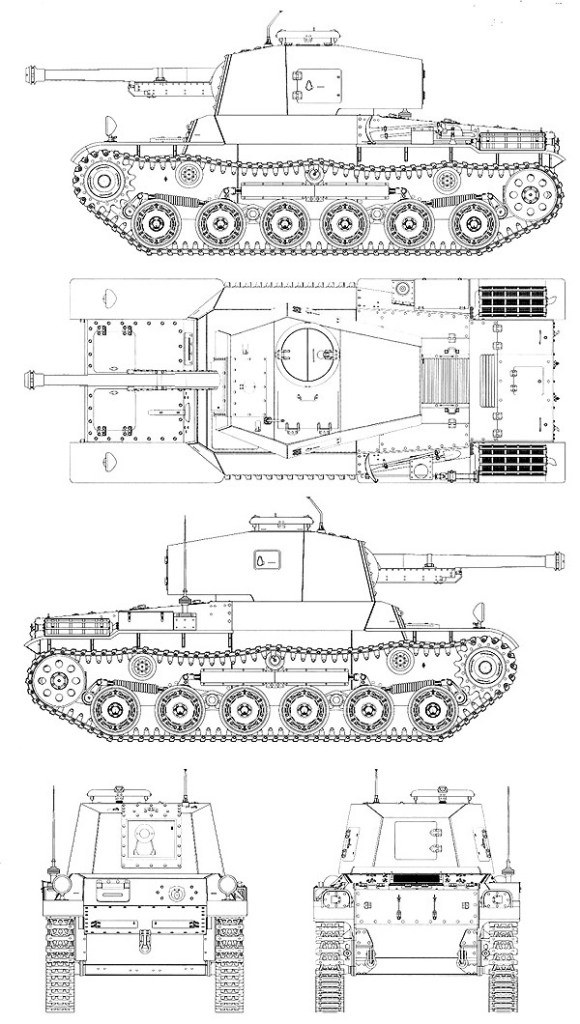
Specifications:
| Crew | 5 |
| Weight | 19 tonnes (21 tons) |
| Length | 5.64 m (18 ft 6 in) |
| Width | 2.41 m (7 ft 11 in) |
| Height | 2.68 m (8 ft 10 in) |
| Engine | Mitsubishi Type 100 21.7 L V-12 diesel |
| Range | 210 km (130 miles) |
| Speed | 39 kph (24.2 mph) |
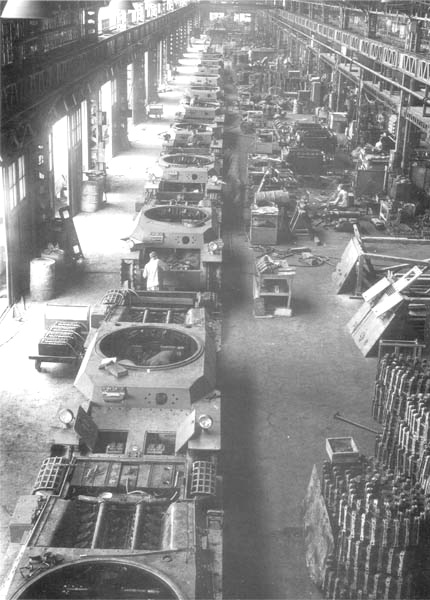
The Type 3 Chi-Nu tank production line in 1945. In the foreground are rolled tank tracks.


IJA 4th Tank Division
The 4th Tank Division (Sensha Dai-yon Shidan) was one of four armored divisions of the Imperial Japanese Army. It was formed on 6 July 1944 in Chiba, near Tokyo and it lacked both infantry and self-propelled gun regiments. Similar to the German Panzer-Lehr-Division, it was created out of the training departments of the Armor School, Cavalry School, Field Artillery School and the Military Engineering School of the Imperial Japanese Army Academy. The division was assigned to the IJA 56th Army Corps and was designated for the defense of the home islands against the expected Allied invasion.
The division was based in Hakata, Fukuoka prefecture on Kyūshū island and was equipped with the finest and most advanced armaments, including a significant number of Type 3 Chi-Nu medium tanks and Type 3 Ho-Ni III tank destroyers, stored at its depot before the end of the war.
After relocated to Japan in early 1945, each of the tank regiments were roughly a battalion in size. The division consisted of:
- Division Headquarters
- 28th Tank Regiment
- 29th Tank Regiment
- 30th Tank Regiment
- Machine Gun Cannon Battalion (20mm AA)
- Motor Transport Battalion
- Signal Company
Following Japan’s surrender, the division was officially demobilized with the rest of the Imperial Japanese Army, without having seen any combat.
Japanese medium tanks photographed in Fukuoka on 14 October 1945. In this photo, 15 Type 3 Chi-Nu tanks can be seen.
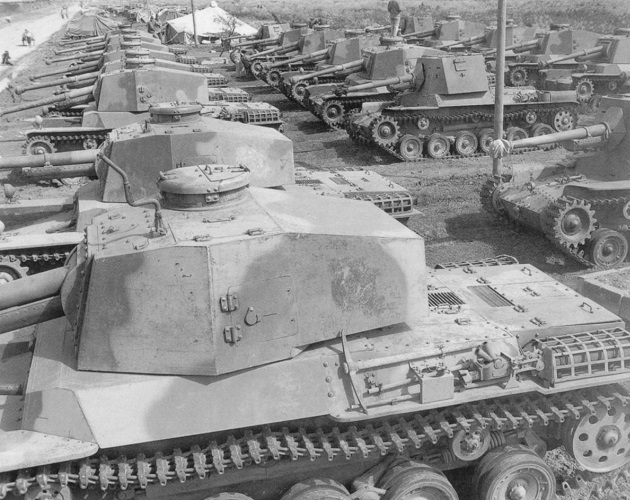
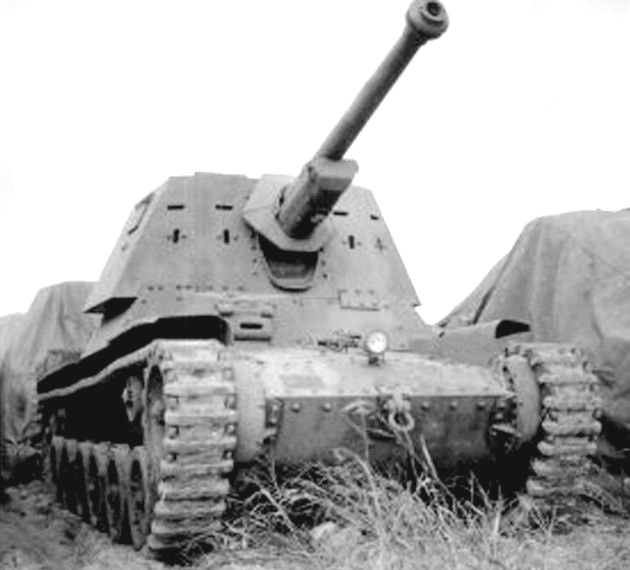
This is my close up of the above photo. This is a Type 3 Ho-Ni III tank destroyer which had the same chassis and 75mm Type 3 gun used on the Type 3 Chi-Nu tank. It had better protection for the gun crew by having a completely enclosed superstructure. The armor was 12–25 mm and it had a crew of 5. An order of 57 was placed and production began in 1944 but it was also hampered by material shortages by US bombing. Only 31 were built before the war ended.

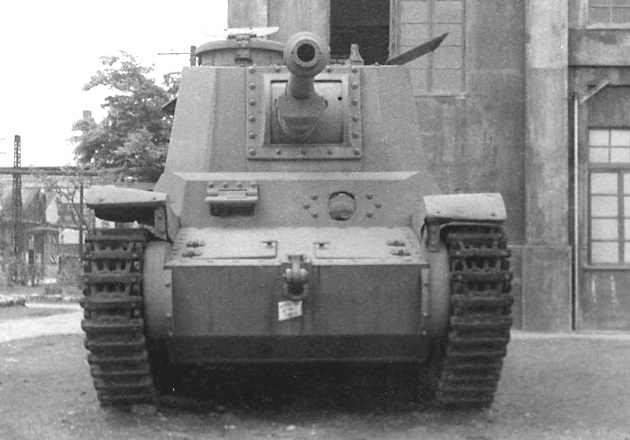
This is a front view of a Type 3 Ho-Ni III. Due to the enclosed superstructure, vision slots were added to front. Note there is no hull machine gun.
Two Japanese soldiers checking one of the Type 3 Chi-Nu tanks.

US soldiers checking out the Type 3 Chi-Nu tanks.


These are rear views of the Type 3 Chi-Nu tank.

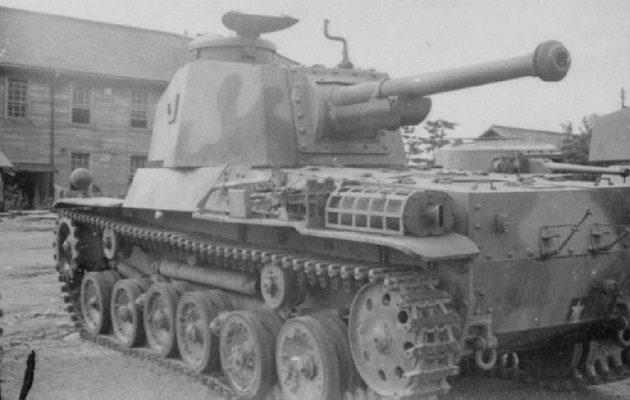
This Type 3 Chi-Nu being is prepared for transport back to the USA for evaluation and testing. Someone had painted “TYPE 3” on the side hull and next to it “Heavy”. Compared to all the light tanks the Japanese used during the war, the Type 3 Chi-Nu could been thought to be a heavy tank.

Type 4 74mm AT rocket launcher
By 1944, the US was using M1 bazooka anti-tank rocket launchers in the Pacific against the Japanese. In response, the Japanese began development of the Type 4 rocket launcher. It was comparable to the German Panzerschreck and the US bazookas. Unlike the US rocket, that used fins to stabilize the rocket in flight, the Japanese rocket had angled venturis in the base which spin the rocket for stability. The launcher was made in two parts that were joined in the middle, similar to the post war US 3.5-inch (89mm) M20 “super bazooka”. It was only issued to units on the Japanese mainland in case of an invasion by the Allies.

It was designed to be fired by a soldier while prone and the weapon itself had a bi-pod. The gunner laid with his body at approximately a 45 degree angle to the bore on the left side while the loader was positioned on the opposite side.
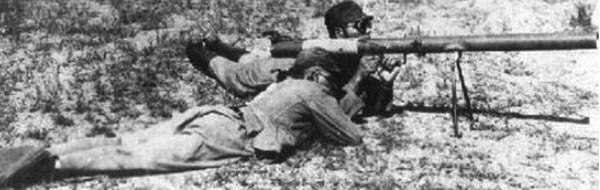
The 74mm rocket used a mortar fuse. There was no set back when the rocket was fired to arm the artillery fuse. The Japanese mortar fuse for the 81mm and 90mm mortars used a shear wire to make it bore safe. The wire went through the brass body and aluminum firing pin plunger. Upon impact, the plunger was forced back shearing the wire and freeing the plunger to strike the firing pin which detonated the rocket.
Artillery Rockets
There was considerable infighting between the Imperial Japanese Army and the Imperial Japanese Navy as both competed for scarce resources. A consequence of this competition was that each produced similar but different weapons. An example of this competition was the Army Type 4 20cm rocket launcher and the 20cm Naval Rocket Launcher.
The Type 4 rocket launcher was developed by the Imperial Japanese Army Technical Bureau, as a relatively low-cost, easy to produce weapon, which had an advantage of greater accuracy over conventional mortars. The Type 4 rocket used a double base solid-propellant whose exhaust gasses were forced through six venturis drilled in the base of the rocket which spin-stabilized the projectile. The rocket used trinitrotoluene explosives and was nose fused. Due to its ease of construction, the rockets were produced in large numbers and distributed to hidden arsenals for use as a last ditch weapon for the expected Allied invasion.
The Type 4 20cm rocket was able to be launched from any ordinary pipe or culvert with a sufficient diameter, wooden rails, or even directly from a slope on the ground.
A US marine inspects a Type 4 20cm rocket launcher on Iwo Jima, March 1945.

This is a Type 4 20cm rocket on a simple wooden launching trough. These launchers were usually used only once because the rocket blast weakened the wooden framework.

Japanese Air Forces
In the summer of 1945, Japan had approximately 12725 planes. The Army had 5651 and the Navy had 7074 aircraft of all types. While many of these were not considered combat ready planes, almost all were converted into kamikaze planes. Sufficient fuel had been stored for this use, but only about 8000 pilots were available. Although the pilots were poorly trained and were no match against experienced US pilots, they were capable enough to carry out suicide attacks against enemy ships. The Japanese were planning to train enough pilots to use all of the aircraft that were capable of flying.
They had airfields throughout Kyūshū, Shikoku and Chugoku. Planes were to be launched in waves of 300-400, at the rate of one wave per hour, against the Allied invasion fleet. Their objective was to attack as many Allied transports as possible as the US fleet approached the shores of Japan. If landings were made, the air forces would then fly missions to sever the Allies supply lines and to support the Japanese ground forces.
Yokosuka MXY-7 Ohka
The Yokosuka MXY-7 Ohka (“cherry blossom”) was a purpose-built, rocket-powered human guided kamikaze attack aircraft used against Allied ships. It was constructed of wood over an aluminum frame to help reduce weight and the need for war-critical materials. The Allies gave the aircraft the name “Baka Bombs”. Baka means “idiot”, “stupid”, or “foolish” in Japanese and is most frequently used as a pejorative term in the Japanese language. It was produced during 1944–1945 and a total of 852 were built.
Although extremely fast, the very short range of the Ohka meant that it had to be carried and launched from an aircraft mother ship, which itself was vulnerable to enemy fighters. It was usually carried underneath a Mitsubishi G4M2e Model 24J “Betty” bomber to within range of its target. On release, the pilot would first glide towards the target and when close enough he would fire the Ohka’s three solid fuel rockets, one at a time or in unison, and fly the aircraft towards the enemy ship that he intended to destroy.
Design work began in 1943 and the authorities would not take any interest in it until the following year. The Imperial Japanese Navy decided the idea had merit and engineers of the Yokosuka Naval Air Technical Arsenal (Dai-Ichi Kaigun Koku Gijitsusho, or in short Kugisho) created formal blueprints for what was to be the MXY-7. The only variant which saw service was the Model 11, and it was powered by three Type 4 Mark 1 Model 20 rockets.
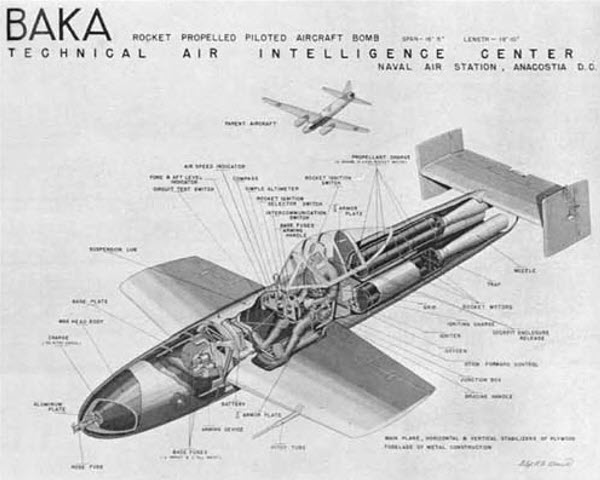
The final approach was difficult for a defender to stop because the aircraft gained high speed 650 km/h (400 mph) in level flight and 930 km/h (580 mph) or even 1000 km/h (620 mph) in a dive. Later versions were designed to be launched from coastal air bases and caves, and even from submarines equipped with aircraft catapults, but none of them were used in combat.
Film: Japanese Planes Carrying ‘Baka’ Kamikaze Rockets, 1945
Film: The Baka Bomb (1945)
Video: Rocket Kamikazes!
Video: Japanese Kamikaze Suicide Aircraft – MXY-7 Ohka
Video: Inside the Ohka Manned Missile
In the first two attempts to transport the Ohkas to Leyte Gulf in late 1944 using aircraft carriers, the carriers Shinano and Unryu were sunk by the US submarines Archerfish and Redfish. The MXY-7 Ohka was used mostly against US ships invading Okinawa, and launched from its mother ship could been effective due to its high speed in a dive.
A G4M2e Model 24J “Betty” bomber with a MXY-7 Ohka mounted. Below are views of a MXY-7 Ohka being launched from the bomber in flight.

Less than 60 Okha’s are thought to have been used in actual combat. Most of the Ohka’s were destroyed or captured on the ground or the G4M2e “Betty” bomber mother ship carrying them was shot down. On 21 March 1945, the Ohka made its combat debut at Okinawa but the 16 bombers carrying them were all shot down by US Navy Grumman F6F Hellcat fighters before they could be launched. On 1 April 1945, first day of the invasion of Okinawa, six G4M2es attacked the US fleet. At least one made a successful attack where one MXY-7 Ohka was thought to have hit one of the 406 mm (16 in) turrets on the USS battleship West Virginia, causing moderate damage. Postwar analysis indicated that no hits were recorded and that only a near-miss took place. The transport ships Alpine, Achernar, and Tyrrell were also hit by kamikaze aircraft, but it is unclear whether any of these were the other Ohkas. None of the G4M2e bombers returned. On 12 April 1945, the first US Navy ship sunk by an Ohka was the destroyer USS Mannert L. Abele (DD-733) of TF 54 protecting the US transports off Okinawa.
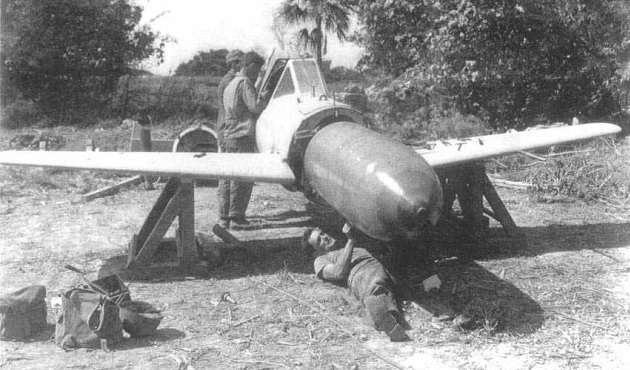
On April 1st, 17 MXY-7 Ohka’s were captured by US Marine and Army forces at Kita Airfield on Okinawa.


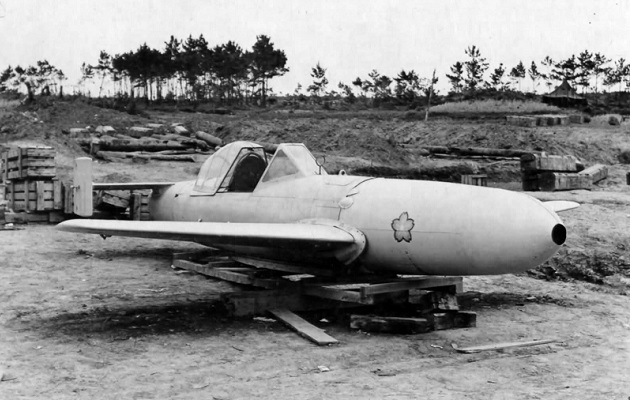

After the nose section was removed, the 2645 lbs (1199.75 kg) warhead can be seen.
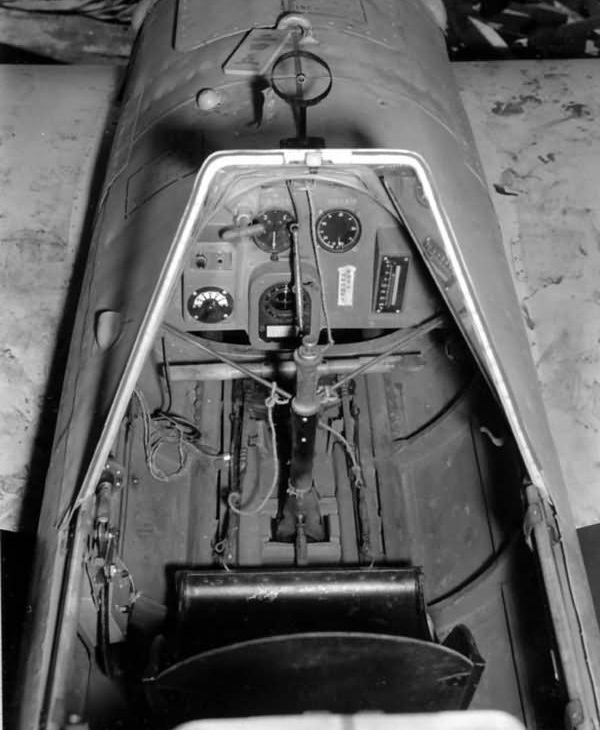
The cockpit of the MXY-7 Ohka was rather simple for its one way mission.
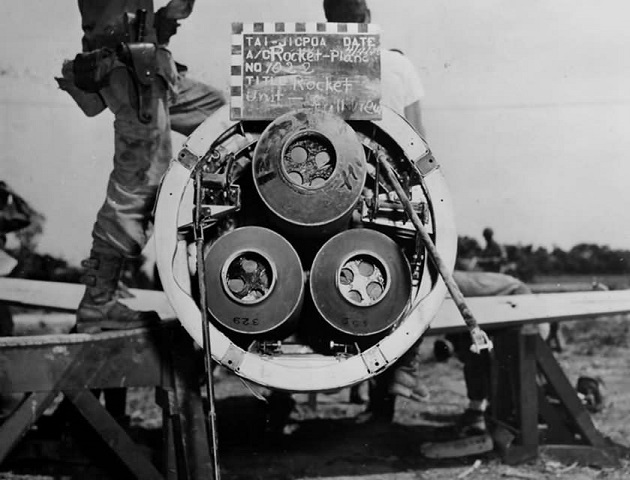
After the tail section was removed, the exhaust pipes of the rockets can be seen.

After the exhaust pipes were removed, the three Type 4 Mark 1 Model 20 rockets can be seen.
Ohka coded I-13 being towed behind a 2-1/2 ton truck after its capture. It and others were shipped to the USA for evaluation.

US National Archives Photo 80-G-192463
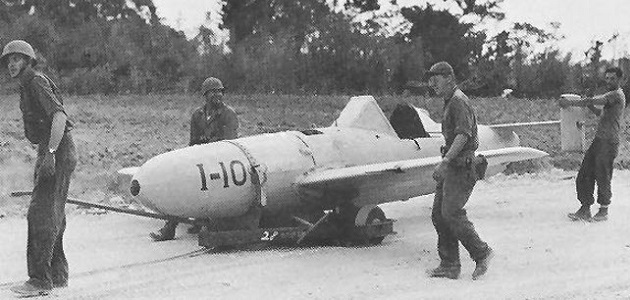
Ohka coded I-10 after captured on Okinawa being towed. Today, it is on display at the Yanks Air Museum in Chino, California.
The Ohka Model 43 K-1 Kai Wakazakura (“Young Cherry”) was a two-seat suicide attack glider trainer with flaps and a retractable skid undercarriage. It was fitted with only one Type 4 Mark 1 Model 20 rocket for limited powered flights.
Suicide motorboats
Around 6200 Shin’yō “Sea Quake” were produced for the Imperial Japanese Navy and 3000 Maru-Ni for the Imperial Japanese Army. Around 400 were deployed to Okinawa and Formosa, and the rest were stored on the coast of Japan for the defense against the expected Allied invasion.
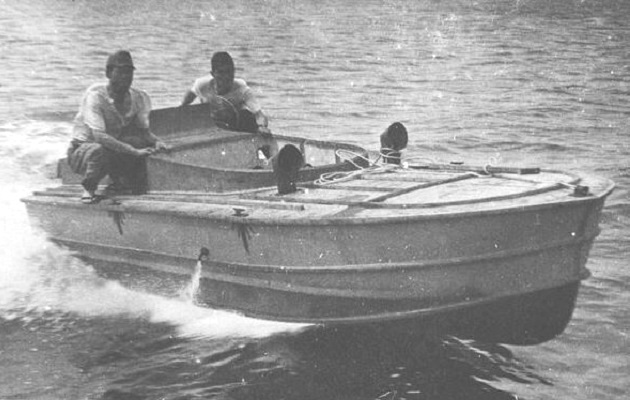
The Kerama Islands are a subtropical island group 32 km (20 miles) southwest of Okinawa Island. Preliminary to the Okinawa invasion, the US 77th Infantry Division landed in the Kerama Islands on 26 March 1945. More than 350 suicide boats were captured and destroyed. They were well dispersed throughout the islands, many of them were in camouflaged hideouts. These plywood boats piloted by one man were 18 feet (5.5 m) long and 5 feet (1.5 m) wide. Powered by 6-cylinder Chevrolet automobile engines of about 85 hp (63 kW), they were capable of speeds up around 35 mph (56 km/h).
The Maru-Ni was a version with two depth charges weighing 264 pounds (119.7 kg) each carried on a rack behind the pilot and were rolled off the stern of the boat when released. According to captured instructions, three boats would attack an enemy ship simultaneously, each seeking a vital spot to release its charge. Delay time for the depth-charge igniters was five seconds. According to a Japanese officer, it was considered possible to drop the depth charges against a ship and escape the blast, but the fragility of the boats made survival highly unlikely. Training for the pilots was minimal.
From hideouts in the small islands, the “Q-boats” with their charges were to speed to the US ships. The objective of the attack was to be transports, loaded with essential supplies, materials and personnel. The attack was to be carried out by concentrating maximum strength immediately upon the enemy’s landing. The Japanese had carefully mapped out possible assembly areas of Allied transports and had prepared appropriate routes of approach to each area. The US initial thrust into the Kerama Islands prior to the main landing on Okinawa completely spoiled their plan.

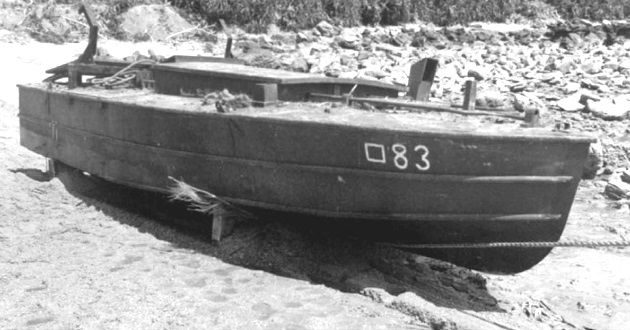
Suicide boats captured at Unten Kō on April 10th by US Marines of the 2nd Battalion, 29th Marine Regiment, US 6th Marine Division. Note the warning signs indicating that the boats had been booby trapped.

Photo: USMC 127905
Film: Kerama islands 1945 – Side show and Suicide boats
Video: The Shinyo Kamikaze Boat – Japan’s World War 2 Desperation
Nakajima J9N1 Kikka
The Nakajima Kikka (“tachibana orange blossom”) was Japan’s first turbojet powered fighter aircraft. It was initially called Kōkoku Nigō Heiki (“Imperial Weapon No. 2”).
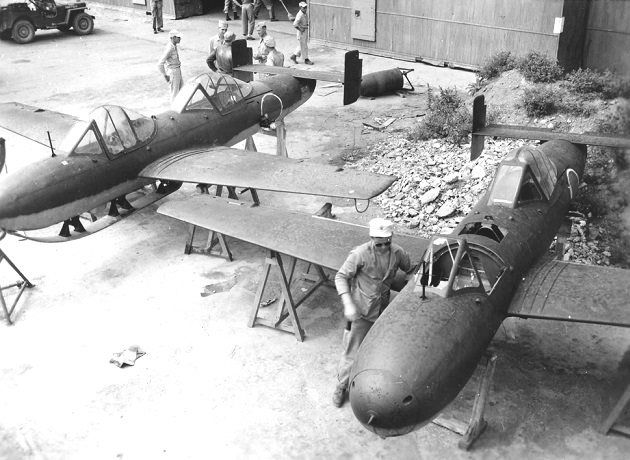
After a Japanese military attaché in Germany witnessed trials of the Messerschmitt Me 262 in 1942, the Imperial Japanese Navy issued a request to Nakajima to develop a similar aircraft to be used as a fast attack aircraft. Among the specifications for the design were the requirements that it should be able to be built largely by unskilled labor. Another feature was the folding wings to allow the aircraft to be hidden in caves and tunnels to protect it from US bombing attacks. Nakajima designers Kenichi Matsumura and Kazuo Ohno laid out an aircraft that bore a strong but superficial resemblance to the Me 262.
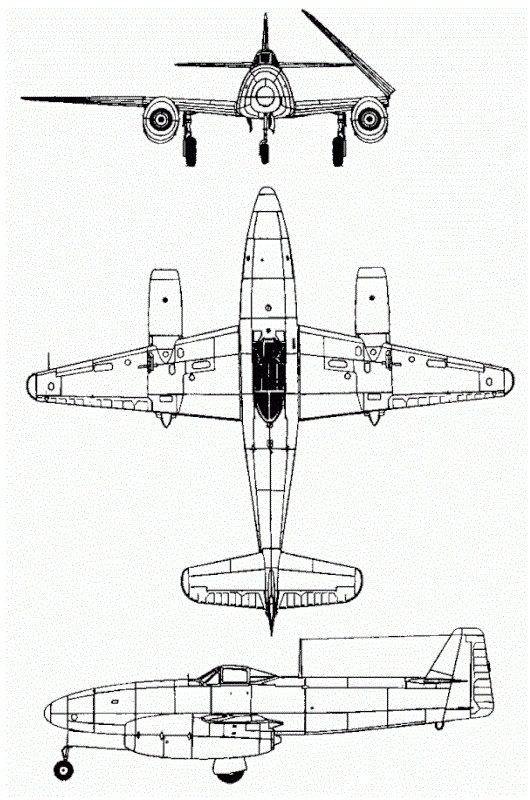
Compared to the Me 262, the Kikka air frame was noticeably smaller and more conventional in design, with straight wings (lacking the slight sweep back of the Me 262) and tail surfaces. The triangular fuselage cross section characteristic of the German design was less pronounced, due to smaller fuel tanks. The main landing gear of the Kikka was taken from the A6M Zero and the nose wheel from the tail of the Yokosuka P1Y twin-engine, land-based bomber.
Development of the engine was troubled, as it was based on little more than photographs and a single cut-away drawing of the German BMW 003; however, a suitable unit, the Ishikawajima Ne-20, was quickly built in 1945. By mid-1945, the Kikka project was making progress once again and at this stage, due to the deteriorating war situation, it is possible that the Japanese Navy considered employing the Kikka as a kamikaze weapon but it was questionable due to the high cost and complexity associated with manufacturing contemporary turbojet engines.

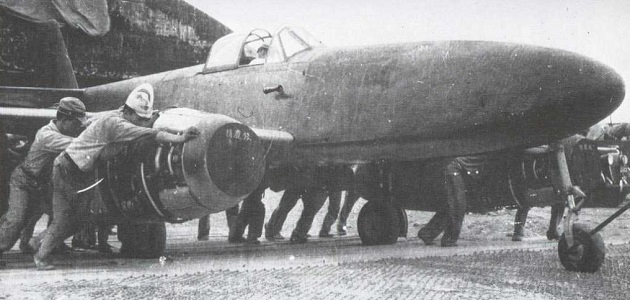
The first prototype commenced ground tests at the Nakajima factory on 30 June 1945. The following month it was dismantled and delivered to Kisarazu Naval Airfield where it was re-assembled and prepared for flight testing. The first flight took place on 7 August 1945 (the day after the atomic bomb was dropped on Hiroshima), with Lieutenant Commander Susumu Takaoka as the pilot. The aircraft performed well during a 20 minute test flight, with the only concern being the length of the takeoff run.


The second test flight was four days later (4 days prior to Japan’s declaration of surrender and two days after the second atomic bomb dropped on Nagasaki), rocket assisted take off (RATO) units were fitted to the aircraft. Four seconds into take off the RATO was actuated, immediately jolting the aircraft back onto its tail leaving the pilot with no effective tail control. After the nine second burning time of the RATO ran out, the nose came down and the nose wheel contacted the runway, resulting in a sudden deceleration, however both engines were still functioning normally. At that point the pilot opted to abort the take off, but fighting to brake the aircraft and perform a ground loop only put him in danger of crashing it into ground installations. Eventually the aircraft ran over a drainage ditch which caught the tricycle landing gear, the aircraft continued to skid forward and came to a stop.
This is the Kikka on the second flight test fitted with RATO rockets for take off.


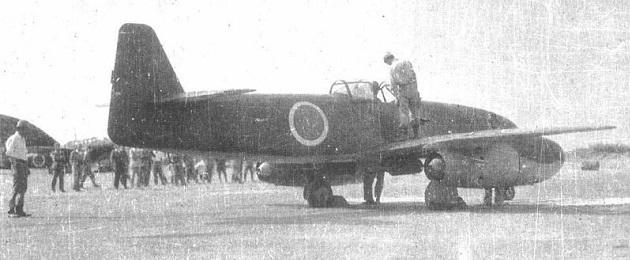
Before the first prototype could be repaired Japan had surrendered. At that time, the second prototype was close to completion, and approximately 23 more air frames were under construction. Five of them were two seat trainers.
Video: The Japanese Me 262 | Nakajima Kikka
Mitsubishi J8M Shūsui
The Mitsubishi J8M Shūsui (literally “Autumn Water”, used as a poetic term meaning “Sharp Sword” deriving from the swishing sound of a sword) was Japan’s first rocket-powered interceptor aircraft closely based on the German Messerschmitt Me 163 Komet. Built as a joint project for both the Navy and the Army Air Services, it was designated J8M (Navy) and Ki-200 (Army). The J8M1 was to be a license-built copy of the Me 163. Difficulties in shipping an example to Japan meant that the aircraft eventually was reverse-engineered from a flight operations manual and other limited documentation.
The Ki-200 and the J8M1 differed only in minor items. The main difference was the JAAF’s Ki-200 was armed with two 30 mm (1.18 in) Type 5 cannons (with a rate of fire of 450 rounds per minute and a muzzle velocity of 720 m/s (2400 ft/s)), while the J8M1 was armed with two 30 mm (1.18 in) Ho-105 cannons (rate of fire 400 rounds per minute, muzzle velocity 750 m/s (2500 ft/s).

Mitsubishi MXY-8 Akigusa (“Autumn Grass”), the glider prototype of the J8M Shusui, built by Dai-Ichi Kaigun Koku Gijitsusho.

On 8 January 1945, one of the two J8M1 prototypes was towed aloft with water ballast mounted in place of the fuel tank and rocket engine to test its aerodynamics. The test flights confirmed the design. Training courses for JAAF and JNAF pilots began on the Ku-53 glider, which shared a similar configuration to the J8M1. Mitsubishi, Fuji Hikoki, and Nissan Jidosha all had tooling for mass production well into the advanced stages, ready to produce both the J8M1 and the J8M2 variant, which differed from the J8M1 in sacrificing one of the Type 5 30mm cannons for a small increase in fuel capacity. The first J8M1 prototype, the MXY-8, equipped with the Toko Ro.2 (KR10) engine was ready in June 1945. It was then transferred from the Nagoya plant to Yokoku for final checks before powered flight testing, after final glide tests with the engine installed.
The J8M took to the air for its first powered flight on 7 July 1945, with Lieutenant Commander Toyohiko Inuzuka at the controls. After his “sharp start” rocket-powered takeoff, Inuzuka successfully jettisoned the dolly upon becoming airborne and began to gain speed, climbing skywards at a 45° angle. At an altitude of 400 m (1,300 ft), the engine stopped abruptly and the J8M1 stalled. Inuzuka managed to glide the aircraft back, but clipped a small building at the edge of the airfield while trying to land, causing the aircraft to burst into flames. Inuzuka died the next day. While Mitsubishi and naval technicians sought to find the cause of the accident, all future flights were grounded. The engine cutout had occurred because the angle of climb, coupled with the fuel tanks being half-filled for this first flight, caused a shifting of the fuel, which in turn caused an auto cutout device to activate because of an air lock in the fuel line. Requests to continue flight testing were denied pending the modification of the fuel pumps in the aircraft. The sixth and seventh prototypes were to be fitted with the modified engine.
The Yokosuka MXY-9 Shuka (“Autumn flower”) was a projected development of the MXY-8 training glider, adding a small motor jet engine, the Tsu-11. It was intended to provide further training for pilots who were to fly the Mitsubishi J8M and Ki-200 rocket-powered interceptor aircraft. None were built prior to Japan’s surrender.
Video: Japan’s Forgotten Me-163 Komet Copies | The Mitsubishi J8M and Ki-200
End of the War
Operation Downfall was cancelled when Japan surrendered on 15 August 1945 after the dropping of the atomic bombs on Hiroshima (August 6th) and Nagasaki (August 9th), the Soviet declaration of war on Japan (August 8th), and the Soviet invasion of Manchuria which began on August 9th. On August 10th, Emperor of Japan Hirohito made the decision to surrender. The next day, Hirohito’s surrender announcement to the Japanese nation was recorded. Despite an attempted last minute coup by radical militarists, the message was broadcasted. Japan agreed to surrender unconditionally. The instrument of surrender was signed by representatives of the Allied and Japanese governments on 2 September 1945, around 0900 hours, Tokyo time, on the battleship USS Missouri (BB-63) in Tokyo Bay.
Similar to Germany, Japan was divided among the Allied countries. These are the Allies occupation zones.

Bad Weather
The fighting on Okinawa went on for so long that the Allies were not be able to launch another operation before the typhoon season, during which the weather would be too risky for amphibious operations and would had grounded all air support. The Pacific typhoon season in 1945 was very active with 26 named storms, lasting from April into November. The first typhoon to hit after the Japanese surrender was Typhoon Ursula (7-15 September 1945) during which six transport planes flying from Okinawa to Manila carrying 120 US ex-POW’s and aircrews were lost, the worst peacetime aerial disaster to that date.
In early October, Typhoon Louise took a sudden unexpected turn and on 9 October 1945 hit Okinawa full force, with hundreds of US ships and vessels in Buckner Bay that were not able to escape to sea. Twelve ships and craft were sunk, 222 were grounded, and another 32 severely damaged beyond repair. Three destroyer-minesweepers and a destroyer escort were driven aground. The destroyer escort, Oberender (DE-444), was re-floated, but the three destroyer-minesweepers were deemed not worth repairing. About 107 amphibious craft were grounded, many of them wrecked beyond salvage, including four of six LSTs that were driven aground. Eighty percent of the buildings on Okinawa were destroyed or severely damaged, many still packed with war supplies. All 60 aircraft on Okinawa airfields were damaged. Only a month earlier, hundreds of aircraft were crammed on Okinawa airfields as well as many more ships and amphibious craft. The toll would have been far higher had Operation Olympic been underway. Instead, the vast majority of ships and aircraft were gone. Estimates shortly after the typhoon concluded that Operation Olympic would have been delayed for about 45 days, which then would have put it in winter storm season. In planning for Operation Downfall, December 1st probably had been assessed as the last feasible date for the operation.
Midget Submarines
In mid-1944, the Japanese Navy developed the Koryu Tei Gata Type D midget submarines. They were the largest of Japan’s midgets, displacing about 60 tons, 86 feet (243.84 m) in length, with a five man crew, featuring a powerful diesel engine, and had improved operating endurance. The Koryu’s armament was two muzzle loaded 17.7 inch (44.95 cm) torpedoes. As with earlier types, individual boats had alpha-numeric names in the “Ha” series beginning with Ha-101. About 115 subs had been built when Japan capitulated and nearly 500 more were under construction.
Midget submarines were employed off Guadalcanal and the Solomon Islands in 1942-43, where they achieved modest success against US shipping. They were deployed around Midway, the Aleutians, the Bismarck Islands, the Philippines, the Marianas, and Okinawa as shore based defensive units, but their overall effectiveness was negligible.
Koryu Type D submarines, along with at least three other classes, at the Kure Naval Arsenal on 19 October 1945. Kure is southeast of Hiroshima on Honshū island.Koryu Type D submarines, along with at least three other classes, at the Kure Naval Arsenal on 19 October 1945. Kure is southeast of Hiroshima on Honshū island.

Photo: 80-G-351875

Photo: 80-G-351876
Koryu submarines in a partially flooded dry dock at the Kure Naval Arsenal, February 1946.

In 1948, first Lieutenant Kingston Winget of the 24th Infantry Regiment, US 25th Infantry Division photographed this Type 3 Chi-Nu tank in Tokyo.

The 12 M26 Pershing tanks that were shipped to Okinawa in 1945 were never issued to any unit and remained in storage on Okinawa. They were not sent to Japan for occupation duty because the bridges in Japan could not support their weight and their steel tracks would ruin the roads. When the Korean War broke out in the summer of 1950, they would have been issued to an US Army or USMC armor unit and sent to fight in Korea.
Today, one surviving Type 3 Chi-Nu tank is on display at the Japan Ground Self-Defense Force Military Ordnance Training School at Tsuchiura, Ibaraki, Japan.

Model Kits
1/32
RB Productions RB-K32003 Yokosuka MXY-7 Ohka Type 22 – 2015
LEM Kits 32034 Nakajima “Kikka” – Imperial Japanese Navy jet fighter – 2022
(limited edition resin kit)
1/35
Fine Molds FM29 Imperial Japanese Army Medium Tank Type 3 Chi-Nu – 2009
Masterpiece Models MMPT008 Japanese Suicide Boat Shinyo “Sea Quake” – 201?
Tamiya 25107 Japanese Army Medium Tank Type 3 Chi-Nu – 2010
Fine Molds 35720 IJA Type 3 SPG Ho-Ni III Interior & Caterpillar Set – 2017
1/48
Fine Molds FB10SP IJN Special attacker Shisei Kikka – 2003
1/72
Choroszy Modelbud S53 Maru-in and Shinyo Explosive Motorboats – 200?
MPM Production 72139 Nakajima Kikka – 2002
AZmodel AZ7386/AZ7387 Nakajima J9N “Kikka” – 2012
Hasegawa 64728 Mitsubishi G4M2E Bomber (Betty) Model 24-Tei w/MXY7 Ohka – 2016
IBG Models 72057/72058 Type 3 Chi-Nu Japanese Medium Tank – 2018
Brengun BRP72034 Yokosuka MXY-7 Ohka model 22 – 2019

 Mike's Research