The Corpo Aereo Italiano (Italian Air Corps), or CAI, was an expeditionary force from the Italian Regia Aeronautica (Italian Royal Air Force) that participated in the final phase of the Battle of Britain and the Blitz during the final months of 1940. The CAI supported the German Air Force (Luftwaffe) and flew against the British Royal Air Force (RAF) and Fleet Air Arm (FAA). The CAI achieved limited success during its brief existence, but it was generally hampered by the inadequacy of their aircraft. They were named Mussolini’s Chianti Raiders.

Upon hearing of Hitler’s plan to invade Britain (Operation Sea Lion), Italian dictator Benito Mussolini, through his Foreign Minister Count Galeazzo Ciano, quickly offered up to ten divisions and thirty squadrons of Italian aircraft for the proposed invasion. With Hitler conquering most of Europe, Mussolini wanted Italy to get its share of the territories conquered. Hitler initially declined his offer but after he could not obtain air superiority over England and the Channel, he allowed a small contingent of Italian bombers and fighters to assist in the Luftwaffe’s aerial campaign over Britain.
On 10 September 1940, the CAI was formed, under the formal aegis of the 1° Squadra Aerea di Milano (“First ‘Milan’ Air Command”). Air Marshal (Generale S.A.) Rino Corso-Fougier was appointed the Commanding Air Officer.
Arrival in Belgium
Most of the CAI bombers arrived at the Chièvres airbase, Belgium between 25-27 September 1940. Three of the 40 aircraft of 43° Stormo crashed en route due to icing and mechanical problems, and some made intermediate landings in Germany to fly on later. One of the 37 aircraft of the 18° Gruppo also crashed, and some others made fuel and oil stops along the way. On the afternoon of 27 September 1940, there were 60 Italian bombers on Belgian soil. The fighter compliment of the CAI did not arrive in Belgium until a couple of weeks later.
Film: Il Corpo Aereo Italiano al Fronte Occidentale
CAI Order of Battle
13° Stormo (translates to “Flock” or Wing)
Commanding Officer: Colonel Carlo de Capoa.
38 BR.20M bombers based at Melsbroek, Belgium.
11° Gruppo (Commanding Officer: Major Giuseppe Aini)
– 1a and 4a Squadriglia
43° Gruppo (Commanding Officer: Major Giulio Monteleone)
– 3a and 5a Squadriglia
43° Stormo (Commanding Officer: Colonel Luigi Questa)
27 Fiat BR.20M bombers based at Chièvres, Belgium.
98° Gruppo (Commanding Officer: Giuseppe Tenti)
– 240a and 241a Squadriglia
99° Gruppo (Commanding Officer: Major Gian Battista Ciccu)
– 242a and 243a Squadriglia
56° Stormo (Commander Officer: Colonel Umberto Chiesa)
18° Gruppo (Commanding Officer: Major Ferruccio Vosilla)
– 83a, 85a and 95a Squadriglia.
50 Fiat CR.42 fighters based at the Saturn base at Ursel, Belgium.
20° Gruppo (Commanding Officer: Major Mario Bonzano)
– 351a, 352a and 353a Squadriglia.
48 Fiat G.50 fighters based at Ursel, Belgium, later at Flugplatz Maldegem, Belgium.
179a Squadriglia (Commanding Officer: Captain Perelli Cippo)
For reconnaissance, there were five three-engine CANT.Z1007bis “Alcione” (“Kingfisher”), twelve Caproni 133Ts, and one Savoia-Marchetti S.75, with nine Ca164s for communications. The Italians obtained a German Junkers Ju 52 on loan to operate as a transport link between the main base in Belgium and Rome. Based at Melsbroek, Belgium.
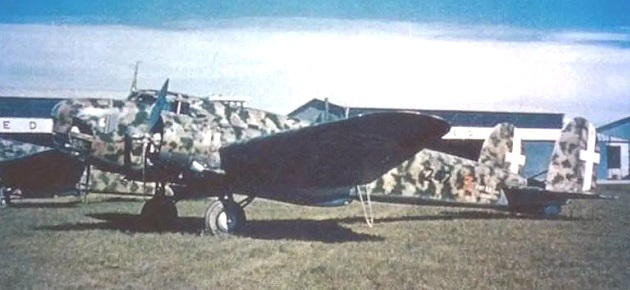
Fiat BR.20M Bomber
The Fiat BR.20M “Cicogna” (“Stork”) was a low-wing twin-engine medium bomber that was developed and manufactured by Italian aircraft manufacturer Fiat Aviazione. It holds the distinction of being the first all metal Italian bomber to enter service in 1936. It was on par with anything the RAF had at that time. It flew faster than the British Hampden, Wellington, and Beaufort with a better bomb load combination (except for the Wellington). It served with Franco’s forces during the Spanish Civil War and with the Japanese during the Second Sino-Japanese War. It had one weakness where its engines consumed so much oil that its range became restricted. Most of the BR.20Ms that failed to cover the distance from Italy to Belgium in one hop had to land to refill oil. For operational sorties over England, this was not a problem due to the shorter distances involved.
Armament
Guns: three 12.7 mm (0.5 in) Breda-SAFAT machine guns
Max Bomb load: 1600 kg (3530 lbs)
The BR.20 could carry a large variety of bomb-loads, ranging from 20 to 800 kg (44 to 1763.7 lbs) bombs, powerful enough to sink or damage larger warships. It could also carry a bomb dispenser system with four bombs containing a total of 720 bomblets, 1 to 2 kg (2.2 to 4.4 lbs) anti-personnel or incendiary bombs.
BR.20M of 242a squadriglia, 99° Gruppo, 43° Stormo on Chièvres airfield.

This BR.20M (MM.22267) coded 242 – 3 was later shot down on November 11.
An Italian ground crewman preparing bombs for loading. The closest bomb has an umbrella painted on it.

A BR.20M of 3a Squadriglia, 43° Gruppo, 13° Stormo. For night bombing missions, the white crosses on the fins were painted over, and the underside of the bomber was painted black.

BR.20M bombers in flight on a bombing mission.


Film: Fiat BR.20 Cicogna
Fiat CR.42 fighter
The Fiat CR.42 “Falco” (“Falcon”) was a single seat biplane fighter developed and produced by Fiat. It served primarily in the Italian Regia Aeronautica in the 1930s and during WWII. It featured a powerful supercharged Fiat A.74R1C.38 air-cooled radial engine and had aerodynamic improvements to its relatively clean exterior surfaces. The fighter proved to be relatively agile in flight, a factor that had been attributed to its very low wing loading and sometimes was a tactical advantage. RAF Intelligence praised its exceptional maneuverability, further noting that “the plane was immensely strong”, though it was technically outclassed by the faster more heavily armed British Hurricane and Spitfire. Luftwaffe aircraft frequently experienced difficulties in maintaining formation flight with the slower biplanes. Although slower, with an open cockpit, many of the biplanes lacked a radio.
Armament
Guns: one Breda SAFAT 7.7mm (0.303 in) and one Breda SAFAT 12.7 mm (0.50 in) machine gun
This CR.42 is plane number 2 of 83a Squadriglia, 18° Gruppo at Ursel.

These Fiat CR.42s belong to 85a Squadriglia.

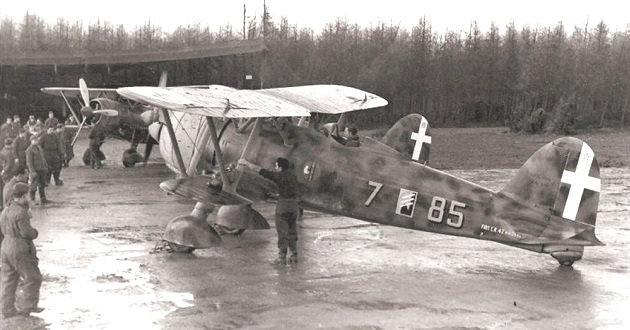
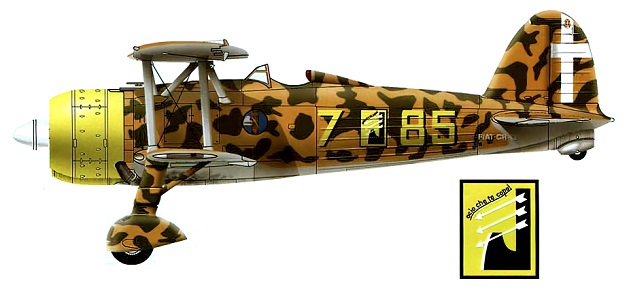
A German officer is examining the cockpit of a 85a Squadriglia CR.42.

Film: Fiat CR.42
Fiat G.50 fighter
The Fiat G.50 “Freccia” (“Arrow”) was developed and manufactured by Fiat. Upon entering service, it became Italy’s first single seat, all metal monoplane that had an enclosed cockpit and retractable undercarriage. The G.50s that were deployed to the CAI in Belgium were the early model which had an open canopy which was fine for the warm Mediterranean climate. It was normally hampered by its relatively slow speed and short range. It was also under equipped with a mediocre radio set (powered by batteries that were prone to freeze at high altitude) and it lacked any armor protection. The Fiat G.50bis, which was equipped with larger fuel tanks, was already in production at the time, but it was not sent to Belgium in time to participate.
Armament
Guns: two 12.7 mm (0.50 in) Breda-SAFAT machine guns
A Fiat G.50 of 352a Squadriglia at Ursel.
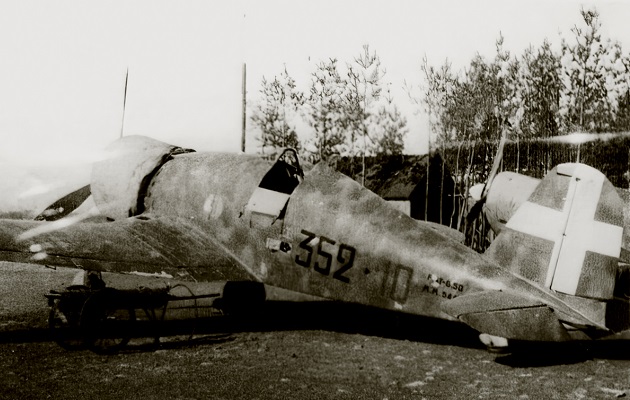
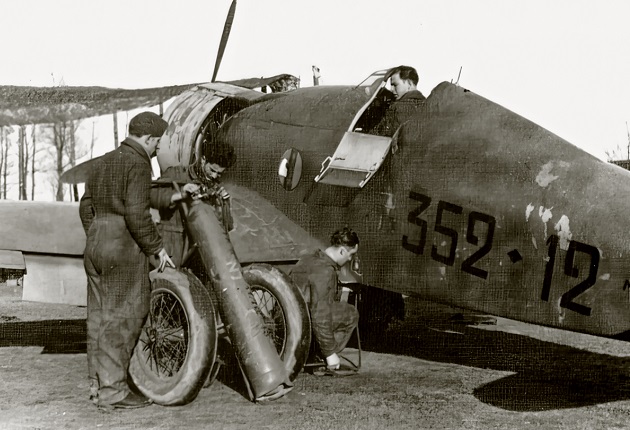
This 352a Squadriglia G.50 is being refilled with oxygen.
The camouflage paint on the fuselage of these two G.50s had been worn off. The G.50 in the background has a command pennant on the fuselage and the number 20 indicating its the 20° Gruppo commander’s plane, Major Mario Bonzano.


Both Fiat fighters with open cockpits were totally unsuited for the “winter” conditions in northwest Europe. Among other items the pilots had to procure lifebelts from the Luftwaffe. The Italians were operating from Belgium as the Luftwaffe leadership had refused to allow them to operate from their airfields in northern France, which considerably hampered their radius of action. The range of the CR.42 was 775 km (481.6 miles) and the G.50 was 445 km (276.5 miles), allowing them barely ten minutes over southern England. In addition, of the 200+ Italian pilots only five had received instrument or blind flying training.
Combat Missions of the CAI
| Date | Targets | Bombers | Fighters |
|---|---|---|---|
| 23 October 1940 | Harwich | 16 | — |
| 29 October 1940 * | Ramsgate | 15 | 73 |
| 5 November 1940 | Harwich | 8 | — |
| 11 November 1940 * | Harwich | 10 | 40 |
| 17 November 1940 | Harwich | 6 | — |
| 20 November 1940 | Harwich/Ipswich | 12 | — |
| 29 November 1940 | Ipswich/Lowestoft/Great Yarmouth | 9 | — |
| 14 December 1940 | Harwich | 11 | — |
| 21 December 1940 | Harwich | 6 | — |
| 22 December 1940 | Harwich | 4 | — |
| 2 January 1941 | Ipswich | 5 | — |
| Totals | 102 | 113 |
(*) Day missions. All the other missions were at night.
Total Bomb tonnages dropped
Day – 9.4
Night – 44.9
Targets
Ramsgate is a seaside town in east Kent, England. The Royal Navy had a shore base and headquarters at Ramsgate named HMS Fervent, which operated Motor Torpedo Boats, Motor Gun Boats and Motor Launches. Ramsgate harbour was the main assembly point for the build up of small craft needed for Operation Dynamo, the evacuation of the British Expeditionary Force (BEF) from Dunkirk.
Harwich is a town in Essex, England, and one of the Haven ports on the North Sea coast. Nearby is Felixstowe to the northeast and Ipswich to the northwest It is the northernmost coastal town in Essex. Harwick harbour was a naval base for British and French submarines. Fleets for Dutch and Dunkirk evacuations were assembled at Harwick.

The CAI flew its first night bombing mission on October 23rd without fighter escort (the fighters had not arrived yet). None of the 16 participating BR.20Ms were shot down. The British reported little damage which was expected since the bombs were dropped from 5000 m (16404 feet) altitude.
On October 29th, the first daylight mission was f;own with 15 BR.20Ms participating. The bombers flew over Ramsgate at a relatively low altitude in a tight wingtip-to-wingtip formation which flabbergasted the British anti-aircraft gun crews. The Italian bombers were described as standing out as peacocks due to their colorful markings and camouflage. The British guns were able to damage five of the Italian bombers; one of them made a forced landing in Belgium, the others made it back to their base after 75 bombs were dropped on Ramsgate.
On the night of November 5th, 13 BR.20Ms flew a night sortie over Harwich and Ipswich without losses. The English newspapers reported that the awakened citizens who complained that the Italian aircraft sounded like “rattling tin cans.” In other words, they made very little difference.
On November 11th, the mission to Harwich code named “Cinzano” was the second and last day light raid and probably contributed the most to the bad reputation of the CAI. Ten BR.20Ms took off around midday, each of them loaded with three 250 kg (551 lbs) bombs. They flew the route Bruges – Ostend – Harwich and approached Harwich at 1440 hours at 3700 m (12139 feet). Bad weather caused the Fiat G.50s and Bf 109s to abort shortly after take off and return to base, leaving only the Fiat CR.42s as escort. The Italian formation encountered parts of several Hawker Hurricane squadrons. The Fiat fighters soon had their hands full trying to engage the enemy fighters. The Italian pilots claimed nine British fighters shot down. One Hurricane was credited to Giuseppe Ruzzin, who fired on a climbing Hurricane. He reported that he hit it and it fell away trailing smoke. Gunners in the bombers also claimed one additional Hurricane.
It probably was only coincidence that on the night of November 11th, the Royal Navy attacked the Italian fleet at anchor in the harbor of Taranto in southern Italy. It was the first all aircraft ship-to-ship naval attack in history which employed 21 Fairey Swordfish biplane torpedo bombers from the aircraft carrier HMS Illustrious and the Italian fleet lost half of its capital ships in one night.
Harwich itself was hit on December 21st. The Italians got all their bombs into the Harbour area. One fell in the water off the Low Lighthouse, another on mud at Shotley Gate, and another in a field near Dovercourt. The only bomb to do any harm demolished the International Stores on Kings Quay Street, wounding about thirty people in nearby houses and causing one man to lose his leg,
An unlucky Falco
This Fiat CR.42 (MM.5701) was piloted by Sergente Pietro Salvadori of the 95° Squadrigli, 18° Gruppo, 56° Stormo, on November 11th. Before the air battle began, an oil line broke and his plane could not keep up with the formation. The engine began to heat up, and Salvadori landed on the beach near the Orfordness lighthouse in Suffolk. Just after landing, he was worried for a moment when a Hurricane flew overhead and looked at him, but when the British pilot waved his wings, he waved back. Salvadori became a POW and was interrogated. Note, the Orfordness lighthouse (east of Orford) was used by both sides as a navigation aid during the war.
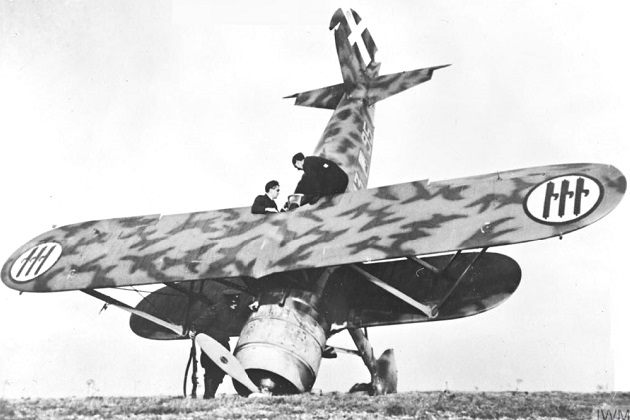


On the hull was the motto of the 95a Squadriglia “Ocio che te copo”, which in Venetian dialect means “Be careful or I will kill you.”
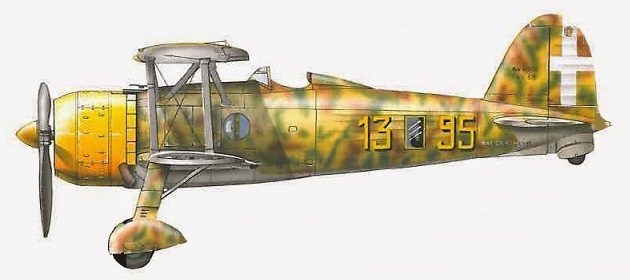
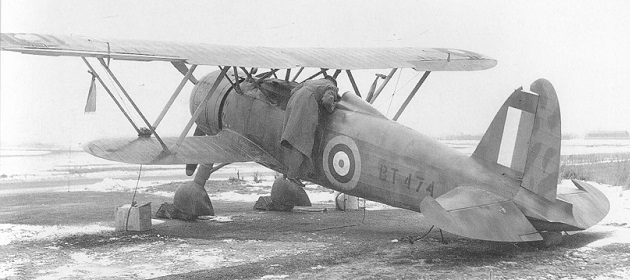
The British were surprised to find that Salvadori’s Fiat had little damage. The plane was dismantled and transported by road to RAF Martlesham Heath airfield. The oil line was repaired, the Italian markings were painted over and the aircraft was given the British serial number BT 474. A number of test flights were carried out from Farnborough. At Duxford, tactics were developed based on practice battles to intercept this fighter, especially since the Fiat CR.42 was a standard fighter in the Middle East, against which the RAF would engage many times.
Fiat CR.42 (85-16, s/n MM.6976, 85a Squadriglia) had crashed near Lowestoft, Suffolk at 1430 hours on November 11th. The pilot, Sergente Maggiore Antonio Lazzari, managed to evade three Hurricanes until the variable pitch gear of his propeller jammed, leaving one of the three blades at a different pitch to the rest. Lazzari decided to land. Upon landing he ran over a railway line which caused the aircraft to crash onto a field. Lazzari was not injured and became a POW.


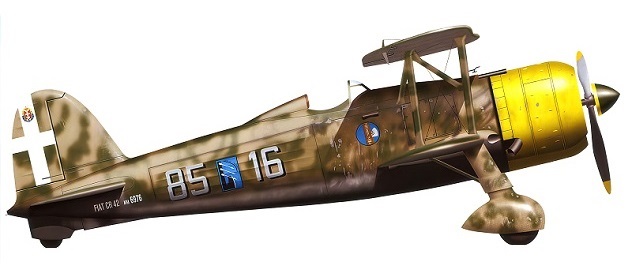
Italian Biplane Ace
Before transferring to the 83a Squadriglia of the CAI, Maresciallo Felice Sozzi already had 5 shared biplane victories. Sozzi scored one shared biplane victory on 2 November 1936 during the Spanish Civil War. In June 1940, Sozzi served with the 365a Squadriglia of 150° Gruppo equipped with Fiat CR.42s. On 15 June 1940, Sozzi and other pilots attacked the airfield at Cuers Pierrefeu (close to the naval base of Toulon) in Southern France with the purpose of destroying and disrupting the French fighter force on the ground. On that day around 1300 hours, Sozzi scored 4 shared biplane victories against Morane-Saulnier M.S.406 fighters.
On November 23rd, an offensive fighter sweep was flown by 29 Fiat CR.42s of the 18° Gruppo. The flight path was Dunkirk – Margate – Eastchurch – Folkestone – Calais while 24 G.50s of the 20° Gruppo covered them. At 1140 hours, 12 Spitfires Mk. IIs (P7550, P7597, P7311, P7496, P7529, P7388, P7289, P7543, P7389, P7449, P7528, and P7324) from RAF 603rd Squadron were scrambled from Hornchurch and headed south. Near Folkestone, 603rd Squadron spotted the Italian CR.42s flying west and the Spitfires hit them from astern. The CR.42s were badly bounced and two were shot down by Archibald Winskill with several others damaged, in return for one Spitfire damaged (although the Italian pilots claimed the destruction of at least five British fighters). During the engagement, Sozzi attacked and chased off a Spitfire on the tail of Sergente Maggiore Luigi Gorrini’s aircraft, who in turn was attacking other Spitfires. Sozzi was however hit by fire from two other Spitfires, who attacked him from behind. He was seriously wounded with three bullets in his lungs, but he succeeded despite pain and a damaged aircraft, to return and made an emergency landing on a Belgian beach. He survived his ordeal and recovered to receive the Medaglia d’argento al valor militare “in the field”.
Maresciallo Felice Sozzi’s Fiat CR.42 (83 – 15) on the Belgian beach on November 23rd. It appears that the left landing wheel was damaged upon landing.
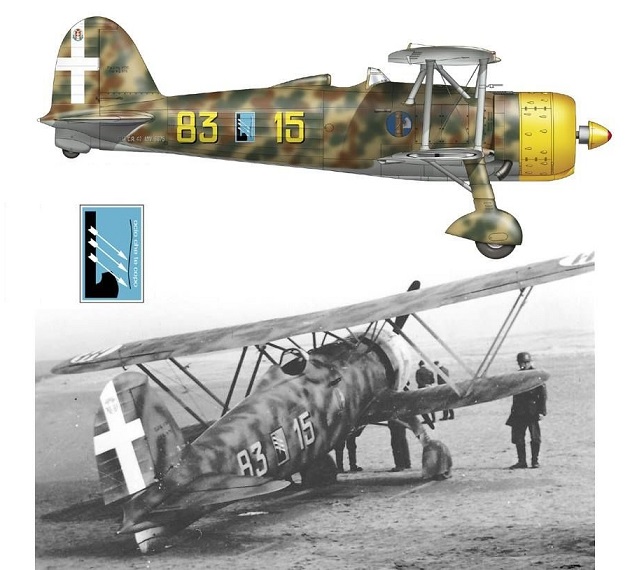
Redeployment
Further bombing raids were carried out by the CAI, mainly on the Harwich and Ipswich areas. By the end of December 1940, shortly before its redeployment, the CAI had flown 97 bomber sorties, for the loss of three aircraft. The Italian planes had dropped 44.87 tonnes of bombs in 77 night sorties, most of them over Harwich. Between October 1940 and January 1941 the CAI fighters flew 454 offensive and 480 defensive sorties (including 113 bomber escort).
In early January 1941, all of the bombers and biplanes were redeployed. Only Fiat G.50s of 352a and 353a Squadriglia, remained in Belgium until 15 April 1941. From January to April 1941, the two remaining Squadriglias flew a further 662 defensive sorties as convoy escort from Dunkirk.
The Squadriglias of the CAI were re-assigned to other units and later flew against the inland of Malta and in the Libyan desert.
RAF on November 11
When the Italian bombers approached the English coast at 12000 feet (3657.6 m) escorted by 40 Fiat CR.42s, they were detected by the Chain Home Radar station at Essex and Hurricanes from 17 and 257 Squadrons were scrambled shortly after 1330 hours while Hurricanes from 46 Squadron, already airborne patrolling a convoy off Foulness Island, were also vectored to intercept the Bandits over the Thames Estuary by Fighter Control. The latter formation was slightly delayed while they investigated a formation which proved to be friendly and were forced to made a wide circle before attacking. Some Spitfires from 249 Squadron were also on a convoy patrol patrolling the same convoy off Foulness. The following air battle went down in British history known as “The Spaghetti Party”.
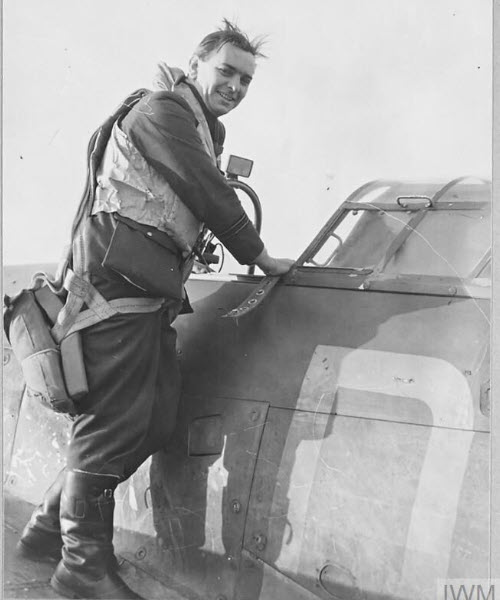
Flight Lieutenant Howard Peter “Cowboy” Blatchford (in Hurricane V6962), leading 257 Squadron, sighted 9 Italian bombers flying in a tight “vic” formation some 10 miles (16 km) east of Harwich. Blatchford got into range and first attacked the rear Fiat BR.20M on the starboard side. Seeing no effect from his fire, he passed across to the port side, where he made two rear-quarter attacks on the left rear bomber. This aircraft looped violently and dived vertically towards the sea, disintegrating before hitting the water. His second bomber was also probably attacked by Pilot Officer Pniak (in Hurricane V7292) of 257 Squadron, who attacked a bomber which began to smoke and burn and then flipped over onto its back before it crashed into the sea 10 miles east of Harwich after one crewman had baled out. Blatchford then attacked another bomber which glided towards the coast, trailing smoke.
Blatchford tried to return to the bomber formation, but instead spotted a large CR.42 formation. He attacked one, fired a few short bursts, the biplane jerked violently and lost altitude. Meanwhile, he was attacked and engaged another. It became a wild melee where in terms of maneuverability the Fiat CR.42 was equal to the Hurricane. After he had exhausted all his ammunition, he tried to ram the CR.42, hitting the upper wing with his propeller and the stricken Italian fighter immediately lost altitude. At 1415 hours, he landed at RAF Martlesham Heath. After landing, he noticed that about 8 inches (203.2 mm) of two propeller blades had been torn off, and the remaining sections were splattered with blood.
Howard “Cowboy” Blatchford of 257 Squadron on his Hawker Hurricane.

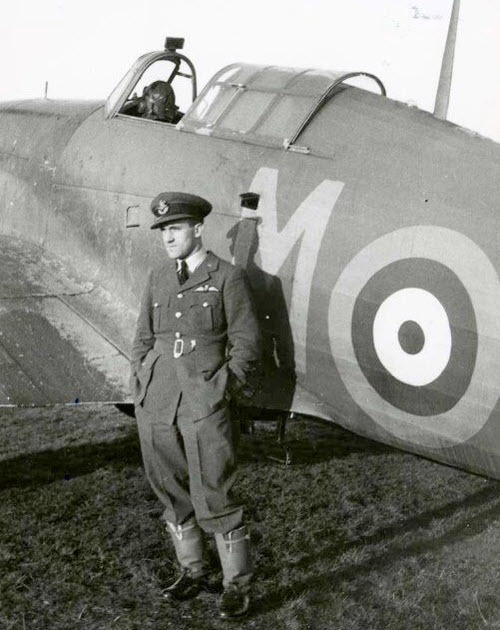
Pilot Officer Karel “Charlie” Mrázek of 46 Squadron fell behind in Hurricane Mk I coded M – PO due to partial engine failure. Sighting a number of bogeys identified as Italian bombers, the 29-year-old Czech destroyed two of the Fiat CR.42 fighter escorts. The first biplane crashed into the sea 4 miles (6.43 km) and the second 3 miles (4.83 km) from Ofordness lighthouse. After the engagement, he landed at RAF Rochester, with empty fuel tanks and 10 machine gun holes in his fuselage and wings.
Mrazek standing next to his Hurricane Mk I coded M – PO.
RAF airmen inspects the wreckage of a Fiat BR.20M bomber which crash landed at Bromeswell, near Woodbridge in Suffolk.


British soldiers open a basket found on board the shot down BR.20M bomber. The serial number is MM.22621 with code 243 – 2.

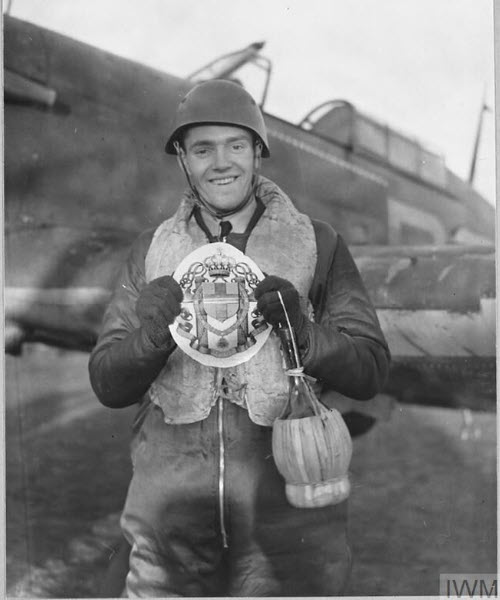
Squadron Leader Robert Stanford Tuck (standing in center) poses with pilots of 257 Squadron under the nose of Tuck’s Hurricane, coded DT – A, at Martlesham Heath, Suffolk, on November 11. They are displaying helmets and other equipment salvaged from Italian aircraft shot down that day.

A pilot of 257 Squadron poses with trophies taken from a shot down Italian aircraft. Behind him is Stanford Tuck’s Hurricane.
RAF claims on November 11
| Squadron | Pilot | 11 November 1940 Claims |
|---|---|---|
| 257 | Flight Lieutenant Blatchford | 1 BR.20 destroyed, 1/4 BR.20 shared destroyed and 2 CR.42s damaged |
| 257 | Pilot Officer North | 2 ½ shared BR.20s destroyed |
| 257 | Pilot Officer Davey | ½ BR.20 destroyed |
| 257 | Pilot Officer Mortimer | ½ BR.20 destroyed |
| 257 | Pilot Officer Pniak | 1 BR.20 destroyed and ½ BR.20 shared destroyed |
| 257 | Pilot Officer Andrews | ½ BR.20 destroyed |
| 257 | Pilot Officer Kay | 2 ½ shared BR.20s destroyed |
| 257 | Sergeant Lucas | 1 BR.20 damaged and 1 CR.42 destroyed |
| 257 | Sergeant Barnes | 1 CR.42 probably destroyed |
| 46 | Flight Lieutenant Gaunce | ½ BR.20 destroyed, 1 CR.42 destroyed and 1 CR.42 probably destroyed |
| 46 | Pilot Officer Leggett | 1/3 BR.20 destroyed |
| 46 | Pilot Officer Mrázek | 2 CR.42 destroyed |
| 46 | Sergeant Parrott | 1 BR.20 destroyed |
| 46 | Pilot Officer Hedley | 1/3 BR.20 destroyed |
| 46 | Sergeant Walker | 1/3 BR.20 destroyed |
| 46 | Flight Lieutenant Burnett | 1 CR.42 probably destroyed |
| 249 | Wing Commander Beamish | 1 CR.42 probably destroyed |
| 41 | Flying Officer Wells | 1 CR.42 damaged |
RAF November 11 Totals
9 BR.20s destroyed
1 BR.20 damaged
5 CR.42s destroyed
4 CR.42s probably destroyed
3 CR.42s damaged
Today
In 1943, the British considered Salvadori’s captured Fiat CR.42 as obsolete and cataloged it as “potential museum material”. After being in stowage for decades, it was restored and in 1979 was transported to the new Battle of Britain Museum, which opened in 1980, forty years after the air battle. Today, Salvadori’s Fiat CR.42, which never returned to Ursel, is on display with its original markings.
RAF Museum: Grahame Park Way, London, NW9 5LL

Video: RAF MUSEUM LONDON / Fiat CR-42 Falco
The Orfordness lighthouse was decommissioned on 27 June 2013 because of the encroaching sea. The electrical equipment and hazardous materials (mercury) was removed. The tower was expected to survive for seven to eight years before falling into the North Sea. In September 2019 however, high tides and harsh weather damaged the lighthouse’s ancillary bungalow, originally an outbuilding of the lighthouse keeper’s cottages, causing it partly to collapse, requiring it to be demolished, and it brought the shoreline only a few feet from the lighthouse itself. In July 2020, work began to dismantle the lighthouse.
Models and Decals
1/32
Revell 00018 Hawker Hurricane Mk.I Revell Classics – 2009
Pacific Coast Models 32012 British Royal Air Force Hawker Hurricane Mk.I – 2011
Silver Wings 32-011 Fiat CR.42 Falco Pre-WW II – 2012
Special Hobby SH32061 Fiat G.50-II Freccia “Regia Aeronautica” – 2015
ICM 32020 Fiat CR.42 Falco WWII Italian Fighter – 2020
1/48
Hasegawa 51639 Fiat G.50 Italian Air Force Regia Aeronautica – 1994
Classic Airframes 474 Fiat CR.42 – 2004
Ark Models 48026 Hawker Hurricane Mk.I Royal Air Force fighter – 2009
Special Hobby SH48105 Fiat BR.20M Cicogna “CAI in Battle of Britain” – 2012
Italeri 2801 FIAT CR.42 Falco – 2020
1/72
AML 72031F Fiat G.50 bis “Freccia” – 2019
Italeri 1437 Fiat CR.42 Falco – 2020
Italeri 1447 Fiat BR.20 Cicogna Battle of Britain 80th Anniversary – 2020
DP Casper 72024 Cinzano Italians over England October 1940 Decalset

 Mike's Research