The Jeep, formally called the US Army truck, 1⁄4‑ton, 4×4, command reconnaissance, was a highly successful American off-road capable, light military utility vehicle. Built by Willys-Overland, American Bantam and Ford to a single standardized design, they were supplied to the US military and Allied forces during WWII, from 1940 until 1945. It was the world’s first mass-produced four-wheel-drive vehicle and it had a reputation of toughness, durability, and versatility.
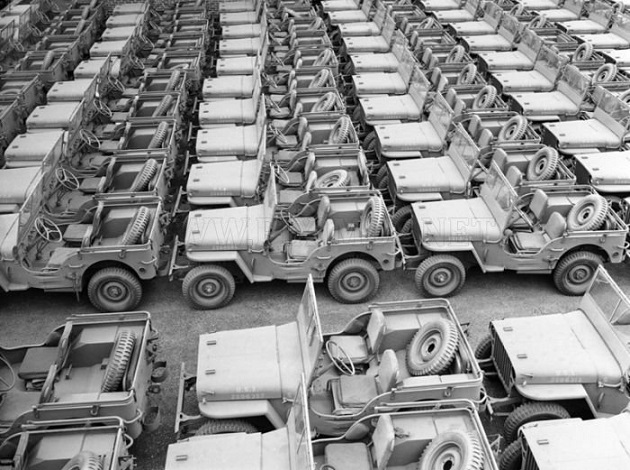
Jeep Production
| Model | Year | Number Built |
|---|---|---|
| American Bantam Pilot | 1940 | 1 |
| American Bantam Mk II / BRC-60 | 1940 | 70 |
| Ford Pygmy | 1940 | 1 |
| Ford Budd | 1940 | 1 |
| Willys-Overland Quad | 1940 | 2 |
| American Bantam BRC-40 | 1941 | 2,605 |
| Ford GP | 1941 | 4,456 |
| Willys-Overland MA | 1941 | 1,553 |
| Willys-Overland MB | 1941–1945 | 361,339 |
| Ford GPW | 1942–1945 | 277,896 |
| World War II Total | 1940-1945 | 647,925 |
Origins of the Name
The word “Jeep” was used well before WWII. US career soldiers used it since World War I as casual Army slang for new, uninitiated recruits or other personnel who still had to prove their mettle. It was also used by Army motor pool mechanics for any new, unproven vehicle or prototype.
Another likely possibility was that the vehicle made quite an impression on soldiers at the time, so much so that they informally named it after “Eugene the Jeep”, a character in the Popeye comic strip created by Elzie Crisler Segar in 1936. “Eugene the Jeep” was Popeye’s “jungle pet” and was small, able to move between dimensions and could solve impossible problems.
Film: Popeye The Sailor # 91 Popeye Presents Eugene the Jeep (1940)
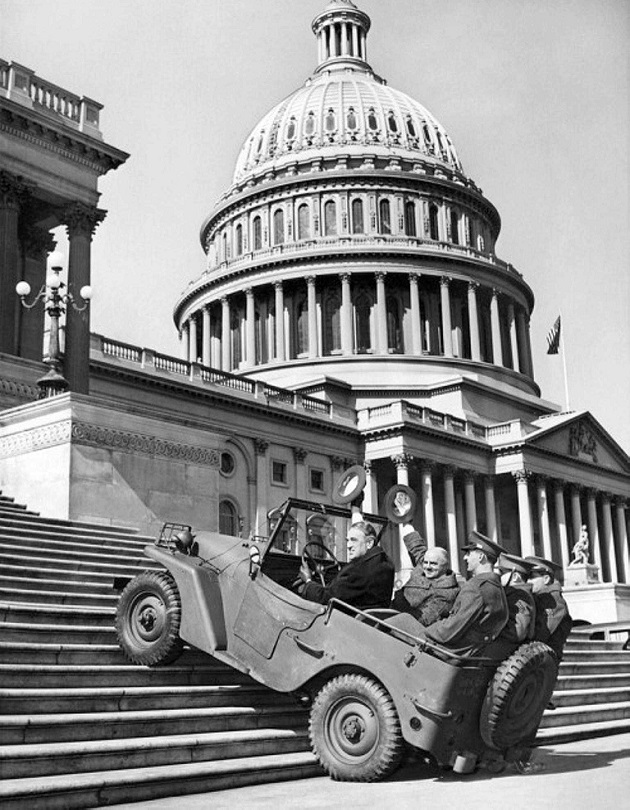
In early 1941, Willys-Overland staged a press event in Washington, D.C., having the Willys Quad prototype demonstrate its prowess by driving up a building’s steps. Irving “Red” Hausmann, a test driver on the Willys development team who had accompanied the car for its testing at the US Army Holabird Quartermaster Depot (Camp Holabird) in Maryland, had heard the soldiers there refer to it as a “Jeep”. He was ordered to go to the press event and give a demonstration ride to a group of dignitaries, including Katherine Hillyer, a reporter for the Washington Daily News (an afternoon tabloid-size newspaper).
US Senators William Meade (New York) and Elbert Duncan Thomas (Utah) riding in the Willys Quad as it climbed the steps in front of the US Congress building in Washington, D.C.
A front view of the Willys Quad on the steps.
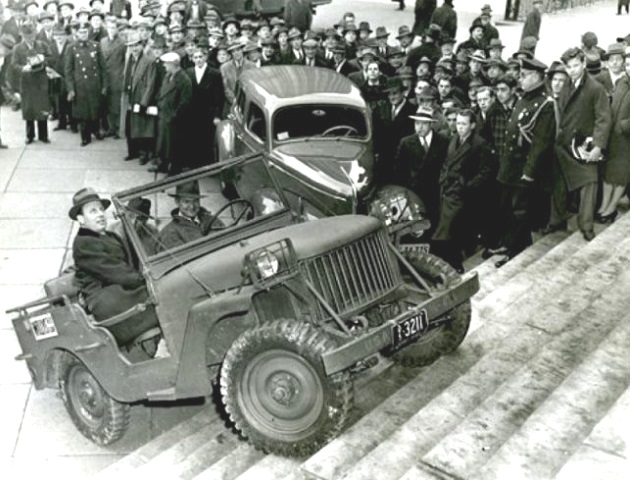
During the demonstration a bystander asked Hausmann, “What is that thing?” Hausmann replied, “It’s a Jeep.” Hillyer was nearby and overheard Hausmann’s reply. Hillyer’s article appeared in the Washington Daily News on 20 February 1941, with a photo showing the Willys Quad driving up the Capitol building steps and the caption included the name “Jeep”. This is the most likely cause of the name being fixed in the public’s eye. Although Hausmann did not create or invent the name “Jeep”, he probably the one most responsible for its first news exposure. Hillyer’s article had spread across the country and a number of copycat public relations events occurred in other cities. On 15 April 1942, three Jeeps climbed the steps of the State Capitol building in Albany, New York.
Training for War
When the coastal artillerymen at Fort Sheridan, Illinois, encounter an impassable ravine with a Jeep, they anchor a cable to trees on both sides of the ravine and ride across with ease, March 1942.
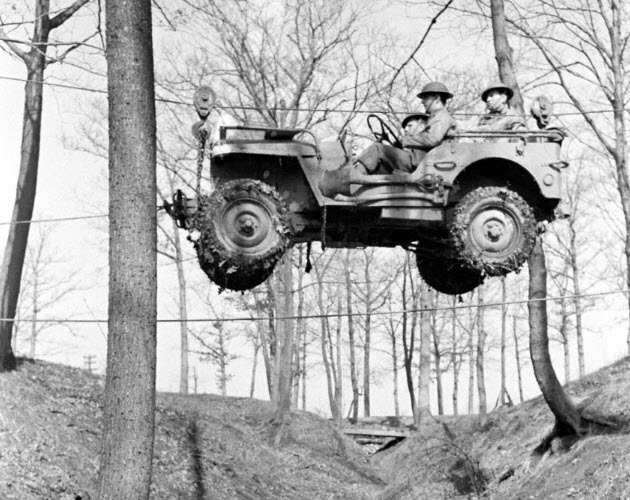
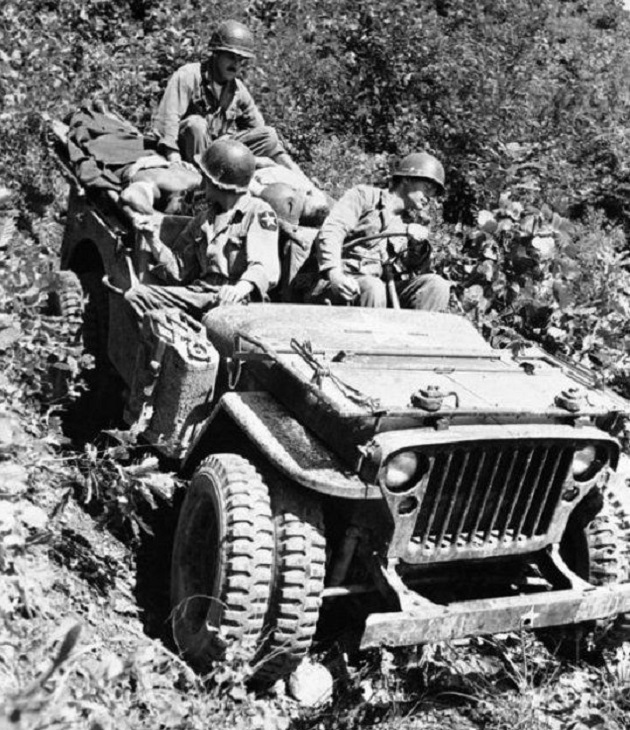
A Jeep with dual tires (front and rear) on maneuvers. The front bumper barely displays the code “2-23-I” but the soldier’s shoulder patch of a white star on a black shield belongs to the US 2nd Infantry Division.
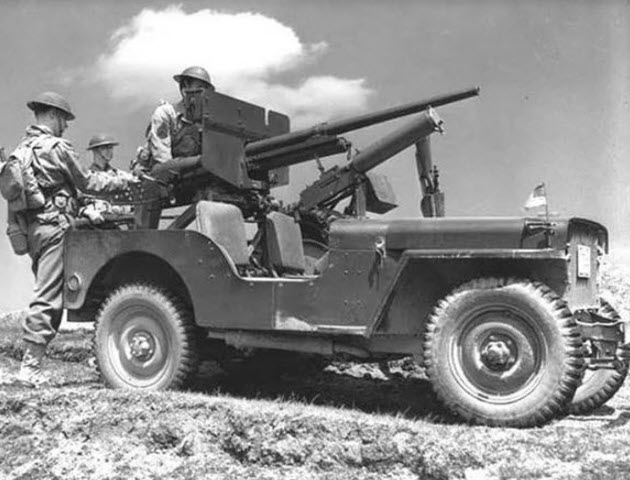
Soldiers of the US 3rd Infantry on maneuvers in 1942 on Newfoundland, a northeastern island in Canada. The Willys/Ford Jeep has a M3 37mm (1.46 inch) anti-tank gun on a pedestal mount and beside it is a Browning 1917A1 .30 Cal water-cooled machine gun. Note the small flag on the front.
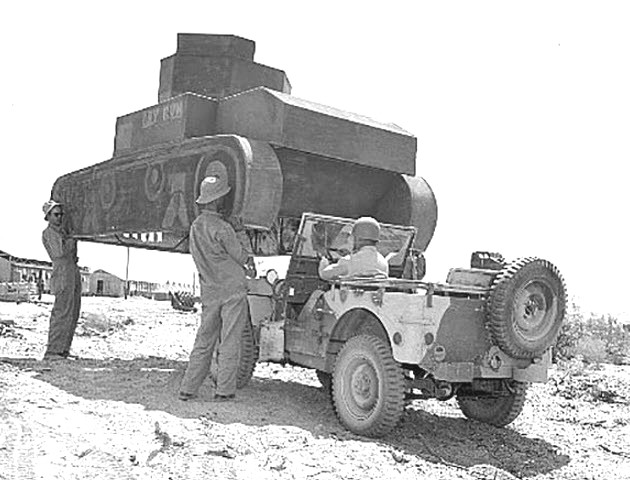
A desert camouflaged Jeep about to become a dummy tank. The structure represents an early production M3 Stuart light tank with a hexagonal turret and octagonal cupola. The buildings in the background suggests it probably is at the Desert Training Center.
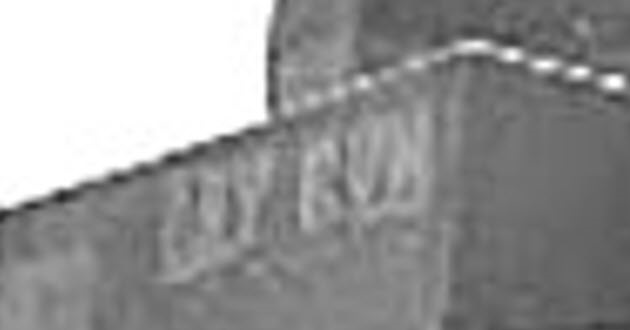
This is my close up of the above photo. The side of the dummy tank hull has a name painted on it which appears to be “DRY RUN”.
Amphibious Jeep
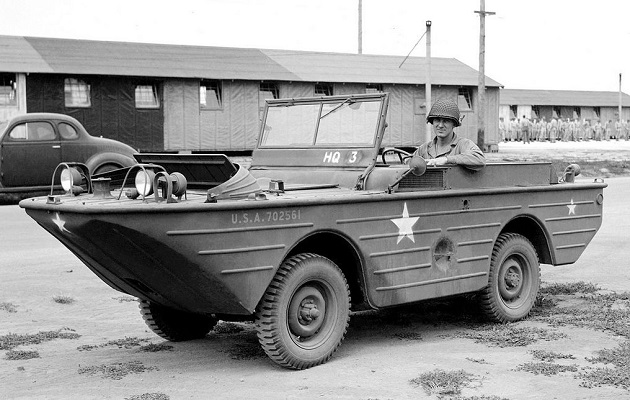
The Ford GPA (Government “P” Amphibious, where “P” stood for its 80-inch wheelbase) was an amphibious version of the Ford GPW jeep. It was called the “Seep”, the contraction of “Sea” and “Jeep”. A total of 12,771 were built during 1942-43.
In contrast to the DUKW, the GPA did not perform well in the field. The production GPA was much heavier than the original specified weight in the design brief, but its volume had not been increased accordingly. As a consequence, a low free board in the water meant that the GPA could not handle more than a light chop or carry much cargo. The GPA’s intended use of ferrying troops and cargo from ships off-shore, drive over a beach and continue inland, was very limited. On land, the GPA was too heavy and its body too unwieldy made it unpopular with the soldiers. GPAs would frequently get stuck in shallow waters, where the regular Willys MB’s water fording abilities allowed it to drive straight through. A small number were used in action in North Africa in 1942. GPAs participated in the Sicily landings in July 1943 and some saw service in the Pacific theater.
Film: “Amphibious Demons” – Ford GPA Amphibious Vehicles
A Ford GPA “Seep” at Blythe US Army Air Field in the southern California desert located 7 miles (11.26 km) west of the town of Blythe. Today, it is Blythe Airport on Interstate Highway 10. The registration number “U.S.A. 702561” is painted in Lustreless Blue Drab. One has to wonder how and why an amphibious vehicle is at an air field in the desert.
The Soviet Union received 3520 GPAs under Lend Lease, and they were sufficiently satisfied with its ability to cross calmer inland waters and other areas, notably in the Pripet marshy area. In the 1950s, they produced their own version, the GAZ-46 MAV.
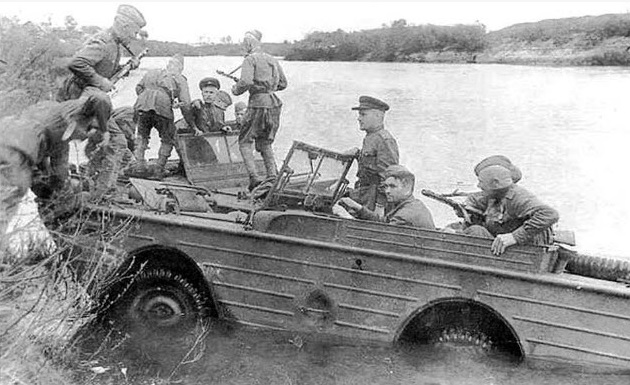
Film: Ford GPA in the Red Army (WW2)
North Africa
Two Jeeps towing M3 37mm anti-tank guns supporting the 26th Infantry Regiment, US 1st Infantry Division, on Beach Y near Les Andalouses in Algeria (north of El Ançor and west of Oran) on the first day of Operation Torch on 8 November 1942. The Jeeps has US flags (48 stars) painted on the windscreen on the presumption that the Vichy French would not fire on them.

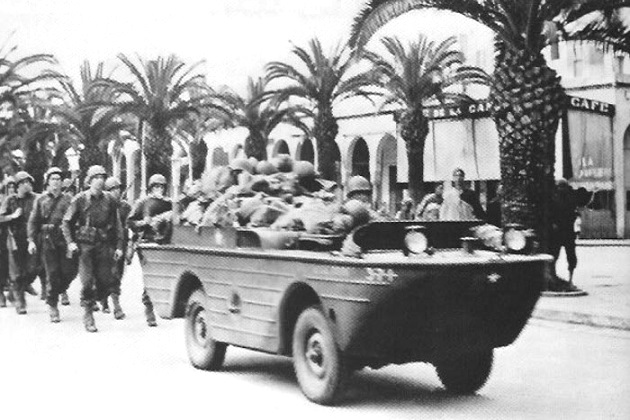
A Ford GPA “Seep” of the 7th Infantry Regiment, US 3rd Infantry Division is leading an infantry column in Casablanca, Morocco, on 11 November 1942. Note all the gear piled in the back.
A US reconnaissance group in Jeeps re-enters Kasserine Pass along the Kasserine-Thala road in February 1943. Rommel pushed his forces up this road during his attack through the pass. Note that the spare tire and Jerry can are not mounted on the rear of the Jeeps in the same positions.
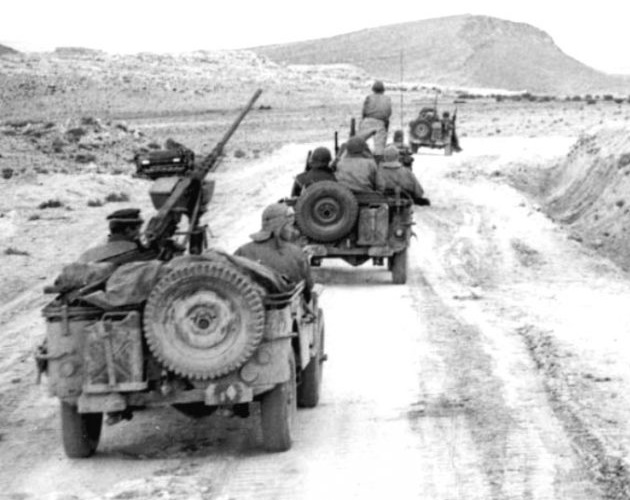
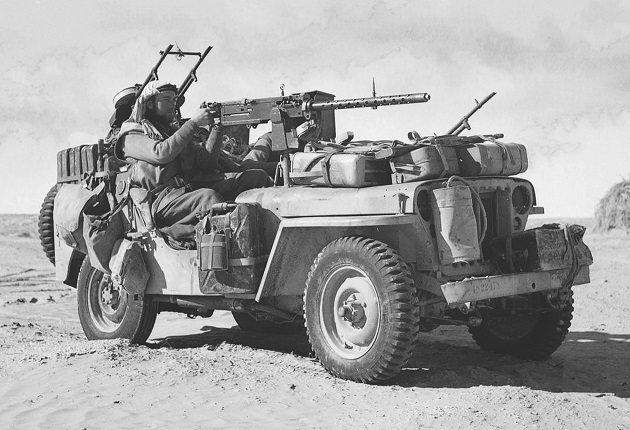
A heavily armed Jeep of British L Detachment Special Air Service (SAS) in Gabes-Tozeur, Tunisia in early 1943. The SAS relied on the “Libyan Desert Taxi Service” to show the way during long-range reconnaissance patrols across North Africa. It is armed with a .50 Cal MG and single and twin Vickers K guns and has a radiator surge tank mounted on the front grill. It carried 20 four-gallon (15.24 Liters) cans of petrol in addition to enough food and water for one month.
Sicily
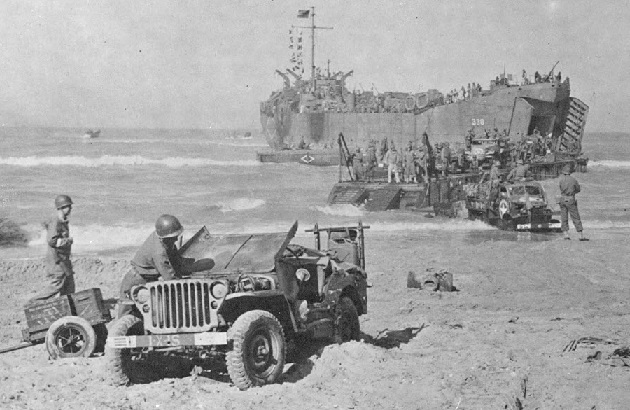
LST-338 unloading vehicles and supplies on the beach at Gela, Sicily, on 10 July 1943. In the foreground on the beach is a stalled Ford GPW Jeep of the 1st Service Battalion of the US 1st Infantry Division.
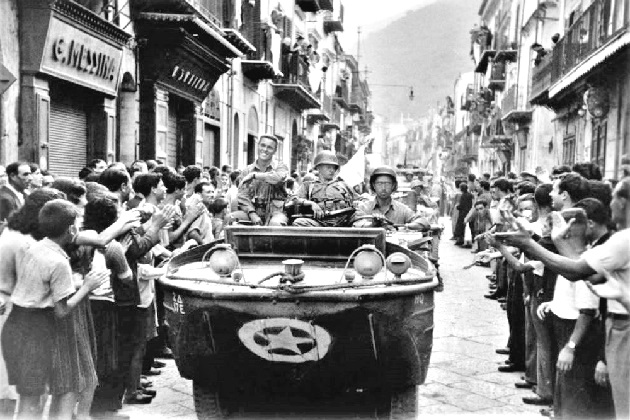
A Ford GPA Seep HQ company vehicle of the 17th Armored Engineer Battalion, US 2nd Armored Division, driving through Monreale (southwest of Palermo), Sicily on 22 July 1943.
An unidentified scene and date, although probably on Sicily, shows a Ford GPA Seep with a knocked out Tiger I (probably of sPzAbt 504) in the background. Note the tracks laid out on the ground beside the Tiger.
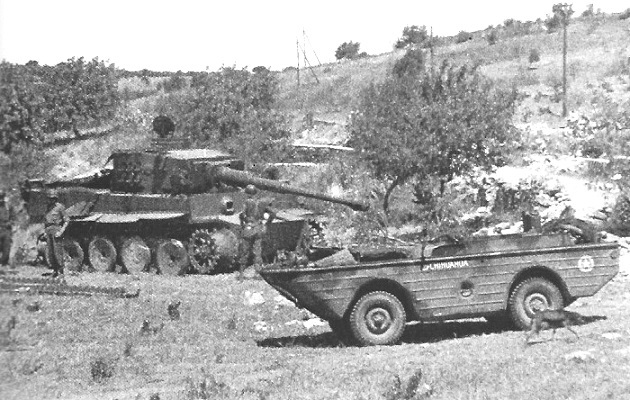
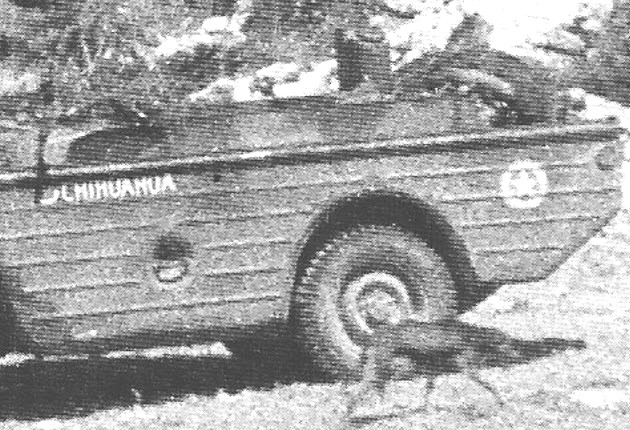
This is my close up of the Seep in the above photo. The name on the hull side of the Seep appears to be “CHIHUAHUA” which is either referring to the Mexican breed of toy dogs (I doubt it) or the state of Chihuahua in northern Mexico on the border adjacent to the US states New Mexico and Texas.
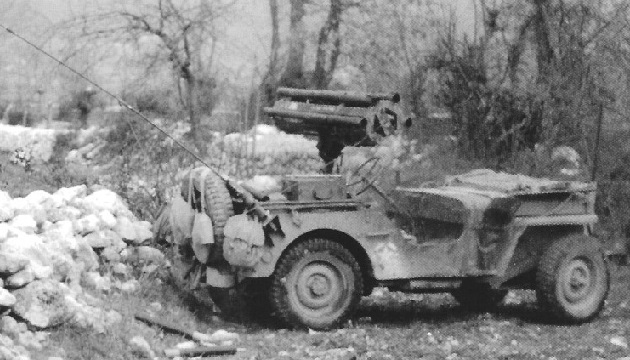
On 30 January 1944 in the Anzio beachhead, this Jeep has been armed with an improvised multiple rocket launchers consisting of four 2.36 inch bazookas mounted on a pedestal. Note the long angled radio antenna.
Film: “Nettunia Quad” Bazookas on Willys Jeep
Russian Jeeps
Through Lend Lease, the Soviet Union received around 50,000 Jeeps during WWII.
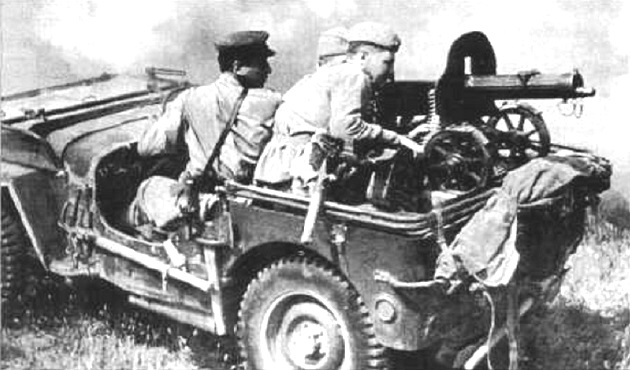
A Russian Jeep carrying a Pulyemyot Maksima 1910/30 (Maxim) water cooled heavy machine gun on a wheeled Vladimirov’s mount. The Maxim weighed 138.1 lbs (62.66 kg).
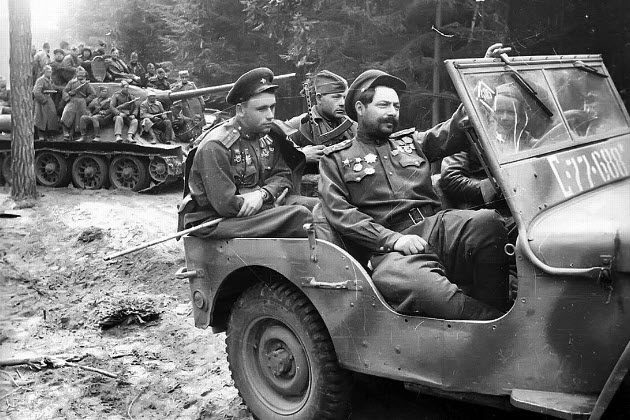
A Russian Lend Lease Jeep carries decorated officers while in the background a T-34/85 tank carries about 20 soldiers (cannon fodder).
This Russian Lend Lease Jeep has a 37mm M.1944 (ChK-M1) Light Paratroop Anti-Tank Gun mounted. The wheels mounted on the front is the travel carriage for the gun. It was light, portable and was nearly recoilless. Out of 472 produced only 104 actually reach the troops.
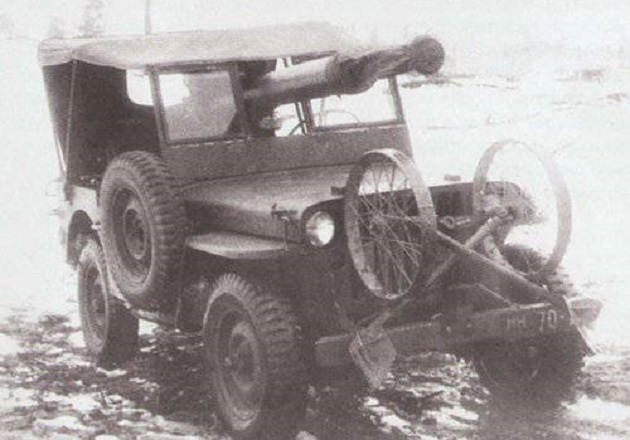
Flight tests were conducted to land the ChK-M1 in an Antonov A-7 glider and parachuting a ChK-M1 from a Lisunov Li-2 transport (a licensed built Soviet version of the Douglas DC-3). A flight test was also carried out using a 1930s Tupolev TB-3 four engine heavy bomber with two Jeeps or GAZ-64s mounting a ChK-M1 cannon suspended under its wings.
France
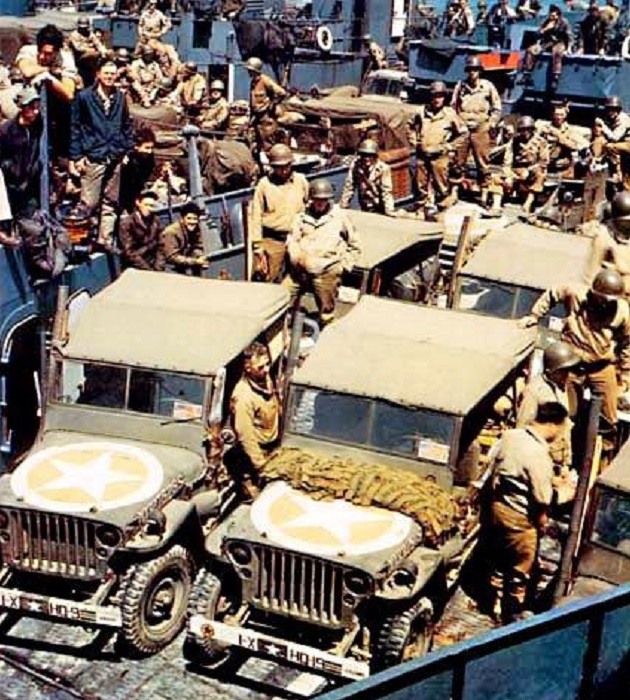
Jeeps of the HQ company of the US 1st Infantry Division loaded in a landing craft prior to the D-Day landings. The yellowish-green color between the white star and circle on the hood (bonnet) is vesicant gas detecting paint. When that painted surface come into contact with a chemical weapon it would turn a pinkish red, warning the occupants of the presence of gas.
Film: What is Vesicant, and how did it saved lives in WWII?
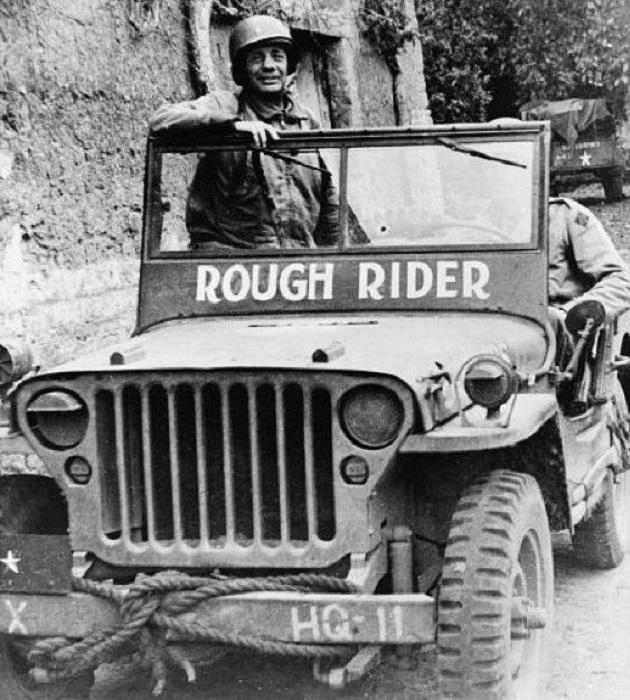
Brigadier General Theodore Roosevelt, Jr. in his Jeep “Rough Rider” near the front lines in Normandy, June 1944. He was the Deputy Division commander of the US 4th Infantry Division which landed on Utah Beach on D-Day. Roosevelt was the only general on D-Day to land by sea with the first wave of troops. At 56, he was the oldest man in the invasion. He named his Jeep after his father’s cavalry unit during the Spanish-American War in 1898. On 12 July 1944, Roosevelt died of a heart attack. Actor Henry Fonda portrayed Roosevelt in the 1962 war film “The Longest Day”.
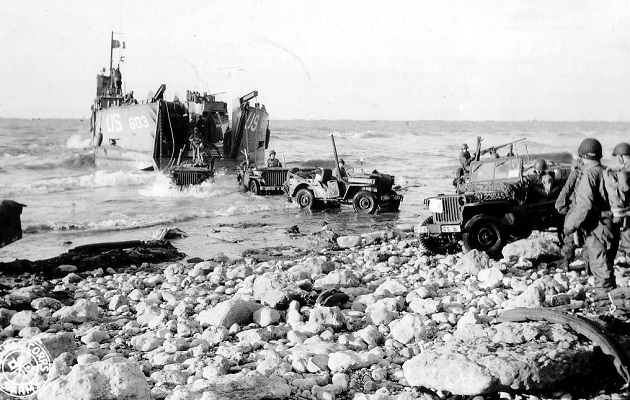
HQ Jeeps of the US 1st Infantry Division disembark from LST-603 in Fox Green sector of Omaha Beach on 12 June 1944.
Film: US Navy LCT-603 disembarks GIs onto OMAHA Beach
This is my close up of the Jeeps in the above photo. The Jeeps are equipped for deep water wading with a snorkel.
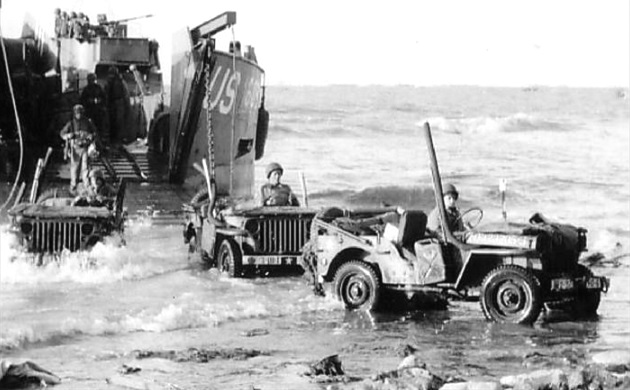
Film: Water proof a Willys Jeep
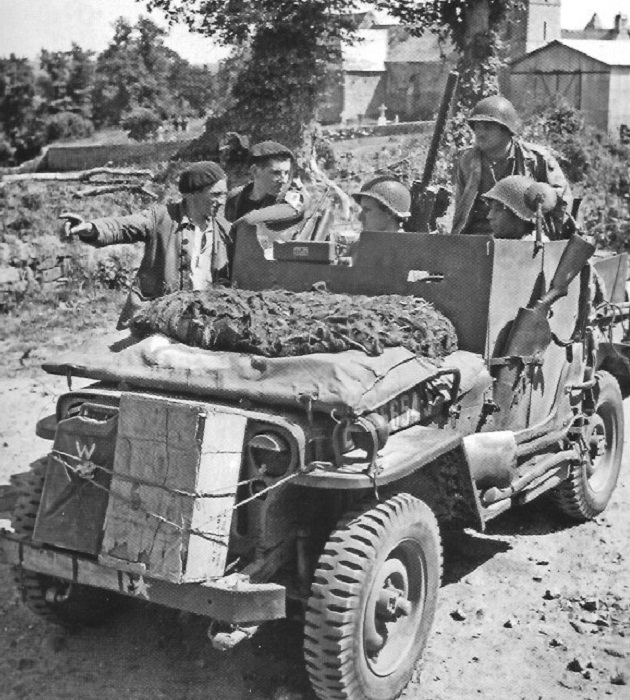
GIs in an armored recon Jeep talk to French civilians while patrolling the outskirts of Cherbourg on 17 July 1944. The armored shields are a field modification. The unit is unknown, the unit codes on the front bumper were painted over.
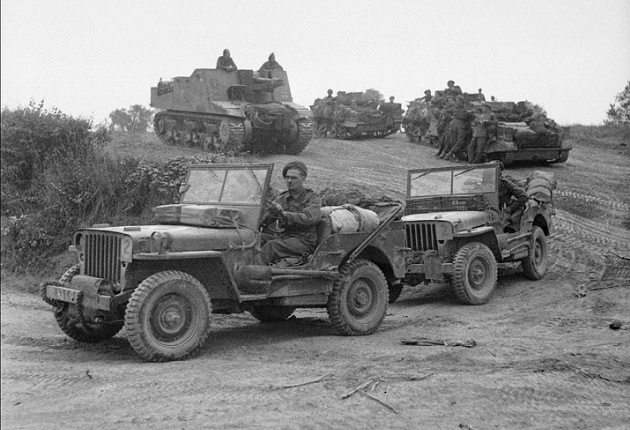
A Canadian built Sexton 25-pdr self-propelled gun, Bren carriers and two Jeeps move forward south of Caen on 1 August 1944. The Sexton probably belonged to the 153rd (Leicestershire Yeomanry) Field Regiment (Royal Artillery), British Guards Armoured Division.
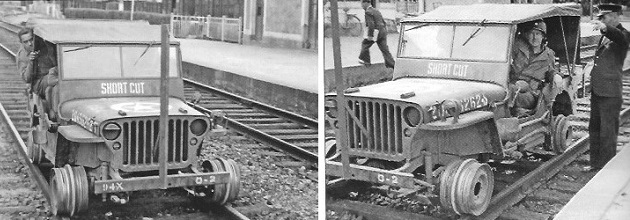
A Jeep named “Short Cut” of the US 94th Infantry Division has been converted to a railroad trolley by changing the tires to steel wheels.
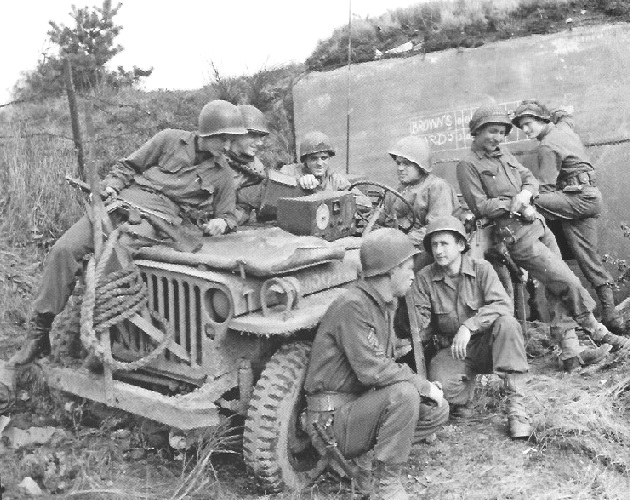
A group of GIs huddled around a Jeep listening to a baseball game on the radio somewhere on the Siegfried Line on 8 October 1944. In the background is a captured bunker.
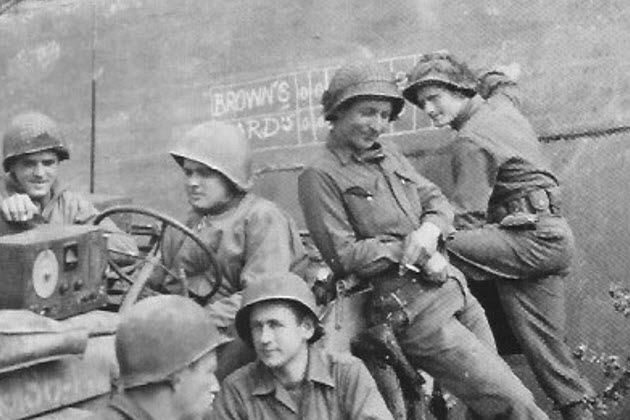
This is my close up of the above photo. The GIs are listening to one of the games of the 1944 World Series in St. Louis, Missouri. The St. Louis Cardinals played against the St. Louis Browns at Sportsman’s Park. The inning scores are chalked on the wall of the bunker. The soldier leaning against the Jeep and smoking appears to be grinning. He probably had money on the Cardinals (the Cards). The Cards won the series four games to two.
Stretched Jeeps
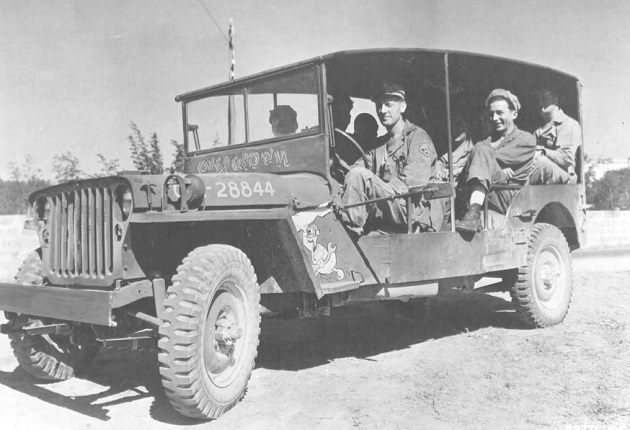
Staff Sergeant Stanley Brown of Richmond, Virginia, an ordnance worker of a B-24 Liberator bomber group of the US 15th Air Force in Italy, dreamed up this oversized Jeep which he built out of two salvaged Jeeps from front line dumps. It seated nine. On the windshield is the name “Overgrown” and on the side is a nose art, a duck with a wrench carrying a bomb over its head.
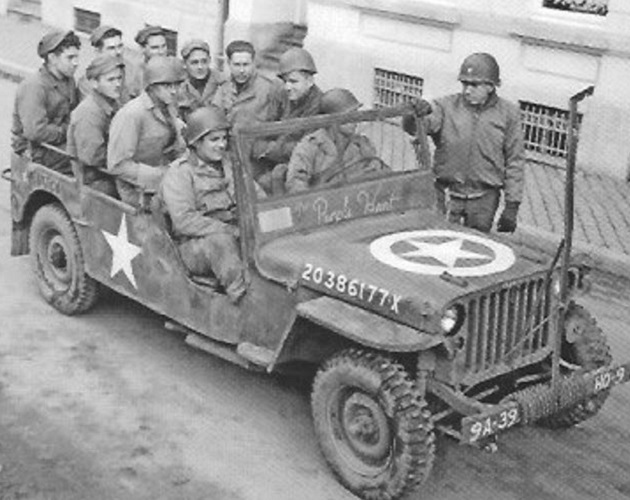
A Jeep named “The Purple Heart” was built from parts of wrecked Jeeps, a French motor car and a German plane. The US 9th Army 39th Signals Construction created it to carry additional troops and equipment to work sites. Mounted on the front bumper is a wire cutter device. An “X” was added to its registration number to note that it was experimental. It is seen here near the Roer River on 16 November 1944.
Rocket Launcher Jeep
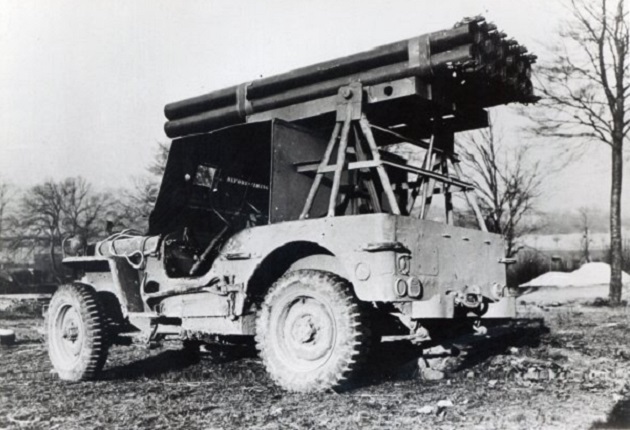
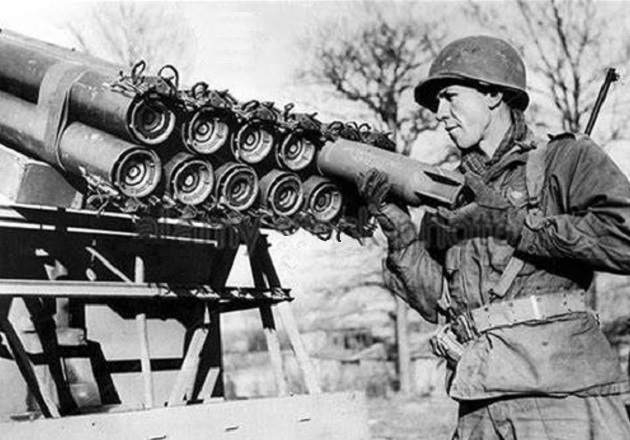
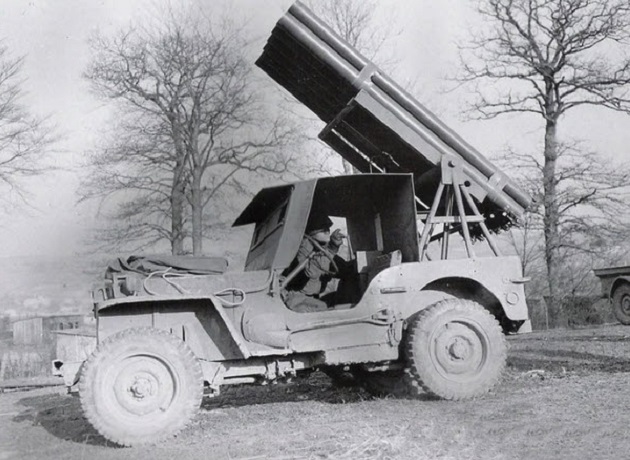
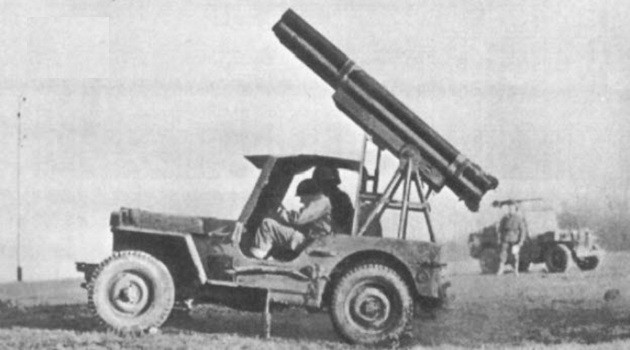
The 156th Field Artillery Battalion (towed 105mm howitzers) of the US 44th Infantry Division built a 4.5 inch (114.3mm) test rocket launcher using M14 launch tubes mounted on a Jeep in Alsace, December 1944. The M14 rocket launcher, 4.5 inch (114.3mm), was 3 steel tubes designed to be mounted on aircraft (P-47 Thunderbolt). The armor plating on the Jeep was to protect the crew from the rockets blast.
Armored Jeeps
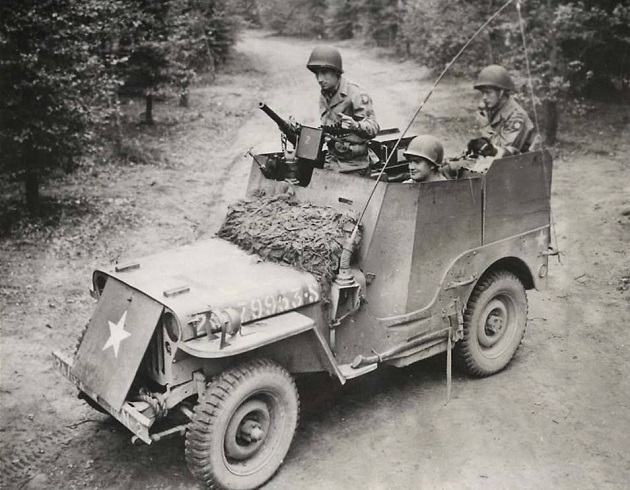
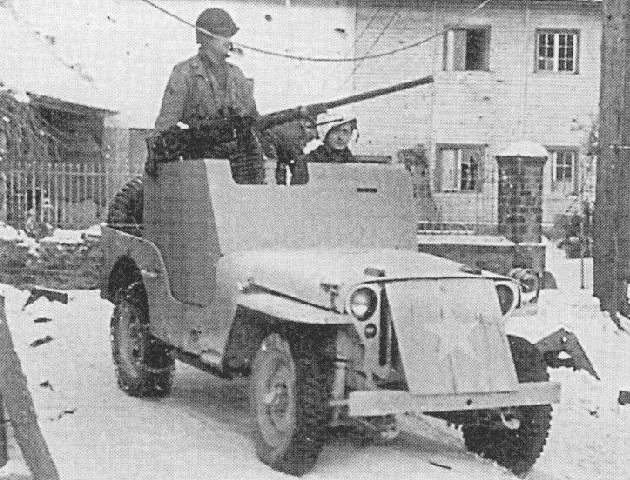
The US 82nd Airborne Division developed its own standardized armor kit and install it on all their recon Jeeps. These Jeeps are seen during the Battle of the Bulge in the Ardennes, December 1944 to January 1945.
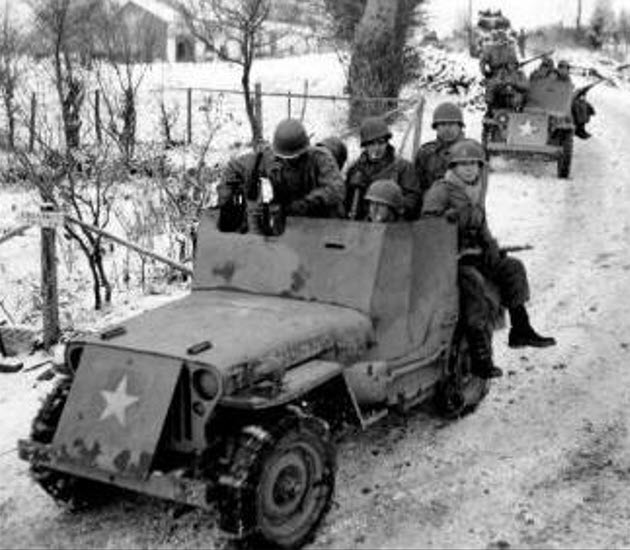
The intelligence and reconnaissance platoon of the 60th Infantry Regiment, US 9th Infantry Division developed their own improvised twin bazooka launcher for their armored scout Jeeps seen here in the Ardennes on 16 January 1945.


Jeeps in Snow
A white washed Jeep of the 13th Tank Battalion, US 1st Armored Division in the Italian mountains on 18 January 1945.
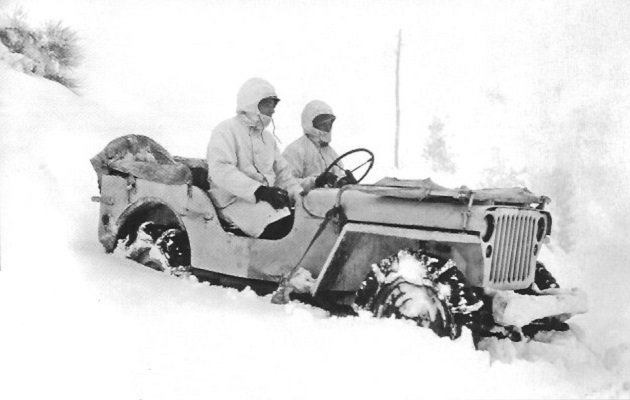
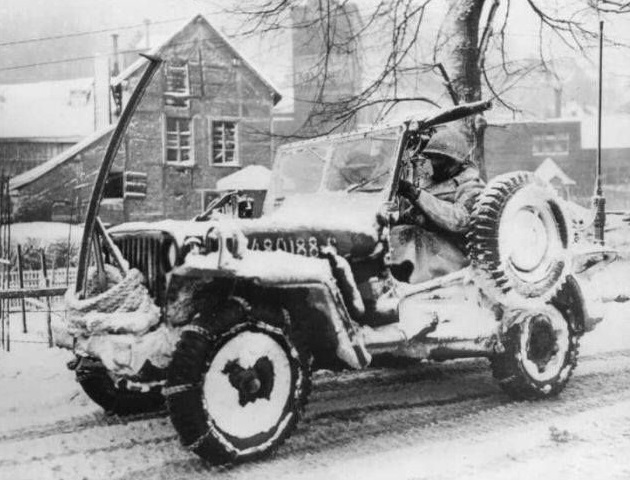
A US 30th Infantry Division Jeep moving to an assembly area near Lierneux, Belgium on 27 January 1945. Note the Browning M1919 .30 Cal machine gun, radio antenna, curved wire cutter bar, and the unusual location of the spare tire.
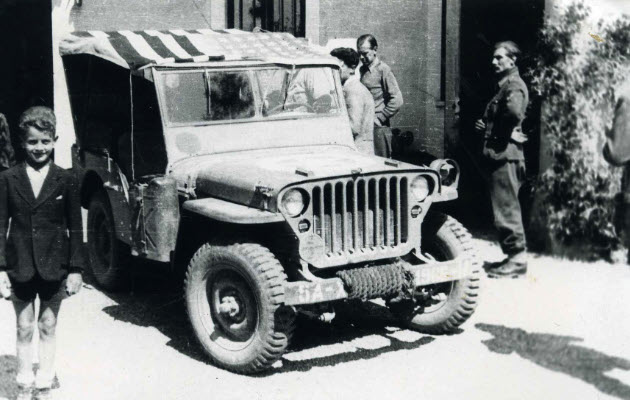
A US 5th Army Jeep somewhere in northern Italy in April 1945. The front right bumper has code “5A – X”. Note the US stars and stripes flag painted on the canvas top as an aerial recognition.
Jeeps at Sea
The US Navy first deployed Jeeps on aircraft carriers in mid 1942. Their first important role on the carriers was to tow planes. They were also referred to as a tractor or a tug. In part, this was due to the Grumman TBF Avengers, which were much heavier than earlier US naval planes. Thus, a tractor was needed to move these planes around the flight and hanger decks. The low range, compact design, and four wheel drive capabilities made Jeeps useful for this purpose.
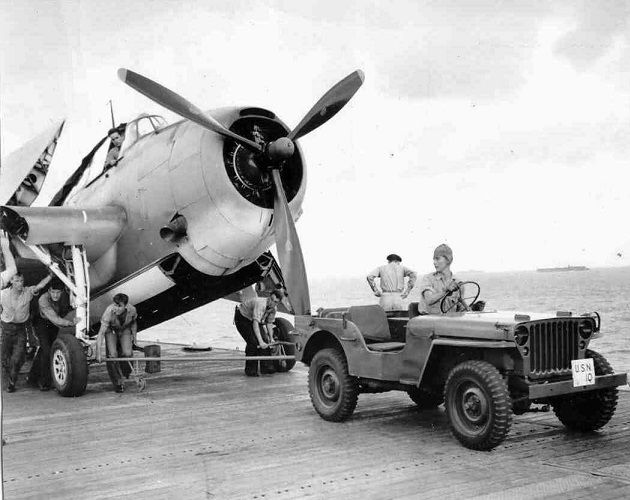
A Jeep on the flight deck of aircraft carrier USS Yorktown (CV-10) towing a TBF-1C Avenger of VT-5 “Torpcats” during air strikes on Wake Island, 5-6 October 1943.
Jeeps and Douglas SBD Dauntless aircraft aboard a US aircraft carrier during the Bougainville campaign on 5 November 1943.
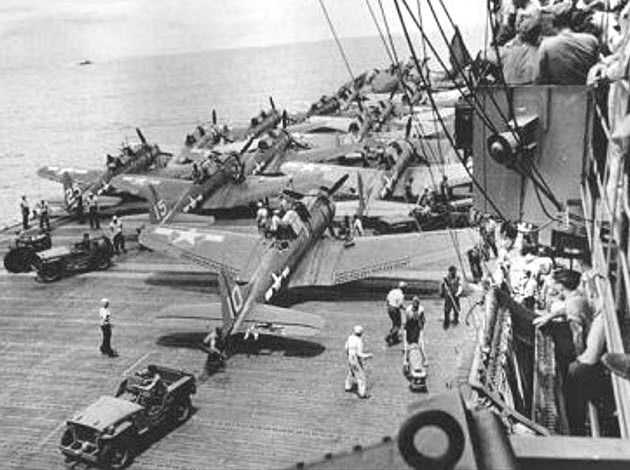
At the beginning of the Bougainville campaign, Task Force 38 launched a carrier raid from USS Saratoga (CV-3) and light carrier USS Princeton (CVL-23) on 5 November 1943 which was a risky air raid to neutralize seven Japanese heavy cruisers which recently arrived at Rabaul to oppose the US landing at Bougainville. The designated launch point was 57 miles (91.73 km) northwest of Cape Torokina (west coast of Bougainville island) at 0900 hours. Air Group 12 (VB-12) launched 22 Douglas SBD-5 Dauntless scout bombers off the Saratoga. They sank no enemy ships but inflicted enough damage which made the Japanese withdraw their heavy cruisers.
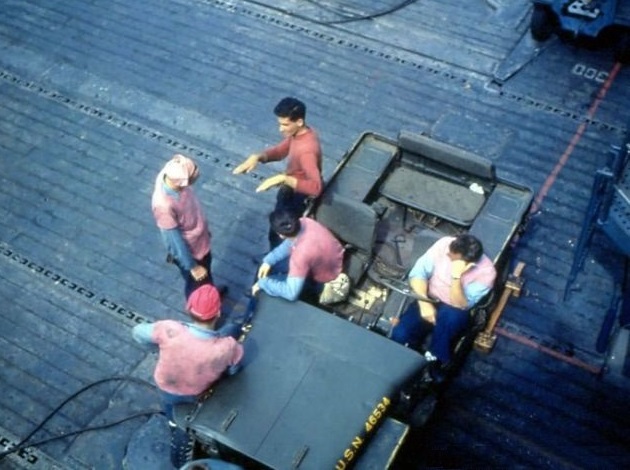
Flight deck crew relaxing around a Jeep on the USS Lexington (CV-16) during the landings on Tarawa in November 1943. The Jeep’s registration number “U.S.N. 46534” is painted in yellow.
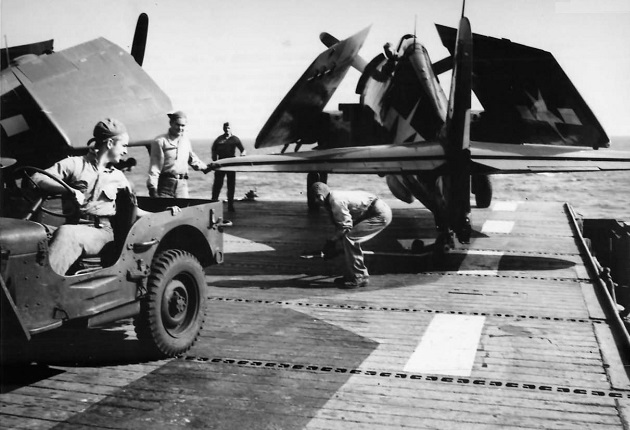
A Jeep towing a Grumman F6F Hellcat on the flight deck of the USS Princeton (CVL-23) in 1944.
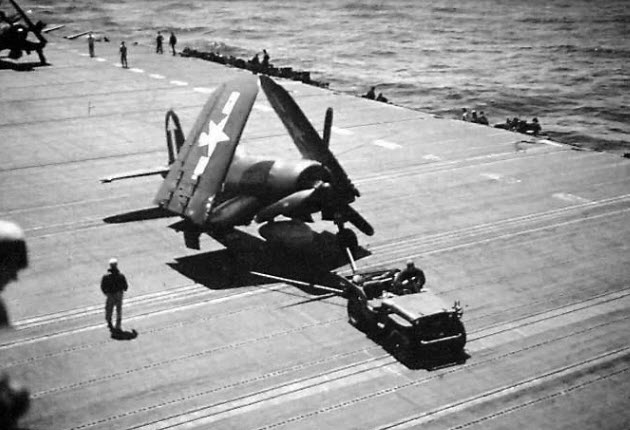
In 1945, USS Bunker Hill (CV-17) had three squadrons of Vought F4U-1D Corsairs: VF-84 “Wolf Gang”, VMF-221 “Fighting Falcons” and VMF-451 “Blue Devils”. Bunker Hill was the flagship of Task Force 58 and fought in the final drive across the central Pacific providing air support for the invasions of Iwo Jima and Okinawa.
Two Jeeps parked in front of F4U-1D Corsairs on USS Bunker Hill in 1945. The placard on the front grill of the Jeeps displays “CV 17” with a number below it.

A Jeep towing a F4U-1D Corsair. In 1945, new geometric shapes were added to all carrier aircraft which identified the carrier. The vertical white arrow marking on the tail fin indicate the carrier is the USS Bunker Hill.
Post War
After WWII ended in 1945, American Bantam and Ford stopped building Jeeps. Willys-Overland continued to supply the US military, as well as many allied nations with military Jeeps. In 1950, the first post war military Jeep, the M38 (or MC), was released, a militarized version of the 1949 civilian CJ‑3A Jeep. In 1953, it was quickly followed by the M38A1 (or MD), featuring an all-new “round-fender” body in order to clear the also new, taller, Willys Hurricane engine.
On the WWII Jeeps, the headlights were inset on a nine slot front grill. On the 1950s M38 and M38A1 Jeeps, the headlights were larger and bulged out on a seven slot front grill.
| Model | Year | Number Built |
|---|---|---|
| Willys M38 (MC) | 1950-1952 | 61,423 |
| Willys M38A1 (MD) | 1952–1957 | 101,488 |
| Total | 1950-1957 | 162,911 |
Korea at Sea
After WWII, many Jeeps were retired from US Navy carriers, but some lingered on (how many is unknown). In 1949, the US Navy received their first jet fighters, 30 Vought F6U-1 Pirates (BuNo 122478-122507). They were sub-marginal in performance, but one item they did require was an auxiliary power unit for starting the engine. Since there was already a few Jeeps on board, someone had the idea to convert a standard WWII jeep into an APU vehicle or a Jet Starter Jeep.
For reasons as yet unknown, the O.E Szekely Company of Philadelphia was awarded the contract to manufacture APU Jeeps for the US Navy. The back end of the Jeep had a tandem wheel setup (like the nose gear of an aircraft) in the middle that steered the vehicle. The front wheels were fixed and only used to power it forward or backward. Instead of the transfer case shifting the vehicle into low range, it engages the generator. Each of the Jeeps had a PTO that powered a generator capable of producing DC and in some cases AC. In addition, two extra gauges were added: a running time gauge and a tachometer.
On 25 June 1950, North Korea attacked South Korean forces at the 38th parallel thus initiating the Korean War. On 3 July 1950, the USS Valley Forge (CV-45) launched the first carrier air strike of the war. On the deck is a Grumman F9F-3 Panther jet of VF-51 “Screaming Eagles” with its wings folded being towed by a tractor. In the center are two white APU Jeeps.
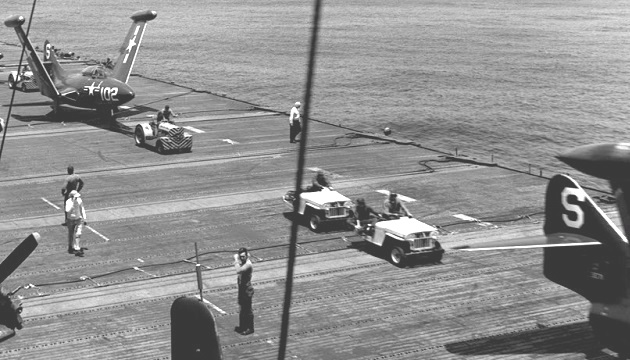
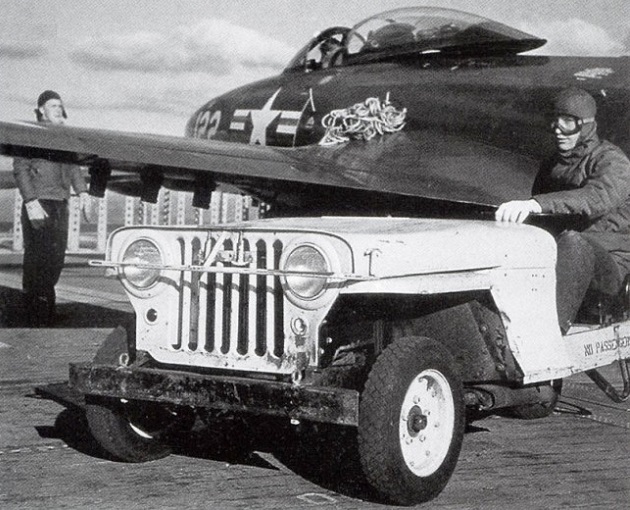
A three wheel CJ-3A APU Jeep with a L-head engine next to a F9F Panther Jet. Note the large bulging headlights and the seven slot grill. Below the driver on the side is painted “NO PASSENGERS” in black.
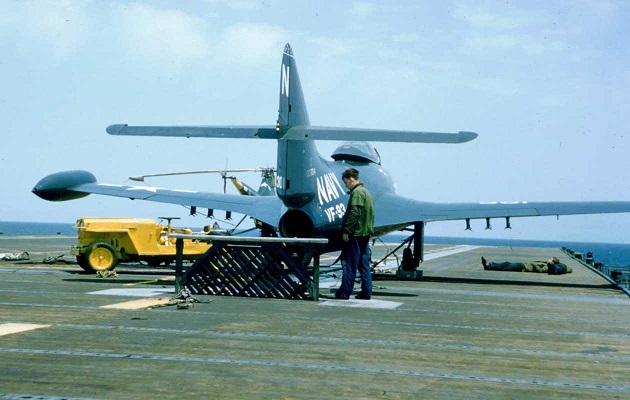
US Navy Fighter Squadron VF-93 was established on 26 March 1952. The squadron’s only Korean War deployment was on the USS Philippine Sea (CVA-47) with CVG-9 (15 December 1952 to 14 August 1953), Tail Code “N”. A yellow CJ-3A APU Jeep is parked next to the F9F Panther Jet positioned on the catapult ready for launch. In the background is a Sikorsky H03S-1 Rescue Helicopter. Note the crewman laying on the flight deck on the right.
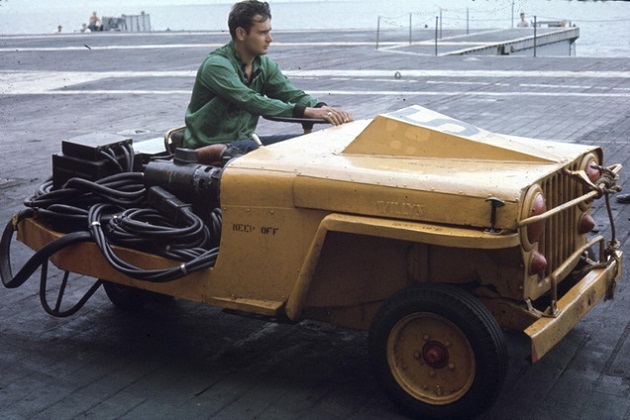
A three wheel CJ-3A APU Jeep with a F-head engine (and hood bump). Stamped on the side of the hood (bonnet) is “WILLYS”. A black “5” is painted on the hood bump and on the side is “KEEP OFF”. Note the steering wheel is mounted level.
Film: APU Navy Jeeps in Korean War 1952
Film: Navy Jeeps, Korea, “The Bridges at Toko-Ri” 1954
Pusan Perimeter
When General MacArthur ordered US ground troops to Korea after the invasion of South Korea by the Communists in June 1950, the 34th Infantry Regiment of the 24th Infantry Division was one of the first units to strike back against the aggressors. The regiment arrived at Pusan (today Busan) on July 2nd, and three days later it was engaged in combat against the North Korean 4th Division. The 34th Regiment assisted Task Force Smith (Lt. Col. Charles B. Smith), consisting of elements of the 24th Division, in their withdrawal from Osan, where the first ground action between US and Communist troops took place. On July 7th, the 34th and other elements of the 24th Division were forced to withdraw from the Pyongtaek and Ansong area. By the 11th, the 34th had fought its way back to the Kum River, 3 miles (4.8 km) north of Kongju, where the 3rd Battalion, which had suffered a large number of casualties, was reorganized as a single company.
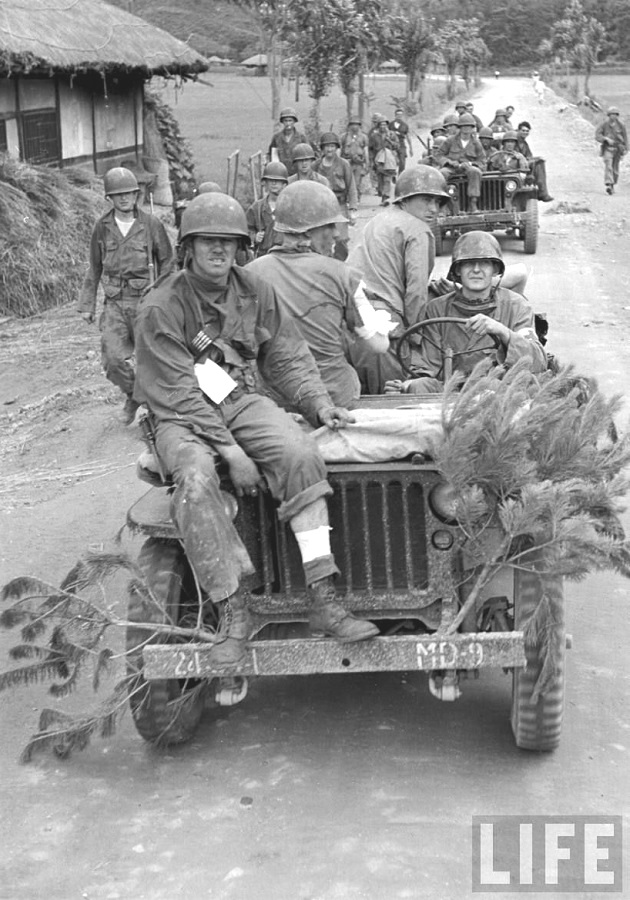
US troops of the 34th Infantry Regiment, 24th Infantry Division in Jeeps move up to the front line in South Korea, July 1950.
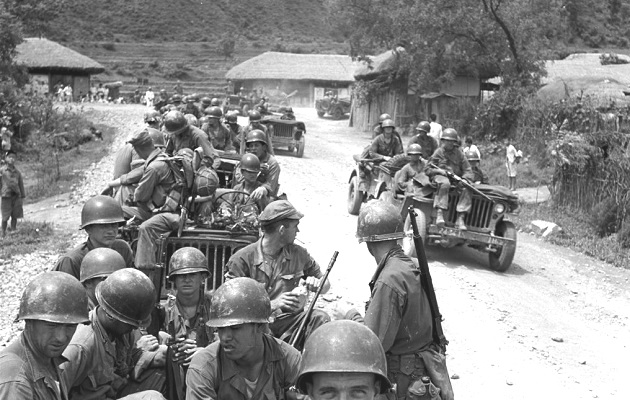
Retreating troops of the 24th Infantry Division in Jeeps retreating south towards Pusan. The Jeep in the foreground is a First Aid Jeep and the driver is wearing a red cross arm band. Note the foliage camouflage.
On 15 September, the US X Corps consisting of the 1st Marine Division and the 7th Infantry Division landed at the port of Inchon (west of Seoul) on 15 September 1950. The US I Corps in the Pusan Perimeter consisted of the US 24th Infantry Division, US 1st Cavalry Division, ROK (South Korean) 1st Division and the British 27th Brigade. The next day, the UN forces in the Pusan Perimeter broke out causing the North Korean forces (8 infantry divisions) in South Korea to retreat north.
A long line of US Army Jeeps are waiting to be ferried across the Kumho-gang River cause a traffic jam on the way to the front on 16 September 1950. The Jeep in the foreground has bumper codes “5-I” and “HQ-34” indicating a HQ Jeep of the 5th Infantry Regiment. The Jeep on the left has bumper codes “1C” which indicates “I Corps”.
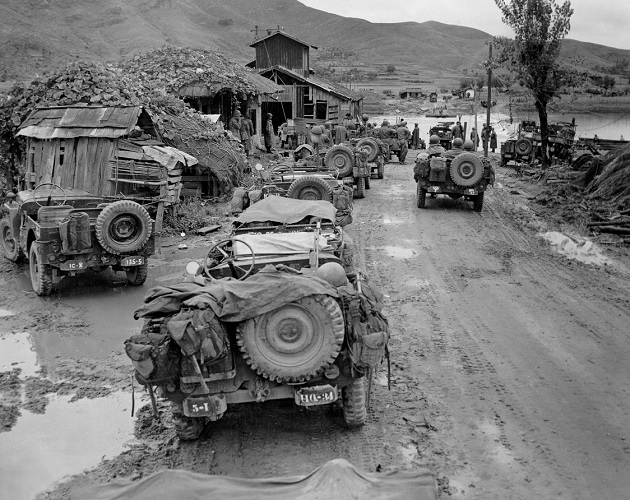
The Kumho-gang River (today Geumho-gang River) starts in the hilly area of western Pohang, flows west for 72 miles (116 km) before meeting with the Nakdong River west of Taegu (today Daegu). In September 1950, the 5th Infantry Regiment was attached to the 24th Division. On September 16th, the 24th Division was north of Taegu which was on the front line at the northwest corner of the Pusan Perimeter.
Korean Winter
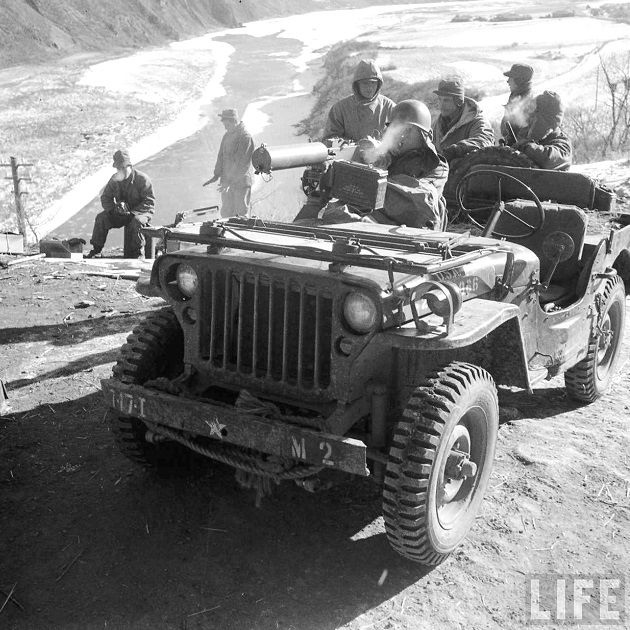
A Jeep of the 17th Infantry Regiment, US 7th Infantry Division along the Yalu River in December 1950. Note the Browning M1917A1 .30 Cal water cooled machine gun. On at least one occasion, US soldiers urinated on the hot gun barrel when the water-cooling had failed in the frigid temperatures of the Korean winter.
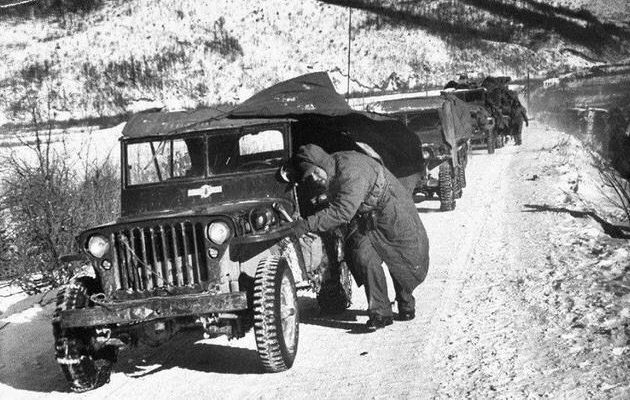
A Jeep of the 5th or 7th Marines, US 1st Marine Division withdrawing from the Chosin Reservoir in December 1950.
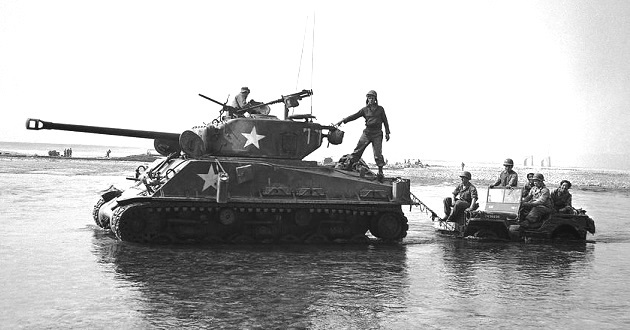
On 24 March 1951 during Operation Ripper, a Jeep of the US 1st Cavalry Division had stalled in the Pukhan River (today Bukhan River) and gets a tow from a M4A3E8 Sherman tank. The Sherman tank probably belonged to the US 70th Tank Battalion and the location is somewhere near Ch’unch’on (today Chuncheon).
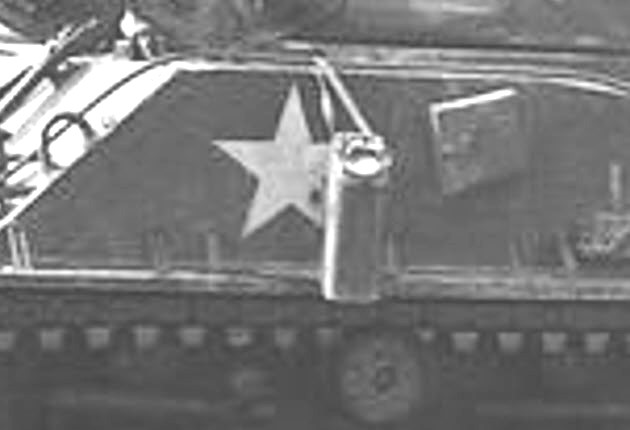
This is my close up the the Sherman in the above photo. It appears the tie down rope of the Jerry can had loosen and the can had pivoted outward on the side fender which is barely hanging on.
UN Allies
On 4 February 1951, the Netherland Battalion was deployed at Huchon, north of Hoengsong to cover ROK forces attacking Hongchon. When the battalion was covering the retreat of ROK forces and an US fire support unit which were being attacked by the Chinese, it lost its commander and fell back in confusion. During this battle, the battalion suffered 17 KIAs and 37 WIAs.
A Jeep of the Netherlands Battalion passes part of a convoy of vehicles burned by retreating ROK troops to prevent their capture by the enemy.
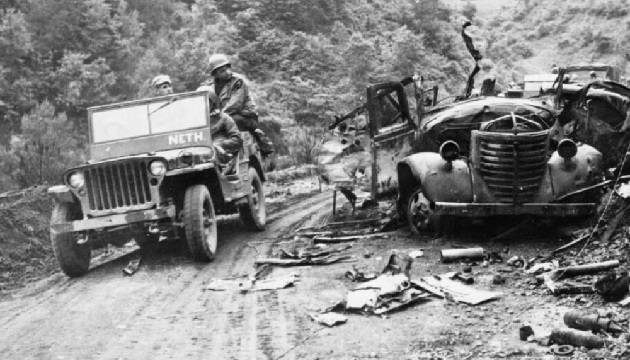
This is my close up of IWM MH 31638.
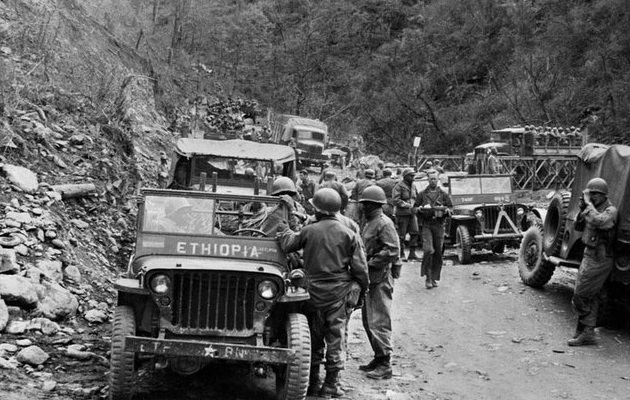
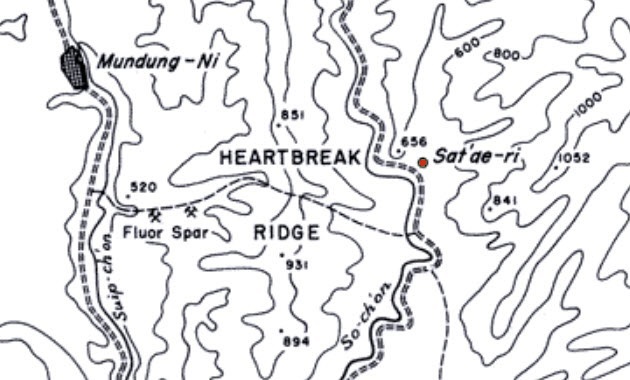
The Ethiopian Kagnew Battalion was attached to the US 2nd Infantry Division during the battle of Heartbreak Ridge (13 September to 15 October 1951). The French Battalion is being relieved by the Ethiopian Kagnew Battalion in the Sat’ae-ri Valley. Note the glass is missing on the driver side of the windshield. It probably was shattered by enemy fire and removed.
Armored Jeep Korea
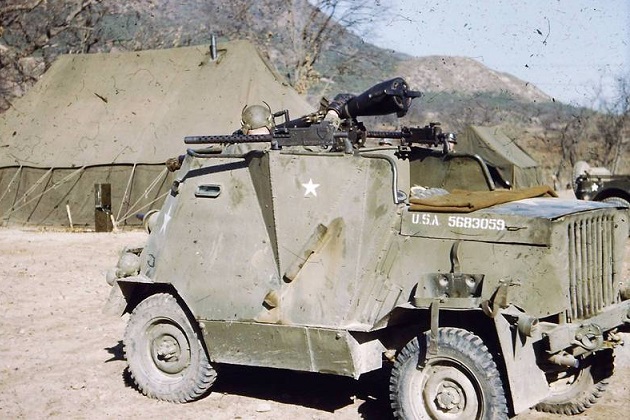
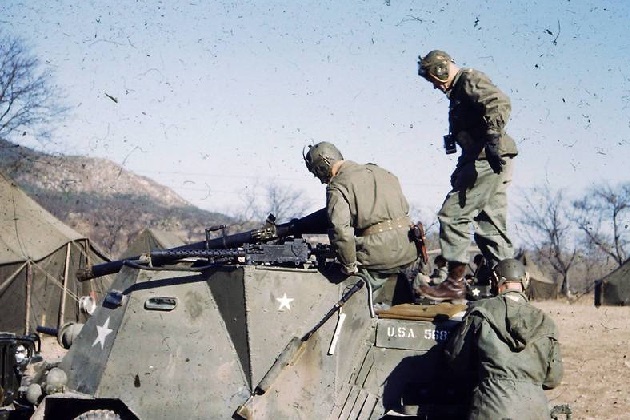
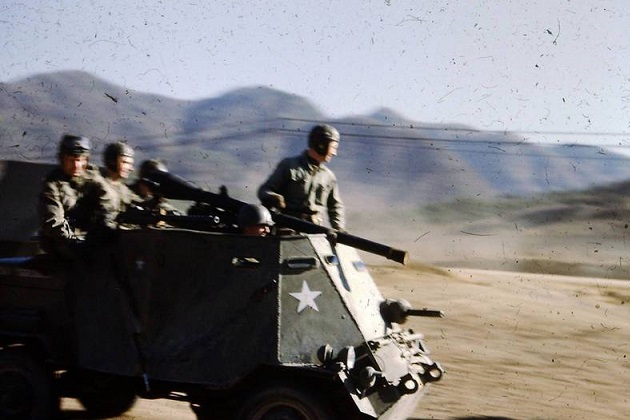
In 1952, the 17th Infantry Regiment, US 7th Infantry Division (IX Corps), created this one of a kind armored Jeep. It was used to supplement their Intelligence and Reconnaissance (I&R) platoon. The IX Corps sector was along the DMZ against the hilly countryside around the Iron Triangle area of Cheorwon, Kumhwa, and Pyongyang.
The Jeep’s armament was a M20 75mm Recoilless Rifle and three Browning .30 Cal M1919A4 light machine guns. The registration number “USA 5683059” starts with “5” which is for trucks over 5 ton and prime movers. For a Jeep, the first number would be a “2”.


Film: Korean War home movies IX Corps 1952-53
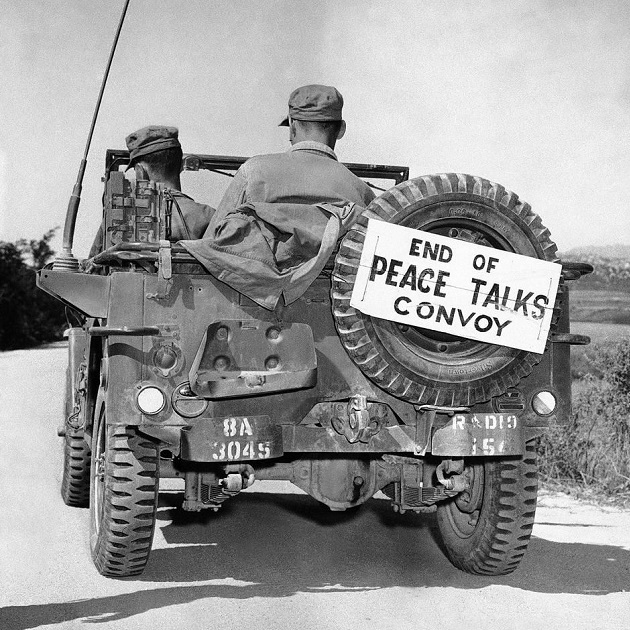
A US Army corporal at Panmunjom took this photo on 8 October 1952 as the last Jeep of the United Nations convoy departed for Munsan, after Korean truce talks at Panmunjom had been recessed indefinitely. Somebody had just hung the sign on the rear of the Jeep.
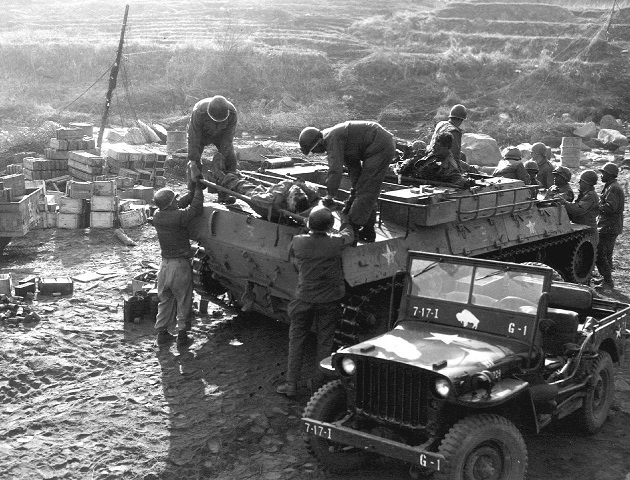
US troops loading wounded at OP onto a M39 Armored Utility Vehicle (a WWII 76mm M18 Hellcat Tank Destroyer minus the turret) of the 17th Infantry Regiment, 7th Infantry Division in 1953. In right foreground is MB or GPW WWII Jeep. The nickname for the 7th Infantry Regiment is “The Buffalo’s”.
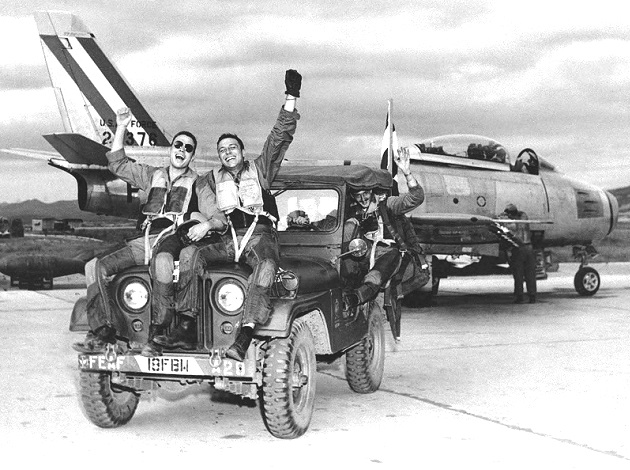
In June 1950, the 67th FBS “Fighting Cocks”, 18th FBW, moved from the Philippines to Teagu (Today Deagu), South Korea. They exchanged their F-80C Shooting Star jets for F-51D Mustangs which were more suited for the ground attack and support role. In January 1953 at Osan Air Base, the squadron transitioned to the F-86F Sabre jet without halting the fight against the enemy. It flew its first jet air mission on 26 February 1953. In the final days of the war, the squadron attacked dispersed enemy aircraft at Sinuiju and Uiju Airfields.
Three happy pilots show how they feel after they returned from a combat mission over North Korea and learned of the armistice signing on 27 July 1953. Left to right are: 2nd Lt. John Putty, Dallas, Texas; 1st Lt. James A. Boucek, Ottawa, Kansas; and 1st Lt. Richard D. Westcott, Houston, Texas (waving from the back seat of the Willys M38A1 Jeep). The stripes on the tail of the F-86F Sabre in the background indicates the 67th squadron.
Model Kits
1/16
SOL MM330 WWII U.S.ARMY 1/4 ton Armored truck – 2019
1/24
Dragon 43247 U.S. “Armored” 1/4 ton 4×4 Truck Battle of the Bulge – 2008
1/35
Dragon 6714 1/4 ton 4×4 Truck w/.50-cal Machine Gun – 2012
Dragon 6727 Armored 1/4-Ton 4×4 Truck – 2019
Dragon 6748 Armored 1/4 ton 4×4 Truck w/Bazookas – 2012
Tamiya 35336 Ford GPA Amphibian ¼ ton 4×4 Truck – 2014
Dragon 30TH-11 Armored 1/4 Ton 4×4 Truck w/Bazookas & U.S. Army Airborne – 2018
Takom 2131 U.S. Army 1/4 Ton Armored Truck – 2020
1/48
Tamiya 89755 U.S. 1/4-ton 4×4 Light Vehicle – 2010
MP Originals Masters Models 48014 Jeep NC-1A APU (Resin) – 2020
Black Dog T48027 JEEP with rocket launcher conversion set (Resin)
1/72
AMC Models (CZ) 72M06 Willys Jeep MB “Rockets” (Resin/Photo Etched)
Dragon 7423 Armored 4×4 Truck 2 kits per box – 2011
F4Models FM7006 NC-1A Aircraft Starter Unit U.S. Navy – 2012

 Mike's Research