James Howell Howard (8 April 1913 to 18 March 1995) was a fighter ace and a General in the United States Air Force. He was also the only US pilot in the European Theater of Operations (ETO) to be awarded the Medal of Honor (MOH). Sergeant Andy Rooney, a wartime reporter for Stars and Stripes, called Howard’s exploits “the greatest fighter pilot story of World War II”.
James Howard was born on 8 April 1913, in Canton (today Guangzhou), China, to Dr. Harvey James Howard and Maude Irene Strobel Howard. In China, his Ophthalmologist father was the head of the Ophthalmology Department at the University Medical School, Canton Christian College.
In 1927, the Howard family returned to St. Louis, Missouri. Throughout young Howard’s high school years at the John Burrough’s School in St. Louis, he was known as “China”. After finishing high school, Howard relocated to Southern California to attend Pomona College and prepared for a future that his family believed he would follow his father’s footsteps into medicine.
During his senior year, his thirst for adventure was stimulated during a visit on campus by a recruiter for US Naval aviation. He submitted an application, completed the physical examination, and reported to Long Beach shortly after graduating in 1937 with a Bachelor of Arts degree, to begin the long process of earning his wings. After initial training, including his first solo flight, just before Christmas 1937, with orders in hand, Howard reported to the Naval Training Station at Pensacola, Florida, to join sixty-nine, other would-be aviators. In January 1939, he received his gold aviation wings and was an Aviation Cadet, USNR (US Naval Reserve), the lowest of the US Navy’s officer ranks.
Howard was assigned to Fighting Squadron Seven (VF-7) on the brand new aircraft carrier USS WASP, which was still undergoing a shakedown cruise in the Atlantic. In the interim, in March 1939, Howard was sent to San Diego to fly F3F-1 biplane fighters as part of a fighting squadron assigned to the carrier USS LEXINGTON. For three months, all of his flights were ground based; he had yet to take off or land on a carrier. In June, Howard received orders to travel to Norfolk, Virginia, to join VF-7. It would turn out to be another step in a continuous shifting of orders that left him looking for his place in the Navy. When he arrived at Norfolk, the WASP was still at sea and Howard was then assigned to the USS RANGER, again spending several months flying only land based familiarization flights, this time in the F2F biplane. When the WASP finally returned, the Navy discovered its roster of pilots was already full, and new orders were cut sending Howard to VF-6 on the USS ENTERPRISE.
Shortly after Howard arrived in San Diego, the ENTERPRISE cruised west to Hawaii. Howard and the other pilots had yet to make their first carrier landing before it departed. The remaining pilots and planes flew in to land on her deck while the carrier was at sea. During the following four months in and around Pearl Harbor, Howard began a regular routine of taking off and landing on the carrier.
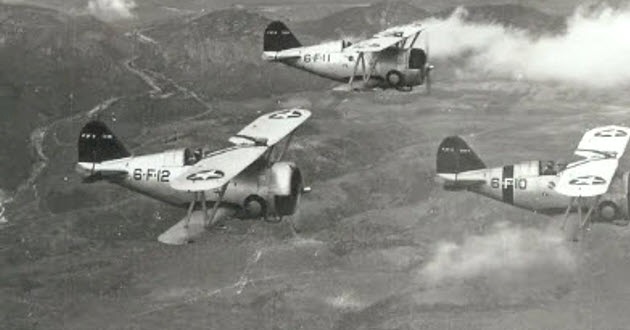
Howard standing next to his VF-6 Grumman F3F-2 biplane number 6-F-12. The F3F was the predecessor of the F4F Wildcat which was beginning to enter service with the US Navy at the time.

Howard’s F3F-2 biplane 6-F-12 in a flight somewhere over Hawaii.
During four months of practice for warfare, Howard flew daily missions to hone his gunnery skills and dive bombing techniques. By the time the ENTERPRISE returned to San Diego, he had become a proficient naval aviator ready for action. Howard had been aboard the ENTERPRISE for nearly a year when the war broke out in Europe. Throughout 1940 and early 1941, the US carriers rotated out of west coast naval bases to Hawaii for continued maneuvers to prepare for war. During that time, Howard was promoted to the rank of Ensign. Upon his return to San Diego in early 1941, the US Navy offered him a regular commission and an opportunity for a naval career. Howard thought it over and decided to decline the commission. In the spring of 1941, he resigned from the US Navy.
Either Howard had a premonition or it was just fate that Howard left the navy. About six months later during the early evening of 7 December 1941 five of six F4F-3A Wildcat fighters of VF-6 launched from the USS ENTERPRISE were shot down by friendly fire while attempting to land at Pearl Harbor. One of the planes shot down was F4F-3A (BuNo. 3938) number 6-F-12. The naval aviator, Lieutenant(jg) Eric Allen Jr., managed to bail out but was hit by a .50-caliber shell on the way down and his parachute only partially opened. Allen swam through oily water to the minesweeper Vireo (AM-52), but died from internal injuries the next day.
Flying Tigers
In April 1941, President Roosevelt authorized the American Volunteer Group (AVG). His order provided for recruitment of reserve officers and enlisted personnel from the US Army, Navy, and Marine Corps. The Central Aircraft Manufacturing Company (CAMCO) was designated as China’s agent in the process of both deliveries of the 100 planes and in recruiting 100 American pilots and 200 ground crewman to maintain them. General Claire Lee Chenault became the commander of the AVG.
At the Curtiss-Wright Airplane Company, Chennault found 100 crated Hawk 81A-3 aircraft (export version of the P-40B/C) ready for shipment. The French government had ordered them but had stopped the sale after France had fallen in 1940. Desperate for any aircraft, the RAF had agreed to purchase the crated fighters despite the fact that they were an older model and were not equipped with a gun sight, bomb rack, or provisions for attaching auxiliary fuel tanks to the wings or belly. Curtiss offered to install a new assembly line in the plant to turn out newer models P-40s for the British if they would give up their claim to the crated planes. The British quickly accepted the offer. The crated planes were shipped to Rangoon where they were re-assembled and made ready for combat.
Free from the US Navy, Howard submitted an application to CAMCO to join a group of volunteer airmen in a dangerous one year mission in China. The contracts the men signed made no mention of the true nature of their service, stating that the signatories were hired to “manufacture, repair and operate aircraft.” His application had been accepted and his orders came through on June 12.
Chenault personally greeted the first group of AVG pilots in San Francisco, California, as they gathered for departure. On July 10, the Dutch M.S. JAGERSFONTEIN departed San Francisco en route to Burma (today Myanmar) by way of Pearl Harbor and Singapore. The 123 AVG passengers onboard carried passports listing them as missionaries, farmers, salesmen, students, acrobats, anything but what they truly were. The mission was considered secret but as the steamer passed beneath the Golden Gate Bridge Radio Tokyo announced that the JAGERSFONTEIN would be sunk before reaching the Far East.
The JAGERSFONTEIN did arrived safely at Rangoon on July 28th. The volunteers then boarded an aging train for the seven hour trip of 160 miles (257.50 km) into central Burma. About 7 miles (11.3 km) beyond the town of Toungoo, the AVG set up shop at the Kyedaw Airdrome that had been constructed by the RAF but never used. Only two of the promised 100 aircraft had been assembled at Rangoon and flown to the muddy airfield.
Three squadrons were hastily formed, the 1st Pursuit Squadron (PS) named “Adam and Eve”, the 2nd PS named the “Panda Bears” (symbolizied the AVG’s mission in China), and the 3rd PS named the “Hell’s Angels.” Howard was assigned to the 2nd PS.
As the planes were assembled and flown into Toungoo, each pilot began sixty hours of flight training. The flight practice was sorely needed, as was evidenced by numerous minor accidents that sent several damaged aircraft up to the CAMCO factory at Lowing, China, for repairs. The pilots also went through an extensive training course where Chenault taught them everything he knew about the Japanese planes/tactics and how to fight them. Many pilots had lied about their flying experience, claiming pursuit experience when they had flown only bombers and sometimes much less powerful airplanes. A number of the pilots who could not keep up with the fast paced training just quit. Even after all the training about one third of the pilots were considered not combat ready. Chenault transferred those pilots to important ground jobs. Only around 68 pilots were flying at any given time and they were at various levels of proficiency. Not all of them could have taken on the Japanese in combat.
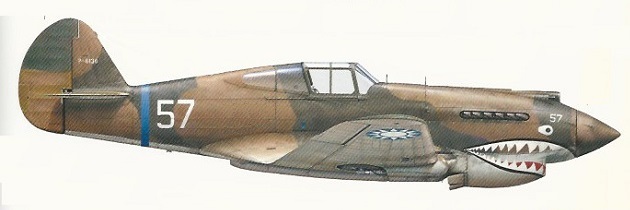
Curtiss Hawk 81A-3 number “57”, Chinese Air Force (CAF) serial number P-8138, was Howard’s assigned aircraft.

The blue tail band is the 2nd Squadron marking and the white P-8138 is on the tail fin. The 1st Squadron tail band was white and the 3rd Squadron’s was red.
On 7 December 1941, the Japanese bombed Pearl Harbor bringing the US into the war and began storming though the Pacific. On December 9th, China declared war on Japan. On the same day, Thailand capitulated, opening the way for Japanese ground forces to launch an invasion of neighboring Burma. Chennault sent the 3rd squadron to Mingaladon Airdrome north of Rangoon to support the meager RAF forces protecting the important port city. His ground crews, numbering around 200 volunteers, began the long trek across the Burma Road to the AVG’s new base at Wujiaba Airport in Kunming, China.
On December 20th, the 1st and 2nd squadrons flew the AVG’s first combat mission intercepting 10 unescorted Kawasaki Ki-48 “Lily” twin engine bombers of the 21st Hikōtai attacking Kunming. The bombers jettisoned their loads before reaching Kunming. Three of the bombers were shot down near Kunming and a fourth was damaged so severely that it crashed before returning to its airfield at Hanoi, Vietnam.
The 3rd Squadron took heavy losses while defending Rangoon against Japanese attacks and needed to be relieved. On December 30th, the 2nd Squadron arrived at Mingaladon with 17 aircraft. The 3rd Squadron was pulled back to Kunming, China, for rest and refit. The 2nd Squadron stayed on alert for the next three days. All remained quiet, but not for long. Squadron Leader Jack Newkirk decided to bring the war to the Japanese.
Vice Squadron Leader Howard’s first big mission was on 3 January 1942. Newkirk led four planes of the 2nd Squadron to strafe Tak airfield near Rahaeng, Thailand (east of Rangoon). The flight consisted of Newkirk, Howard, Allen Bert Christman, and Flight Leader David Hill. All four of them were ex-US Navy. Christman had engine problems and was forced to break off and return to Mingaladon. Newkirk, Howard, and Hill continued on alone.
They arrived at the airfield just as Nakajima Ki-27 “Nate” fighters from the 77th Sentai were landing. The Japanese fighters were from Lampang, the main Japanese headquarters in Thailand, and had just raided Moulmein (today Mawlamyine) air base in Burma and were using Rahaeng for refueling. Some of the Ki-27s had just landed as Newkirk, Howard and Hill approached, while the 77th Sentai’s third element actually followed the AVG planes in (mistaking them as RAF Spitfires).

Spotting many aircraft lined up on the airfield, Howard went down to strafe them, unaware that he had a Ki-27 on his tail. Newkirk turned in behind the Ki-27, opened fire and reported that it crash landed, turned over and burst into flames. He was credited with a “Zero” and an “I-96” shot down, the other fighters not being specifically identified. Meanwhile, Hill claimed another enemy fighter shot off Newkirk’s tail, and Newkirk then claimed another before heading back to Rangoon. Howard claimed destroying 4 Japanese fighters on the ground and also strafed enemy troops that were firing at them. He almost bailed out when his engine momentarily quit on him. The Japanese reports listed one Ki-27 was burned, one badly damaged and one damaged to a lesser extent.
Note: The “I-96” was probably a Mitsubishi A5M Type 96 (1936) “Claude” fighter, predecessor of the Mitsubishi A6M “Zero” (1940).
Painting “Spoiling the Party” by Stan Stokes depicts the attack. Howard’s plane just above the burning Japanese plane is strafing the field with a Ki-27 on his tail.

Second squadron pilots riding in a 1941 Ford GP Jeep at Mingaladon in late January 1942. They are, front left to right, Jack Newkirk, pilot Henry Geselbracht and James Howard (driving). Behind them, left to right, are pilots William Bartling and Robert Layher.

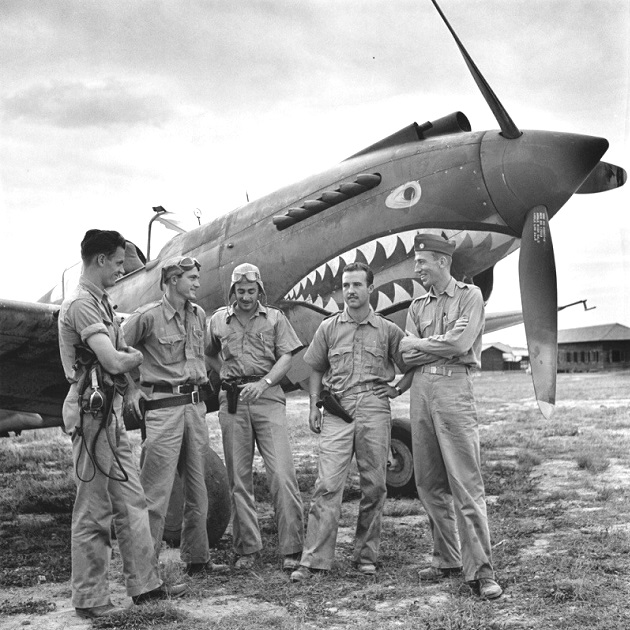
This is another photo of the group standing in front of the plane above. Howard is on the right end.
After serving at Rangoon, Howard was appointed Group operations Officer and was ordered to assist in preparing new bases in China. In early May 1942, he was promoted to squadron leader status and was back in the air. The promotion meant only a pay raise since there were no vacant squadron leader positions at the time. He flew 56 missions with the AVG. On 4 July 1942, the AVG’s last day of operations, while flying a P-40E (ex-USAAF) he claimed a Ki-27 making his total 6.33 kills.
Howard then volunteered for two extra weeks in China with the USAAF 23rd Fighter Group which replaced the AVG in China. The P-40Es of the 23rd FG carried the same “Shark Teeth” nose art which was used on the AVG aircraft.
Home Front
James Howard, Flying Tiger Ace, found a hero’s welcome awaiting him upon his return to St. Louis. He relaxed at home, ate heartily to regain the pounds lost during 12 months of living in China, and enjoyed his role as a returning combat veteran. He was wined and dined and invited to speak at nearly every school, church, and civic club. After awhile, the boredom of life at home began to gnaw at Howard who had traveled halfway around the world in search of adventure and experienced the adrenaline rush of being a fighter pilot in combat against a formidable foe.
He received two offers. The US Navy offered him the rank of Lieutenant, senior grade, and to train new Naval Aviators for duty in the escalating war. The US Army Air Force (USAAF) offered him the rank of Caption and they would make intelligent use of his experience he gained in China. After a long time thinking it over, he finally sent a letter to the USAAF to accept their offer.
On 31 January 1943, he traveled back to California to become a Captain in the US Army’s 4th Air Force. He spent his first weeks learning the fly the twin-engine, twin-tailed Lockheed P-38 Lightning that was becoming a hot fighter for the USAAF in both Europe and the Pacific. The P-38 had proven itself in North Africa during Operation Torch which was launched two months earlier.
Howard’s hope for combat diminished when he was assigned to the 329th Fighter Group in California. The 329th was a training unit using P-38s to train replacement pilots. Howard became a P-38 instructor to train P-38 pilots in the final phases of their fighter pilot training before shipping overseas. The 329th also provided cadres for fighter groups in combat, so there was still some hope.
Mustang Pilot
In the spring of 1943, Howard was offered command of the 356th Fighter Squadron which was training with P-39s at Santa Rosa airfield (today Charles M. Schulz–Sonoma County Airport) in California. The squadron had lost its first commander, Captain Charles C. Johnson, earlier in the year when he was killed in a training accident flying a P-39, afterward morale had sunk badly for lack of proper leadership. On 24 May 1943, Captain Howard became the new commanding officer of the 356th FS.
356th “Red Ass” Fighter Squadron
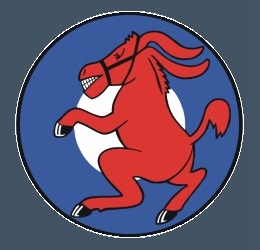
In June 1943, the 356th was re-equipped with new P-51B Mustangs. It transitioned to the Mustang throughout the summer of 1943. Howard thought that the USAAF would send the squadron to the Pacific to fight the Japanese but instead it was deployed to the ETO and assigned to the 354th Fighter Group of the US 9th Air Force in England. The 354th FG became known as the “Pioneer Mustang Group” which was the first US fighter group to fly the P-51B Mustang in combat.
Although the group was intended for ground attack, since the P-51B had the high altitude performance Merlin engine the 354th was ordered to fly as fighter escort for long-range heavy bombers of the US 8th Air Force while remaining within the 9th Air Force command structure.
On 20 December 1943, Howard claimed his first German kill, a Messerschmitt Bf 109, while returning from a bombing mission over Bremen, Germany. Howard was near the border of Holland, heading back to England, when he spotted a lone B-17 5000 feet (1524 m) below him. Two Bf 109s were circling above it and were ready to pounce on it. Howard rolled and dived on the first Bf 109. With a 20 degree deflection from the rear, he fired two short bursts from 300 yards (274.32 m). He did not see any hits, and the German pilot continued flying straight and level, unaware that his life was in danger. Howard closed to 80 yards (73.152 m), and fired again. Several of his rounds hit the cockpit area. The plane went spinning down in a wake of white smoke.
11 January 1944
The target was Oschersleben, Germany where the AGO Flugzeugwerke aircraft factory (a prime subcontractor for the production of Focke-Wulf Fw 190 fighters) was located. Forty-nine Mustangs of the 354th FG was escorting the 401st Bombardment Group to the target. Major Howard, who had been rotating mission leadership with Colonel Kenneth Ray Martin, led that day.
As Howard neared the lead B-17 formation, he spotted a twin engine Bf 110 Zerstörer (destroyer, heavy fighter) streaking in from the rear to attack the trailing B-17. Howard nosed into the enemy fighter, diving until it was almost impossible to miss. He raked the bandit until it nosed over and plummeted, slamming into the ground 14000 feet (4267.2 meters) below.
Quickly Howard pulled out of his dive to climb above the friendly bombers, intent on changing his position. The P-51B Mustang had a strong resemblance to the Bf 109 even at a fairly close range, and could easily become a B-17 tail gunner’s target when coming up on a bomber from the rear. As he pulled out, Howard spotted a Bf 109 moving in on the rear of the Fortress formation and he raked it with his four wing guns, sending it out of control and trailing smoke and fire as it fell to earth.
In those first moments upon reaching the lead bomber formation, Howard was so busy he did not notice that he was the only friendly fighter around. The rest of the P-51s was further back in the formation, dueling on their own to save the B-17s. In the Flying Forts of the 401st, 300 airmen watched the blitz by a single US pilot as Howard opened fire on a third enemy fighter in scant minutes. As the Focke-Wulf Fw 190 crossed in front of him, Howard pulled up after it in a chandelle. Closing in for the kill and preparing to fire when he was less than 100 yards (91.44 meters) away from what might have appeared to be an imminent collision, the German pilot jettisoned his canopy and bailed out.
Howard circled trying to join up with the other P-51s. He saw an Bf 109 just underneath and a few hundred yards ahead of him. The enemy pilot saw him at the same time and chopped his throttle, hoping Howard would fly pass him. It was an old trick. Howard started scissoring and then both of them went into a circle dogfight and it was a matter of who could maneuver the best and make a tighter circle.
Howard dropped his flaps to 20 degrees and began cutting inside him, so the enemy pilot quit and went into a dive, with Howard after him. Howard got on his tail and got in some long distance bursts from 300 or 400 yards (274 to 365 meters). Howard got some hits on him, but did not see him hit the ground. Back with the bombers again, Howard saw an Bf 110. Howard shot at him and got hits all over him. The Bf 110 flicked over on its back and began trailing white and black smoke.
By that point in the mission, Howard had been in action non-stop for nearly half an hour engaging about 30 Luftwaffe fighters and was down to two functioning wing guns. Climbing back up to join the B-17s he found a Bf 109 slipping in to attack from the side and he attacked it with only one functioning gun. They were both pretty close to the B-17s, and Howard was close to him. Howard gave him a burst and he headed straight down with black smoke pouring out. Howard continued to fight until he was out of ammunition, then resorted to bluffs to break up enemy attacks on the bombers by diving at incoming fighters until his fuel was dangerously low and there were no more bandits in sight. By that time, the 401st had bombed its target successfully and had begun the long return flight to England. Though four of the 401st’s B-17s were lost, not one of them was shot down during Howard’s epic battle against overwhelming odds. Howard claimed only two enemy fighters destroyed, two damaged and two probables.
This is North American P-51B-5 Mustang 43-6441, coded AJ ☆ X of the 356th FS. Squadron Mission Schedules showed that Howard flown this plane on 4, 5, and 11 January 1944.

The following week, the USAAF held a press conference in London where Major Howard described the attack to reporters, including the BBC, the Associated Press, CBS reporter Walter Cronkite, and Andy Rooney (Stars and Stripes). The story was a media sensation, prompting articles such as “Mustang Whip” in the Saturday Evening Post, “Fighting at 425 Miles Per Hour” in Popular Science, and “One Man Air Force” in True Magazine.
On 30 January 1944, during a mission over Brunswick, Germany, he shot down another Bf 110 and on 8 April 1944, he shot down a Fw 190 over Brunswick, his last aerial victory of the war.
On 11 February 1944, Colonel Kenneth Ray Martin, the Commanding Officer of the 354th Fighter Group, collided with a German Bf 109 and went down near Frankfurt, Germany, becoming a POW. The next day, James Howard was promoted to Lieutenant Colonel and put in command of the group which consisted of the 353rd (“FT”), 355th (“GQ”) and the 356th (“AJ”) Fighter Squadrons.
354th Fighter Group
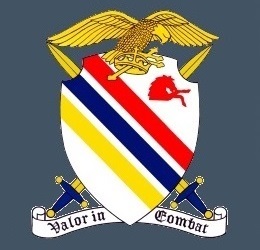
On 18 April 1944, Howard was transferred to a higher headquarters and no longer flew combat missions.
Summary of Howard’s enemy aircraft destroyed:
| Date | # | Enemy Aircraft | Location | Aircraft | Unit | Ground/Air |
|---|---|---|---|---|---|---|
| 3 Jan 1942 | 3 | Nakajima Ki-27 | Tak Airfield, Thailand | Hawk 81A-3 | 2nd PS, AVG | Ground |
| 19 Jan 1942 | 0.33 | Mitsubishi Ki-21 | Mae Sot, Burma | Hawk 81A-3 | AVG | Air |
| 24 Jan 1942 | 1 | Ki-27 | Rangoon, Burma | Hawk 81A-3 | AVG | Air |
| 4 Jul 1942 | 1 | Ki-27 | Hengyang, China | P-40E | AVG | Air |
| 20 Dec 1943 | 1 | Messerschmitt Bf 109 | Bremen, Germany | P-51B | 356 FS | Air |
| 11 Jan 1944 | 2 1 | Messerschmitt Bf 110 Focke-Wulf Fw 190 | Oschersleben, Germany | P-51B 43-6441 | 356 FS | Air |
| 30 Jan 1944 | 1 | Bf 110 | Brunswick, Germany | P-51B | 356 FS | Air |
| 8 Apr 1944 | 1 | Fw 190 | Brunswick, Germany | P-51B | 354 FG | Air |
| Total | 11.33 |
Since CAMCO counted aircraft destroyed on the ground in the calculation of bonus payments, Howard became an ACE in China under CAMCO standards with 6.33 total victories. However, the USAAF only counted air-to-air kills, making Howard’s official tally 2.33 Japanese plus 6 German kills for a total of 8.33.
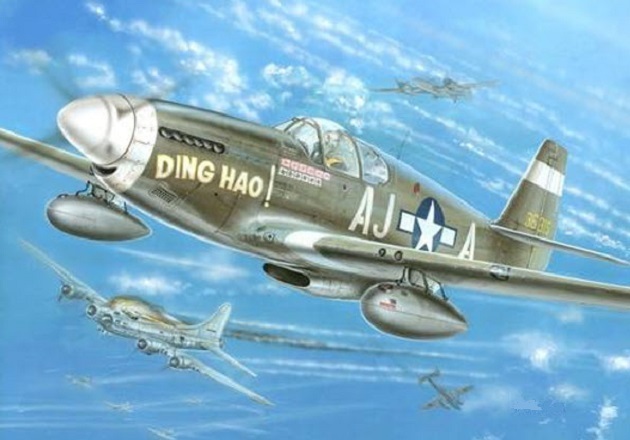
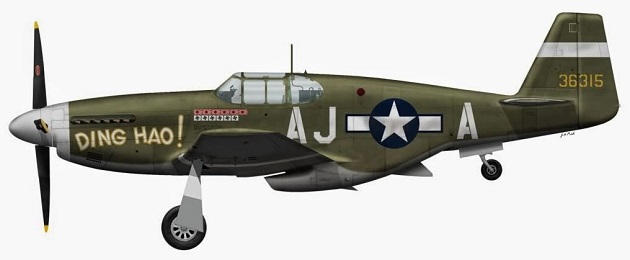
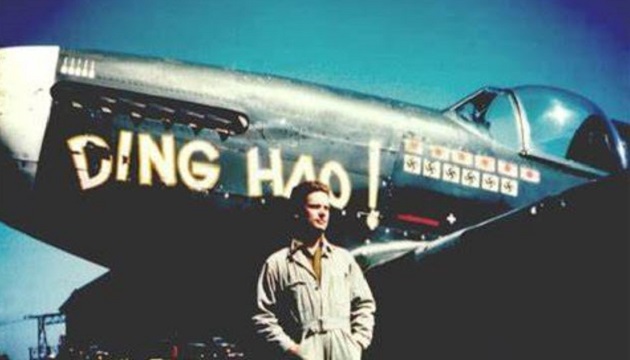
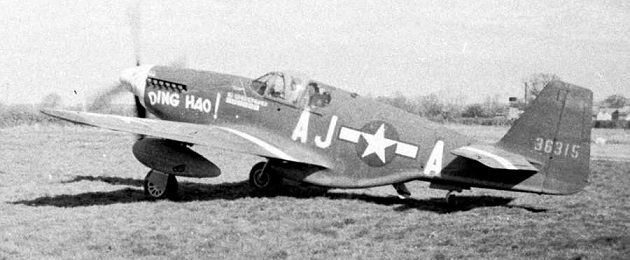
Howard’s assigned aircraft in the 356th FS was North American P-51B-5 Mustang 43-6315 coded AJ ☆ A. Howard named his Mustang “DING HAO!” (it is pronounced “Ding How”). It was an American WWII slang term based on the Chinese phrase, “ting hao de” meaning “very good” or “number one”.
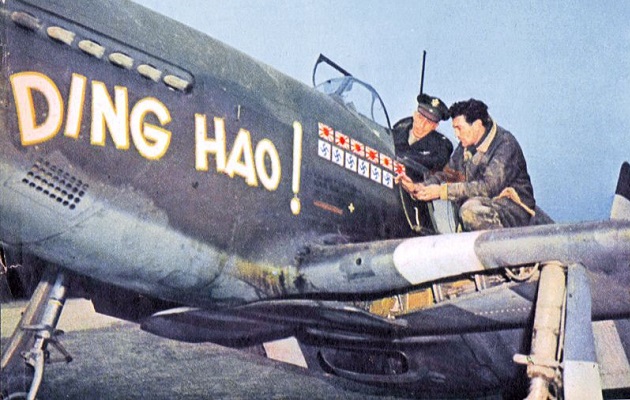
The following three photos were passed for publication on 25 January 1944. For the publicity photos, the USAAF Public Relations insisted on displaying 6 Japanese victory flags which he claimed instead of just the two aerial kills which he got with the AVG. At that time, Howard did not get his last two German kills so 2 more German victory flags (probably the 2 damaged claims from January 11) were also added. No photos of Mustang “DING HAO!” before 1944 exists.
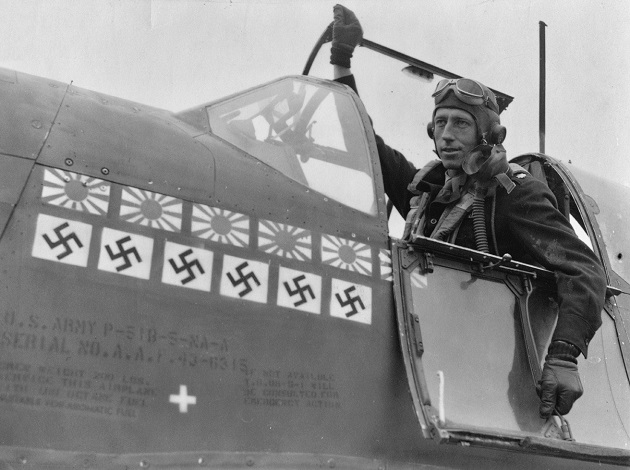
Howard watches Staff-Sergeant Marcus Hanson from Millburn NJ, the squadron painter, puts the finishing touches on a German “Kill” marking.


Frame shot from a film showing Mustang “DING HAO!” taking off. Note the second Japanese kill marking.

Film: Criticalpast Clip 65675077892
A color photo of Howard and Staff-Sergeant Marcus Hanson for magazines.
In the spring of 1944, Mustang “DING HAO!” was updated with a Malcolm Hood. On the nose above the engine exhaust are 5 broom markings which indicate 5 fighter sweep missions. Fighter sweep missions allowed fighter aircraft to seek out and destroy enemy aircraft or targets of opportunity in a designated area.
Malcolm Hood
When the Mustang III was delivered to Britain, the RAF discovered that the hinged cockpit canopy offered too poor a view for operations. A fairly major modification was made in which the original framed hinged hood was replaced by a bulged Perspex frameless canopy that slid to the rear on rails. This canopy gave the pilot much more room and the huge goldfish bowl afforded a good view almost straight down or directly to the rear. It was manufactured and fitted by the British corporation R Malcolm & Co and it became known as the Malcolm Hood. The hood was fitted to most RAF Mustang IIIs, and many USAAF 8th and 9th Air Force P-51B/C fighters received the modification as well. Many pilots regarded the Malcolm-hooded P-51B/C as the best of the entire series. It was lighter, faster, and had crisper handling than the later bubble-hooded P-51D and actually had a better all around view. Its primary weakness was the armament, only four .50 caliber (12.7 mm) Browning machine guns, which often jammed.
A couple photos of Horward in the cockpit of Mustang “DING HAO!”

This is a closer view showing the pilot and Crew Chief (C/C) names. Note few of the kill markings are beginning to fade off.

Mustang “DING HAO!” with 75 Gallon (283.9 Liters) auxiliary drop tanks.
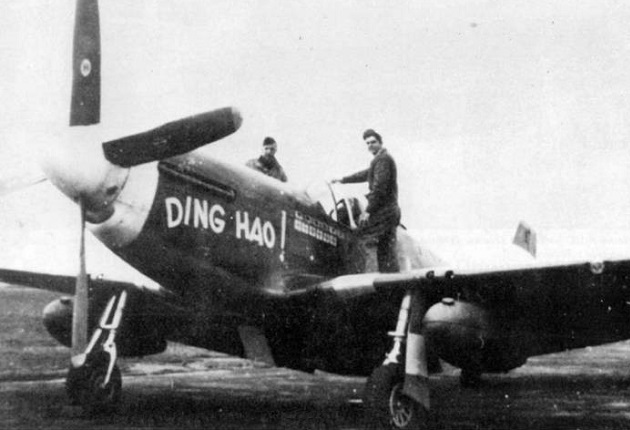
Another view of Mustang “DING HAO!”. The white horizontal identification band on the tail fin/rudder was painted out.
Howard climbing in or out of Mustang P-51B-1-NA 43-12175 coded FT ☆ I of the 353rd FS. Howard was posing in this aircraft but he never flew it. The date is unknown but probably was taken sometime after he became the 354th FG commander.


On 5 June 1944, Lieutenant Colonel James Howard was awarded the Medal of Honor from General Carl Andrew Spaatz, commander of Strategic Air Forces, for his actions on January 11th. The story in the newpapers was overcasted by the D-Day invasion the next day.
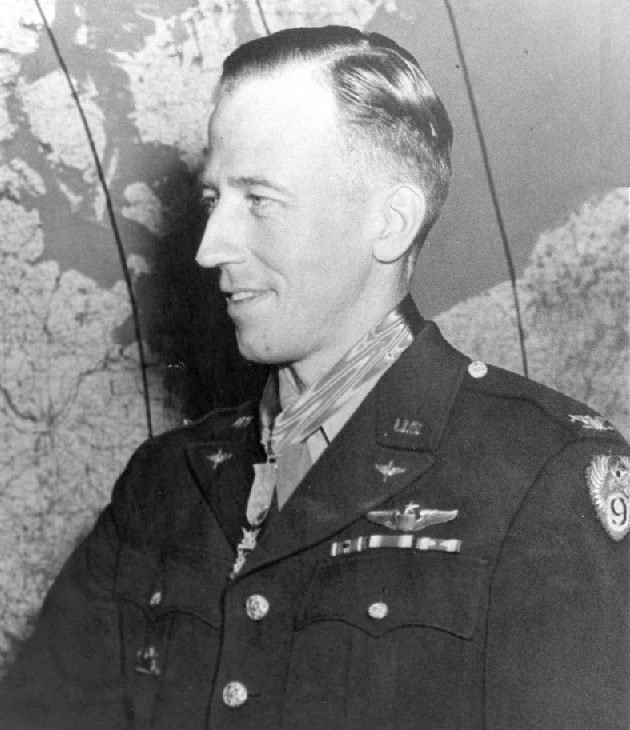
Howard also was awarded:
- 2 Distinguished Flying Crosses
- 1 Bronze Star
- 10 Air Medals
Mustang 43-6315 did not survive the war. After Howard left the group, it remained with the 356th FS and it was re-coded AJ ☆ S. It is not known if it was still named “DING HAO!” or still had the 12 Japanese/German kill markings. For the D-Day invasion, the B/W invasion stripes would been painted on the wings and fuselage.
The 354th FG supported the Normandy invasion by escorting gliders on D-Day and attacking ground targets such as bridges, railways, and German gun positions in northern France. On June 22nd, the group moved to Advanced Landing Ground A-2 at Cricqueville-en-Bessin (Cricqueville), France.
At 1810 hours on July 23rd, Mustang 43-6315 was shot down by AAA fire east of Caen, France. The pilot flying it was 1st Lieutenant Theodore Dichter (no middle initial) from Brooklyn, Kings County, New York. Dichter was KIA and buried at Plot G Row 4 Grave 41, Normandy American Cemetery, Colleville-sur-Mer, France.
In January 1945, Howard was promoted to Colonel and assigned as base commander of Pinellas Army Airfield (today St. Petersburg-Clearwater International Airport) located 9.8 miles (15.77 km) northwest of St. Petersburg, Florida. Pinellas was a training base for the US 3rd Air Force.
Post War
With the establishment of the USAF as a separate service in 1947, Colonel Howard was transferred to it. In 1948, he was promoted to the rank of Brigadier General in the USAF Reserve, commanding the 96th Bombardment Group at Gunter Field, Alabama.
Howard was Director of Aeronautics for St. Louis, Missouri, managing Lambert Field while maintaining his military status as a brigadier general in the USAF Reserve. He then founded Howard Research, a systems engineering business, which he eventually sold to the Control Data Corporation. He retired from the USAF Reserve in October 1966.
In the 1970s, Howard retired to Belleair Bluffs in Pinellas County, Florida. In 1991, he wrote an autobiography, “Roar of the Tiger”, mostly devoted to his wartime experiences.
On 18 March 1995, Howard died at the Bay Pines Veterans Hospital and was buried at Arlington National Cemetery.
Model Kits and Decals
1/32
Trumpeter 02274 P-51B Mustang II – 2007
Zotz Decals 32015 Decals P-51B Mustang in the ETO Part 2
1/48
Accurate Miniatures 3413 Grumman F3F-2 Classic U.S. Navy Fighter – 2005
Academy 12326 US Navy Fighter F3F-2 VF-6 “Fighting Six” – 2021
Premium Hobbies 136V P-51B “Ding Hao” – 202?
Lifelike Decals 48-057 Type 97 Fighters Part 5 (Ki-27) – 2021
Peddinghaus-Decals 48 4010 Mustang P-51B-5 Lt.Col. J.H.Howard Medal of Honor – 2022
1/72
Airfix A01003 Curtiss Hawk 81-A-2 – 2011
Arma Hobby 70067 P-51 B/C Mustang – 2023
Kovozávody Prostějov (KP) KPM0030 P-51B Mustang “Malcolm hood” – 2015
Lifelike Decals 72-034 Type 97 Fighters Part 1 (Ki-27) – 2015

 Mike's Research