Staff Sergeant Lafayette “War Daddy” Pool was an American tank-crew and tank-platoon commander during WWII and was a US tank ace, credited with 12 confirmed panzer kills and 258 total armored vehicle and self-propelled gun kills, over 1000 German soldiers killed and 250 more were taken prisoner, all accomplished in only 81 days of combat from 29 June to 19 September 1944.
Lafayette Green Pool was born in Odem, Texas, to John McKinley Pool and Marion Lee Ruth (Lacook) Pool on 23 July 1919, five minutes after the birth of his twin brother, John Thomas Pool. The boys were raised in a small farming community. As they grew older, the twins were sometimes called “L. G.” and “J. T.,” but Lafayette often went by “Lafe.” Upon graduation from Taft high school in 1937, where Lafe was a star football player, he and John decided to enlist in the US Navy. The older brother was accepted, but an eye injury Lafe had sustained at age of five got him rejected. Instead, he enrolled in an all-boys Catholic Corpus Christi College-Academy, graduating as the class valedictorian in 1938. Lafe then began pursuing an engineering degree at the Texas College of Arts and Industries in Kingsville (today Texas A&M University-Kingsville).
To help pay for his education, Lafe worked as a foreman on his father’s farm and took up boxing, earning cash prizes for winning matches. He continued to hone his skills in the Golden Gloves amateur league, but never lost sight of the military. When the national draft was instituted in September 1940, Pool enlisted in the US Army on 14 June 1941, faking his way through the required vision test by memorizing the eye chart before his eye exam.
Pool received his basic training at Fort Sam Houston in San Antonio, Texas. Upon completion, he was sent to Camp Beauregard, Louisiana, and was assigned to the 40th Armored Regiment. Initially trained as a mechanic, he became part of a tank crew and then a tank commander. When the 40th Armored Regiment was inactivated on 1 January 1942, Pool was transferred to the 32nd Armored Regiment, 3rd Armored Division, at Fort Polk, Louisiana. The regiment trained at the Desert Training Center in the Mojave Desert (southern California and western Arizona); Camp Pickett, Virginia; and Indiantown Gap, Pennsylvania. Pool trained hard, both as a tank commander and in the ring.
Pool became the Division boxing champion and won the US Army’s regional belt. He received a bid to fight at the Golden Gloves championship in Chicago, but he turned it down in order to master the latest M3 tank variant his division had just received. He did not want to fall behind the other tank commanders.
In 1943, Pool was promoted to staff sergeant. He similarly turned down a chance to attend Officer Candidate School (OCS), preferring to drill his crew and prepare for combat. The crew he picked remained together throughout most of his combat service. Although Pool was younger than two of his crewmen, they called him “War Daddy”, a man with a burning desire to engage the enemy in combat. He in turn called his crew his “Pups.”
| Crewman | Name |
|---|---|
| Driver | Corporal Wilbert “Red” Richards |
| Assistant Driver | Private First Class Bertrand “School Boy” Close |
| Gunner | Corporal Willis “Ground Hog” Oller |
| Loader | Technician Fifth Grade Delbert “Jailbird” Boggs |
Note: Boggs chose to enlist rather than face a manslaughter sentence.
In August 1943, Pool’s regiment moved to Camp Kilmer, New Jersey, in preparation to be shipped overseas. On September 4, he boarded a train bound for New York Harbor and the next day departed aboard the British passenger liner RMMV Capetown Castle. The ship arrived in Liverpool, England on September 15. Pool was billeted at Codford, Wiltshire, and he trained at Salisbury Plain with the 3rd Platoon of I Company. Pre-invasion training was conducted near Bristol and Liverpool.
Pool and his crew received their Sherman tank, a M4A1 with a cast hull and 75mm gun. This was the first of three Sherman tanks which Pool commanded in combat. Pool named the tank “IN THE MOOD”. Unfortunately, there are no known photos of this tank.

The tank’s name means someone wanting to do something. It followed the WWII tradition where US tanks were often named with a name that began with the letter of their company. It was also the name of a popular Glenn Miller 1939 song which dominated the airwaves during the war. Glenn Miller’s swing orchestra played the song in the 1941 movie “Sun Valley Serenade“.
In Liverpool in early 1944, Pool volunteered to box against the heavyweight champion, Joe Louis, the “Brown Bomber”. It was meant to be an exhibition bout, but Pool got a little too enthusiastic and rapped Louis a few good ones. Louis got Pool in a clinch and whispered “White man, I’m going to teach you a big lesson.” Louis then proceeded to give Pool a good going over, although there was no knockout.
The division remained in Somerset, England, until 23 June 1944 when it moved to the port of embarkation at Weymouth bound for Normandy.
Omaha Beach
On June 24, the 3rd Armored Division began landing on Omaha Beach in Normandy. The weather was rainy while the division’s vehicles were de-water-proofed, and men and machines were made ready for combat in the crowded assembly areas. The division was re-organized and the 32nd Armored Regiment was assigned to Combat Command A (CCA). The composition of the 32nd Armored Regiment and CCA as follow:
32nd Armored Regiment
1st Battalion:
- A Company (M5A1 Tanks)
- D Company (M4/M4A1 Tanks)
- G Company (M4/M4A1 Tanks)
2nd Battalion:
- B Company (M5A1 Tanks)
- E Company (M4/M4A1 Tanks)
- F Company (M4/M4A1 Tanks)
3rd Battalion:
- C Company (M5A1 Tanks)
- H Company (M4/M4A1 Tanks)
- I Company (M4/M4A1 Tanks)
CCA
Task Force X (TF X):
- 3rd Battalion, 32nd Armored Regiment
- 3rd Battalion, 36th Armored Infantry Regiment
- A Company, 703rd Tank Destroyer Battalion (M10s)
- C Company, 23rd Armored Engineer Battalion (-1 Squadron)
- 5 Tank Dozers
Task Force Y (TF Y):
- 2nd Battalion, 32nd Armored Regiment
- 2nd Battalion, 36th Armored Infantry Regiment
- B Company, 703rd Tank Destroyer Battalion (M10s)
- A Company, 23rd Armored Engineer Battalion (-1 Squadron)
- 5 Tank Dozers
Task Force Z (TF Z):
- 1st Battalion, 32nd Armored Regiment
- 1st Battalion, 36th Armored Infantry Regiment
- 703rd Tank Destroyer Battalion (-2 Companies)
- Recon Company, 32nd Armored Regiment
- 2 Squadrons Engineers
- 1 Angle Dozer
Villiers-Fossard
An enemy salient existed in the zone of the US 29th Infantry “Blue and Gray” Division. This salient was some 3000 yards (2743.2 m) deep and protected the town of Villiers-Fossard just east of the Vire River and north of Saint-Lô. CCA was ordered to reduce this salient, seize and hold Villiers-Fossard until relieved by the 29th Division. This was the 3rd Armored Division’s first combat in WWII.
Defending the salient, was a strongly reinforced German Fusilier battalion of the 353. Infanterie-Division. Their positions were well prepared and supported by artillery and anti-tank weapons. Their defenses took full advantage of the small hedge-bound fields and a little stream that ran just north of Villiers-Fossard. For the attack, CCA Task Forces X and Y were positioned abreast of each other north of Villiers-Fossard. TF Z was behind them held in reserve.

At 0900 hours on June 29, the attack was launched. TF X attacked on the left flank and TF Y on the right flank. Following the artillery preparation, there was a short, rapid advance. Since the Shermans could not negotiate the thickly built-up hedgerows, the tank dozers (M4 tanks with bulldozer blades) penetrated the hedgerows at various points. During the attack, Pool claimed destroying 3 German vehicles (types unknown). At 1130 hours, TF X reached the La Forge-Bois de Brétel road (today D448) and was ordered to remain there.
At the small village of Les Forges (today intersection of D6 and D448), Pool’s M4A1 was hit by a Panzerfaust anti-tank weapon. The blow knocked out the tank, but Pool and his crew abandoned their stricken tank.
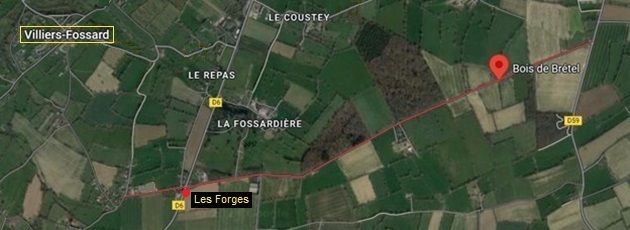
The tank and infantry teams of TF Y advanced slowly against the enemy’s well dug-in positions, and reached the little stream north of Villiers-Fossard. The next day, the attack was resumed. Both Task Forces pressed forward to their objectives, where they stabilized and secured the positions until they were relieved by elements of the 29th Division. CCA lost 31 tanks and 12 other vehicles during the two day battle.
On July 1, Pool and his crew got their replacement tank, a M4A1(76)W which Pool also named “IN THE MOOD”. The name was not suffixed with a number, letter or a Roman numeral.
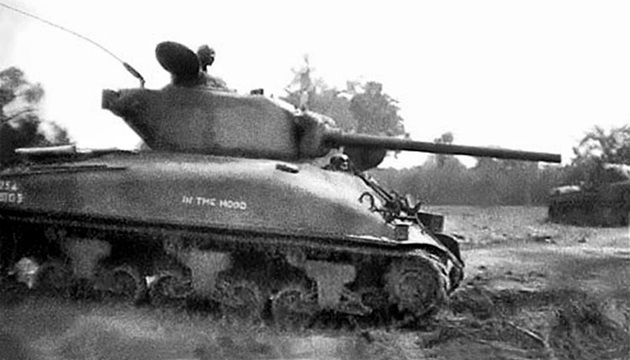
The M4A1(76)W featured the much more effective M1 76mm gun, with better performance against armored targets. The “W” refers to “wet stowage” for its ammunition where the 76mm rounds in each rack were surrounded by containers of a mixture of water, ethylene glycol, and a rust inhibitor, known as “Ammudamp.” The wet stowage greatly reduced the risk of fire and exploding the ammunition when the tank was hit.
CCA was ordered to protect the right flank of XIX Corps. Between July 7 to 19, the US 29th, 30th and 35th Infantry Divisions assaulted and liberated Saint-Lô. On July 10, CCA was attached to the US 9th Infantry Division of the VII Corps.
On July 11, CCA moved northwest to the vicinity of Saint-Jean-de-Daye to counter an enemy panzer threat. There the tank companies were parceled out to infantry regiments, and, in conjunction with elements of the 9th Division. CCA fought a stiff and successful defensive action against elements of the Wehrmacht, principally Fallschirmjäger (paratroopers) supported by panzers.
On July 26 during Operation Cobra, the 3rd Armored Division broke out at Marigny (west of Saint-Lô) along side the US 1st Infantry Division and advanced south to Brécey, 23 km (14.29 miles) northwest of Mortain.
On July 31, fierce fighting took place near Brécey along the Sée River. The US forces retain the advantage and the German forces retreated south and to the southeast.
On August 2, the US 1st Division supported by the 3rd Armored’s CCA and the 634th Tank Destroyer Battalion (M10s) assaulted and captured the village of Juvigny-le-Tertre (northwest of Mortain) which was held by the 116. Panzer-Division and part of the 2. SS-Panzer-Division. M4 Shermans of TF X were knocked out by the 2. SS-Panzer-division.
Between August 5 to 8, CCB (33rd Armored Regiment) and the US 35th Infantry Divison stopped an assault by the 2. Panzer-Division during the German counter-attack between Mortain and Avranches. During this period, CCA continued advancing south to Mayenne.
On August 13, the 3rd Armored Division was ordered to advance east to take part in the race to close the Falaise pocket.
Near Origny (east of Mayenne near Mamers), it was getting dark when the order came down to halt and bed down for the night. Pool was about to say “Driver, Halt” but instead found himself looking down the barrel of a German 88mm gun in the gloom ahead. He immediately yelled “Gunner, Fire!” and Oller, without hesitation, blasted the enemy gun before its crew spotted them.
The 3rd AD began advancing northward towards the Falaise pocket.
Pool and his crew led TF Y into Colombiers (northwest of Origny). Pool’s tank nearly collided with a German Panther, which fired first and missed at point-blank range. The Panther got off a second shot and missed again before Oller blew its turret clean off with his first shot. Pool had led the task force into 2. Panzer-Division’s assembly area, and he destroyed another Panther at close range as well as two armored cars in the short, sharp action.
Near Rânes, CCA‘s advance element, TF X, came in contact with a strong defensive line held by units from the 1. and 9. SS-Panzer-Divisions. Not only TF X could not break through, but soon went from being a hunter to a prey. The men from TF X, including staff officers and cooks, were on the firing line fighting off SS attacks, only supported by the US Army Air Force while the rest of the division was charging to the rescue. On August 15, the 3rd Armored Division captured Rânes and started advancing north toward Fromentel against the heaviest resistance they have encountered so far in Normandy.
Fromentel
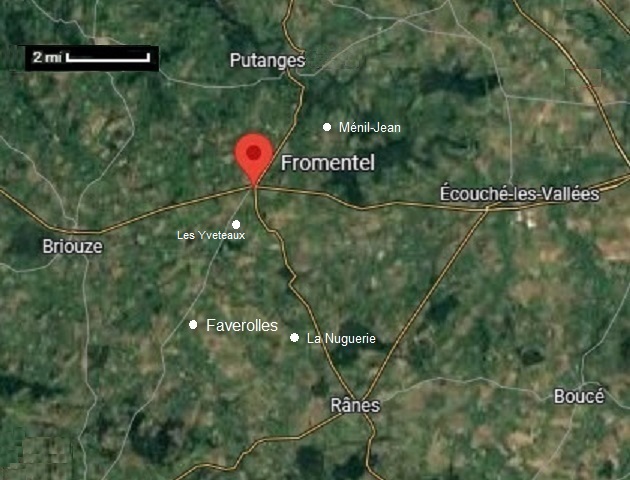
Fromentel became one of the access points to Putanges and the La Villette bridge northeast of Ménil-Jean, the only crossing points of the Orne River still usable for the Germans retreating towards Trun. Aware of the importance of holding Fromentel as long as possible, elements of the 1. SS-Panzer-Division Leibstandarte entrenched themselves in the paths, behind hedges, and in the homes of the village, supported by panzers and heavy weaponry.
On August 15, CCA’s advance towards Fromentel had not progressed much beyond the outskirts of Rânes, but 500 prisoners were taken. The next morning, August 16, the 3rd Armored launched a coordinated attack toward Fromentel. CCA met panzer resistance and heavily defended roadblocks, causing their attack to move slowly. At about 1230 hours, the German defenses cracked a little, and CCA was able to advance to La Nuguerie. Then at 1500 hours, the Germans launched a counterattack in some strength. This caused CCA to withdraw south about 1000 yards (914.4 meters). At 1630 hours, the advance continued and by 2200 hours there was fighting on the outskirts of Fromentel. CCB followed a route generally to the west of CCA and they met heavy resistance all the way. By dark, CCB reached Les Yveteaux just southwest of Fromentel. Fifteen panzers were destroyed and 400 more prisoners were taken.
During the day of August 17, CCA fought its way into Fromentel from the east with TF X leading. CCB attempted to launch an attack on Fromentel from the southwest in conjunction with CCA’s attack, but heavy resistance was met that CCB could not reach the town. At about 1700 hours, when all but the western part of the town had been cleared of the enemy, flights of US P-38 fighter bombers heavily bombed Fromentel. During the bombing, Pool’s tank was knocked out by friendly fire when a P-38 pilot mistook it for a German panzer. Pool and his crew abandoned their disabled tank and took cover.
The closest P-38 unit at the time was the 370th Fighter Group (401, 402nd, 485th Fighter Squadrons). On August 15, the 370th moved from Advanced Landing Ground A-3 Cardonville (northeast of Isigny near the coast) to A-19 La Vieille located at the foot of Hill 192, 10 km (6.2137 miles) northeast of Saint-Lô and east of Villiers-Fossard. The P-38s probably flown in from the northwest and bombed the panzers around Fromentel. Pool’s tank would been in their flight path and it could not be identified as friendly with all the smoke from the bombing.
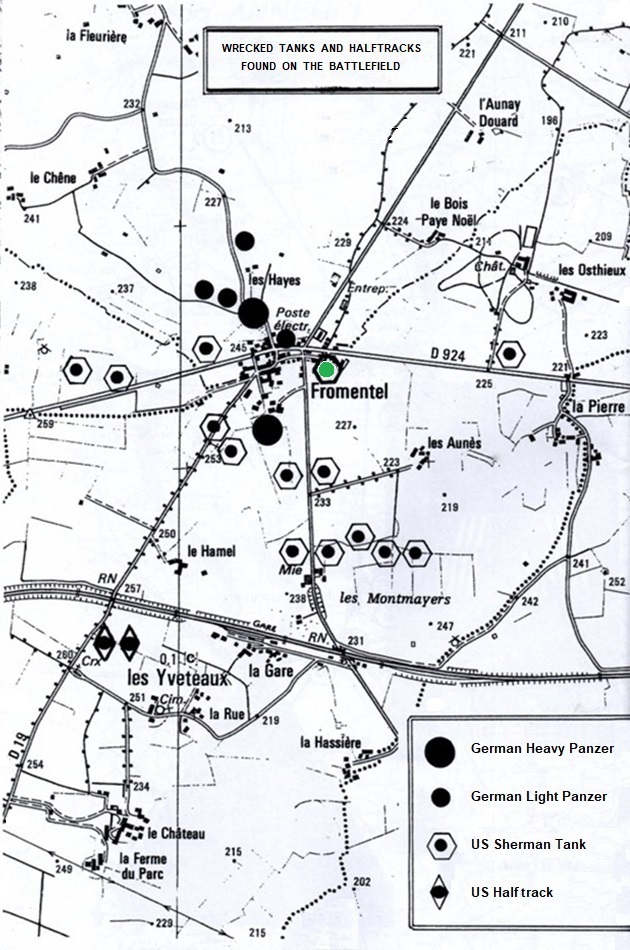
This map shows the locations of wreaked tanks and half-tracks around Fromentel. There were two Panthers, two Pz.Kpfw. IVs and two light panzers (probably StuG IIIs or some other SPs). Since TF X attacked Fromentel from the east and Pool’s tank was most likely leading, the US Sherman tank symbol with the green (Pool’s middle name) circle is the approximate location where Pool’s tank was knocked out.
Pool and his crew got a replacement tank, another M4A1(76)W. Pool also named it “IN THE MOOD”.
After the Falaise pocket was closed, the 3rd Armored Division moved east to the south of Paris. On August 26, the day after Paris was liberated, the 3rd Armored Division crossed the Seine River between Corbeil (today Corbeil-Essonnes) and Melun. The division then advanced northeast liberating Meaux, Soissons, Laon, and Marle.
In the three-day span of August 29 to 31 alone, Pool and his crew was credited with destroying 4 German panzers, 3 anti-tank guns, and approximately 50 armored vehicles during the Aisne River crossings between Soissons and Pontarcy, south of Laon.
On September 2, the 3rd Armored Division crossed into Belgium and went on to liberate Mons, Charleroi, Namur, Liège and Dison.
On September 5, near Namur, a small city at the confluence of the Sambre and Meuse Rivers, Pool and his crew destroyed 16 enemy vehicles, including assault guns, self propelled anti-tank guns, plus several half-tracks in one day.
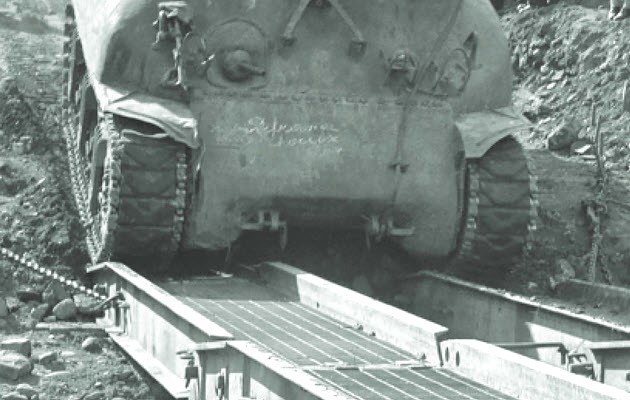
On September 8, Liège was liberated and the 3rd Armored CCA mopped up the north side of city while CCB mopped up the south side. The 23rd Armored Engineers constructed a 510 foot (155.45 m) tread-way bridge across the Meuse River in Liège.
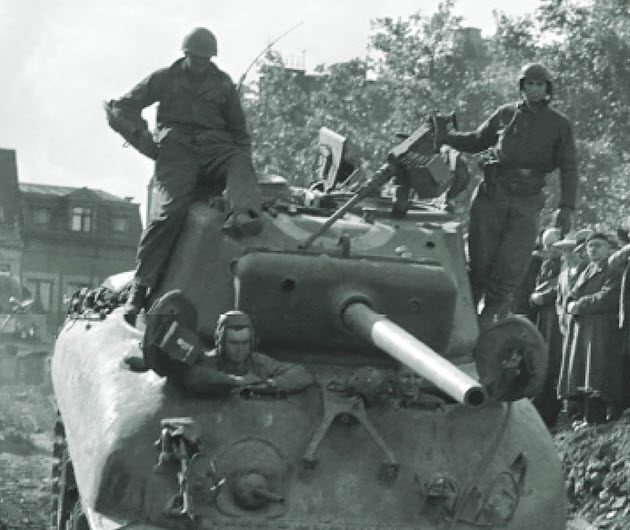
Pool’s tank driving down the embankment and is being directed onto the tread-way bridge while citizens of Liège stand watching along the river bank.

Pool’s one problem was that he was claustrophobic (fear of confined spaces) and preferred to ride, as much as possible, on the outside of his tank. He was always exposed while standing in the turret or sitting on top of the turret. Richards had the same condition in that he always drove with his overhead hatch open, having been trapped once with a jammed hatch.
This is my close up of the above photo. Pool is sitting on the outside of the turret on the left wearing a US M1 helmet. His right elbow and arm is leaning against the open commander’s hatch. Note the large circled white star on the turret roof and that the headlights are not mounted, only the headlight guards are seen on the front hull.
This is my close up of the tank’s lower hull. Some cheerful civilians had chalked a message on the transmission housing cover and the writing is not legible. There could been more messages written on the hull sides.
At Dison (east of Liège), Pool distinguished himself while acting as a platoon leader. He used his own tank to clean out a pocket of resistance on the left flank of the route they were traveling. After finding and destroying 6 enemy half-tracks, Pool discovered that the head of his column had been fired upon by a German Panther. Quickly he ordered Richards to move to the head of the column. Upon arriving at the head of the column, he spotted the enemy tank and gave a single estimated range to Oller. Oller then fired an Armor Piercing (AP) round at 1500 yards (1371.6 meters) and destroyed the Panther. The column then moved on with Pool again in his customary place, in the lead.
Siegfried Line

On September 12, Aachen and its fortified surroundings were besieged by the US 1st Infantry Division with the 3rd Armored Division assisting it from the south. The city of Aachen was defended by the German 116. Panzer-Division under the command of Oberst (Colonel) Gerhard Wilck. The US VII Corps continued to probe German defenses, despite the resistance encountered on September 12–13. Between 14 and 16 September, the 1st Division continued its advance in the face of strong defenses and repeated counterattacks, ultimately creating a half moon arc around the southern side of the city. The Germans still held the city, that would change a month later.
On September 12, CCA of the 3rd Armored Division penetrated the first line of defenses of the Siegfried Line about 1 km (0.62) mile) south of Oberforstbach. In the Oberforstbach vicinity, the outer defenses of the Siegfried Line ran in a northwest to southeast direction, 1000 yards (914.4 meters) or less behind the border. The defenses were faced all along the line with “Dragon’s Teeth,” and large pillboxes every 100 yards (91.44 meters) or so to the rear on favorable terrain, and further supported by some hasty trenching and numerous large caliber guns and mortars in depth.
The infantry advanced through the dragon’s teeth and became pinned down by MG fire from a pillbox about 150 yards (137.16 m) beyond the dragon’s teeth. While waiting for the tanks to move into supporting positions, M10 tank destroyers fired about 50 rounds at the pillbox. It was penetrated in several places and it stopped returning fire. The infantry continued moving through the barrier and as they came to the crest of the first ridge about 200 yards (182.88 m) beyond, they were raked by MG fire from another pillbox to the right front and were forced to withdraw back to the dragons teeth for cover. An attempt was made to approach this second pillbox from the west in a flanking maneuver, but fire started coming from the first pillbox believed to have been knocked out. This attack and another failed, and the area began to receive heavy enemy mortar fire. For hours the situation did not improve. The engineers worked at placing demolition charges in spite of the mortar fire.
At about 1500 hours, it was decided to use a previously discovered crossing through the dragon’s teeth about 300 yards (274.32 m) to the right of the point of the penetration. This crossing was a roadway made by filling in between the teeth with stone and earth and was apparently constructed by local civilians for their own convenience. The passage was under heavy mortar fire and was reported to be mined, so a flail tank was sent through it first. It got stuck in the loose earth and threatened to tip over and block the passage. Two Shermans were used to tow the flail tank out of the passage, and then 20 tanks of TF X started to cross the barrier. The tanks were across by 1550 hours and had started to cruise the pillbox area and the draw to the south. Six pillboxes and several 88mm guns were destroyed. Some of the 88mm guns were unmanned.
The infantry and tanks of TF X were ordered to move east towards the town of Nütheim. As the tanks cleaned out the nearest pillboxes and moved over the crest to the north, German artillery and anti-tank fire became extremely heavy, especially from the vicinity of Oberforstbach. The attack continued toward Nütheim and soon drew anti-tank fire from the vicinity of that town. A halt was made to reorganize between 1700 and 1800 hours. Only 10 tanks remained in action. Two tank platoons of TF Y were sent to re-enforce TF X. Small arms fire from the vicinity of Nütheim continued to be heavy, and enemy anti-tank guns knocked out two more of the tanks. At about 2300 hours, TF X had reached a position just west of Nütheim and closed into a leaguer for the night.
The depleted 2nd Battalion of the 32nd Armored Regiment was relieved by the 3rd Battalion of the 32nd. On the morning of September 14, TF X was ordered to attack northward towards the vicinity of Eilendorf. The infantry would stand and mop up Nütheim. TF X left Nütheim around noon and, except for a skirmish at Brand, there was no considerable fighting during the day. Around 1930 hours, TF X reached just south of Eilendorf and made contact with elements of the 1st Division.
Between 16 and 18 September, the 1st Division supported by 3rd Armored’s CCA attacked and liberated Eilendorf.
Pool and his crew were soon due to rotate home for a war bond tour. Boggs was temporary sent back to the USA for a check-up hearing prior to rotating back to the states. The replacement gunner was Private First Class Paul Kenneth King, 20, from Anderson County, Tennessee.
Münsterbusch
On 19 September 1944, Companies A and B of the 1st Battalion, 16th Infantry Regiment assaulted the town of Münsterbusch (east of Eilendorf). The infantry took heavy losses while fighting against pillboxes. On the right flank, TF X attacked Münsterbusch from the south.

At 1500 hours, TF X began advancing towards Münsterbusch. Defending Münsterbusch were a number of Landesschützen militiamen, older reservists who entered combat wearing the uniforms they had brought home from WWI. These troops manned the west wall fortifications and the town while the Luftwaffe’s 7th Flak Division provided a large number of anti-aircraft guns. Mobile defense was provided by elements of the 9. Panzer-Division. A month earlier, the 9. Panzer-Division escaped from the Falaise Pocket loosing most of it panzers and it had not been refitted yet.
Pool’s tank was not leading but was flank guard for the task force that day. As Pool and the 3rd Platoon moved forward, they came under intense enemy fire. The forward-most Sherman, in the spearhead position, a H Company tank, was struck by a German shell that killed or wounded four of the crew. Tank and artillery fire quickly suppressed this opposition, and by 1630 hours the task force had broken through and continued. By 1815 hours, they advanced into the Münsterbusch area with a force from the 16th Infantry Regiment, 1st Infantry Division. Just before they reached the road to Stolberg, a set of natural and man-made obstacles halted forward movement. Ahead lay a deep gully, with a set of railroad tracks along its side. The leading tank crew was ordered to reconnoiter the terrain for the best point to cross. Soon later, word was received from the scouting tank that a crossing point through the ravine had been located.
Pool ordered Richards to move out and Richards followed the procession of Shermans across the gorge. As I Company’s leading elements advanced through the ravine, Pool’s platoon came under fire from a well-hidden enemy position on their right. No one was certain whether the incoming shells had come from a German panzer or an antitank gun. Pool’s tank and those ahead of him were caught without warning in the German gunners’ crosshairs. The first barrage struck a nearby H Company tank.
Pool shouted to Oller to take a shot. The crew’s regular loader, Boggs, had never missed a beat, but King struggled to quickly load his next shell. Pool sensed that Oller was unable to fire as quickly as needed. He was not about to wait for the Germans to fire another round and hollered to Richards to quickly back up the tank.
Richards shifted the tank into reverse, but before he could back up, the German gun fired again. A shell slammed into the front of the tank’s turret near where Pool and Oller were standing. It sounded like a cathedral bell as the round passed through the turret and out the back side. The shell and shrapnel from the explosion hit the ammo racks, and a piece of the shell hit King. It also sliced through Oller’s left leg and, behind him, through Pool’s right leg. The force of the explosion blew Pool out of the hatch. He hit the ground and tried to get to his feet, but his leg was nearly severed. He collapsed as the limb gave way under his weight.
Oller was on the ground about 20 yards (18.29 m) behind the tank, having bailed out or been blown out of his hatch by the explosion. He felt warm blood on his left leg which was ripped open just above the knee, with bone and tissue exposed.
Inside the tank, two of the crew were still alive. Richards and Close slammed their hatches open, ready to evacuate if the Sherman went up in flames and threatened to detonate the 76mm ammunition. Close turned around and saw King slumped on the floor. The shell fragment that hit him had killed him instantly. Without Pool or Oller above guiding him, Richards kept driving the tank straight backward, hoping to get out of range of the German guns.
But the tank reversed just a short distance before another enemy round hit it. The shell ripped through the tank in almost the same place — although once again the lives of Close and Richards were spared. Since their tank was not yet ablaze, Richards kept moving swiftly backward. Oller, on the ground, looked up and see his Sherman surging toward him and somehow managed to roll his wounded body out of the path of its churning tracks.
Richards’s blind retreat was short-lived. At the edge of the ravine, the tank lurched as its treads encountered a large crater. Richards and Close were slammed against the tank’s steel interior as it rolled onto its side and flipped upside down, coming to rest three-quarters overturned. There was just enough space for Richards and Close to crawl out of the hatch. As the German guns continued to fire and other Shermans replied with high explosives in return, the pair scurried underneath their tank for cover from the enemy fire.
Earth and vegetation blasted skyward as a heavy German barrage chewed up the area around three shattered US tanks. In the midst of the shelling, Richards and Close crawled back into the tank. Together, they moved King’s body through the hatch and laid him on the ground underneath their Sherman.
Richards eventually escaped toward the rear of the carnage and Close remained huddled under their stricken tank. Nearby, Oller and Pool lay badly wounded, bleeding profusely from their mangled legs. Pool managed to give himself a shot of morphine for the pain, then tried to cut away the ruined portion of his right leg with his own pocketknife. The task force commander jumped from his tank and ran to Pool on the ground. He administered a second shot of morphine and shouted for medics. Two corpsmen braved the enemy fire to reach Pool. They quickly wrapped his leg, then one of them gave him a shot of morphine, unaware that Pool had already received two doses. He was drifting off into unconsciousness as they strapped him to a litter.
Post War
The war was over for Pool. His leg was so badly mangled that it later had to be amputated eight inches (20 cm) above the knee. In June of 1946, he was discharged from the US Army, and went home with an artificial leg, later to farm and run a gas station.
Pool was twice recommended for the Medal of Honor. The first time the papers were lost, the second time it was turned down as the higher-ups felt that it was a crew, not an individual effort. He was awarded the Distinguished Service Cross, Silver Star, Legion of Merit, Purple Heart, French Croix de Guerre with Bronze Star, Belgium Fourragere, and the Order of St. George Medal.
In 1948, he was called back to active duty along with seven other amputees because of their technical skills as specialists. He was classified as “Z.I.” (no duty out of zone interior). He returned as a staff sergeant and taught tank mechanics as a master mechanic. He started in the Transport Corps and later was transferred to the 3rd Armored Division.
Pool in uniform in 1949.

While at Fort Knox, he was offered the job as technical advisor for the movie “The Tanks Are Coming” (released in 1951). He refused and decided to sue Warner Brothers for one million US dollars. At the time, he was under contract to Universal Studios for his life’s story. The judge ruled that Warner Brothers had changed the names and scenarios in their movie enough that it was not an infringement. Pool thought that the leading actor Steve Cochran in the movie, did a good portrayal of him, although the tank commander’s name in the movie was “Sergeant Sullivan.”
Film: “The Tanks Are Coming” 1951
On 19 September 1949, five years after being knocked out of his tank and losing his leg, Pool was honored at a ceremony at Fort Knox, Kentucky.

After a promotion to Warrant Officer Second Class in 1952, he worked as an ordnance inspector. Pool retired from the US Army at Fort Sam Houston, Texas on 19 September 1960. He continued to visit the division and spoke with the new generations of tread heads.
The US Army’s deadliest tank commander died in his sleep on 30 May 1991.
Two years after his death, the Armored Force School at Fort Knox had a new tank driver training simulator hall named in Pool’s honor. However, in 2010, the United States Army Armor School (today’s name) was moved to Fort Benning (today Fort Moore) as part of the United States Base Realignment and Closure program.
Today
Video: Lafayette Pool Number One U.S. Tank Commander is History
This is the US 3rd Armored Division Monument at Fromentel located on the northwest corner of the intersection of D909 and D924. It is dedicated to the 55 US soldiers who were KIA around Fromentel.

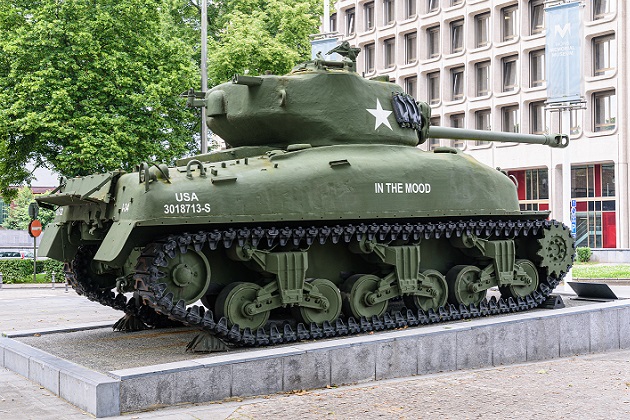
This M4A1(76)W named “IN THE MOOD” is on display at the Mons Memorial Museum in Belguim. This tank was most likely from the Belgium Army which was in service from 1949/50 and phased out of service sometime after 1951. It is a later M4A1 production model equipped with a muzzle break on the 76mm gun. The muzzle brakes were added to the M4 production lines in the fall of 1944.
Models and Decals
1/35
Dragon 6083 M4A1(76)W “Operation Cobra” – 2005
Italeri 6568 M4A1 Sherman with US Infantry – 2019
1/72
Neo Dragon Armor 63176 M4A1(76)W VVSS “In The Mood” (Pre-assembled) – 2023
1/76
Aleran Miniatures Decals US-2 US Sherman Aces Markings – 2003

 Mike's Research