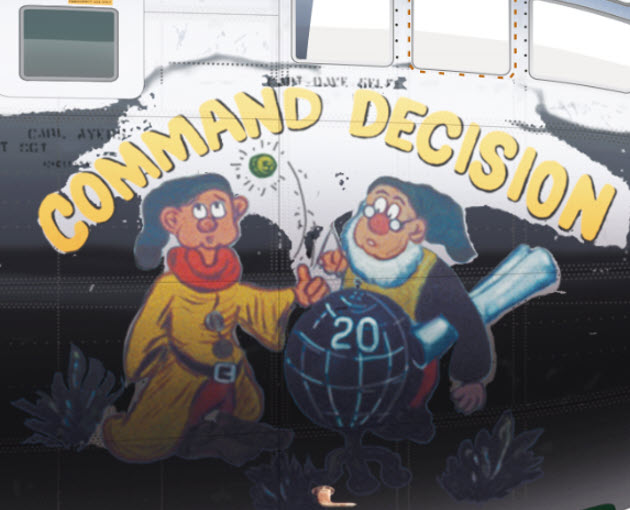
B-29 named “Command Decision” became famous during the Korean War for shooting down five enemy MiG-15 jet fighters, making it the world’s only bomber “jet ace.”
The largest US aircraft of WWII, the Boeing B-29 Superfortress was designed with state-of-the-art technology at the time, which included a pressurized cabin, and a dual-wheeled tricycle landing gear. The pressurized compartments allowed the crew to fly at freezing high altitudes without having to wear heavy heated flight suits, gloves, and oxygen masks.
The total cost to design, develop, and produce the B-29 fleet during WWII was approximately $3 billion (roughly $54 billion today) USD. The B-29 program was the single most expensive weapons project for the US during the entire war. It exceeded the highly classified Manhattan Project (the Atomic bomb) which cost roughly $1.9 to 2 billion USD.
B-29 Superfortress Specifications
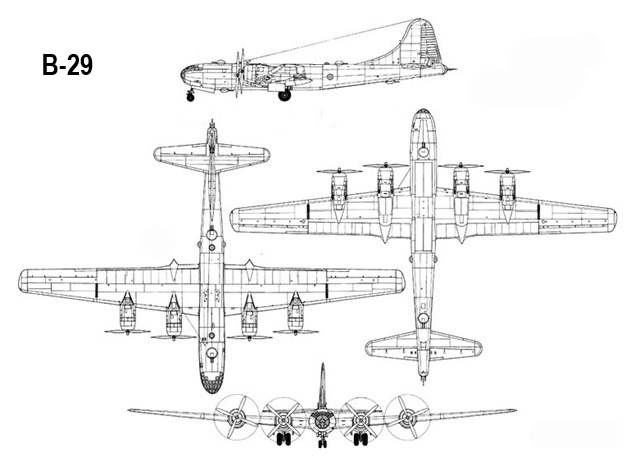
Crew: 11
Span: 141 ft. 3 in. (43 m)
Length: 99 ft. (30.2 m)
Height: 27 ft. 9 in. (8.5 m)
Weight: 133,500 lbs. (60554.6 kg) maximum
Engines: Four Wright R-3350s of 2,200 hp each
Maximum speed: 357 mph (558.44 kmh)
Cruising speed: 220 mph (354 kmh)
Range: 3700 miles (5954.57 km)
Ceiling: 33,600 ft. (10241.28 m)
Offensive Armament:
20,000 lbs. (9,071.84 kg) of bombs
Defensive Armament:
Two .50-caliber machine guns in four remote controlled turrets plus two .50-caliber machine guns and one 20mm cannon in the tail. Each .50-caliber machine gun had 500 rounds of ammunition.
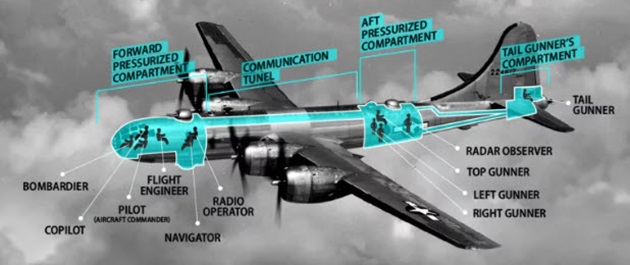
The B-29 had three pressurized compartments. The flight crew were in the forward compartment. The Radar Observer and three gunners were in the aft compartment and the tail gunner was in his own isolated compartment in the tail. A tunnel connected the forward compartment and the aft compartments.
The General Electric Central Fire Control (CFC) system on the B-29 directed four remotely controlled turrets armed with two .50 Caliber Browning M2 machine guns each. All the weapons were aimed optically, with targeting computed by analog electrical instrumentation. There were five interconnected sighting stations located in the nose and tail positions and three plexiglas blisters in the central fuselage.
Five General Electric analog computers (one dedicated to each gun sight) increased the weapons’ accuracy by compensating for factors such as airspeed, lead, gravity, temperature and humidity.
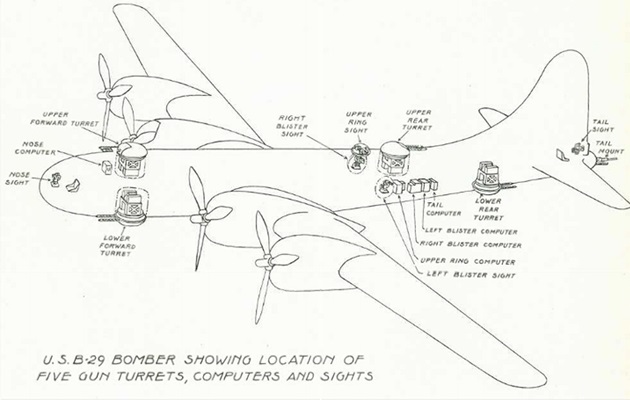
Each of the B-29’s five gun turrets had provisions for mounting a standard GSAP (Gun Sight Aiming Point) camera, such as the rectangular AN-N6 gun camera. The gun cameras were integrated onto the gunners’ pedestal gunsights rather than inside the unmanned gun turrets themselves. To ensure combat results were fully captured, the system included an “overrun” control mechanism. This kept the gun camera recording for up to 3 seconds after the gunner stopped firing, capturing whether the target burst into flames or broke apart.
The CFC system allowed a single gunner to operate two or more turrets (including the tail guns) simultaneously.
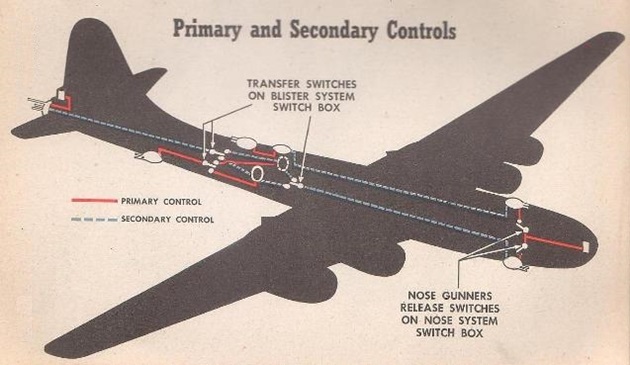
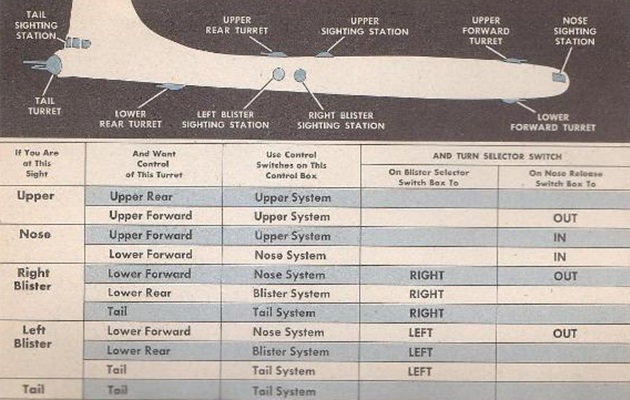
Upper Forward Turret:
Controlled primarily by the Bombardier (Nose Gunner). Control could be switched over to the Top Gunner (CFC Officer).
Lower Forward Turret:
Also controlled primarily to the Bombardier. Control could be transferred down to either the Left or Right Side Blister Gunners.
Upper Aft (Rear) Turret:
This turret was completely exclusive to the Top Gunner and could not be switched over to any other station.
Lower Aft (Rear) Turret:
This turret was designated primarily for the Side Blister Gunners. While no other stations (like the nose or top) could take it over, the left and right waist gunners could switch control of it between themselves using toggle switches.
Tail Turret:
Operated primarily by the Tail Gunner from his isolated compartment. Control could be handed off as a secondary option to the Left or Right Side Blister Gunners
The CFC system tracked targets by pairing manual optical tracking with a network of electromechanical analog computers which was highly effective against propeller aircraft during WWII. To track an enemy aircraft, the system relied on the human gunner and the machine. The gunner sat at a Gun Sighting Station and used a remote optical sight.
Pedestal Gun Sighting Station
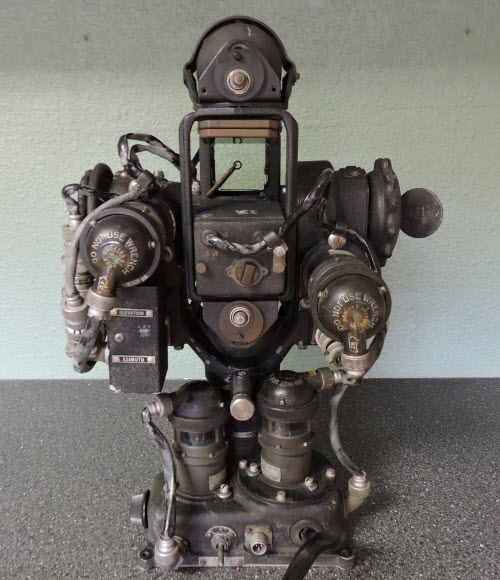
The gunner manually tracked the enemy aircraft, keeping it framed inside a circular ring of dots (a reticle). As the aircraft closed in, the gunner manually adjusted a knob to expand or contract the reticle ring to perfectly match the target’s profile. The gunners were required to memorize the wingspans of all enemy aircraft types. By inputting the specific wingspan of an aircraft such as a MiG-15, the 33 foot (10 meters) wingspan is entered into the sight, the computer could then instantly calculate the exact range of the target based on how wide the gunner had opened the reticle.
As the gunner moved the sight to follow the enemy aircraft, digital and electrical measuring devices on the sight base transmitted the live azimuth (horizontal) and elevation (vertical) angles straight to the target analog computer.
Overridden Gun Sight Control
The gunner who lost control of a gun turret can still freely move their own gunsight pedestal, look through the optics, adjust their range dials, and track targets. The only difference is that their sight is now “dead” in terms of output. It is sending electrical tracking data to an empty circuit rather than the servo motors of the remote gun turret. The glowing ring of dots (the reticle) inside the sight stays illuminated, allowing the overridden gunner to keep tracking an enemy fighter in case they get the turret control back again.
Because the sights did not give physical feedback (like a sudden jerk or locking in place) when a turret control was lost, B-29 doctrine strictly required gunners to communicate over the interphone when taking or giving up a gun turret control. This ensured no gunner spent critical seconds firing a “disconnected” gun sight.
Analog Computer
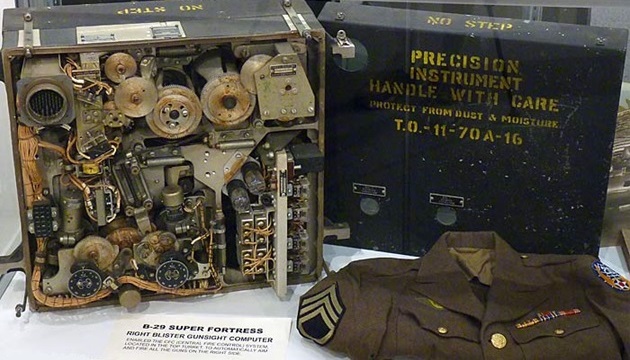
Once the tracking data reached the analog computer’s dense, 50 pound (22.66 kg) steel boxes filled with gears, clutches, and electrical relays calculated the variables mechanically to aim the unmanned, remote gun turrets. It calculated three main corrections:
Target Lead:
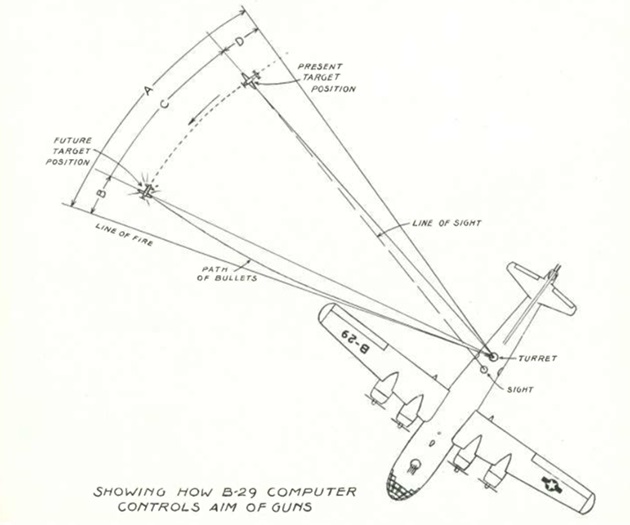
Internal gyroscopes inside the sight measured the speed at which the gunner was tracking the target. The computer used this angular velocity to determine the “lead”, aiming the machine guns up to hundreds of yards (meters) ahead of the jet so the machine gun fire would hit the target.
While early production B-29s initially paired twin .50 Caliber machine guns with a single 20mm M2 cannon in the tail, the configuration was highly problematic. Because the heavier 20mm shell and the lighter .50 caliber rounds had vastly different ballistic trajectories, the CFC analog computer could not accurately predict a single unified lead angle. This caused the two gun types to diverge drastically downrange, making long range bursts highly inaccurate. In later production batches, the 20mm M2 cannon was omitted and the tail had two or three .50 Caliber machine guns.
Environmental Ballistics:
The computers were plugged directly into the B-29’s flight instruments. It continuously factored in the bomber’s airspeed, altitude, outside air temperature, and wind deflection to counteract gravity drop and air resistance on the .50 caliber rounds.
Parallax Correction:
Because the gunners sat comfortably inside a heated, pressurized fuselage while controlling unmanned gun turrets mounted a distance away on the outside of the plane, the computer instantly calculated the physical offset (parallax). This ensured that no matter where the gunner was sitting, the remote guns converged exactly where the optical sight was pointing.
This image shows the final result of a firing solution of the upper aft gun turret on a B-29.
The effective range of the CFC system was 900 yards (822.96 meters), which was 50% better than the manual systems used on the older B-17 and B-24 bombers. Between August 1944 and August 1945, B-29 gunners were credited with shooting down 914 Japanese fighters.
B-29 Production
Manufacturing the B-29 was a complex task that involved four main-assembly factories. Thousands of subcontractors were also involved in the project. Production of all variants ran from 15 April 1943 to 28 May 1946.
| Manufacturer | Facility & Location | Plant Code | Number Built |
|---|---|---|---|
| Boeing | Wichita, Kansas | BW | 1644 |
| Boeing | Renton, Washington | BN | 1122 |
| Bell Aircraft | Marietta, Georgia | BA | 668 |
| Glenn Martin Company | Omaha, Nebraska | MO | 536 |
| Total | 3970 |
Boeing Wichita B-29 Assembly Line
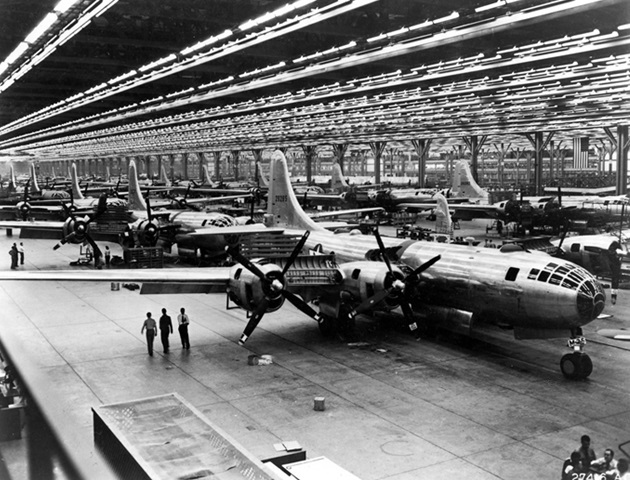
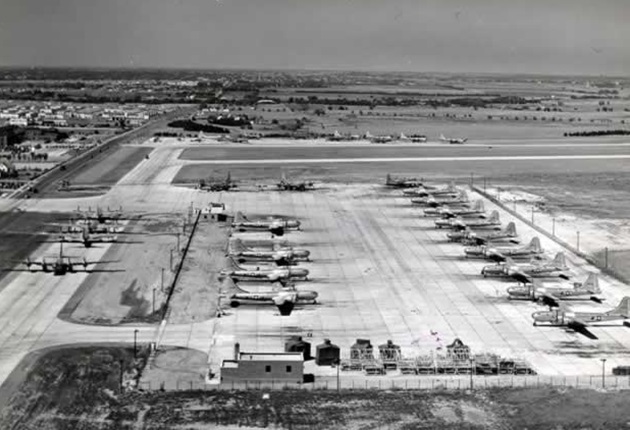
New B-29s parked on the tarmac at the Boeing Wichita Plant.
B-29 44-87657
Boeing B-29-85-BW Superfortress, serial number 44-87657, construction number 12478, was built at the Boeing Wichita Kansas plant during mid 1945. B-29 44-87657 was in one of the later production blocks which did not have a 20mm cannon. It had three .50 Caliber machine guns in the tail.
On 9 June 1945, the completed B-29 44-87657 was delivered to the USAAF and was to be sent to Gaum for assignment. It was scheduled to be ferried to Gaum which took 4-7 days of islanding hopping depending upon the weather. B-29 44-87657 arrived on Gaum sometime in late June or early July 1945. The ground crews began making in-theater modifications to it.
B-29 44-87657 was assigned to the 878th Bomb Squadron, 499th Bomb Group, 73rd Bomb Wing on Saipan as a replacement aircraft. Before flying to Saipan, the new crew flew a couple shake down flights. On Saipan, the 878th squadron ground crews began getting it ready for combat missions which included adding tactical markings.
On 15 August 1945, the Japanese announced their surrender and the war ended before B-29 44-87657 flew any combat missions. The USAAF immediately ceased combat operations and quickly shifted its focus to peacetime operations. Over the next several months, the fleet of B-29s were dispersed. While the war-weary early version B-29s were sent to Clark Field in the Philippines to be scrapped, the newer versions were said to been ferried back to the US.
There is no information of what actually happened to B-29 44-87657 during the late 1940s. Sources state it was used to maintain strategic bombing readiness and trained bomber crews but does not list which units it belonged to. Some believe B-29 44-87657 was put into long-term storage at one of the facilities in the US waiting until it was needed again.
Korean War
On 25 June 1950, North Korea invaded South Korea. On 28 June 1950, four B-29s from the USAF 19th Bomb Group attacked North Korean-occupied rail yards and bridges near Seoul. This strike was roughly six hours before US President Harry S. Truman officially authorized US military intervention in Korea. Also on June 28th, the very first official aerial victory was awarded to a B-29 gunner during the war when gunners of a B-29 shot down an attacking North Korean Yak-9P fighter over Kimpo Airfield, about 15 km (9 miles) west of the central district of Seoul.
B-29 44-87657 was made ready for combat and was sent to the 28th Bomb Squadron of the 19th Bomb Group at Andersen Air Force Base on Guam. The 19th Bomb Group was assigned to its parent wing, the 19th Bomb Wing, and it was physically detached to fly combat missions out of Kadena Air Base on Okinawa. The exact date of its arrival is not known.
Administratively, the 19th Bomb Group belonged to the USAF Twentieth Air Force. However, for its daily combat operations over Korea, it was placed under the operational control of the Far East Air Forces (FEAF) Bomber Command (Provisional). Unlike most other B-29 units sent to Korea, the 19th Bomb Group was unique because it was already permanently stationed in the theater and was the only B-29 unit that did not belong to the Strategic Air Command (SAC).
The distance from Kadena Air Base, Okinawa to the Yalu River in North Korea is approximately 923 miles (1,486 km) or about 802 nautical miles.
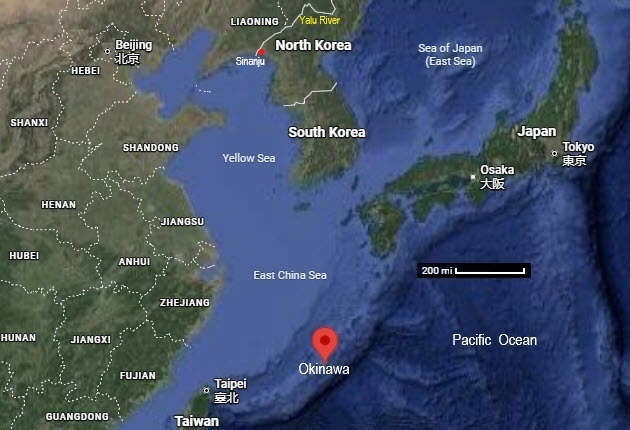
On 1 November 1950, the MiG-15 jet first appeared in combat over Korea. On the morning of November 30th, a B-29 attacking an airfield in North Korea was intercepted and lightly damaged by a jet fighter moving at a speed too fast for the bomber’s gunners to properly track. The B-29’s Central Fire Control (CFC) system had met its technological limit. The high speeds and high closing rates of the Soviet-built MiG-15 often outpaced the physical calculation speeds of the computer’s spinning gears and electrical relays.
B-29 Command Decision
The crew named B-29 44-87657 “Command Decision” after the 1948 movie of the same name directed by Sam Wood. The movie was based on the 1948 stage play with the same name written by William Wister Haines, which he based on his best-selling 1947 novel. It was about the difficult decisions and heavy casualties of bomber operations over Europe in WWII.
Film: Command Decision (1948) Clark Gable, Walter Pidgeon, Van Johnson
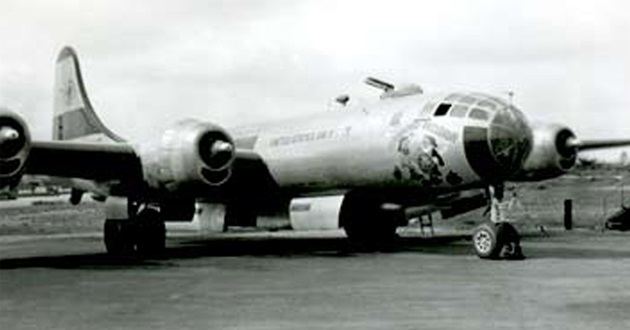
B-29 Command Decision parked on its hard stand.
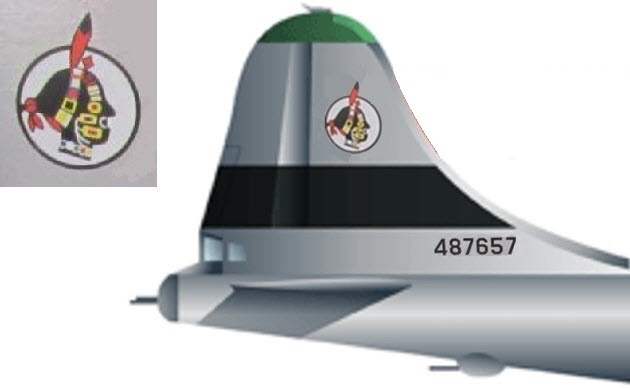
The tail details of B-29 Command Decision. On the tail is the “Indian Head” insignia of the 28th Bomb Squadron and the tail tip is painted the squadron color Green.
B-29 Command Decision 1951 crew
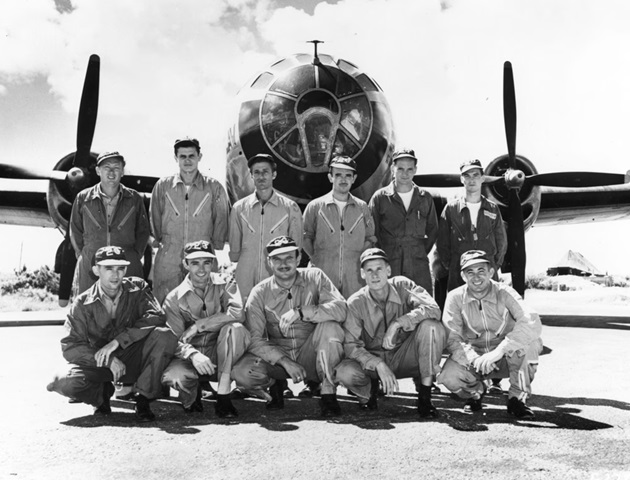
Standing left to right:
- Technical Sergeant Carl W. Ayers, Flight Engineer
- Sergeant Stanley Smigel, Radio Operator
- Staff Sergeant Michael R. Martocchia (22 May 1919 to 14 April 1999), Central Fire Control (CFC) Gunner
- Sergeant John J. Nally, Left Waist Gunner
- Private First Class Henry E. Ruch (5 November 1925 to 27 November 1999), Right Waist Gunner
- Sergeant Merle Allen Goff (8 December 1930 to 10 November 2006), Tail Gunner
Kneeling, left to right:
- Captain Donald Marion Covic (6 July 1923 to 16 June 1991), Aircraft Commander/Pilot
- Captain David Anthony “Dave” Self Jr. (13 November 1923 to 8 September 2010), Co-Pilot
- Lieutenant Daniel M. Price, Navigator
- First Lieutenant William M. Hammond, Bombardier/Nose Gunner
- First Lieutenant Bernard G. Stein, Radar Observer
Nose Art
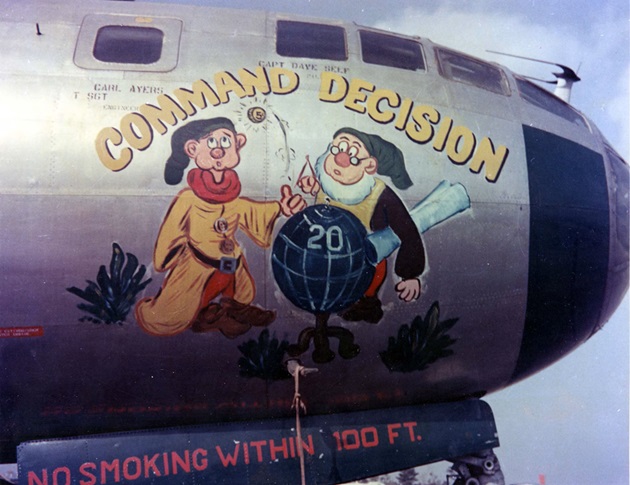
Facing high-risk missions over Korea, the crew joked that the high-stakes, seemingly impossible “command decisions” handed down to them by top brass were not actually the result of complex strategic planning. Instead, they cynically and humorously believed the top brass must just be flipping a coin to make their choices.
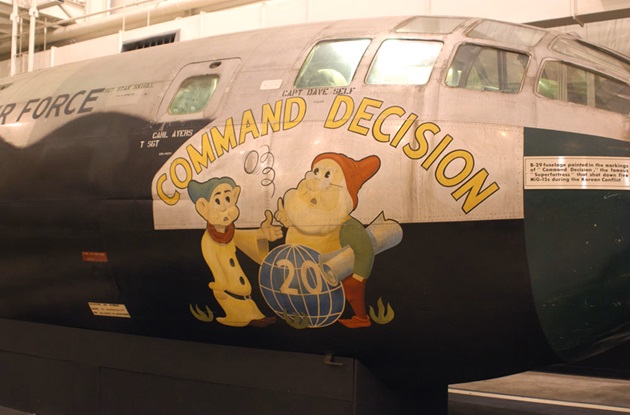
The nose art depicts Walt Disney’s cartoon characters Dopey and Doc (from Snow White and the Seven Dwarfs) flipping a coin to make a “command decision”.
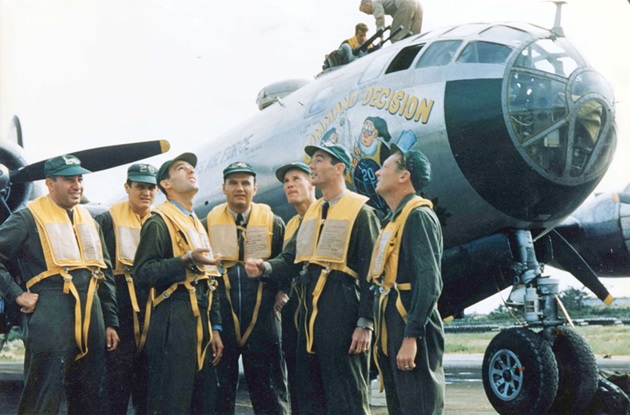
The second crewman from the right flipped the coin to make a command decision. Captain Covic is the third man from the left, looking upward and holding his hand out to catch the coin which is in the air. The other crewmen stand around watching the coin toss.
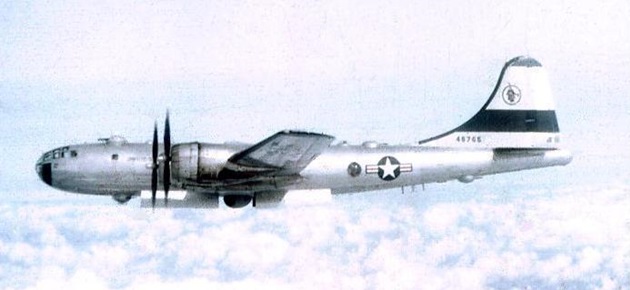
B-29 Command Decision in flight on an early bombing mission. There is no information on what date was its first bombing mission over Korea. The US national insignia on the fuselage has the thin red bars on the wings. On the belly between the two open bomb bay doors is the AN/APQ-13 radar dome.
Confirming Kill Claims
For B-29 gunners in Korea, confirming a MiG-15 claim followed a rigid verification process managed by US military intelligence. To have a claim officially “confirmed,” the USAF required rigorous supporting proof to minimize the chaos and natural over-claiming of the high-speed air battles.
The most decisive pieces of physical evidence was gun camera films. After returning from a mission, intelligence officers reviewed this footage from all five Gun sights to look for undeniable visual proof of a kill:
- The MiG-15 explicitly exploding or breaking apart in mid-air.
- The MiG-15 catching fire and entering an unrecoverable, fatal spin.
- The pilot bailing out of the MiG-15.
Because combat against the high speed MiG-15 happened in fractions of a second, gun camera film was frequently supplemented by visual witness testimony. A claim typically required verification from other observers who could confirm what happened to the enemy jet. This included:
- Testimony from gunners on other B-29s within the combat formation.
- Confirmation from a UN escort (F-86, F-84, F-80, F9F Panther, F2H Banshee, RAAF Gloster Meteor).
- Testimony from another crewman inside the same B-29. This was the most common eyewitness verification.
The gunners of B-29 Command Decision scored their five confirmed MiG-15 kills on three separate bombing missions.
31 May 1951 Mission
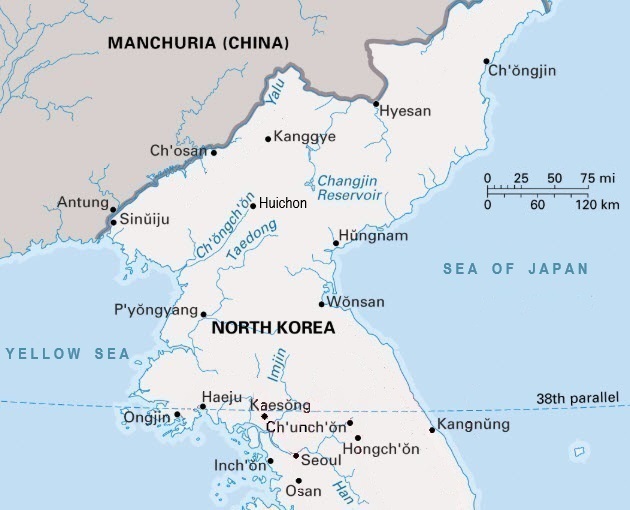
The target of the daylight 31 May 1951 mission was the Sinhung-dong rail bridge in North Korea. Sinhung-dong is an administrative neighborhood (or dong) located in the southern part of Huichon city. The vital Manpo Railway Line runs directly along the Chongchon River valley there. As the rail line enters the southern outskirts of the city, it crosses the river channel at Sinhung-dong.
In Korea, the bomber crews did not exclusively own their aircraft. While Captain Covic is famously celebrated for commanding B-29 “Command Decision”, bombers frequently were offline for heavy depot maintenance, damage repairs, or periodic checks. During these gaps, a crew would be assigned whatever combat-ready airframe was available on the tarmac.
On the 31 May 1951 mission, Captain Covic and his crew actually flew B-29A-35-BN named “Never Hoppen”, serial number 44-61562, also referred as B-29 #1562 (last 4 digits of the serial number).
Originally, the nose art on B-29A “Never Hoppen” was totally nude. After complaints from the base commander’s wife, the base Chaplain, and the USAF top brass, orders were issued to remove all indecent nose art from the B-29s. The crew of B-29A Never Hoppen compromised and painted a bikini swim suit over the private areas.
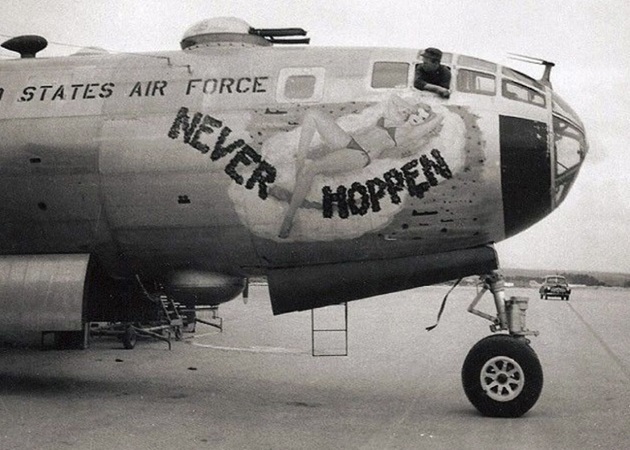
B-29 #1562 arrived at the assembly point and got into formation as #2 wing man in a two ship formation. From the assembly point, Command Decision proceeded to the fighter rendezvous and picked up a four ship F-86 fighter escort. Just as B-29 #1562 left the initial point on the bomb run to the target, they were attacked by approximately 20 MiG-15s.
In the ensuing battle the tail gunner, Sergeant Goff, damaged a MiG-15 and CFC gunner, Staff Sergeant Martocchia, shot down another MiG-15. Martocchia’s MiG-15 kill was confirmed by Lieutenants Self and Hammond. Lieutenant Self was able to take a photograph of the MiG-15 pilot as he bailed out and floated down pass the rear of B-29 #1562’s starboard (right) wing. While on the bomb run, the forward bomb door failed to open so Covic pulled the emergency release handle to his left and it then opened and the bombs dropped.
B-29 #1562 was hit by a canon shell from the MiG-15 fighters just aft of #2 engine. A hole about 2 feet (60.96 cm) square was later found as a result of the cannon exploding in the wing section. Lieutenant Hammond was able to drop his bombs exactly with the lead aircraft while the attack was in progress and the target was hit. The enemy fighters continued their attack until the turnoff the target was accomplished despite the fact that the F-86 escorts had engaged them.
Days after this mission, Captain Covic and his crew was flying B-29 Command Decision again.
17 October 1951 Mission
This mission was a daylight raid targeting the strategic Sinanju Rail Bridges on the Yalu River on the China-North Korea border.
Since F-86 Sabre pilots had reported that the MiG-15s would not fight over water, the B-29s were routed over the Yellow Sea for as long as possible. But in the short time while the bombers turned inland to attack the bridge, they were jumped and attacked by MiG-15 jet fighters operating in the area.
Sergeant Merle Allen Goff (tail gunner) was credited with shooting down a MiG-15. As the MiGs swooped into the vulnerable rear quadrant of the aircraft, Sergeant Goff locked onto an attacking fighter from his manned tail turret. He fired a continuous, accurate burst of .50-caliber rounds directly into the path of the oncoming jet, scoring critical hits that destroyed the MiG-15.
Meanwhile, Private First Class Henry Ruch (right waist gunner) claimed two more MiG-15s from his sighting station, however, both of them were not confirmed.
27 October 1951
This mission was a daylight medium-bomber raid, returning once more to destroy the repaired Sinanju Rail Bridges on the Yalu River. Eight B-29s attacked a railway bypass bridge at Sinanju. Command Decision was the lead aircraft of the second formation. About 95 MiG-15s overwhelmed the escort fighters and attacked the B-29s.
Aerial photograph shows B-29 Command Decision (A/C #657) dropped it bombs on the railroad bypass and bridges at Sinanju, North Korea, on 27 October 1951.
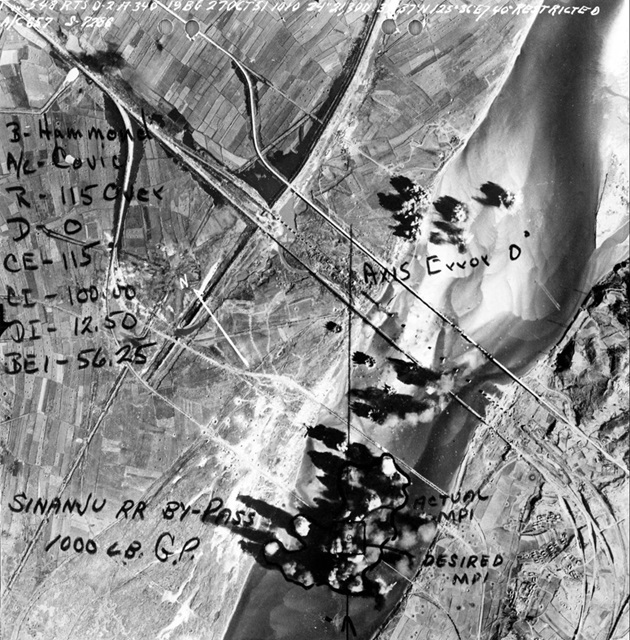
After B-29 Command Decision dropped their bombs, it was attacked by a formation of six MiG-15’s. Private First Class Harry E. Ruch, the right waist gunner, concentrated his fire on the lead MiG-15 until it was only 200 yards (182.88 meters) out. At that point, the MiG-15 had large flames pouring from its trailing edge. It began falling and crashed into the earth.
Two MiG-15s broke toward the tail of the bomber, right into Sergeant Merle Goff’s gunsights. He covered both MiG-15s with fire starting at 800 yards (731.5 meters). One MiG-15 was hit immediately and started spinning violently, later hitting the ground. Since the MiG-15 crashing was not observed, it had been recorded as damaged or a probable kill. He continued firing on the second MiG-15 until it got out about 2000 yards (1828.8 meters), after which it peeled off to the left and plunged straight into the ground.
Staff Sergeant Michael R. Martocchia was credited with a MiG-15 kill. A single MiG-15 made a pass from high and behind the bomber. It dove within 10 yards (9.144 meters) of Martocchia’s gun, directly into his sights. He poured heavy fire into the MiG-15 until it was about 100 yards (91.44 meters) in a climbing turn. Then the MiG-15’s canopy was seen flying off in pieces and the MiG began to fall sharply downward, crashing into the ground.
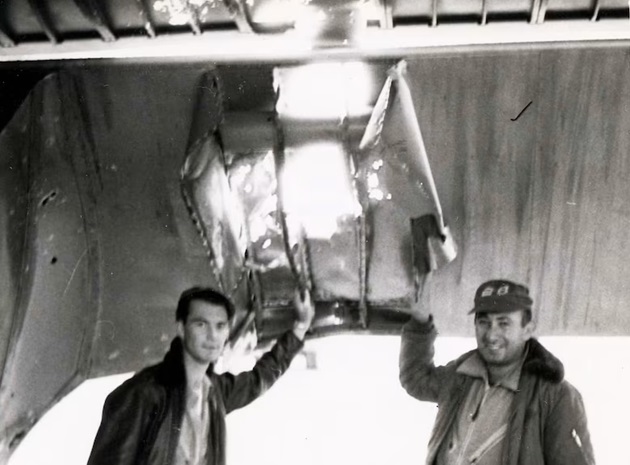
These 3 victories came at a cost. During the intense aerial dogfight, a 23mm or 37mm cannon shell from an attacking MiG-15 struck B-29 Command Decision, causing serious damage to one of its wing flaps. Despite the damage, the crew successfully flew the aircraft back to Okinawa.
Two airmen pose with the hole in B-29 Command Decision‘s flap caused by a MiG-15’s cannon shell.
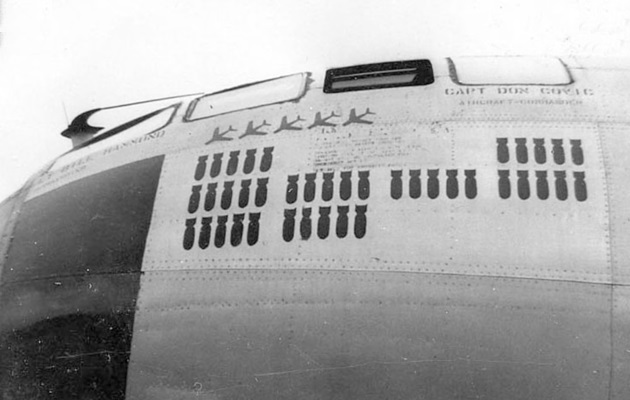
B-29 Command Decision 1951 Gunner’s Confirmed MiG-15 Kills.
| Mission Date | Martocchia | Goff | Ruch | Totals |
|---|---|---|---|---|
| 31 May 1951 | 1 | 1 | ||
| 17 October 1951 | 1 | 1 | ||
| 27 October 1951 | 1 | 1 | 1 | 3 |
| Totals | 2 | 2 | 1 | 5 |
Some sources state the confirmed kills were these, but it is recorded that PFC Ruch got only one confirmed kill on October 27th. Staff Sergeant Martocchia still had his 31 May 1951 confirmed kill, but it was not considered one of the five.
| Mission Date | Martocchia | Goff | Ruch | Totals |
|---|---|---|---|---|
| 17 October 1951 | 1 | 2 | 3 | |
| 27 October 1951 | 1 | 1 | 2 | |
| Totals | 1 | 2 | 2 | 5 |
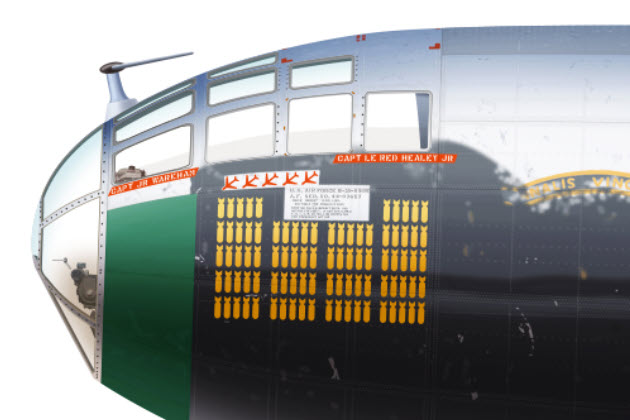
The scoreboard on B-29 Command Decision shows the five MiG-15 markings plus 40 bombing missions. The name under the window on the right is “CAPT DON COVIC”.
MiG-15 Units
Soviet pilots flew MiG-15s with North Korean (and Chinese) markings to provide plausible deniability and prevent a direct military escalation with the US, which could have triggered WWIII. To maintain this absolute secrecy, the Soviet military implemented a series of strict operational deceptions:
The Soviet pilots were required to wear North Korean military uniforms or plain civilian clothing rather than their Soviet gear. Many of these pilots were hardened WWII combat veterans and top-scoring aces who possessed hundreds of flight hours and lots of experience fighting the German Luftwaffe.
The Soviet pilots were strictly forbidden from speaking Russian over the radio. They were issued Cyrillic-based phonetic cheat sheets containing common Korean aviation terms. However, this fell apart during fierce dogfights, where panicked or adrenaline-fueled pilots instinctively reverted to swearing and coordinating in Russian, a fact quickly picked up by US intelligence and UN pilots. In some close combat encounters, UN pilots reported that the MiG-15 pilot had blonde or red hair.
Three MiG-15s attacking USAF B-29s over Korea, 1951.
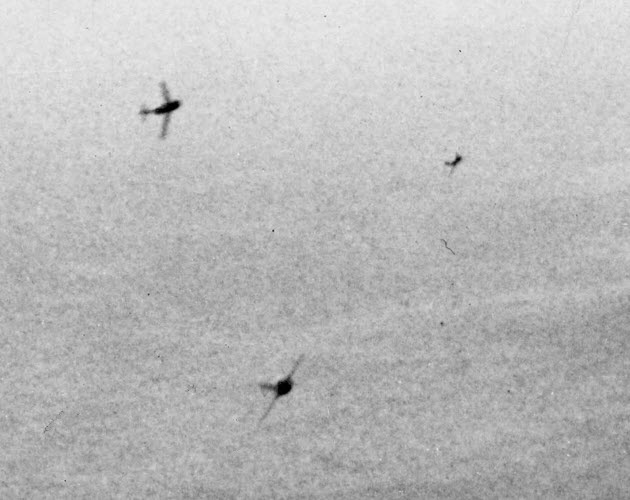
The Soviet Union’s 64th Fighter Aviation Corps operated 5 elite MiG-15 fighter aviation regiments out of the Antung Air Base complex. These regiments were divided into two main Fighter Aviation Divisions:
324th Fighter Aviation Division (324th IAD)
- 176th Guards Fighter Aviation Regiment (176th GIAP)
- 196th Fighter Aviation Regiment (196th IAP)
303rd Fighter Aviation Division (303rd IAD)
- 17th Fighter Aviation Regiment (17th IAP)
- 18th Guards Fighter Aviation Regiment (18th GIAP)
- 523rd Fighter Aviation Regiment (523rd IAP)
The 324th IAD, commanded by the famous WWII ace Colonel Ivan Kozhedub, had been operating from Antung since April 1951. The 303rd IAD, commanded by General-Major Georgiy A. Lobov, arrived in the theater in June 1951 and engaged in full combat operations by August 1951.
At a conference in Japan on 28 October 1951, the FEAF leadership agreed that virtually no amount of fighter escort could keep the MiG-15s off the bombers. But instead of not using the B-29s, it was proposed that Bomber Command operate only at night.
Using beacons on the ground and transceivers in the bombers, Short Range Navigation (SHORAN) bombing allowed the B-29’s to accurately and safely conduct bombing raids at night. SHORAN bombing attacks began in November 1951 and it effectively ended the MiG-15 threat to the bombers.
For night missions in WWII and Korea, the underneath surfaces and the lower sides of the B-29s were painted with a highly specialized, mirror-like high-gloss jet black paint (designated as Jet No. 622). Standard flat black paint scatters light in all directions, making the bomber appear as a bright, glowing silhouette against the dark night sky when hit by a searchlight beam. When a concentrated searchlight beam hit the glossy black belly, the light reflected off the surface at a tight, specific angle (specular reflection) rather than bouncing straight back down to the ground operators.
One B-29 in four carried an AN/APR-4 radar intercept receiver and an additional crewman to operate it. This radar scanned the radiation from the enemy’s searchlight radars and gun-lying sets. As a result, these threats could be located and mapped.
While lacking onboard search radars, standard MiG-15 jet fighters were used as night fighters. They were guided by ground-controlled interception (GCI) radar units and searchlight beams on the ground to hunt and attack B-29s at night.
Because the standard AN-N6 gun cameras relied on ambient light to capture clear 16mm film, their effectiveness for air-to-air combat documentation dropped significantly during pitch black night (new moon phase) missions.
B-29 Command Decision crew in December 1951.
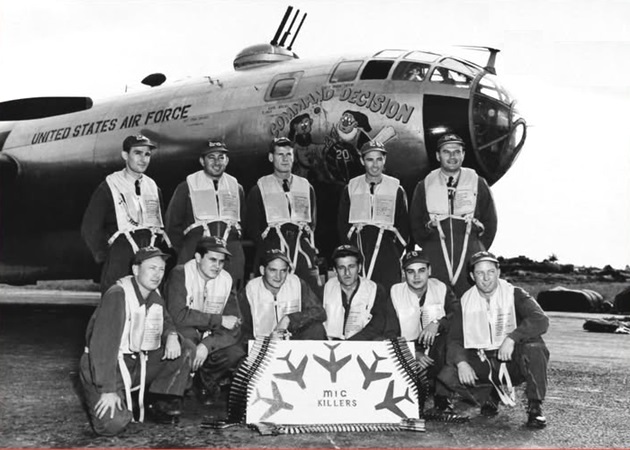
Standing left to right:
- Captain Covic, Aircraft Commander/Pilot
- First Lieutenant Stein, Radar Observer
- First Lieutenant Hammond, Bombardier/Nose Gunner
- Captain Self, Co-Pilot
- Lieutenant Price, Navigator
Kneeling, left to right:
- Technical Sergeant Ayers, Flight Engineer
- Sergeant Smigel, Radio Operator
- Private First Class Ruch, Right Waist Gunner
- Sergeant Nally, Left Waist Gunner
- Staff Sergeant Martocchia, Central Fire Control (CFC) Gunner
- Corporal Floyd J. Brown, Tail Gunner
By December 1951, Sergeant Goff (two kills) had completed his designated number of combat missions or his operational tour and had rotated back to the US, and Corporal Floyd J. Brown took over as the tail gunner.
Covic was promoted to Major. Instead of returning stateside, he signed up for another combat tour. During his second tour, he served as the Operations Officer for the 28th Bomb squadron.
By early 1952, all the 1951 crewmen of B-29 Command Decision had either rotated home or moved on.
B-29 Command Decision with black paint around the nose art. In the background is the rear of a GMC CCKW-353 M-27 Bomb Service Truck.
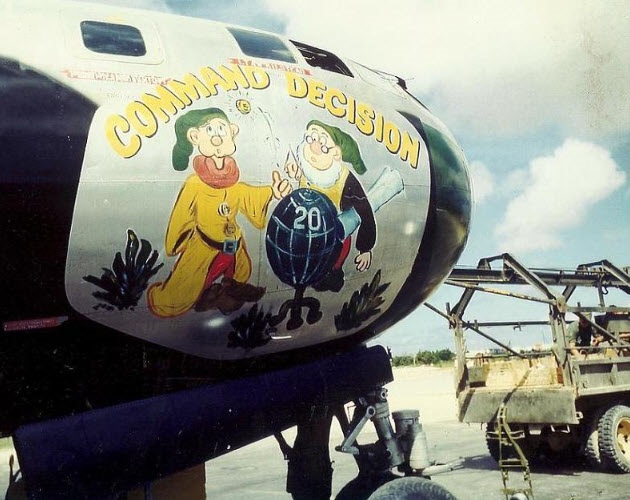
Photo: David Twombly
The last combat crew of B-29 Command Decision lined up for inspection in early 1953. Note the bomb mission markings on the fuselage on the left. Photo: Anthony J. Queeno
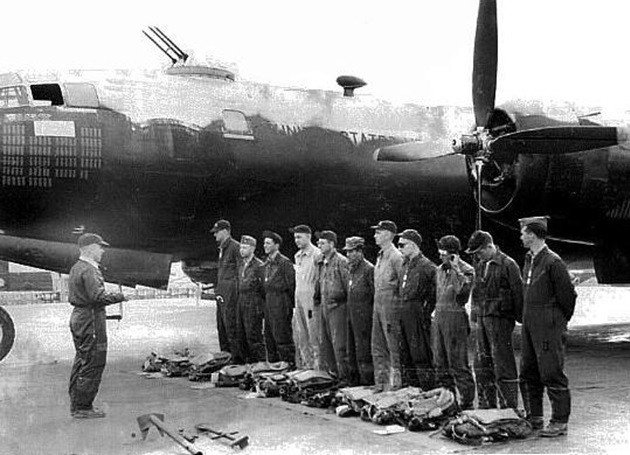
Left to Right: John Lappo, Bill Altimus, Harold French, Lawrence O’Day, James Pierce, Herbert Parsons, Bernard Cortez, Lyston Stuart, Anthony Queeno, Riccardo Fonzi, Ronald Ratliff, and a “sandbagger” (an observer or passenger).
B-29 Command Decision flew 121 missions and dropped 2.5 million pounds (1250 US tons) of bombs over Korea. Its last mission was on 27 July 1953, in the air just hours before the armistice was to take effect.
Throughout the Korean War, B-29 gunners officially claimed 27 enemy aircraft destroyed. 16 confirmed kills were specifically Soviet-built MiG-15 jets. The remaining 11 confirmed credits were older, piston-engine enemy aircraft (Yakovlev Yak-9/9P, Ilyushin Il-10, Lavochkin La-11). In addition to the 27 confirmed kills, B-29 gunners recorded 17 probable and 11 enemy aircraft damaged.
The five MiG-15 kills achieved by the gunners of B-29 Command Decision in 1951 represented nearly one-third of all the confirmed jet fighter kills credited to B-29 gunners during the entire three-year conflict.
In late 1953 after the armistice was signed, Captain L. E. “Red” Healey Jr. was the aircraft commander of B-29 Command Decision. There are 90 bombing mission markings. Due to a lack of space on the fuselage, a number of the bomb marking represent 5 missions. Note the MiG-15 kill markings are red for communist.
Aside from the credits and historic unofficial “jet ace” status for shooting down five enemy MiG-15 jet fighters, the 1951 crewmen became recognized as the most highly decorated B-29 crew in the USAF’s Far East Bomber Command. These crewmen of B-29 Command Decision received numerous individual military decorations for their service and outstanding performance over Korea.
Collectively, the crewmen received:
- 7 Distinguished Flying Crosses (DFCs)
- 9 Air Medals
Individual crewmen accumulated significant personal decorations for their roles in the missions:
- First Lieutenant Stein (Radar Observer) received the Air Medal with 3 Oak Leaf Clusters.
- Captain Covic (Aircraft Commander) earned multiple high-level awards throughout his career, including 2 DFCs, a Bronze Star, and 4 Air Medals, in addition to 18 other decorations.
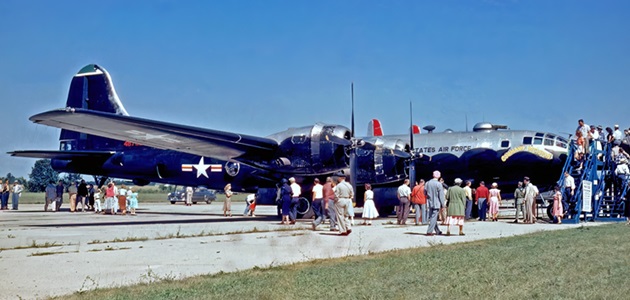
Between 1 and 7 September 1954, B-29 Command Decision (44-87657) was placed on static display at the National Aircraft Show (commonly referred to as the Dayton Air Show). The event took place at the James M. Cox Municipal Airport in Vandalia, Ohio, marking the very first time the major national show was hosted at that specific airfield. In Korea, the “Doc” and “Dopey” nose art was allowed because it boosted morale.
For the Dayton Air Show, the nose art on B-29 Command Decision was temporary overpainted black (probably water soluble paint) due to strict USAF censorship policies regarding unauthorized cartoon characters and pin-up art.
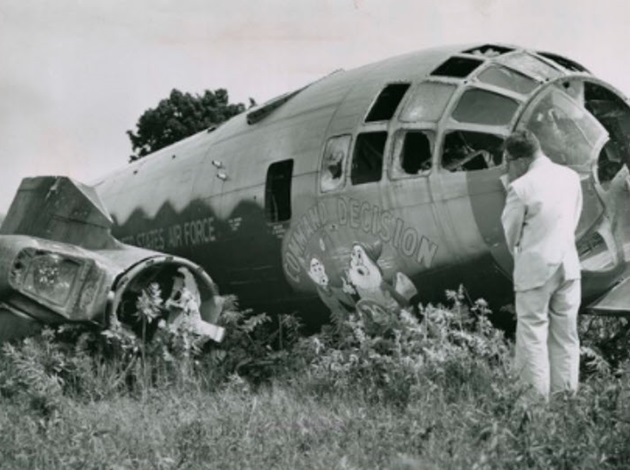
As jet bombers like the Boeing B-47 Stratojet was coming into service after the Korean War, the B-29 was declared obsolete. B-29 Command Decision was the last B-29 bomber retired from the USAF and around the beginning of 1957 it was sent to Wright-Patterson AFB to be scrapped.
The wreck of B-29 Command Decision in a dump at Wright-Patterson AFB on 14 June 1959.
Today
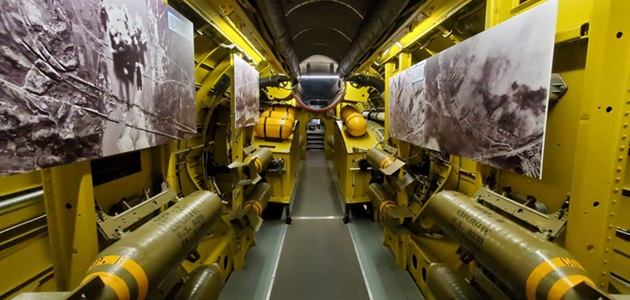
The National Museum of the United States Air Force in Dayton, Ohio, created a popular walk-through exhibit. The fuselage section of a different aircraft (B-29A-65-BN 44-62139) was painted in the historic markings of B-29 44-87657 Command Decision. One of the original defensive gunnery sighting stations from B-29 44-87657 survived the scrapping process and is preserved in the display.
Video: The MiG Eating B-29: COMMAND DECISION
Video: Command Decision B-29 Korean Bomber – Flew 121 Missions
Model Kits and Decals
1/72:
Hobby 2000 72070 B-29 Superfortress – 2023
Eduard 7423 MiG-15 – 2014
Kits World 172066 Boeing B-29 Superfortress (‘Command Decision’ and ‘Kee Bird’) Decals