The Reichswehr 1932 autumn maneuvers were large-scale military exercises in Germany, using dummy tanks showed the German army’s capabilities under the Treaty of Versailles restrictions. Reich President Paul von Hindenburg and foreign military attachés observed the maneuvers. These maneuvers was four months before Adolf Hitler was appointed chancellor of Germany.
Bewegungskrieg (war of movement) was the traditional operational doctrine of the Prussian and German armies since the 18th century. It was a military philosophy that prized speed, outflanking maneuvers, and decisive encirclement battles over static, attritional warfare.
The Germans entire strategy for WWI manifested in the Schlieffen Plan which was designed to be a massive, rapid war of maneuver to bypass French fortifications, loop around Paris, and crush the enemy in a matter of weeks. The Germans did not choose to abandon Bewegungskrieg; rather, the unique material, technological, and logistical realities of 1914 forced them to abandon it and employ Stellungskrieg (positional/trench warfare). The Germans surrendered on 11 November 1918. The Treaty of Versailles was signed on 28 June 1919 and it ended the state of war between Germany and most of the Allied Powers.
Post WWI
Reichswehr literally means “Reich Defense” and was the official name of Germany’s armed forces from 28 June 1919 to 21 May 1935. The Reichswehr was officially established on 1 January 1921, following the limitations imposed by the Treaty of Versailles, which restricted the army to 100,000 men and the navy to 15,000, prohibited heavy weapons, and forbade the establishment of a general staff.
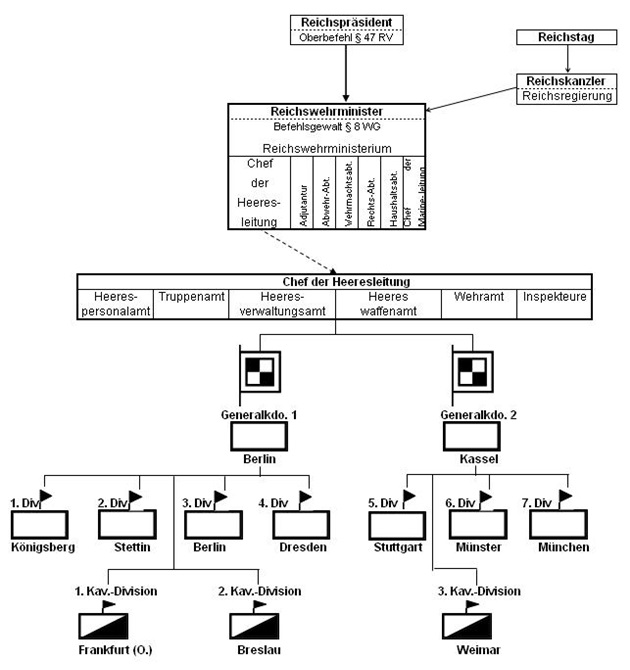
The Reichswehr consisted of two General Commands with 7 Infantry Divisions and 3 Cavalry Divisions (Kav-Divisions).
Video: Reichswehr – Germany’s Forgotten Army
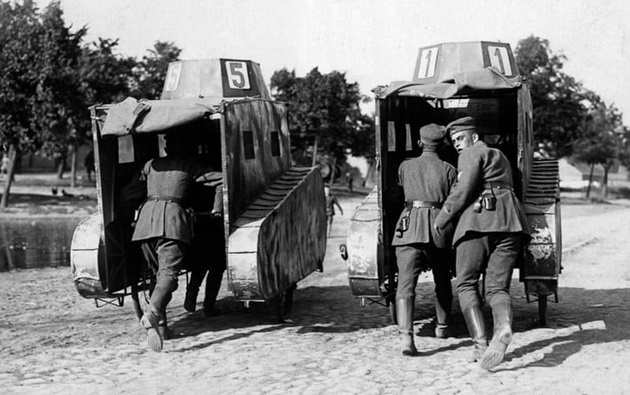
Since the Treaty of Versailles did not allow actual tanks, dummy tanks were constructed with simplified wood framed superstructures covered with tissue or cardboard mounted on bicycle tires and they were not water or weather proof.
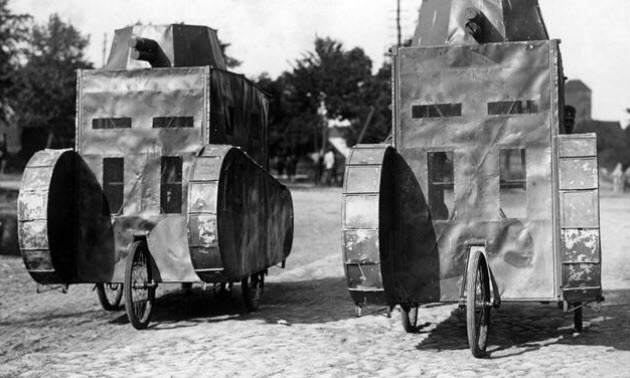
These Fahrrad (bicycle) panzer-attrappe (tank mock-ups) in 1925 were pushed by two crewmen. Note the windows on the hull sides.
Between 1930 to 1932, panzer-attrappe based on car chassis were procured. The cars used for the conversion were existing cars in the Reichswehr. The frameworks were made of wood and covered with thick cardboard or sheet metal (tin) to replicate the silhouette of a tank or armored car with a turret. They were typically constructed on the Hanomag, BMW Dixi, and the Adler Standard 6.
The Hanomag panzer-attrappe was based on the Hanomag two seater 2/10 hp passenger car also called the kommissbrot because it was often used by bakers to deliver bread. The body was simplified and covered by thin metal plates mounted on a frame. From 1927 to 1932, 300 Hanomag panzer-attrappe were procured.
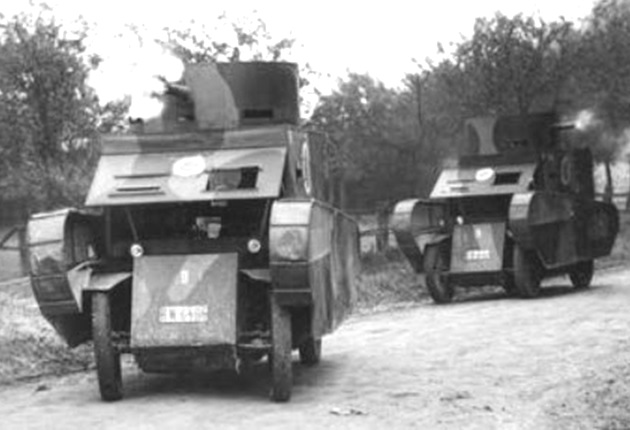
This is a close up view. The upper forward panels on the side of the tracks are sections of chicken wire screens so the driver is able to see left and right.
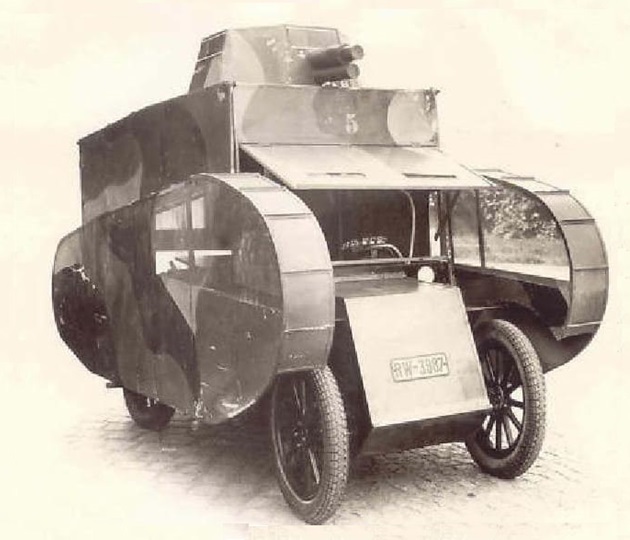
The BMW Dixi was a licensed version of the British Austin Seven produced by the auto factory in Eisenach, Germany. In 1929, the BMW firm, which only manufactured motorcycle and aircraft engines, sought to establish itself in the automobile industry. Rather than developing a vehicle on its own, it bought the factory and produced the Dixi under its own name. It was BMW’s first car model also named the BMW 3/15 hp.
The Dixi was capable of running at 45 km/h (27.9 mph) on the road and 20 km/h (12.4 mph) off-road. It weighed 750 kg (1653.5 lbs.) and had a range of 200 km (124.3 miles). From 1927 to 1929, 160 BMW Dixi panzer-attrappe were procured.
The panzer-attrappe had three separate sections made of wood and cardboard attached to a BMW Dixi car chassis. On the inside of the right side section, there is a rack for holding the spare tire. Note the rear of the car’s body had been removed.
These panzer-attrappe drew intense mockery from the traditional German infantry and cavalry units. Passing troops of these units frequently amused themselves during field exercises by puncturing the canvas walls of the panzer-attrappe with their bayonets.
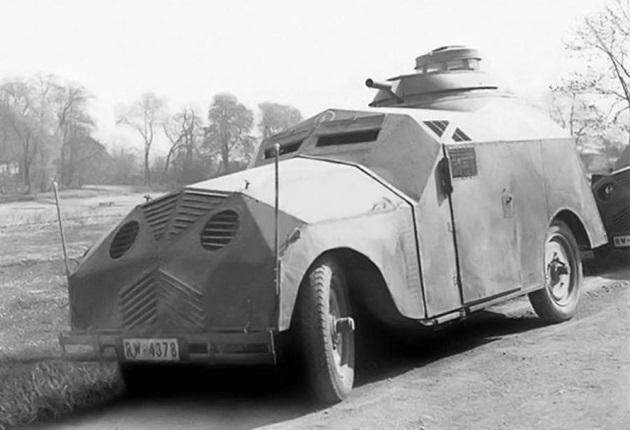
An unknown number of these Panzer-attrappe auf Adler Standard 6 were procured from 1930 to 1932. The superstructure was made of sheet metal. The weight was 2 tons (1814.4 kg). The speed was 31 mph (50 km/h) on the road and 30 km/h (18.6 mph) off-road. The operational range was around 300 km (186.4 miles).
Adler Standard 6 Allwetter (All-weather) Limousine
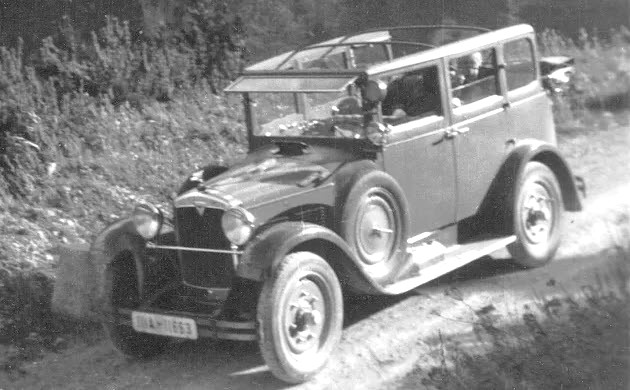
Photo: Michael Schlenger collection
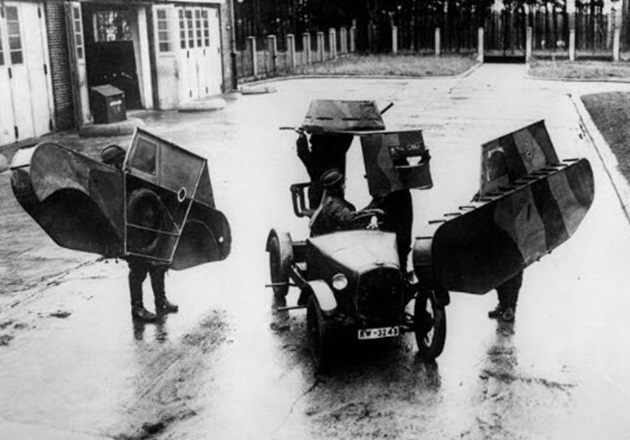
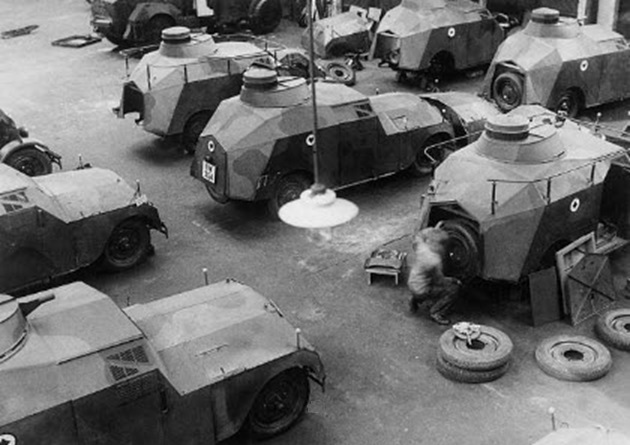
Overhead view of panzerwagen-attrappe in a workshop. The white object in the middle of the photo is the top of an overhead light fixture. A couple of panzerwagen-attrappe have the rear panel removed showing the spare tire.
It was an imposing vehicle which had a crew of four, the Commander, Driver, Gunner, and Radio Operator/Signaler. The crew are wearing the early motorized unit protective fatigue overalls with specialized crash helmets, which were standard issue for Reichswehr motorized and reconnaissance units (Kraftfahrttruppe) during the early 1930s.
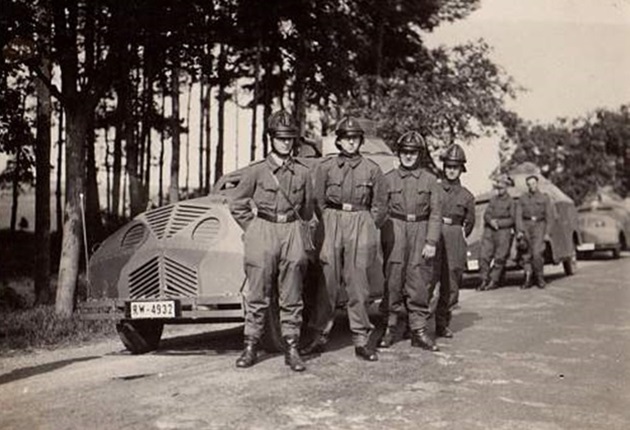
The crew posing with their panzerwagen-attrappe der Alder Standard 6 in 1930.
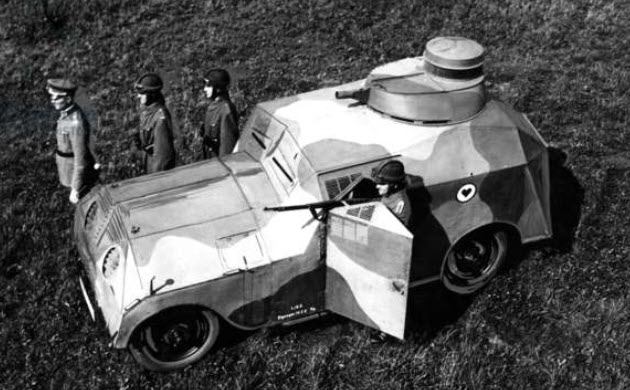
This is my close up of the above photo. Painted on the lower hull to the left of the open door is a small inscription. The top line “1./K.3.” means 1. Kompanie / 3. Kraftfahr-Abteilung. The bottom line “Eigengew. 1420 kg” is the abbreviation for Eigengewicht: 1420 Kg (3130.5 lbs.) which is the empty/net weight of the vehicle.
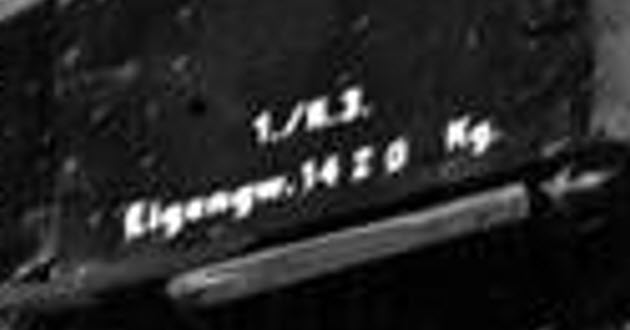
The 1. Kompanie / 3. (Preuß.) Kraftfahr-Abteilung (1st Company, 3rd (Prussian) Motorized Transport Battalion) was based within Military District III (Wehrkreis III) at the Kraftfahrer-Kaserne (Motor Transport Barracks) in Berlin-Lankwitz (southwest of Berlin) during 1930-31.
Major Heinz Guderian was the commander of 3. (Preuß.) Kraftfahr-Abteilung from 1 February 1930 to 30 September 1931. On 1 February 1931, Guderian was promoted to Oberstleutnant (Lieutenant Colonel).
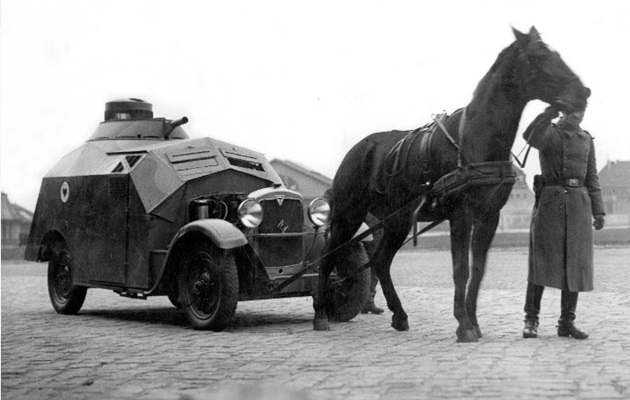
A horse towing a broken down panzerwagen-attrappe, June 1931. Note the buildings in the background which are probably at the Kraftfahrer-Kaserne in Berlin-Lankwitz.
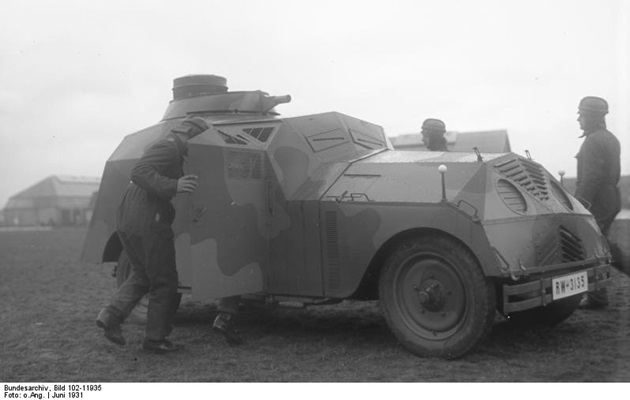
The crew by their panzerwagen-attrappe with license plate number RW-3135, June 1931. A large hangar-style building is visible in the background on the left. The buildings appear similar to the buildings in the above photo.
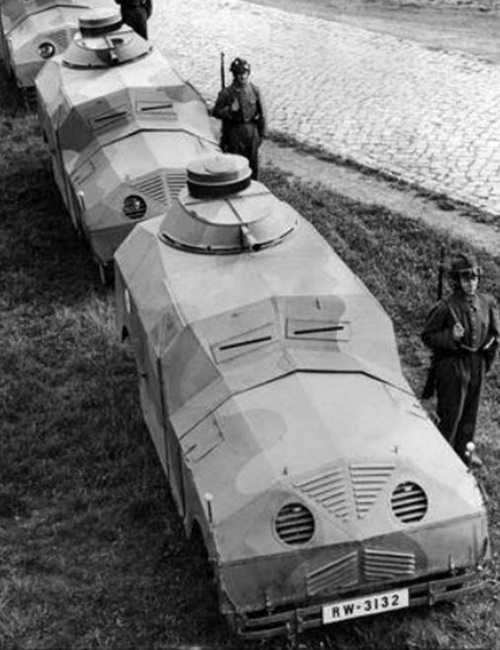
Overhead view of three panzerwagen-attrappe during August 1931. Note the small hatches on both sides of the engine cover.
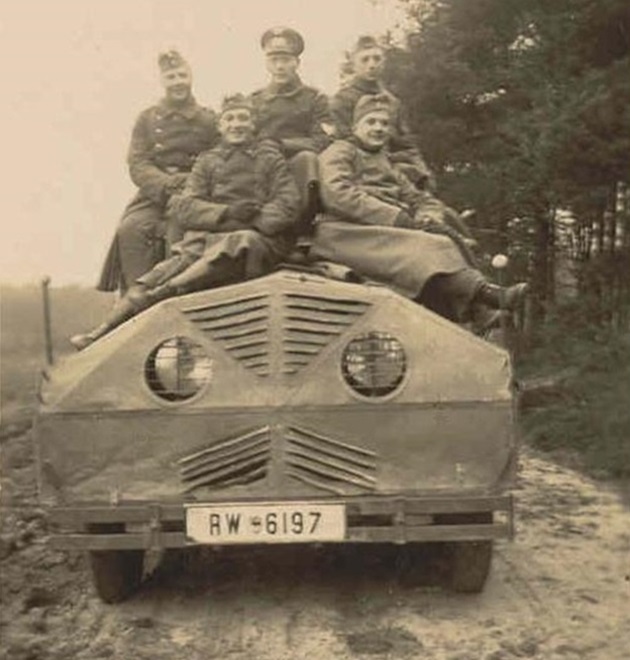
The sheet metal (tin) structure was strong enough to support five soldiers posing on top of the panzerwagen-attrappe. The Grille Slats or louvers on the front makes it looks like an angry face with the two headlights being the eyes.
On 1 October 1931, Oberstleutnant Guderian was appointed as Chief of Staff to the Inspectorate of Motorized Troops, Generalmajor Oswald Lutz. Guderian and Lutz worked in a symbiotic partnership to test and establish the baseline principles of modern mechanized warfare. Lutz provided the official institutional backing and authority required to advance motorization while Guderian acted as the organizational force and public advocate for independent armored formations.
Guderian was notoriously argumentative and frequently clashed with other traditionalist officers who opposed the independent deployment of tanks. Lutz, as the head of the Inspectorate of Motorized Troops, used his high-ranking bureaucratic weight to persuade, cajole, and smooth over the political fallout caused by Guderian’s abrasive demeanor. Without Lutz acting as an internal shock absorber, Guderian’s aggressive insubordination likely would have ended his military career much sooner.
Together, Lutz and Guderian spearheaded the creation of a mobile warfare doctrine. This included experimenting with motorized infantry, artillery, and tactical radio communication to ensure panzers could operate independently of foot-soldiers.
Guderian focused extensively on logistical and operational communication. Utilizing his background as a signals officer in WWI, he determined how radio communications could keep fast-moving armored columns coordinated without losing momentum.
The Funkkraf panzerwagen-attrappe (Radio-equipped armored vehicle mock-ups) acted as mobile command centers on the move. They allowed commanders to simulate how a fast-moving, motorized advance guard would communicate with the main forces and higher headquarters without needing to halt to string up traditional telephone lines. The mock-ups also allowed the motorized signalers to practice operating heavy, delicate interwar radio sets in restrictive spaces while coordinating directly with the driver and vehicle commander.
A Funkkraf panzerwagen-attrappe based on the Alder Standard 6. Note the framed radio antenna on this vehicle is angled on the front.
Film: Deutschlands 100.000 – Ein kleiner Auschnitt aus dem täglichen Leben unserer Reichswehr, 1932
Film title in English: “Germany’s 100,000 – A small glimpse of the daily life of our Reichswehr, 1932”. See time segment 6:38 for panzerwagen-attrappen.
Hindenburg vs Hitler
Reich President Paul von Hindenburg was a Field Marshal in the Imperial German Army commanding armies on the eastern front during WWI while Adolf Hitler held the rank of Gefreiter (equivalent to Corporal) in the Bavarian Infantry Regiment 16 of the Royal Bavarian Army during the war.
After the Treaty of Versailles was signed, Hindenburg spoke with hostility about Poland, often expressing a hope that it would disappear from the map of Europe “at an appropriate moment”.
Hindenburg met Hitler for the first time in October 1931 at a high level conference in Berlin. They took an immediate dislike to one another.
Hindenburg privately often referred to Hitler as “that Austrian corporal”, “that Bohemian corporal” or sometimes simply as “the corporal”. He also ridiculed Hitler’s Austrian accent. Hitler called Hindenburg “that old fool” or “that old reactionary” in private conversations.
In early 1932, the 84 year old independent incumbent Hindenburg was campaigning for re-election as Reich President.
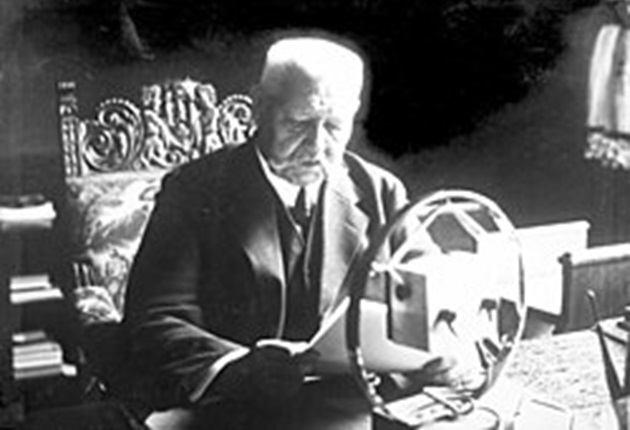
On March 10th, Hindenburg delivered a crucial 15-minute national radio address from his study. This was his only radio speech, and the only public address, of the spring 1932 German presidential campaign. Adolf Hitler of the Nazi Party (NSDAP) was not given radio access.
On March 13th, the presidential elections were held in Germany with a runoff on April 10th. Hindenburg won his second seven-year term against Hitler by receiving 53% of the popular vote.
The Maneuvers
The 1932 autumn maneuvers had two main objectives. The first concentrated on experimenting with the organization of the infantry and cavalry divisions. The second objective was to test the army’s ability to move large groups of troops across a wide, rapid flowing river.
The tactical objectives of the maneuvers focused heavily on modernizing combat doctrine under the restrictions of the Treaty of Versailles. Rather than traditional static defense, the battlefield exercises tested speed, dynamic decision-making, and technological integration.
The core tactical objectives included:
Establishing a Corps-Level Radio Net within 24 Hours:
The center stage tactical problem, often referred to as the “Radio Exercise” (Funkübung), simulated a surprise invasion scenario. The tactical objective was to force signal units and field commanders to establish a functional corps-wide radio network in less than a single day, testing the logistical speed of military communications.
Evaluating Radio Operators as Tactical Decision Makers:
The exercise aimed to test whether radio operators could act as active participants in the mission rather than just static technicians. Commanders evaluated the radiomen’s ability to interpret the broader operational battlefield, prioritize urgent tactical voice messages, and filter out low priority background clutter to speed up the flow of commands.
Testing Combined Arms Coordination with Motorized Mock-ups:
The objective was to practice the fast synchronization of infantry, cavalry, and reconnaissance elements operating alongside mock-up armor to see how motorized pace affected battlefield positioning.
Refining Decentralized Command (Auftragstaktik):
Building on doctrine advanced by Generaloberst (Colonel general) Johannes “Hans” Friedrich Leopold von Seeckt, the maneuvers tested decentralized command control. Subordinate officers were deliberately given broad mission goals rather than rigid directives. The tactical objective was to see if local commanders could use the newly provided voice radio access to make instant, aggressive battlefield adaptations without waiting for lagging approvals and instructions from upper commands.
Assessing Force Mobilization and Assembly Speeds:
The tactical blueprint simulated a sudden threat requiring units to assemble from all across the Reich into a single theater of war. Staff officers aimed to measure exactly how fast scattered motorized units and standard infantry could deploy, merge, and launch counter-maneuvers under time pressure.
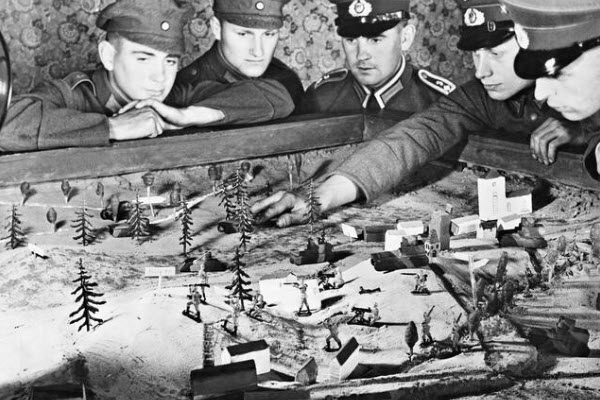
Tactical training was conducted at all levels. Reichswehr enlisted men and non-commissioned officers (NCOs) participating in tactical training using a miniature sand table model.
Frankfurt an der Oder
The 1932 autumn maneuvers (Herbstmanöver) took place in the areas around Frankfurt an der Oder and Furstenberg between September 19-22.
The Blue Force (German):
Commanded by Generalleutnant (Lieutenant General) Karl Rudolf Gerd von Rundstedt, this force was built around the core of the 3rd Infantry Division (3. Division). It primarily comprised the 7th, 8th, and 9th Infanterie-Regiments, and the 3rd Artillery Regiment, which simulated a traditional, foot-marching field army.
The Red Force (Polish, the aggressor):
Commanded jointly by prominent officers including Generalleutnant Fedor von Bock, GeneralMajor Werner von Fritsch, and GeneralMajor Ewald von Kleist, this force was composed of reinforced border guard assets (Grenzschutz) and specialized local defense formations native to the eastern border regions. They were paired with the highly mobile cavalry regiments of the 1st and 2nd Cavalry Divisions (Kavallerie-Division), and the 3rd Company, 3rd (Prussian) Motorized Battalion to simulate a fast-moving, modern invading army.
This was the first time that German infantry and cavalry units operated closely with a Motorized Reconnaissance Detachment (MRD) which spearheaded columns. A MRD consisted of a signal platoon, an armored car platoon, an anti-tank platoon, a bicycle company, a machine gun troop, and a cavalry troop.
The Russians were not chosen to represent the aggressors because they were secret military partners with Germany at that time. To bypass the restrictions imposed by the Treaty of Versailles, Germany entered into a secret pact with the Russians, the Treaty of Rapallo (1922). Germany built secret testing grounds and bases (Kama Tank School, Lipetsk Fighter-Pilot School, Tomka Gas Test Site) inside Russia to develop tanks, combat aircraft, and chemical weapons. In exchange, German officers trained the Soviet officer corps and provided modern industrial and military technology. This relationship began to desolve in 1933.
The Blue Force and Red Force enacted a scenario where a mobile, aggressive Polish force advanced towards Berlin from the east. The Blue force utilized the Oder River as a natural defensive barrier and established blocking positions along the west bank of the river with their main force in Frankfurt an der Oder.
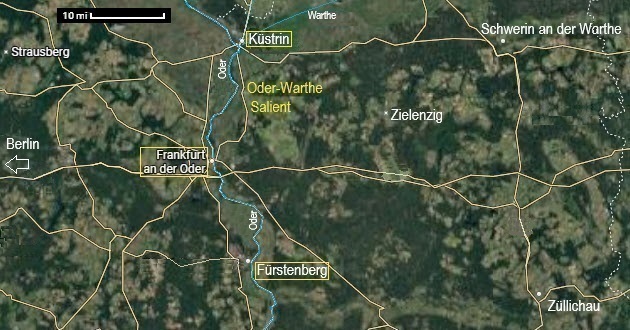
The Red forces were split into two separate advancing groups:
The Northern Group (Red 1st Army) advanced west through “Schwerin an der Warthe” and passed Zielenzig before targeting crossing sites at Küstrin and the waterways immediately north of Frankfurt an der Oder. They relied on traditional infantry and horsed cavalry capabilities rather than mechanized spearheads.
The Southern Group was the Provisional Cavalry Corps (also referred to in operational documents as the Red cavalry corps) under the command of Generalleutnant Fedor von Bock. It advanced through Züllichau toward Fürstenberg.
Once the Red forces advance was detected, Blue Force troops crossed the Frankfurt bridge into the Oder-Warthe Salient and their objective was to act as a fast-moving screen to harass, disrupt, and delay the Red forces advancing from the east. By utilizing the geographic features of the salient, this force sought to buy crucial time for the Blue force main body to organize a sturdier defensive line along the west bank of the Oder river.
Day 1 (Opening Phase)
The Red forces advance from their assembly areas. Using highly swift cavalry and motorized columns, they aggressively pushed westward. By the end of the first full day of simulated combat, their advance units had pushed deep into the salient, overwhelming Blue Force scouts and forcing them back toward the Oder river.
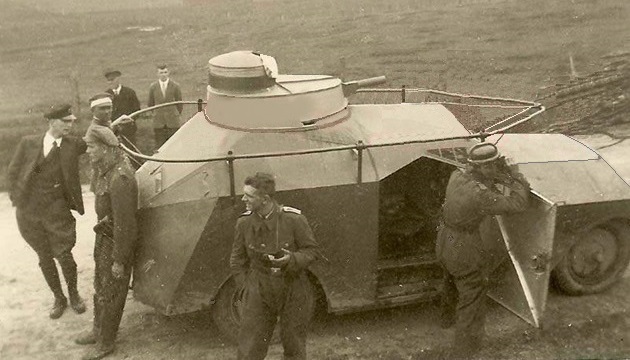
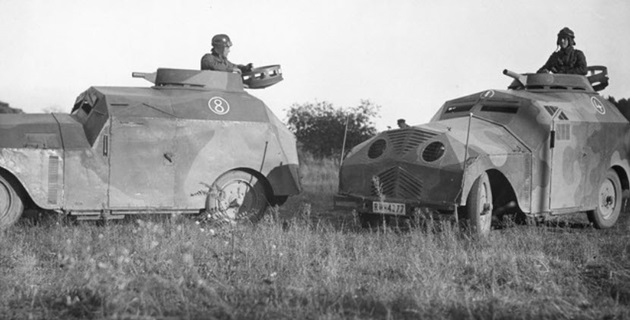
Red force panzerwagen-attrappe number 8 and number 4 stopped in a grass field somewhere between Züllichau and Furstenberg. Note how the commander’s copula flips open on the turret. There are also vision slots around the base of the turret.
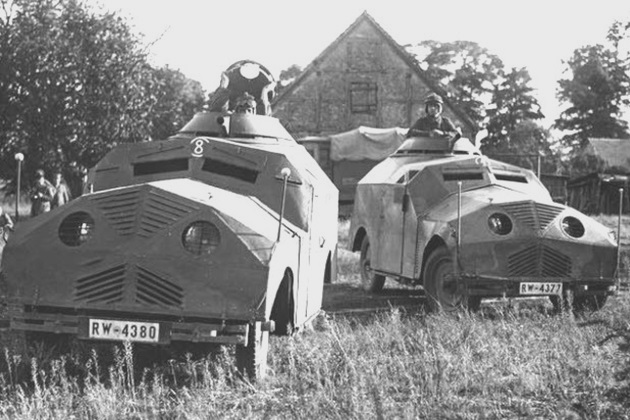
This angle shows Panzerwagen-attrappe number 8 and number 4 had stopped at a farm or a small town. In the background in front of the building is a truck (probably an Austro-Daimler ADG) with a canvas cover over the cargo bed.
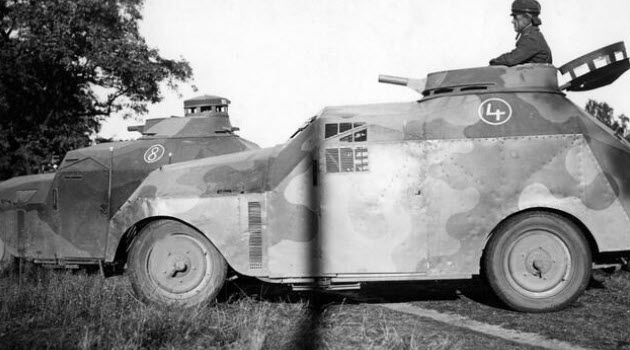
Panzerwagen-attrappe number 8 and number 4 pulled over to the side of a road. The dark image on the ground and runs up the side of panzerwagen-attrappe number 4 is the shadow of a telegraph pole created by the setting sun to the west.
Standard civilian cars of the early 1930s were not engineered to carry the structural weight of simulated armored plates or to withstand grueling off-road military operations. Mechanical breakdowns ranged from radiator boil-overs to snapped belts and clogged fuel lines were commonplace.
Crewmen of panzerwagen-attrappe number 4 removed the engine cover to let the engine cool down and add water to the radiator. Panzerwagen-attrappe number 8 is in the background on the left.
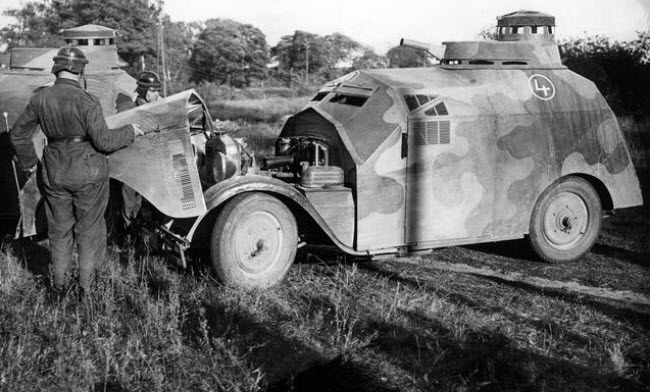
During the maneuvers, instances of panzer-attrappe having mechanical breakdowns or getting stuck in the mud were simulated primarily through the intervention of military referees and umpires (Schiedsrichter). The umpire used two primary criteria to determine exactly when and which panzer-attrappe would “break down” or get stuck.
Pre-Planned Tactical Inject (Scenario-Driven):
The chief maneuver directors often planned failures before the maneuvers began. They would select specific times or phases of an advance, such as immediately after a river crossing, during a high-speed flanking maneuver, or when a column reached a muddy bottleneck, to intentionally strip a commander of their simulated armor. This tested how the unit adapted when its forward momentum was suddenly disrupted.
Geographical and Terrain Violations (Umpire’s Discretion):
As unit umpires moved alongside the columns, they watched exactly where the drivers drove their lightweight BMW Dixi passenger car (panzer-attrappe). Because a Dixi could physically zip across soft ground that would swallow a real 10 ton panzer, umpires intervened if a crew drove recklessly across a swampy marsh or up an impossibly steep slope. The umpire would rule that, realistically, a real tracked vehicle would have thrown a track or sunk to its hull in the mud.
The maneuvers required immediate, highly visible communication because radio sets were scarce and engine noise was loud. The umpires communicated their rulings using a combination of the following methods:
White Umpires’ Flags and Whistles:
Umpires carried distinctive white flags and frequently used loud whistles to stop a panzer-attrappe. The umpire would physically run up or ride near the vehicle on a horse or motorcycle and wave the white flag directly at the driver or vehicle commander.
The Verbal Ruling:
Once the panzer-attrappe halted, the umpire would deliver a precise, formal assessment (e.g., “Transmission failure, immobilized for 45 minutes” or “Sunk in mud, requires secondary vehicle for towing”).
Visual Status Markers:
To prevent other units or opposing forces from firing on a vehicle that was already “destroyed” or broken down, a visual marker, often a specific flag or a colored panel, was placed on the panzer-attrappe. This told passing units that the vehicle was temporarily or permanently out of play.
Supervised Actions:
The communication did not end with a flag. The umpire stood by with a stopwatch, forcing the crew to open their panzer-attrappe hatches and physically simulate the time consuming repair work before allowing it back into the exercise.
If an umpire ruled that a panzer-attrappe crew was taking too long or failed to follow proper breakdown recovery protocols, the immediate punishment directly sabotaged the unit’s mission. The following are the possible punishments.
Forced Extension of the Casualty Window:
If the crew did not execute the simulated field repair efficiently or tried to cut corners, the umpire simply added more time to the stopwatch. A 30 minute transmission fix could easily be extended to 2 hours or more, entirely sidelining the panzer-attrappe and leaving the advancing infantry without simulated armored support.
Arbitrary Loss of Additional Assets:
If a panzer-attrappe was ruled “stuck in deep mud” and the platoon leader failed to quickly coordinate a proper recovery or call for support, the umpire would often penalize the unit further. The umpire might declare that the second vehicle attempting a sloppy rescue was now also stuck or had “burned out its clutch,” multiplying the platoon’s problems.
Direct Capture or Destruction by the Enemy:
If a unit left a broken down panzer-attrappe unprotected on a roadway while failing to secure a perimeter around it or setting up a tow line, the umpire would allow the opposing force to freely advance and declare the crew and vehicle captured or destroyed effectively removing them from the remainder of the maneuvers.
Poor performance by an officer during the maneuvers had immediate and devastating consequences for their military career:
- Reassignment to Backwater Posts
- Stalled Promotions or Blacklisting from the General Staff
- Rapid Career Termination or Forced Retirement
An umpire had stopped Panzerwagen-attrappe number 4 and issued the crew an “engine problem” with a time limit. Two crewmen dismounted and are lifting the engine cover off while one start looking at the engine while the panzerwagen-attrappe commander stands in the opened turret. Standing nearby a young boy wearing shorts watches.
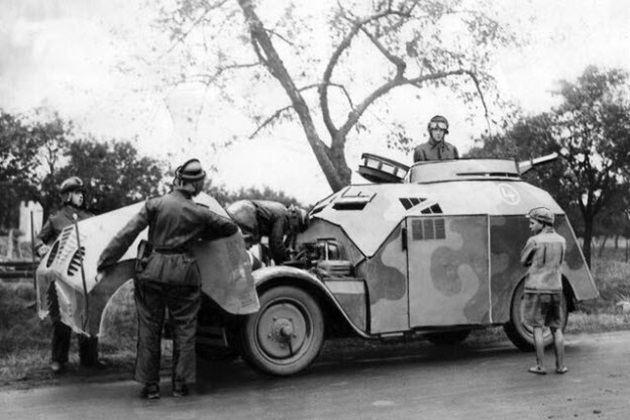
This is the other side of Panzerwagen-attrappe number 4. The crew did not actually repair the functional engine. They acted out that they are fixing it, making it realistic as possible. The umpire with white armband and white band on his cap is observing and keeping time on the crew’s “repair”.
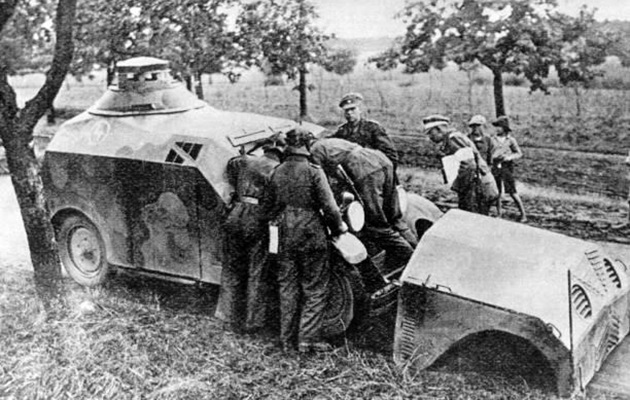
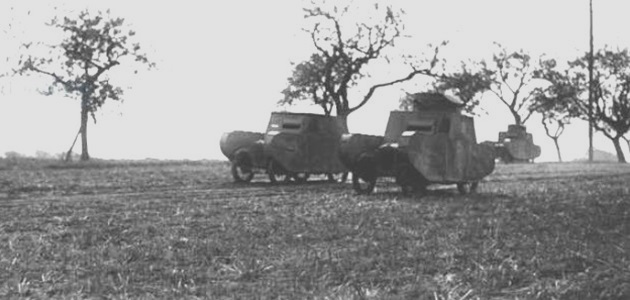
Red force panzer-attrappe advancing towards Fürstenberg.
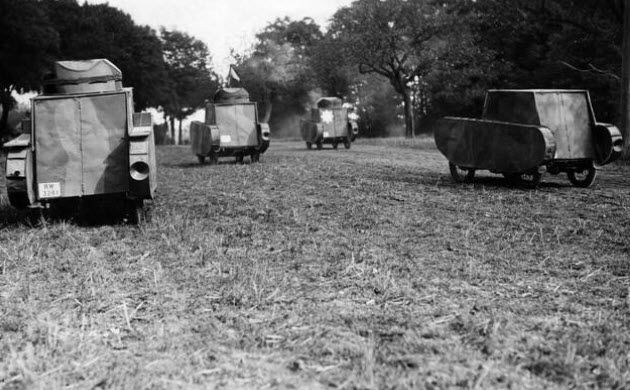
Front view of the Red force panzer-attrappe. These panzer-attrappe are based on the BMW Dixi car chassis.
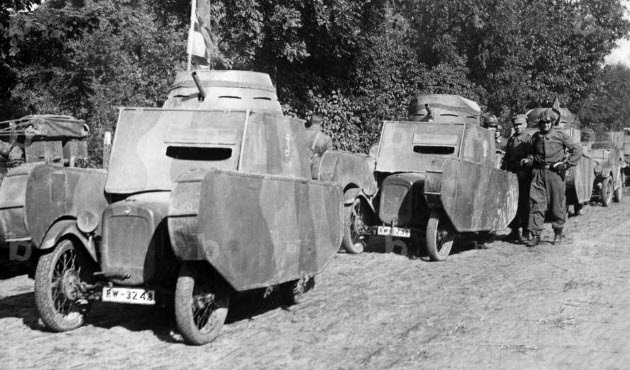
A column of Red force BMW Dixi panzer-attrappe halted on a road. The leading panzer-attrappe has a Red-White Pennant, probably a command panzer.
Day 2 (Reaching the River)
By the second day, the Red Force’s two advancing group had successfully reached the eastern banks directly opposite Frankfurt an der Oder and Fürstenberg. It was during this day that the Blue forces hastily retrograded to the west bank, resulting in the simulated “blowing up” of the permanent bridges at Frankfurt an der Oder and Fürstenberg to halt the Red advance.
A column of Red force panzerwagen-attrappe near the opposite bank of Fürstenberg. The second vehicle in the column is a Funkkraf panzerwagen-attrappe with a frame antenna around the hull.
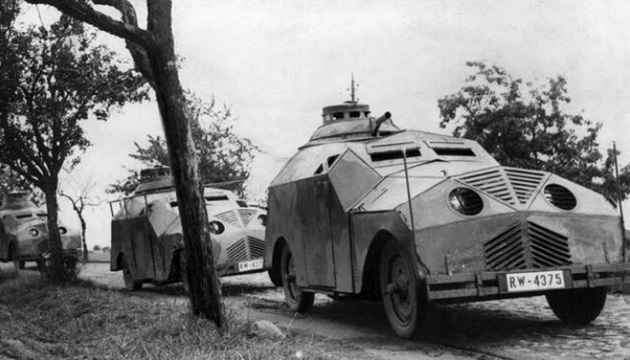
This the other side of the panzerwagen-attrappe column in the above photo. On the hull side just below the turret of the first panzerwagen-attrappe is a circle with a number 2 within it. It is a tactical marking but there is no information on what the circle means. Note the camouflage pattern.
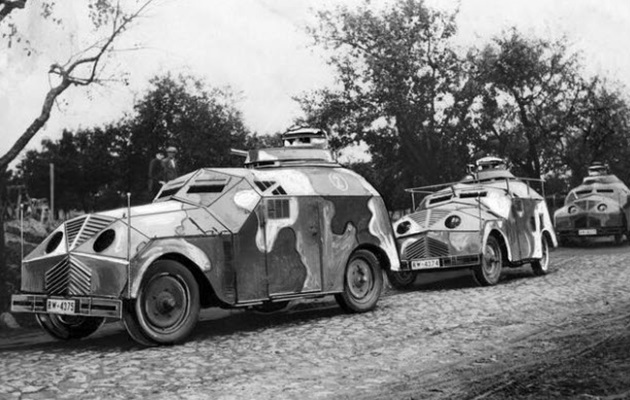
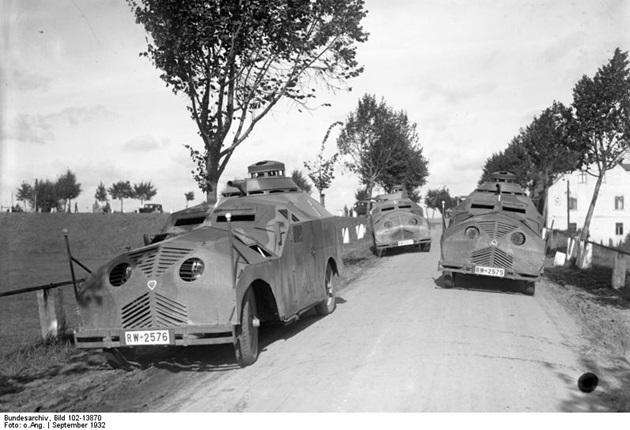
Panzerwagen-attrappe on a road near the east bank opposite Fürstenberg . Note the vertical white band on the side hull of panzerwagen attrappen with license plate number RW-2576. The license plate number of the panzerwagen-attrappe on the right is RW-2575.
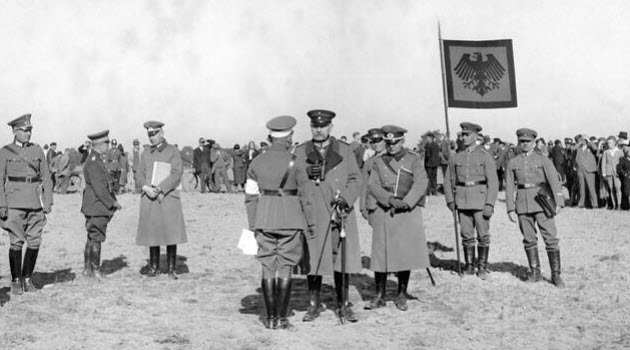
The morning of Day 3 began with intense high-profile attention. Eighty four year old Reich President Hindenburg, accompanied by Defense Minister Kurt von Schleicher and top Reichswehr generals, arrived at a specially designated observation post overlooking the Oder River valley near Fürstenberg. Surrounded by foreign military attachés, Hindenburg watched through binoculars to evaluate how effectively Germany’s restricted army could breach a major geographic barrier.
Oberst (Colonel) Fischer (with white armband and white band on his cap) presenting the initial battlefield and maneuver reports directly to President Hindenburg.
Because the permanent bridges at Frankfurt an der Oder and Fürstenberg were marked as “destroyed”, the Red Force had to execute a multi-pronged tactical river crossing under simulated enemy fire.
Smoke Screen:
To mask their intentions from the Blue Force machine gun and artillery positions embedded on the hills of the west bank, Red Force deployed a massive, dense smoke screens over the Oder river. To laid down the smoke screen, the Red force primarily utilized specially equipped aircraft that sprayed chemical smoke, augmented by smoke-producing artillery shells.
Under the strict terms of the Treaty of Versailles, Germany was officially forbidden from possessing a military air force (the Luftwaffe did not officially exist yet). To bypass these restrictions, the German military operated a clandestine air wing under the guise of civilian organizations like the Deutscher Luftsportverband (German Air Sports Association) and commercial airlines like Deutsche Luft Hansa. The Heinkel HD 38 and Junkers F 24 (civilian-disguised and sport trainer aircraft) were fitted with internal chemical vats or under-wing spraying apparatuses (Nebelanlagen) which were used for crop dusting and forest spraying.
During the crossing of the Oder at Fürstenberg, the aircraft flew low over the water, deploying a specialized chemical mixture (often containing chlorosulfonic acid or titanium tetrachloride) that reacted instantly with the damp river air to create a heavy, blinding artificial fog.
While 7.5cm Feldkanone 16nA (Field Gun) and 10.5cm leFH 16 (Light Field Howitzer) units fired smoke shells, the Reichswehr also tested the Nebelwerfer-Kompanien (Smoke Mortar Companies). Because Germany was forbidden from having heavy artillery, they heavily invested in developing specialized chemical/smoke troops equipped with early 10.5 cm Nebelwerfer 35 mortars. These smoothbore mortars were technically classified as infantry support weapons or “smoke projectors” rather than standard artillery, allowing the military to project massive amounts of smoke shells while remaining within the strict loopholes of the Versailles Treaty limitations.
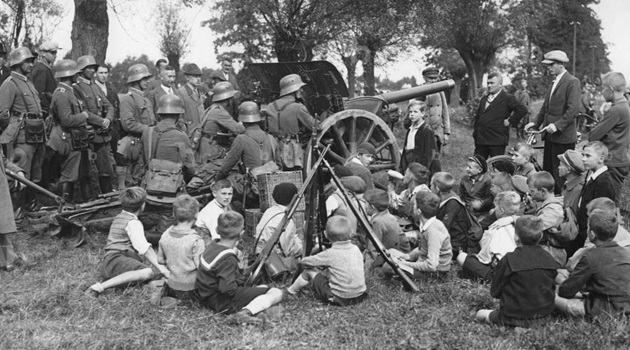
This is a typical moment from these exercises where an artillery battery has halted, and local school boys have gathered around to get a close up look at the modernized 7.5cm Feldkanone (FK) 16nA field gun and chat with the soldiers. This field gun originally began service in WWI as the 7.7cm FK 16.
First Wave:
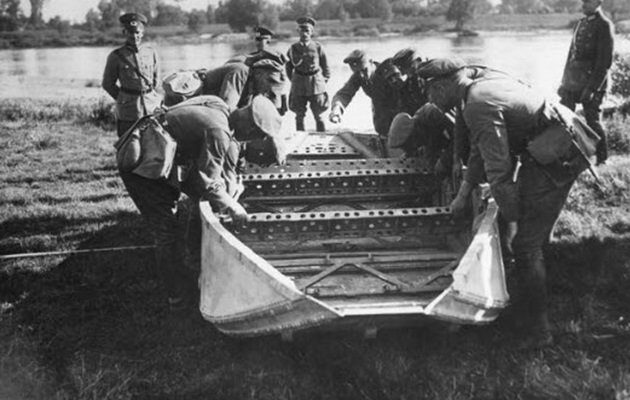
The assault began with Red infantry engineers storming the eastern bank, launching small assault boats (Sturmboote) and wooden folding pontoon boats to ferry the initial wave of riflemen across the fast-moving river to establish a fragile, western bank foothold.
Soldiers of a Reichswehr Pioneer Battalion (Pionierbataillon) assembling a folding pontoon boat on the east bank of the Oder. The folding pontoon boat was able to carry 15–16 armed infantrymen along with a small steering crew across the river.
Heavy Ferries:
Multiple folding pontoon boats were lashed together side-by-side in the water and wooden roadways (Kradschützensteg) were laid across the tops of the rigid internal frames to rapidly construct a heavy ferry.
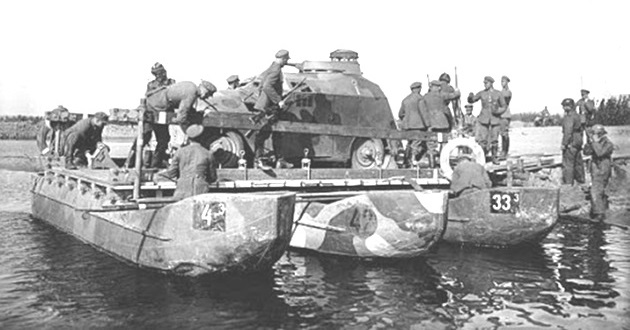
Once the west bank of the Oder was secured, engineers deployed heavy-duty pontoon ferries and the Red Force floated across their “armored” units. The ferries then transported cavalry horses, artillery pieces, and supply wagons across the river.
A Red force panzerwagen-attrappen loaded onto a pontoon ferry on the east bank of the Oder. The meaning of the different sizes numbers on the bow of the pontoons are unknown.
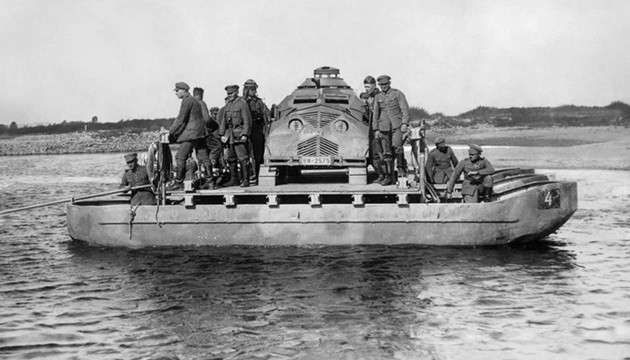
This is a side view of the pontoon ferry in the above photo. The license plate number of the panzerwagen-attrappe is RW-2575.
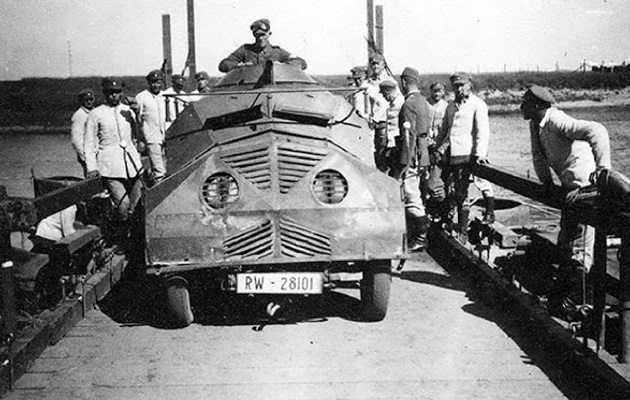
A Red force funkkraf panzerwagen-attrappe disembarking from a pontoon ferry onto the west bank of the Oder river.
The Red forces successfully pushed past the Blue Force’s riverbank outposts south of Frankfurt an der Oder, shifting the exercise from a static river battle into an open war of maneuver on the western plains toward Berlin. The Red Force successfully targeted and disrupted the Blue Force rear areas by heavily prioritizing speed, mobility, and communications sabotage.
Day 4, the final day of the maneuvers, the Blue Force launched its grand final counter-attack by shifting from a rigid frontline defense to a fluid doctrine of active encirclement and converging counter-thrusts.
As the Red Force pushed further west into the open terrain beyond the Oder, they became geographically elongated. The Blue Force used heavily fortified, pre-established secondary defensive strongpoints to absorb and slow down the Red force motorized columns, attempting to force them to halt their rapid westward momentum.
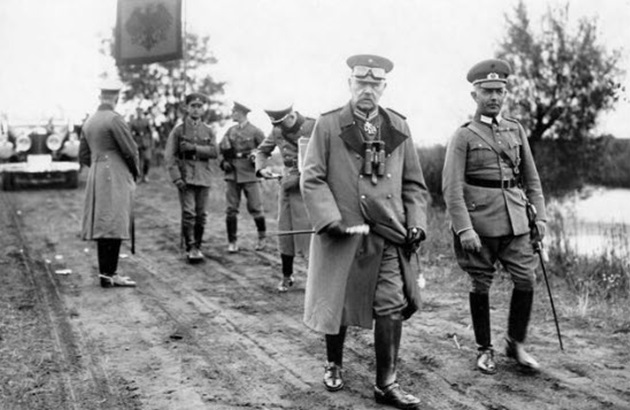
Hindenburg arrived at the maneuvering area to inspect the troops and receive the concluding tactical debriefs on the Reichswehr’s performance. Hindenburg and his staff are walking along a field road to meet the senior regiment commanders.
Because the Reichswehr was heavily restricted from mass-producing and deploying standard anti-tank weaponry in the early 1930s, troops routinely trained with highly detailed wooden artillery mockups (Geschützattrappen). These training pieces mirrored the low-profile gun shields, split-trail carriages, and thin barrels of the actual 3.7 cm design to properly simulate tactical placement, camouflage, and sighting along roads.
The 3.7 cm Tankabwehrkanone (TAK) L/45 originally had wooden-spoked wheels with hard iron/steel rims or solid rubber bands. It was developed secretly by Rheinmetall to bypass the Treaty of Versailles restrictions. It was later officially designated by the Wehrmacht as the 3.7 cm Panzerabwehrkanone 36 (Pak 36) with pneumatic rubber tires when Germany openly rearmed.
The 3.7 cm TAK L/45 and gun crew is securing an access road in the maneuver area. Setup on the side of a road, the gun crew is tracking an enemy target. The gun crew loads and fires a standard blank ammunition round to simulate the signature bang and muzzle flash of defensive anti-tank fire.
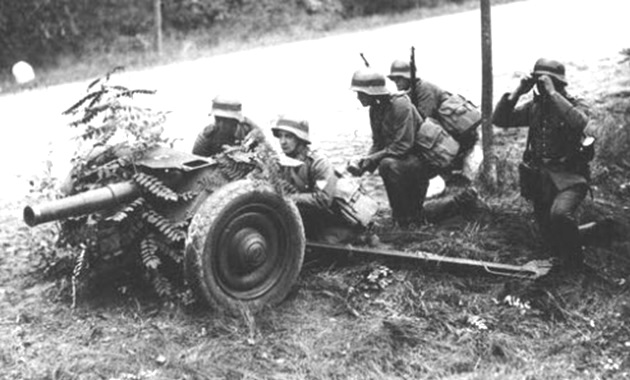
This is a close up of the above photo. The only way to identify which force this gun crew belonged to is the color of the band on their helmets, either Red or Blue. In this B/W photo, it is difficult to determine the color. Standing on the road in background is an umpire overseeing the gun crews’ actions. Note this gun has the later pneumatic rubber tires.
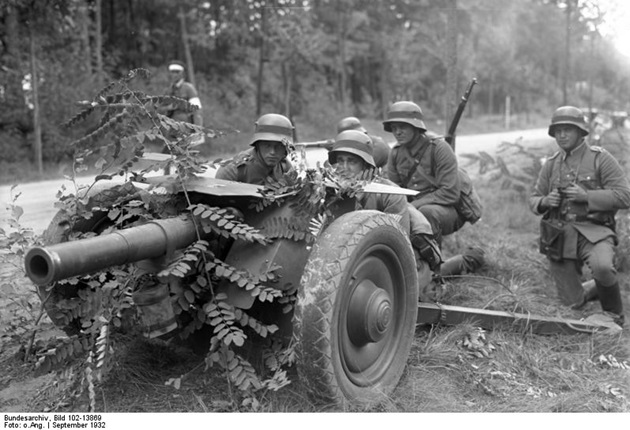
Determining a damaged or a destroyed vehicle during the maneuvers was a highly structured process. Without live ammunition or advanced technology like lasers, the German military relied on strict field mathematics, specialized signaling props, and the field umpires. The umpires did not just guess who won an engagement. They carried pocket-sized cheat sheets containing calculated statistical probabilities.
When the infantry engages a panzer-attrappe, the umpire cross-referenced the range, the type of weapon being simulated (e.g. 37mm anti-tank gun), the duration of fire, and the degree of cover.
If a panzer-attrappe was advancing across an open field in broad daylight against a dug-in anti-tank gun at less than 400 meters (437.4 yards), the mathematical tables dictated an automatic loss of the panzer-attrappe. The umpire would ruled “destroyed” and order the panzer-attrappe crew to immediately stop. The panzerattrappe would display a solid white flag indicating it was “dead” and could no longer move or communicate.
To simulate a panzer-attrappe having minor repairable track/engine damage, the umpire would order the panzer-attrappe to halt in place and display a “damaged” flag for 15, 30, or 60 minutes.
With the Red spearhead temporarily stalled, the Blue Force unleashed their main reserves, which had been intentionally held back from the riverbanks. Blue launched two simultaneous counter-attacks targeting the flanks and supply corridors of the Red breakthrough. The northern pincer struck southward from the heights northwest of Frankfurt an der Oder and the southern pincer struck northward from the wooded terrain west of Fürstenberg.
The ultimate goal of this double-envelope counter-attack was to sever the Red Force from their fragile pontoon ferry bridgeheads on the west bank. By converging behind the main Red body, Blue Force infantry and specialized anti-tank bicycle/motorized units sought to pin the Red troops against the river they had just crossed, effectively neutralizing their operational mobility.
As the Red and Blue forces collided in a massive, chaotic simulated battle on the plains, the exercise reached its scheduled end. Chief of the Army Command (Heeresleitung) General Kurt von Hammerstein-Equord and Reich President Hindenburg officially called an end to the maneuvers.
Film: German Reichswehr troops march as President Hindenburg reviews them in Berlin, Germany.
Foreign Military Attachés
Because the Reichswehr was heavily engaged in bypassing the restrictions of the Treaty of Versailles, testing motorized dummy tanks and prototype combined-arms tactics, foreign observers were strictly managed. The attachés were only allowed to witness tightly controlled, five-hour demonstrations of standard infantry regiments using outdated, WWI-era equipment to deliberately downplay Germany’s rearmament progress.
Film: Hindenburg Greets Foreign Attaches
Foreign Attachés:
- Major Antoni Szymański (Poland)
- Soviet Military Delegation (High-ranking Soviet military representatives and attachés from the Soviet Embassy in Berlin) regularly observed the maneuvers. Also included was the Red Army’s armored theorist General Mikhail Tukhachevsky.
- Italian Military Attaché
- British and French Military Attachés (French observers were occasionally excluded or strictly barred from sensitive experimental zones due to diplomatic tensions).
- Baltic and Eastern European Attachés (representatives from Lithuania, Latvia, and Czechoslovakia)
- US Army attachés: Colonel Jacob Wuest and assistant attaché Major McLean.
Major McLean attended the maneuvers and created a highly detailed, comprehensive intelligence report which captured how the Reichswehr structured its theoretical “Command Groups,” mapped out how the dummy-tank units simulated tactical breakthroughs, and analyzed how the German command evaluated the exercises. Colonel Wuest sent Major McLean’s back to the Military Intelligence Division (MID) of the US War Department.
Major McLean’s report presented a dual reality: the 1932 Reichswehr was logistically and materially unready for immediate conflict, but conceptually and structurally primed for rapid militarization. He warned Washington that if Germany were ever freed from treaty restrictions and allowed to mass-produce weapons, their superior training foundation would allow them to field a highly lethal, modern army faster than any other nation.
The Ultimate Consequence
Because the War Department took no preemptive action based on these 1932 warnings, the US found itself completely caught off guard when the Nazi regime took absolute control just months later in 1933. By 1935, the “skeleton framework” McLean had warned about in 1932 was already transforming into the highly mechanized, devastatingly Wehrmacht.
Kfz. 13/14
The Kfz. 13 (also Maschinengewehr-Kraftwagen) was the first armored reconnaissance vehicle introduced by the Reichswehr in 1933 and, by 1935, only 147 were built by Daimler-Benz.
Although the Kfz. 13 was equipped with all-wheel drive, the vehicle had poor cross-country capability and the added weight led to engine overheating. It had a high center of gravity that led to accidents. With only 8mm (0.31 inches) of armor, it was not thick enough to protect the two man crew from small-arms fire. It was armed with one MG13 machine gun with a small gun shield.
The unarmed version, the Kfz. 14 armored radio car (Funkkraftwagen), was equipped with a radio set instead of a machine gun. The Fu 9 radio set (specifically the Fu9 SE 5), which consisted of a 5-watt transmitter and receiver. To meet the power demands of the Fu 9 system, the vehicle’s electrical generator was upgraded to produce 90 watts of electricity.
The radio operated via a distinctive, large tubular frame antenna mounted on four vertical struts above the open-topped fighting compartment. This frame antenna could be folded downward while the vehicle was traveling to reduce its silhouette and height.
Range (Voice):
Effective range of 6 to 8 km (3.7 to 5.0 miles) while stationary, which dropped to 3 to 4 km (1.8 to 2.5 miles) while on the move.
Range (Morse Code/Telegraph):
Achieved a much longer range of 30 km (18.6 miles) while stationary and 20 km (12.4 miles) on the move.
To make production quick and cheap, the Kfz.13/14 were built by welding an open top steel hull onto the chassis of an Adler Standard 6 car. During foul weather, a canvas tarp was erected over the open top hull.
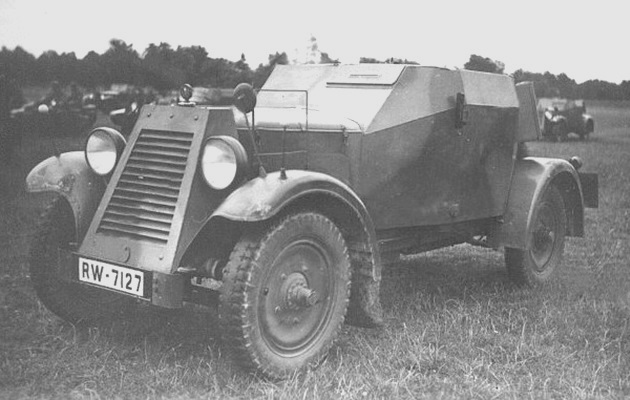
Front view of a Kfz. 13 Maschinengewehr-Kraftwagen on a road. The headlights are either painted out or covered. The width indicator (Kotflügel-Peilstange) mounted on the left front fender has a circular rear view mirror attached. On the right front fender, the meaning of the white diamond with a the cross inside the diamond is unknown.
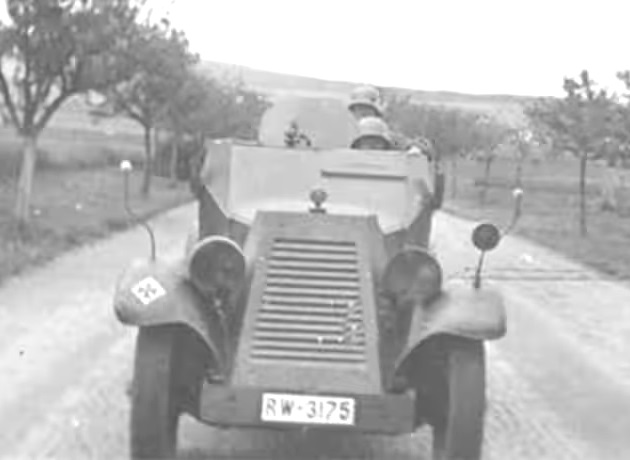
A column of two Kfz. 13s and a Kfz. 14 (center). The Kfz. 14 collapsible framed radio antenna is folded down.
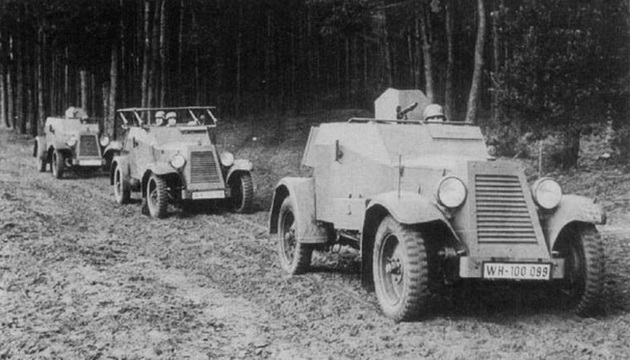
The Kfz. 13/14 seen service in Poland 1939, Belgium and France 1940, and the Balkans and Soviet Union 1941. All of the cars sent to the Soviet Union were destroyed and all remaining cars were retired from active service in 1941, afterwards only being used for training or by second-line troops.
Due to a severe breakdown of Germany’s democratic system, the country’s economy collapsing, and some intense backroom political maneuvering, Reich President Hindenburg reluctantly appointed Adolf Hitler chancellor of Germany on 30 January 1933.
On 1 October 1933, Heinz Guderian was promoted to Oberst (Colonel). On 15 October 1935 in Würzburg, Bavaria, the 2. Panzer-Division was established under the command of Oberst Guderian. Guderian’s replacement, Field Marshal Friedrich Paulus, was not effective and the momentum of the development of the Panzerwaffe (armored forces) slowed down.
On 2 August 1934, Reich President Hindenburg died at the age of 86 from metastasized bladder cancer which had spread to his lungs, at his home in Neudeck (today, Ogrodzieniec, Warmian-Masurian Voivodeship), East Prussia. Hitler immediately assumed the powers and duties of the presidency in accordance of the law and was named “Führer und Reichskanzler” (Leader and Reich Chancellor) of Germany.
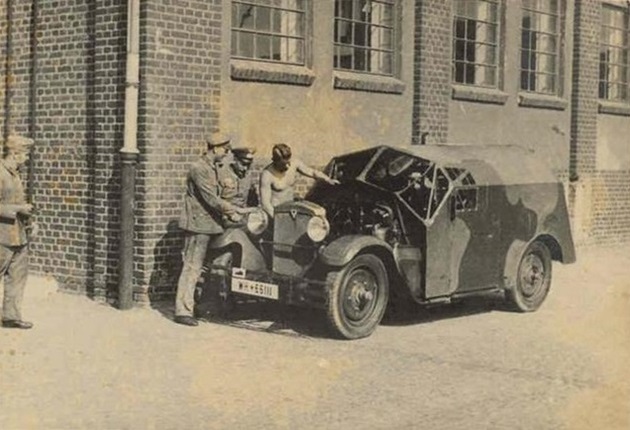
On 21 May 1935, the Reichswehr was renamed the Wehrmacht. An order was issued stating between 1 October and 31 December 1935, all vehicle license plates must change the “RW-” number to “WH-” with a five digit number.
This appears to be a former panzerwagen-attrappe parked outdoors next to a brick building, probably a training facility. The turret on the rear hull was removed and glass windscreens were installed. Soldiers or mechanics are inspecting the exposed engine bay. The license plate number WH-56111 indicate the photo was taken in late 1935 or later.
On 1 August 1936, Heinz Guderian was promoted to Generalmajor.
During the autumn/late 1936, Lutz ordered or requested Guderian to write a book that promoted the ideas of the Mobile Troops Command and defended strategic mechanized warfare against the traditionalist army critics. Guderian fulfilled the order by compiling his previous war academy lectures, historical reviews, and theories into “Achtung – Panzer!”, which was published the following year in 1937.
Generalmajor Lutz was retired from active duty in February 1938 after falling from Adolf Hitler’s favor. Hitler then promoted Guderian to take over Lutz’s role.
During WWII, Lutz was recalled to service and appointed on 22 September 1941 to head a minor special staff unit before being retired again on 31 May 1942. He died in Munich in 1944 at the age of 67.
Multiple print runs of Guderian’s book “Achtung – Panzer!” had sold out inside Germany. Foreign intelligence agencies and traditional military thinkers across Europe bought copies but largely underestimated it. They viewed it as radical or boastful propaganda rather than a literal blueprint for the future of warfare. They only realized its accuracy when panzer divisions swept across Europe using the exact doctrine outlined in the book.
The Wehrmacht integrated the traditional Bewegungskrieg mindset with 20th century technology:
- Cavalry were replaced by concentrated panzer (armored) divisions to spearhead the breakthrough.
- Foot infantry were upgraded to motorized infantry to keep pace with the panzers.
- Morse code wired telegraphs were replaced by two-way voice radios to allow rapid coordination between units.
- Artillery was supplemented by Luftwaffe Junkers Ju 87 dive-bombers acting as flying artillery to destroy immediate obstacles.
In 1939, when the Allied press coined the sensational term “Blitzkrieg” (lightning war) to describe Germany’s rapid conquests, the German military high command did not officially use the word. To them, it was simply Bewegungskrieg updated with modern technology.
The Reichswehr 1932 autumn maneuvers did made a prediction of the future. About twelve and a half years later in 1945, a Red force (the Soviet Red Army) did crossed the eastern border and invaded Germany. On 16 April 1945, the Soviet Army crossed the Oder river at several sites bypassing and besieging Frankfurt an der Oder, at the launch of the final battle of Berlin.
Today
Today, the border between Germany and Poland is along the Oder River, though it is more accurately known as the Oder–Neisse line. The cities, towns and villages that the Germans had occupied were renamed with Polish names.
| German Name in 1932 | Polish Name Today |
|---|---|
| Küstrin | Kostrzyn nad Odrą |
| Schwerin an der Warthe | Skwierzyna |
| Zielenzig | Sulęcin |
| Züllichau | Sulechów |
A BMW Dixi Panzer-attrappe replica is on display at the Deutsches Panzermuseum Munster (German Tank Museum) located in Munster, Lower Saxony, Germany.
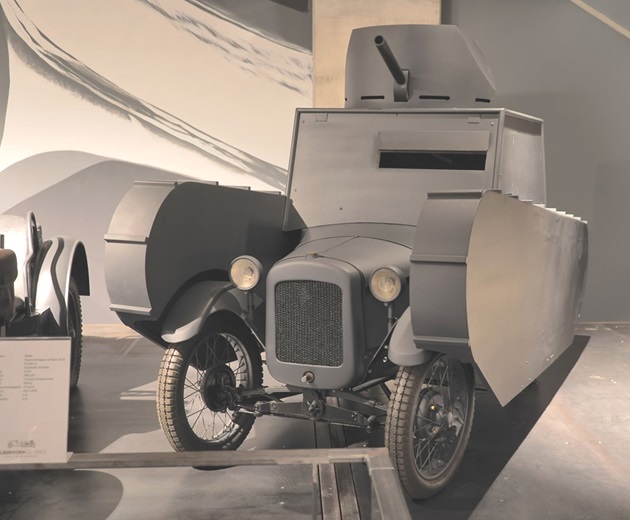
Photo: Georg Kludsky
Book: “Achtung – Panzer!” in English PDF
No Model Kits are available. A Panzerwagen-attrappe auf Adler Standard 6 is on my wish list. It probably will never be released because it is an odd unknown subject and there is no surviving examples in a museum.
There are only two options, either scratch build it or print it on a 3D printer.
CAD File: AUTODESK Tinkercad Panzerattrappe auf Adler Standard 6