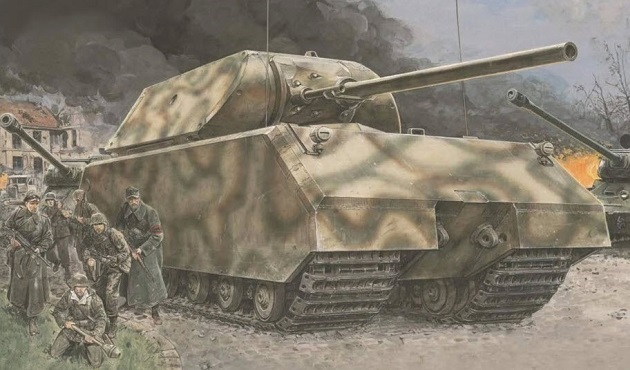
The Panzer VIII Maus was the German last and only super heavy tank built during WWII. It was the heaviest fully enclosed armored fighting vehicle ever built and was planned to be employed as a “break through” panzer. The Maus was the only German panzer program to been canceled due to the Allied strategic bombing campaign. Only two prototypes were completed (two hulls and one turret).
Panzerkampfwagen is German for “armored combat vehicle” which is abbreviated as PzKpfw or PzKW. Other related abbreviations include KPz for “Kampfpanzer” (combat tank) and Pz for “Panzer” (tank). Panzer Ausfuehrung means “tank design” or version and is abbreviated as Ausf. The Panzer Ausfuehrung was an alphabetic letter. Design work of the first German panzer, the PzKpfw I, began in 1932 and mass production of 1,190 PzKpfw I Ausf As began in 1934.

Forgotten Panzer
Hitler saw the threat of the Soviet heavy tanks and ordered a super heavy panzer to be designed which had much thicker armor and far more firepower than any future enemy tank. The first super heavy panzer design was the Panzer VII Löwe (Lion) which was designed by Friedrich Krupp AG (Krupp) of Essen (northeast of Düsseldorf), Germany. The project was initially code named VK 70.01 (K). It was designed as two variants, unofficially designated Leichter Löwe (Light Lion) and Schwerer Löwe (Heavy Lion) and both would have a crew of five.
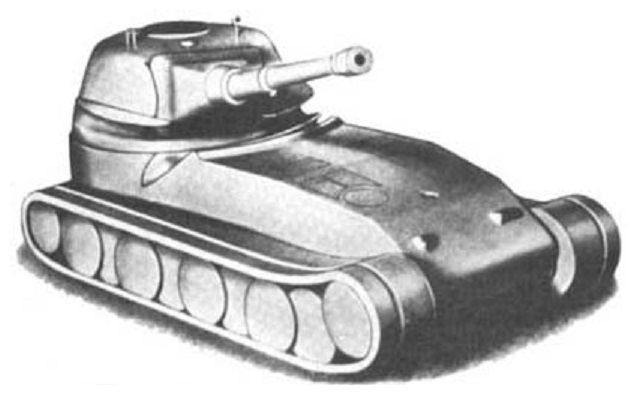
Leichter Löwe / VK 70.01 (K) weighed 76 tons, with 100mm (3.9 in) frontal armor, a rear mounted turret, a 105mm (4.1 in) L/70 high velocity gun, and a coaxial machine gun, with a top speed of 27 km/h (17 mph). It was later canceled by Hitler who favored the Schwerer Löwe (below). This is a wooden model of the Leichter Löwe.
Schwerer Löwe / VK 72.01 (K) weighed 90 tons, with 120mm (4.7 in) frontal armor, a center mounted turret, a 105mm L/70 gun, and a coaxial machine gun, but only managed a top speed of 23 km/h (14 mph). After a redesign, it had 150mm (5.9 in) frontal armor, a 88mm (3.5 in) L/71 gun, and the top speed increased to 35 km/h (22 mph).
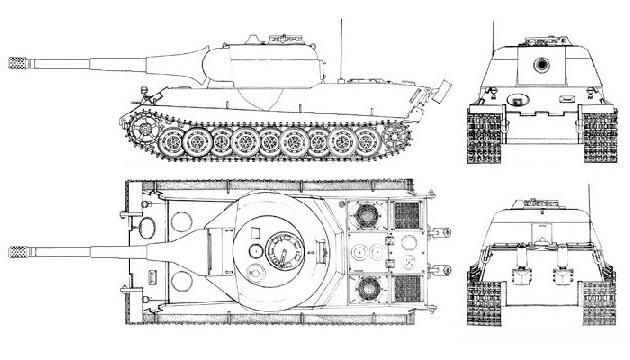
The Schwerer Löwe never left the drawing board as Hitler canceled it in March 1942, in favor of the heavier Panzer VIII Maus. The hull and chassis design of the Schwerer Löwe later had an influence on the 70 ton Tiger II which was designed in 1943 and built by Henschel (hull) and Krupp (turret) in 1944-45.
The Maus
The Maus originated from a contract given to Ferdinand Porsche for the design of a 100 ton panzer in March 1942. Hitler reviewed and approved Porsche’s design, known as the VK 100.01 / Porsche Type 205, in June 1942. Design work began immediately and the first prototype was to be ready in 1943. Initially it was named “Mammut” (mammoth). In December 1942, it was reportedly changed to “Mäuschen” (little mouse) and then finally to “Maus” (mouse) in February 1943 which became the common name for this panzer. The prototypes were built at the Krupp steel works in Essen.
RAF bombed Essen 1943
The Krupp steelworks in Essen was an important industrial target and was designated as a “primary target” for area bombing in the February 1942 British Area bombing directive. As part of the bombing campaign in 1943, known as the Battle of the Ruhr, Essen was a regular target.
The Germans built a large-scale night-time decoy, the Krupp decoy site (German: Kruppsche Nachtscheinanlage) which was a copy of the Krupp steel works. It was designed to divert Allied bombing raids from the actual production site of the arms factory but it did not make a difference.
March 2/3
6 RAF Mosquitos flew to the Ruhr without loss. The aircraft which bombed Essen scored direct hits in the middle of the main Krupp factory.
March 5/6
442 RAF aircraft in the first raid of the Battle of the Ruhr on the night that was the RAF Bomber Command’s 100,000th sortie of the war. Fourteen aircraft (4 Lancasters, 4 Wellingtons, 3 Halifaxes, 3 Stirlings) were lost: 3.2% of the force. A further 56 aircraft turn back early. Three of these were Oboe-equipped Mosquito marker aircraft leaving five to mark the target. Marking was carried out “blind”, avoiding the effects of the industrial haze that usually concealed Essen. The main force bombed in three waves. Two thirds of the bomb tonnage was incendiary, the rest was high explosive. One third of the high explosive bombs were fused for long delay. The attack lasted for 40 minutes. Reconnaissance photographs showed 160 acres (0.65 km2) of buildings within the Krupp works were hit by bombs.
March 12/13
457 RAF aircraft flew a successful Oboe-marked raid. The center of the bombing area was across the giant Krupp factory, just west of the Essen center, with the later bombing drifting back to the northwestern outskirts. From photographic evidence, it was believed by Bomber Command that Krupp received 30% more damage on this night than March 5/6.
Film: THE BLITZING OF ESSEN
July 25/26
The last raid on Essen during the Battle of the Ruhr consisted of 705 RAF aircraft of which 3.7% were lost. The raid had been planned to take advantage of the recent introduction of “Window” radar-jamming system. The Krupp works suffered what was probably its most damaging raid of the war.
Wooden Maus
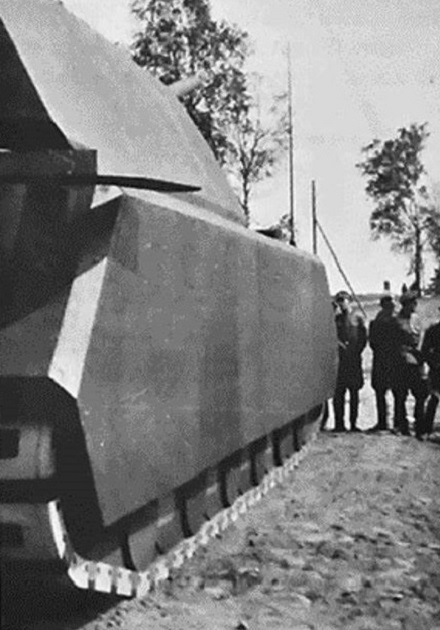
On 14 May 1943, a demonstration of new weapons with held for the Führer (Hitler) and other officials. On display was a full size wooden mock up of the Maus. It was early in its development as the the turret had a cupola for the tank commander which was later omitted. Another early feature was two flame projectors at the rear upper corners of the rear hull. The Flammenwerfer Anlage (flamethrower system) was based on the Gross–Flammenwerfer (heavy flamethrower) system which had been installed on the PzKpfw III, but a long range of 150 to 200 meters (164 to 218.7 yards) was wanted for the flame projectors on the Maus. After the demonstration, the flame projectors were ordered to be removed.
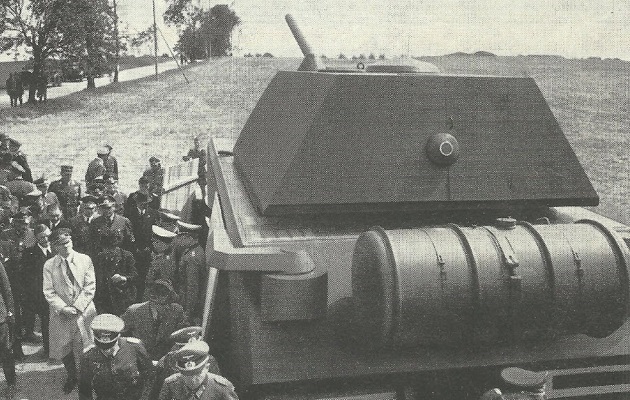
On the small table were the plans for the Maus. Two 128mm shells are used as paper weights. The gun was fed with two-piece ammunition, the projectile and cartridge making up separate sections. This allowed the gun to be fired using three different size propellant charges; a light, medium or a heavy charge.

There was also a small remote controlled scale model of the Maus. On the ground behind the model is the control cable.
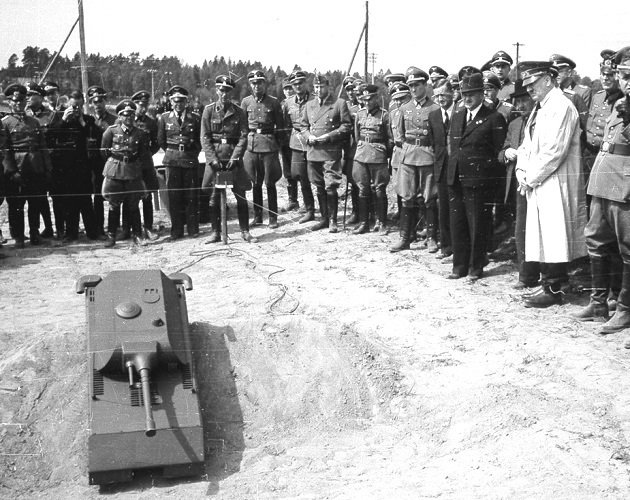
A German officer is operating the control box mounted on a post. There appears to be two controls which probably controlled the direction of each track.

Also on display was a mock up of a Jagdpanzer IV 0-Serie pre-production tank destroyer. It had two front facing firing ports (covered) on both sides of the main gun.

Hitler was pleased and approved the Maus for mass production and ordered the first series of 150 vehicles.
Film: Rare Panzer VIII Maus Footage
Cancellation
Due to the production delays caused by RAF bombing, Krupp received orders on 27 October 1943 stating that, instead of 150 vehicles, just one Maus was to be completed. All of the unused armor plates were ordered to be transferred to the Sturmgeschütz program at Harkort-Eicken, excluding those already prepared for Maus construction. Then another order followed cancelling all further development of the Maus and the cancellation of the Maus series production. On 5 November 1943, another order was received which clarified the situation, changing the initial contract to only 6 prototypes. A week later, the contract for 6 prototypes was changed to just 2 prototypes.
Maus Prototypes
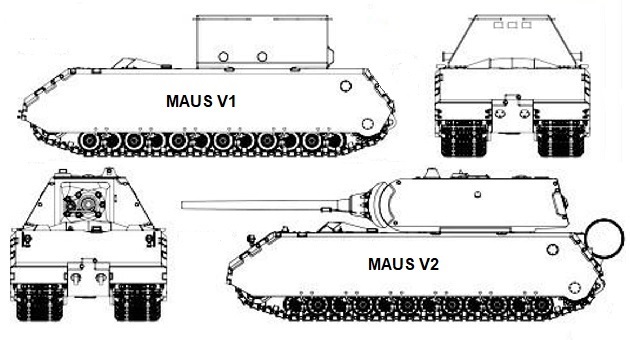
Maus V1
The first, turret-less prototype V1 was assembled by Alkett in December 1943 and a mock up turret was fitted. The mock up turret (Ersatzgewicht, “Replacement weight”) was crude, roughly similar in shape and size with the same weight of the actual turret (with guns) would be. The turret was not able to rotate, it was held in place by cross pieces which were simply tightened up against the underside of the opening in the hull for the turret ring. The Engine was a MB509 V12 petrol engine (DB 603 derivative), 1080 hp (805 kW).
Maus V2
The second prototype V2 differed in many details from prototype V1. The prototype V2 was fitted with the first produced Maus turret. The prototype V1 was supposed to be fitted with the second produced turret, but that never happened. The engine was a MB 517 V12 diesel engine, 1200 hp (895 kW).
The dominant feature was the enormous rectangular turret roughly half the length of the entire panzer. The engine was mounted ahead of the center line but delivered drive to the sprockets at the rear via an electrical drive. The entire panzer was mounted on 12 pairs of double road wheels running along a 1 meter (3.28 feet) wide track. The engine was connected to an electrical generator which, in turn, delivered the electrical current to a motor on each side at the back, each connected to a 918mm (36.14 inch) diameter drive sprocket.
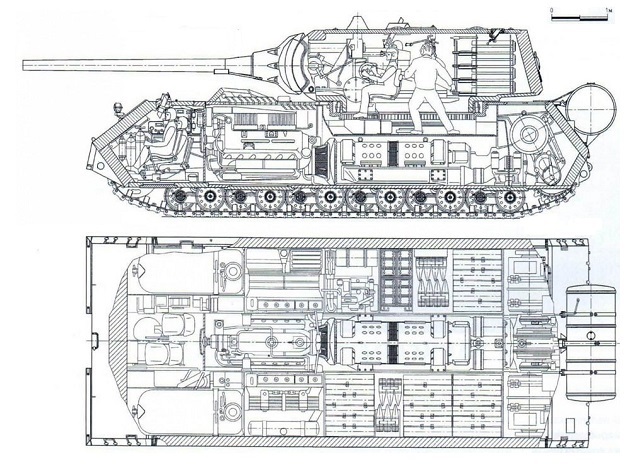
Maus Specifications
Crew: 6 (commander, gunner, 2 loaders, driver, radio operator)
Length: 10.2 m (33 ft 6 in)
Width: 3.71 m (12 ft 2 in)
Height: 3.63 m (11 ft 11 in)
Weight: 188 tons
| Armor | mm (in) |
|---|---|
| Turret front | 220 (8.5) |
| Turret sides and rear | 200 (7.9) |
| Hull front | 200 (7.9) |
| Hull sides | 180 (7.1) |
| Hull rear | 150 (5.9) |
Main armament
128mm (5 in) KwK 44 gun L/55 (68 rounds)
The armor-piercing kill range was 3500 meters (2.17 miles).
There was an option to switch the 128mm gun with a 150mm L/38 gun to provide additional high-explosive firepower and both options could be fitted on the same carriage, making the exchange simple.
Secondary armament
75mm (3 in) KwK 44 gun L/36.5 (co-axial, 100 rounds)
7.92mm (0.31 in) MG 34 machine gun (co-axial, 1000 rounds)
Power/weight: 6.4 HP/ton
Ground clearance: 500mm (20 in)
Fuel capacity
Internal tank: 2700 Liters (710 US gal)
External tank: 1500 Liters (400 US gal)
Operational range
Highway: 160 km (99 miles)
Off-road: 62 km (39 miles)
Speed
Maximum: 20 km/h (12 mph)
Average road speed: 18 km/h (11 mph)
River Crossings
The Maus was too heavy to cross bridges so an alternative system was developed where the Maus would instead ford the rivers it needed to cross. Due to its size, it could ford relatively deep streams, but for deeper ones it was to submerge and drive across the river bottom. The solution required the huge panzers to be paired up. One Maus would supply electrical power to the crossing Maus via a cable until it reached the other side. While submerged, the engine would not be running and the electrical power would be sent directly to the track drive motors. The crew would receive air through a large snorkel, which was tall enough for the panzer to drive through 8 meters (26 feet) of water. After the first Maus had reached the opposite bank, the roles would be reversed. It would supply electrical power for the other Maus to cross the river.

Prototype Assembly
With the Maus being canceled, there was little point in finishing the Maus V1, which still needed some machining work done but was otherwise finished. It was transported from Krupp to Alkett on 26 September 1943, where it was fitted with the internal components and the drive train. This was completed on December 22nd and then ordered to be transported to the testing grounds at Böblingen (southwest of Stuttgart) on 10 January 1944. When it left for Böblingen the next day via railway, the panzer was able to move under its own power and load itself, but work on the hull was otherwise incomplete inside. At Böblingen, Krupp technicians would complete the assembly. The journey to Böblingen took 3 days.
Alkett (German: Altmärkische Kettenwerk GmbH, lit. ”Altmark track works”) was a major manufacturer of armored vehicles for the Wehrmacht. The main factory was located in Berlin-Borsigwalde on the Breitenbachstraße. The completed vehicles were test driven on Holzhauser Street. Since 10 to 20 vehicles left the factory every day, their appearance was a common sight at the time. Alkett also repaired damaged panzers that were transported by rail from the front to the plant site.
Böblingen
The Maus V1 arrived at the testing grounds at Böblingen.

Ferdinand Porsche wearing a hat and long coat stands with his back to the camera.
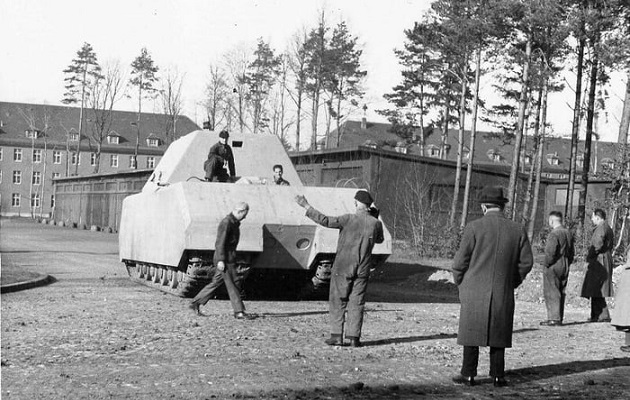
The Maus V1 on the testing grounds. Note the special ladder for the crew to climb aboard.

The Maus V1 trials started on 15 January 1944, with a 2 km (1.24 mile) off-road trip showing the extreme ease and accuracy of the steering. During traveling off-road on soft clay soil, despite its enormous bulk, the Maus only sank 50cm (19.69 inches) into the ground, yet it still managed to steer and drove through it successfully.

The Maus V1 driving pass a Soviet KV-1 heavy tank that was captured in 1941. The KV-1 was destroyed on the firing range by several hits from AT guns and hollow charge weapons. The KV-1 is closer to the camera so it appears larger than it really is.

The work at Böblingen to finish the interior was done in the second half of January 1944. After that it undertook its first successful test run and was then back on trial on January 31st. During the trails, a problem was found. The rubber rings within the road wheels started to fail under the load after just 14 km (8.69 miles). The new and improved road wheels were already on order despite the existing orders for no further development on the Maus to take place. While the Maus was officially considered dead, Porsche was calling it by its original designation, the Type 205.
Porsche’s driving system had been proven effective with the ease of steering and this was reinforced on February 3rd when the turning of this massive panzer was tested. It could turn both within its own length, by reversing one track and driving the other one forward, or in a minimum radius of 14.5 m (47.57 feet) for a full 360 degree turn when driving forwards on just one track. The final work on the hull, such as welding on towing eyes, was completed during February. On 8-9 February, Porsche personally conducted a two day off-road trial.
During early February 1944, the grey colored Maus hull and Ersatzgewicht turret were repainted with a rough three tone camouflage scheme consisting of a base coat of Dark Yellow (Dunkelgelb RAL 7028), over which olive green (Olivgrun RAL 6003), and reddish-brown (Rotbraun RAL 8107) curvy stripes were painted.
During 15-17 March 1944, the Maus became stuck in a very soft swampy area on the testing ground. That area was avoided by all vehicles but the new driver not knowing his way around, drove though the swampy area and the hull sank to about half its height in the soft mud.
This high view of the Maus stuck in the mud shows the top of the Ersatzgewicht turret was open.

Work has began to dig out the stuck Maus. Note the Soviet hammer and sickle motif the Germans painted on the center of the hull. It probably was to confuse any observers about the origins of this vehicle. Inset is the actual Soviet hammer and sickle.

Extricating this enormous panzer was easier than one would imagine. It required only the mud at the front and rear to be dug out and some wood placed under the tracks for traction, and it was able to free itself under its own power. Note the pile of wood gathered.
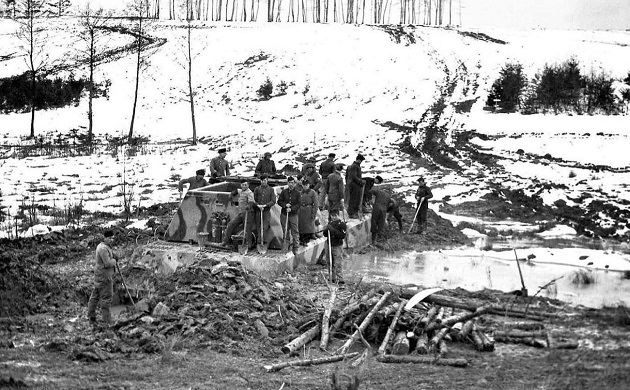
After it extricated itself, the mud was scraped off the hull. On the rear of the Ersatzgewicht turret are a couple of fire extinguishers.


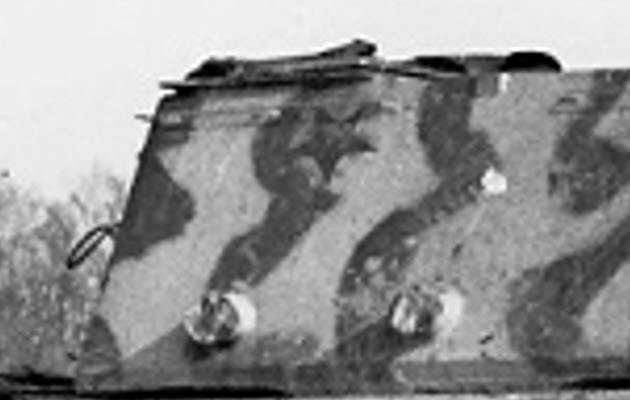
This is my close up of the Ersatzgewicht turret in the above photo. Note the upside down Soviet star on the turret side near the top.
The Maus V2 arrived at Alkett on 8 January 1944, but work stopped by the middle of the month with a focus on Sturmgeschütz assembly instead. After about two weeks of lying idle, it was decided to transport the partially assembled Maus V2 (fitted with just suspension and mechanical brakes) to Böblingen to finish the assembly.
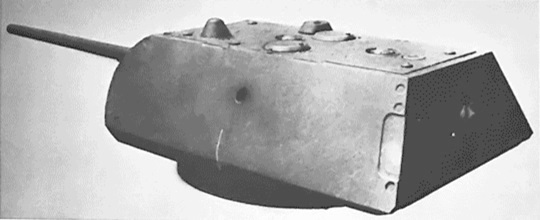
The single Maus turret which had been ordered to be completed was not ready. It was not finished until the middle of April 1944, several months behind schedule probably the result of being a low priority project as serial production had been canceled. The single turret was transported directly to Böblingen, where Krupp technicians finished the work on it.
The completed turret for the Maus V2. The hole in the side is the machine pistol ball-mount (MP-kugelblende) and on the rear is the loading port with machine pistol port (Munitionsluke mit MP-stopfen).
Rail Transport
The Schwertransportwagen für Gerät 205 (Heavy-duty truck for equipment 205) was a 14-axle special transport wagen of the German railways (Reichsbahn), which was developed and built by the Graz-Simmering-Pauker works in Vienna. On account of the panzer’s massive size and weight, a rail route between Berlin and Böblingen, had to be found, avoiding all tunnels and bridges. That was not an easy task and it resulted in an extremely convoluted route.

The Maus V2 hull without turret on its Schwertransportwagen on 10 March 1944. The location is unknown.
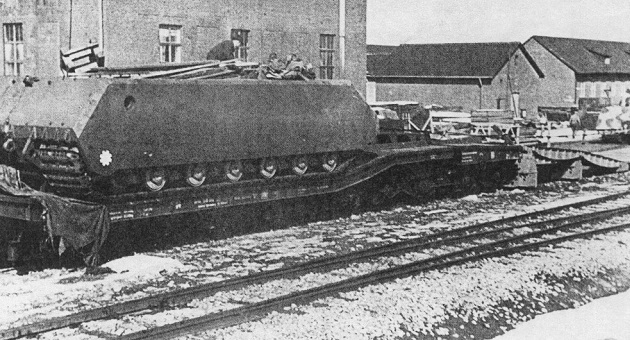
Arriving at Böblingen on 3 May 1944, the turret was finally mounted on the Maus V2 hull during the night of June 7/8.
This is the unpainted Maus V2 with turret during the initial testing at Böblingen.
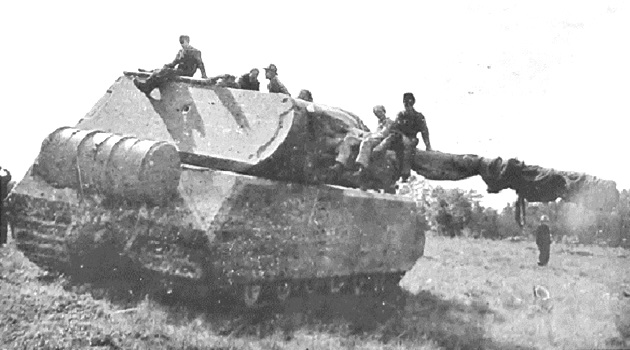
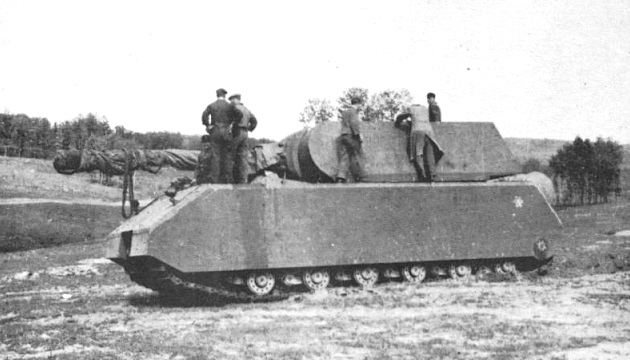
The tests were successful. The Maus could be driven easily and with a fine degree of control, ground pressure and traction were acceptable and the drive system sufficient for the job. There were some problems requiring changes to a few features such as periscopes to improve visibility, the driver’s seat, ammunition stowage, the traversing mechanism, and the original wheels which had failed. The engine had also not worked as well as expected and was suffering valve damage although it was not determined if it was a manufacturing problem or as a result of stress on the engine during testing. Also the original wide flat-plate track (plattenkette) had proven unsuitable and was replaced with a new track plate with removable ice cleats which were produced by Škoda (Griffigere Gleiskette).
Škoda Auto, a Czech automobile manufacturer, was part of the Reichswerke Hermann Göring producing components for German military terrain vehicles, military planes, other weapons components and cartridge cases.
The Maus V2 was repainted with a rough three tone camouflage scheme. It is driving from the Porsche workshop at Böblingen toward the testing grounds on 22 June 1944.
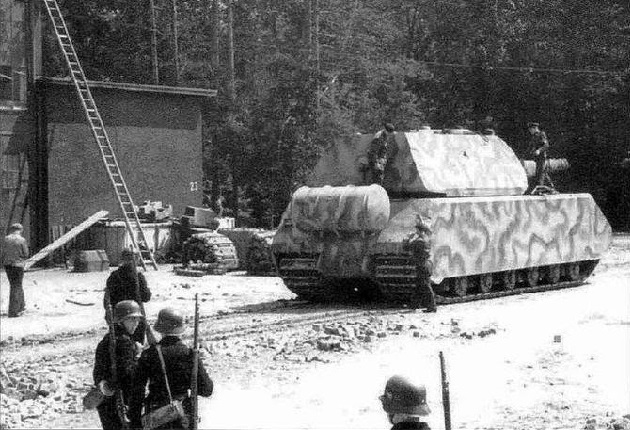

Both Mäuse (Mice) are photographed together. The V2 with turret is closest to the camera and the V1 with the Ersatzgewicht turret is in front of it.

The towing eyes have been added and there are two additional shell deflectors on the hull roof. The Maus V1 Hull only had the center shell deflector.
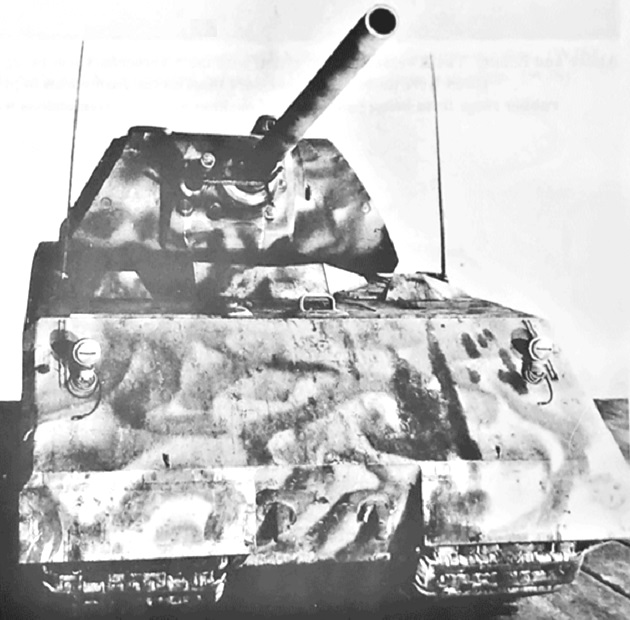
There was nothing out of the ordinary during testing and the panzer was able to move and maneuver adequately under its own power yet, despite this, on 19 August 1944, all work on both vehicles was stopped and the Krupp workers were diverted to more urgent war work.
Sometime during the fall of 1944, both Mäuse were transported by rail from Böblingen to Kummersdorf, Germany.
Kummersdorf
Kummersdorf is the name of an estate near Luckenwalde, around 25 km (15.5 miles) south of Berlin, in the Brandenburg region of Germany, southwest of Zossen. Kummersdorf hosted the weapon office of the German Army which ran a development center for future weapons as well as an artillery range. The analyses, studies and testing of various German-captured Allied tanks and armoured fighting vehicles (AFVs) were conducted there. The Wehrmacht also tested new German panzers there and compared them to the captured Allied tanks.
Size comparison of the Maus compared to the Soviet T-34/85.

Spring 1945

The Ruhr pocket was a battle of encirclement that took place in April 1945. The US Ninth Army surrounded the pocket consisted of Duisburg, Düsseldorf, Müllheim, Ratingen, Velbert, Essen, Herten, Herne, Witten, Dortmund, Lünen, Iserlohn, Menden, and Hamm. On April 5th, 18 US Divisions began to clear the Ruhr Pocket. On April 10th, Essen was captured.
Maus hull 351453 and turret was discovered by Allied forces in the Krupp factory in Essen, May 1945.


This photo shows the size comparison of a Maus turret and a Tiger I turret (sitting on top of the Maus turret).

Meppen
The town of Meppen is located about 20 kilometres (12 miles) from the Dutch border at the mouth of the Hase River into the Ems River between the cities of Papenburg (to the north) and Lingen (to the south). At Meppen was Krupp’s proving ground and firing range.
Troops of the Polish 1st Armoured Division (Polish 1 Dywizja Pancerna) are examining three Maus hulls and three turrets at Meppen in May 1945. The hulls are lying on their sides and the turrets are upside down on the ground.
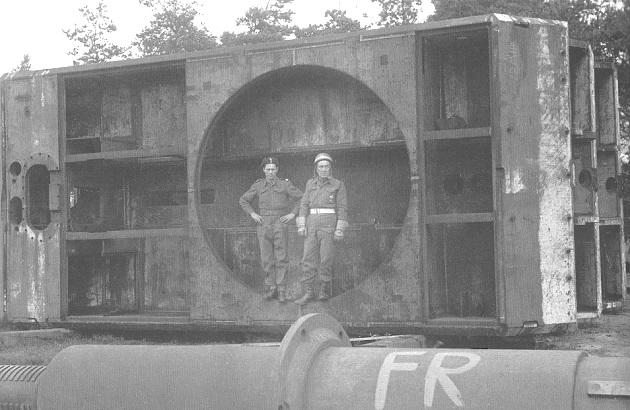


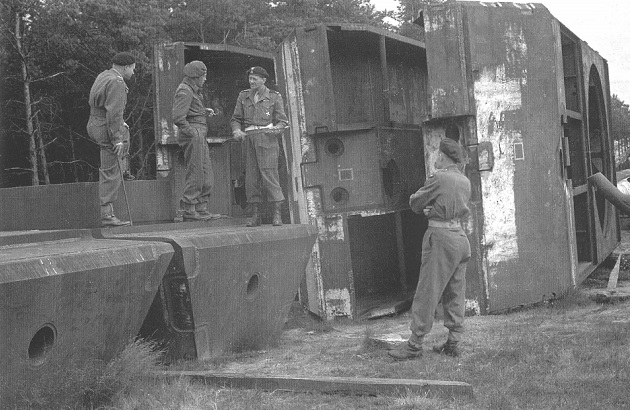
The turrets had not yet had the roof plates holes cut out for the hatches and sight.

The underside of the three Maus turrets shows the heavily protected inner turret basket, 55mm (2.16 in) thick, and the 93mm (3.66 in) thick turret floor.
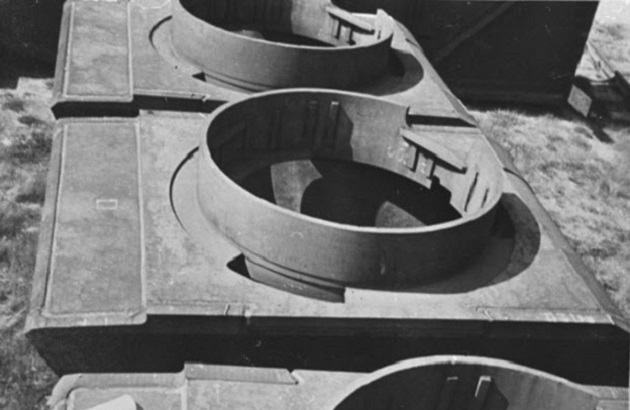
Examination of the hulls and turrets found the opening in the hull for the turret ring was 2959mm (9.7 feet) in diameter and the basket of the turret was 2388mm (7.8 feet) in diameter.
A complete 128mm KwK 44 monobloc gun with coaxially mounted 75mm KwK 44 monobloc gun was found on the Meppen firing range a few miles away.
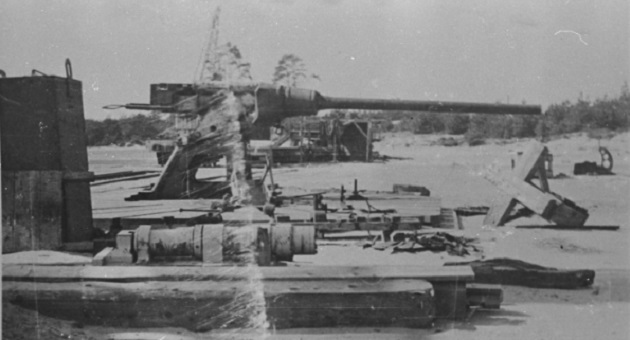
Since the Krupp steel works at Essen was a major RAF target and took heavy damage, the Germans probably began to disperse the Maus production and Maus components (hulls and turrets) were moved to Meppen.
Captured Mäuse
In Late April 1945 during the Battle of Berlin, Soviet forces captured Kummersdorf.
At Kummersdorf, the Soviets found the Maus V1 pretty much intact.

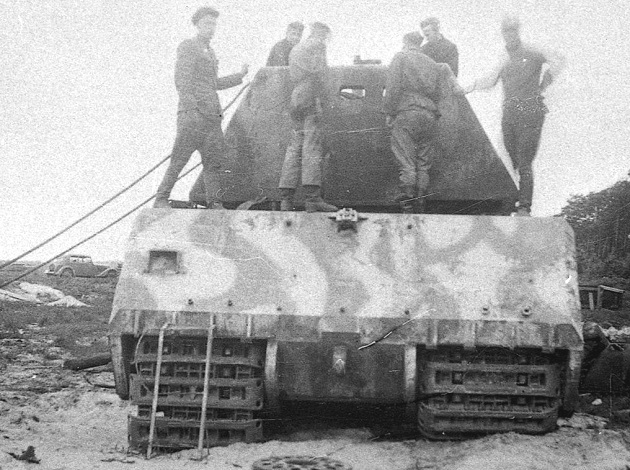
The soviets conducted some firing trials on the Maus V1. At least seven hits were obtained on its side, including two on the sides of the Ersatzgewicht turret. Some or all of the hits were from shaped charges probably RKG-43 or RKG-6 anti-tank hand grenades. The hull front was also subject to being fired at with at least 10 hits on the glacis, lower front, and track guards respectively.
When the Soviet forces were approaching Kummersdorf, the Germans decided to blow up the Maus V2 prototype because there was no time to evacuate it.

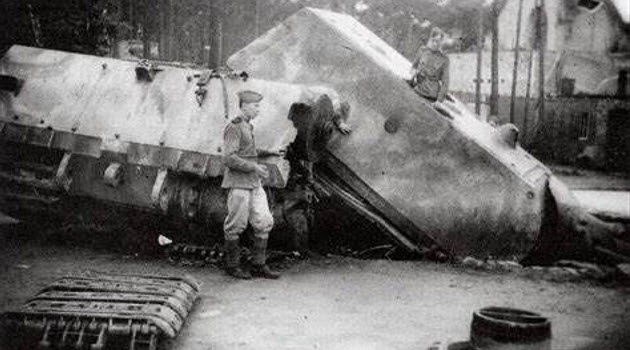
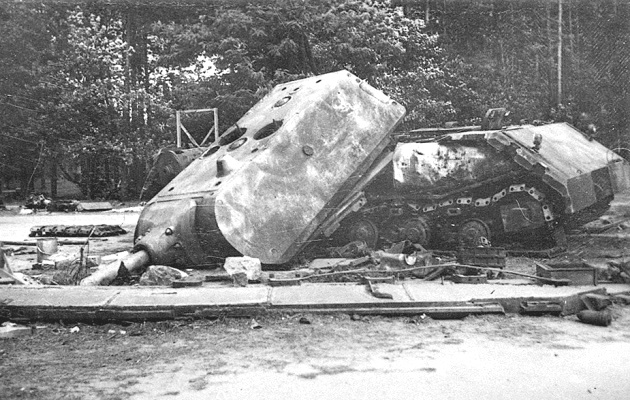
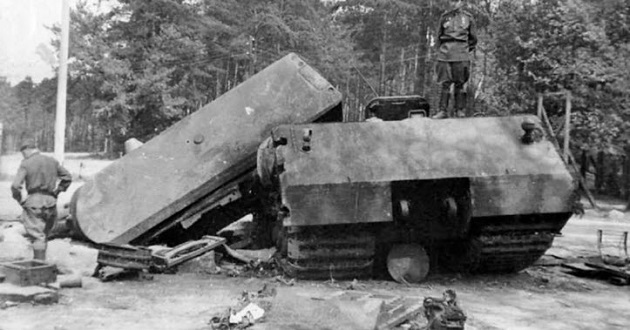
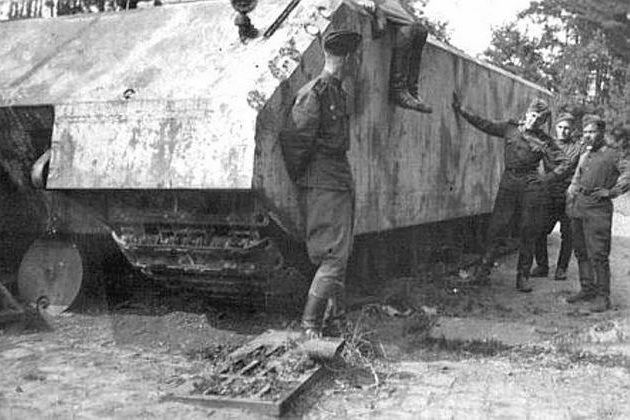

After the war, the Soviets used six captured German FAMO Sd.Kfz.9 18 ton half-tracks to pull the 55 ton gun turret off the destroyed Maus V2 hull. The Ersatzgewicht turret was removed from Maus V1 hull and the completed turret was installed.

The Maus V1 hull with turret still had the hits from the earlier impromptu firing trial.
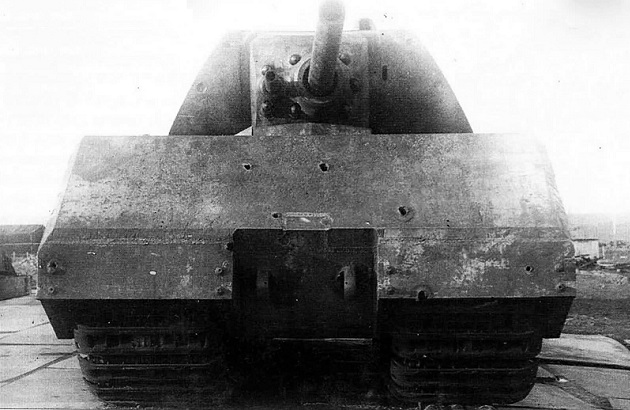
On 4 May 1946, the “hybrid” Maus was transported on its Schwertransportwagen to the test site at Kubinka, Moscow, for further examination.

The “hybrid” Maus and a Sturmtiger (German: “Assault Tiger”) armed with a 380mm (14.96 in) RW 61 rocket launcher traveled together. The combined weight of just these two vehicles was 280 tons which was more than nine Shermans.

The rail route from Kummersdorf to the outskirts of Moscow must have been difficult to avoid all tunnels and bridges. The journey must had taken a long time with many delays.


Today
For almost a half a century, it was presumed the Maus prototypes have been scrapped. Then, in 1992, after the collapse of the Soviet Union, the Russians opened the tank museum at Kubinka to displaying their vast collection of captured and Soviet-era armored vehicles. Among these is the “hybrid” Maus. It had all of the interior stripped out, and the engine, motors, and transmission were all removed, leaving an empty armored shell. It is now on display in Kubinka tank museum hall N 6.
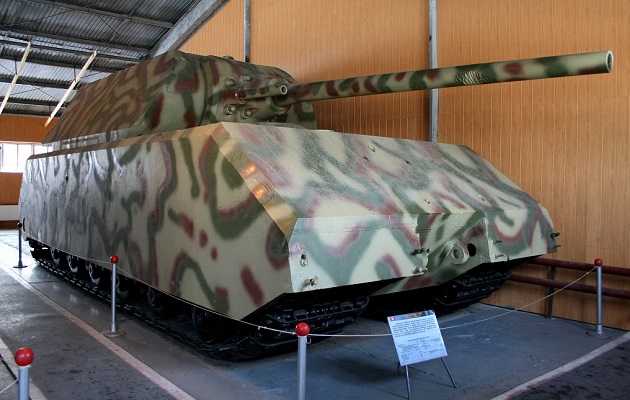
The shell holes from the firing trials are visible on the front hull. Note gun barrel is plugged.

Video: Kubinka Tank Museum / Кубинка
The Tank Museum Gun sight
For many years, this item was in the archive of the Tank Museum as an unidentified optical sight, one that did not appear in any of the standard references. The sight came from a collection of German optics that had been returned to Britain after WWII and had ended up at The Tank Museum.
This gun sight is the only part of the original Maus tank program to end up in the UK. The sight has a three letter code which indicated it was delivered in June 1943 to the Maus project for incorporation in the wooden turret mock-up.

Model Kits
1/16
Dnepro Model 1621 Pz.Kpfw.VIII Maus Porsche Typ 205.v2 Super Heavy Tank (Full resin kit)
1/35
Amusing Hobby 35A005 Löwe Panzerkampfwagen VII – 2012
Amusing Hobby 35A007 Panzerkampfwagen VII VK72.01(K) – 2014
Hobby 2000 35003 Pz.Kpfw. VIII Maus – 2022
Takom 2050X Maus V1 & V2 (2 in 1) Limited edition – 2022
Takom 2050 WWII German Super Heavy Tank Maus V2 – 2017
Takom 2049 WWII German Super Heavy Tank Maus V1 – 2017
Trumpeter 09541 Pz.Kpfw. VIII Maus with full interior – 2018
DML 6007 Maus German Super Tank – 1993
Profimodeller 35007 Transportwagen MAUS
Resin Armor (CMK) RA029 Transportwagen-Maus
1/48
Gaso.line GAS50084K Maus German heavy Tank (Resin kit)
1/72
Trumpeter 07446 Pz.Kpfw. VIII Maus – 2020
Vespid Models VS720001 Pz.Kpfw. VIII Maus V2 German super heavy tank – 2020
Zvezda 5073 German Superheavy Tank Maus (Snap-Tite) – 2020
Dragon 7255 Maus Heavy Tank – 2005
Pegasus Hobbies 7501 Maus WWII Super Heavy Tank – 200?

 Mike's Research